September 16, 2026 | House Select Committee on China
Import Controls
Tools to Counter the CCP's Industrial Policy and Supply Chain Threats
September 16, 2026 | House Select Committee on China
Import Controls
Tools to Counter the CCP's Industrial Policy and Supply Chain Threats
Hearing Video
September 16, 2026
Download

Full Written Testimony
Section I: Introduction
Chairman Moolenaar, Ranking Member Khanna, and distinguished members of the committee, thank you for the opportunity to testify today on the national security risks posed by Chinese emerging technologies and the steps Congress can take to address them.
For years, Washington’s technology-security strategy has focused primarily on what China might acquire from the United States. Congress and successive administrations have strengthened export controls, sought to restrict outbound investment in sensitive technologies, and tightened access to advanced semiconductors and the equipment needed to produce them. These measures remain essential. At the same time, Beijing has pursued the reverse flow with equal purpose, building formidable positions in technologies it now seeks to sell, scale, and embed throughout the United States.
Today, Beijing is converting industrial policy into market power across the technologies that will define the drivers of the next industrial revolution. Chinese firms already hold dominant or rapidly growing positions in drones, batteries and energy storage, power electronics, advanced sensors, telecommunications equipment, and displays. These technologies will underpin the factories, grids, networks, vehicles, and autonomous systems of the future. China’s recently released 15th Five-Year Plan (2026-2030) seeks to deepen those advantages by accelerating strategic emerging industries and expanding artificial intelligence (AI) across the physical economy.[1]
The security consequences of China’s strategy extend beyond market share. The U.S. intelligence community assesses China as the most active and persistent cyber threat to U.S. government, private-sector, and critical-infrastructure networks and warns that Beijing continues to pre-position capabilities for future disruption.[2] That record should shape how Washington evaluates Chinese-controlled technologies that collect data, connect to networks, receive remote software or firmware updates, or control physical systems. Industrial concentration creates another form of leverage when critical American systems depend on Chinese capacity that could take years to replace.
The United States needs a doctrine for the inbound side of technology competition. Existing tools remain fragmented. Tariffs change economic incentives. Procurement restrictions protect defined buyers. Entity designations target individual firms. The Federal Communications Commission and Commerce Department can restrict selected technologies under specific authorities. Yet these measures do not amount to a coherent system for managing foreign-adversary technology risk. Congress should build one that identifies risks early, determines when market access should be restricted or conditioned, and acts before Chinese commercial scale becomes enduring strategic leverage.
Section II: Beijing’s Innovation-to-Scale Model
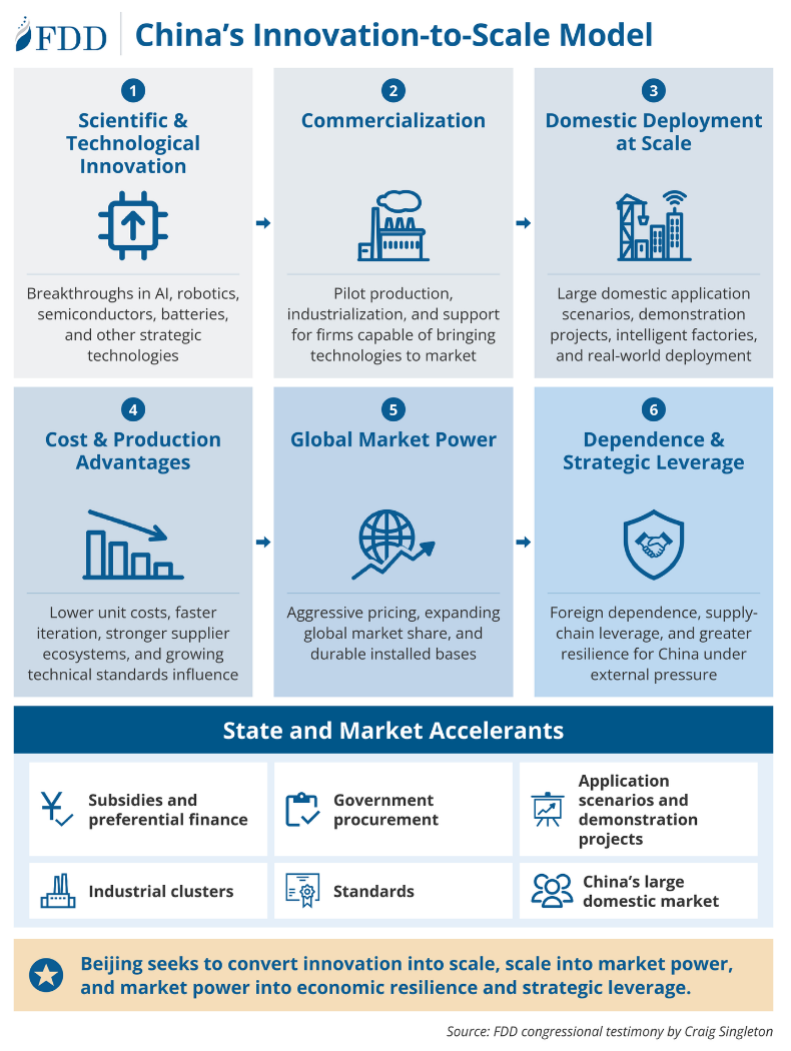
China is attempting a fundamental shift in its economic model. The engines that previously powered its rise — property and infrastructure investment — can no longer sustain the same pace of growth as returns on investment decline, while weak domestic demand has increased reliance on exports.[3] Beijing’s answer is an innovation-to-scale model centered on technological development, advanced manufacturing, higher productivity, greater technological self-reliance, and economic resilience. The objective is a stronger and more productive Chinese economy with an industrial depth that enhances China’s national power.
Strategy
Chinese leader Xi Jinping’s concept of “new quality productive forces” provides the organizing logic for China’s macro-economic transition. The phrase, which Xi introduced in 2023, sounds like Chinese Communist Party (CCP) jargon; however, its meaning is considerably more concrete. He defines this new concept around technological breakthroughs, new combinations of production factors, deep industrial transformation, and a substantial increase in total factor productivity. Innovation, Xi says, is its defining characteristic. He has instructed officials to strengthen original and disruptive research, upgrade traditional industries, build strategic emerging industries, and develop future industries.[4] Importantly, in Xi’s formulation, these new forces must be “autonomous and controllable, safe and reliable.”[5]
This strategy builds on the Made in China 2025 campaign Beijing launched more than a decade ago. As part of that initiative, Beijing concentrated state resources on 10 advanced manufacturing sectors, including next-generation information technology, robotics, aerospace, new-energy vehicles, power equipment, advanced materials, and medical devices. It sought breakthroughs in core technologies, stronger domestic supply chains, globally competitive firms and industrial clusters, and a higher position in global value chains. But Xi’s new agenda reaches further by seeking to connect scientific innovation, industrial upgrading, commercialization, and mass deployment across the wider economy rather than advance a discrete list of favored manufacturing sectors.[6]
China’s 15th Five-Year Plan (2026-2030) embodies this new push by placing a “modern industrial system” and technological self-reliance near the top of China’s national agenda.[7] It calls for an advanced manufacturing backbone, higher supply-chain autonomy, and decisive breakthroughs in integrated circuits, industrial machinery, high-end instruments, foundational software, advanced materials, and biomanufacturing. It separately prioritizes next-generation information technology, new energy, intelligent connected vehicles, robotics, biomedicine, high-end equipment, and aerospace. Moreover, Beijing now identifies embodied intelligence and 6G as future industries that it intends to turn into new engines of growth.[8]
Crucially, Beijing is building mechanisms to move those technologies rapidly from invention to industrial use. Xi has instructed officials to exploit China’s industrial foundation and “super-large-scale market” so that more scientific achievements move “from samples into products” and ultimately form industries.[9] China’s Ministry of Industry and Information Technology (MIIT) is now implementing that mandate through manufacturing innovation centers, pilot-scale platforms, intelligent factories, industrial clusters, and support for integrated circuits.[10] The significance lies in the change in function. Advanced technology is moving from a portfolio of favored sectors to a core mechanism for generating growth, productivity, and resilience across the Chinese economy. In doing so, Beijing is increasingly treating economic security, industrial scale, and innovation as parts of the same development model.
Security
Xi has made the security logic behind this model unusually explicit. In an April 2020 speech on China’s long-term economic strategy, he described the pandemic as a “stress test” for industrial and supply chains.[11] To safeguard industrial and national security, Xi said China must be capable of maintaining economic operations even under “extreme circumstances.”[12] Xi then directed his government to strengthen areas where China already held advantages, including power equipment, new energy, communications equipment, and high-speed rail. He also ordered his subordinates to “tighten international industrial chains’ dependence on China” to create stronger capacity for “countermeasures and deterrence.”[13]
In other words, Xi’s mandate seeks to reduce the leverage foreign countries hold over China while increasing the leverage China can exercise over them. Xi’s dual-circulation strategy advances the same objective. It seeks a Chinese economy capable of sustaining itself through a powerful domestic market and secure supply chains while remaining deeply connected to international markets. Xi has repeatedly emphasized that China should use its enormous domestic market to attract global resources and strengthen its position in international competition. For example, the 14th Five-Year Plan (2021-2025) called for China to stabilize its share of international markets, improve the value of its exports, and create a “powerful gravitational field” for global resources and production factors.[14]
The desired asymmetry is clear. Beijing wants greater insulation from foreign coercion and continued foreign exposure to Chinese supply. China can then enter a crisis with more alternatives of its own and fewer alternatives available to its competitors. That logic helps explain why the Chinese Communist Party treats leadership in batteries, electrical equipment, telecommunications, advanced sensors, robotics, semiconductors, and other critical technologies as a matter of economic security and national power. The deeper those technologies become embedded in foreign economies, the greater the leverage Beijing’s industrial strategy can create.
Scale
Beijing’s approach also recognizes that technological leadership depends on scale. China has used its massive domestic market to move technologies from laboratories into factories and then into widespread commercial deployment. The 15th Five-Year Plan (2026-2030) turns that instruction into policy. It calls for strategic industrial clusters, large-scale demonstrations of new technologies and products, expanded access to application scenarios, and accelerated commercialization.[15] For future industries, Beijing plans to share investment risk, create demonstration projects, develop application scenarios, test business models, and establish dedicated research institutes and industrial zones.
China’s robotics campaign illustrates how this works in practice. In June, MIIT and China’s State-Owned Assets Supervision and Administration Commission launched a national program to place humanoid robots and embodied-intelligence systems into factories, logistics facilities, hospitals, emergency-response settings, and other real-world environments.[16] The program directs local governments and state-owned enterprises to open operating environments, generate real-world training data, organize industry consortia, support standards development, and accelerate robot deployments. Beijing wants more than 100 high-value application scenarios and the capacity for deployment at the 10,000-unit level by the end of 2026.
The same approach now extends across a wider portfolio. Chinese economic officials identify integrated circuits, aerospace, biomedicine, the low-altitude economy, new-energy storage, and intelligent robotics as six new “pillar industries.”[17] Beijing estimates that these sectors generated nearly RMB 6 trillion (roughly $890 billion) in output in 2025, and wants that figure to exceed RMB 10 trillion (roughly $1.5 trillion) by 2030.[18]
Scale creates its own advantages. Larger production runs lower unit costs. Dense supplier networks accelerate iteration. Massive deployment generates data and operational experience. Domestic demand gives Chinese firms room to mature before competing abroad. Once those firms reach global markets, scale allows them to price aggressively, pressure incumbents, shape standards, and build installed bases that become increasingly difficult to replace.
Importantly, Beijing’s innovation-to-scale model does not operate on market terms. State subsidies, preferential credit, procurement support, regulatory favoritism, and other non-market practices help Chinese firms absorb losses, expand capacity, and capture market share faster than commercial economics alone would permit. That matters because the resulting market positions can later become sources of dependency and leverage inside the United States.[19]
The Made in China 2025 strategy demonstrated what China is capable of when it commits to large-scale industrial policy. The U.S.-China Economic and Security Review Commission found that China met or exceeded many of its ambitious targets and made significant gains even where it fell short.[20] Between 2015 and 2023, China’s share of global manufacturing-value-added rose from 25.9 percent to 28.8 percent. Chinese exports in Made in China 2025 sectors reached roughly $1.5 trillion in 2023, nearly one-fifth of global exports in those sectors. China-based firms accounted for nearly one-quarter of the worldwide growth in exports tied to those industries over that period.
Stakes
Beijing’s new growth strategy inherits and sharpens a fundamental tension. China wants household consumption to contribute more to growth while preserving and upgrading an enormous manufacturing base. If domestic demand fails to rise fast enough, more of that industrial output must find buyers abroad. The stronger China’s innovation-to-scale model becomes, the more pressure it can place on foreign markets to absorb the resulting production.
Beijing has long recognized weak consumption as a constraint, but it is now setting more explicit rebalancing targets. The 15th Five-Year Plan (2026-2030) calls for the household consumption rate to play a stronger role as a principal driver of growth.[21] In July, the State Council went further, approving a dedicated five-year consumption plan that seeks to raise the household consumption rate, increase retail sales to roughly RMB 60 trillion, or about $9 trillion, by 2030, and strengthen consumption’s contribution to economic growth.[22] However, these measures do not resolve the underlying tension between stronger consumption and continued expansion of industrial capacity.
The International Monetary Fund reached a sharper diagnosis. It found that private domestic demand remained weak in 2025 even as robust exports helped China meet its growth target and pushed the current account surplus to an estimated 3.3 percent of GDP.[23] The IMF warned that China’s size and rising trade tensions make continued reliance on exports increasingly difficult to sustain and that stronger Chinese exports could provoke additional tariffs and non-tariff barriers abroad.[24]
That tension matters directly for the United States. China’s innovation-to-scale model needs foreign demand as well as domestic scale. Access to large overseas markets sustains production runs, reinforces supplier ecosystems, and gives Chinese firms room to convert domestic advantages into global positions. Yet that success also generates resistance as governments confront lost industrial capacity, concentrated supply chains, and security dependencies. Access to the American market is therefore a source of leverage. Washington faces a choice over which Chinese technologies it allows to gain durable positions in the U.S. market, and which it must block before those positions become entrenched. The consequences of those choices will become increasingly visible across the American economy.
Section III: China’s Technological Beachheads
As noted, Beijing’s innovation-to-scale model has already produced formidable positions across technologies that increasingly underpin American infrastructure, industry, communications, and daily life. These positions are best understood as technology beachheads. They give Chinese firms a durable base from which to expand into adjacent products, customers, and markets.
In military terms, a beachhead matters because it provides more than other captured territory already taken. It creates a base from which further advances become easier. The commercial dynamic works much the same way. Once a Chinese firm reaches sufficient scale in a technology market, it accumulates supplier relationships, distribution networks, installed infrastructure, operating data, standards influence, customer familiarity, servicing networks, and cost advantages. Each gain lowers the cost of the next one and raises the cost of dislodging the incumbent.
China’s industrial system magnifies these advantages. Scale in batteries supports drones, robots, vehicles, and energy storage. Leadership in LiDAR and other sensors strengthens autonomous systems. Cellular modules connect those systems to networks. Advanced manufacturing drives down costs across the stack. As these positions reinforce one another, Chinese firms can move faster into adjacent markets while American competitors face rising capital requirements, weaker supplier ecosystems, and shrinking opportunities to achieve comparable scale.
The resulting leverage takes several forms. Industrial concentration can leave the United States dependent on Chinese capacity that would take years to replace. Connected products can preserve continuing access through software, firmware, cloud services, and remote updates. Autonomous systems add physical agency because they can perceive their surroundings, make decisions, move, and act. Whereas some Chinese technology beachheads create risk through access, others create leverage through their potential absence, from the possibility that China could cut off their supply in a crisis. Increasingly, the most consequential can do both.
These beachheads are most visible across four interconnected clusters: autonomy and sensing, power systems, ubiquitous computing and connectivity, and industrial chokepoints.
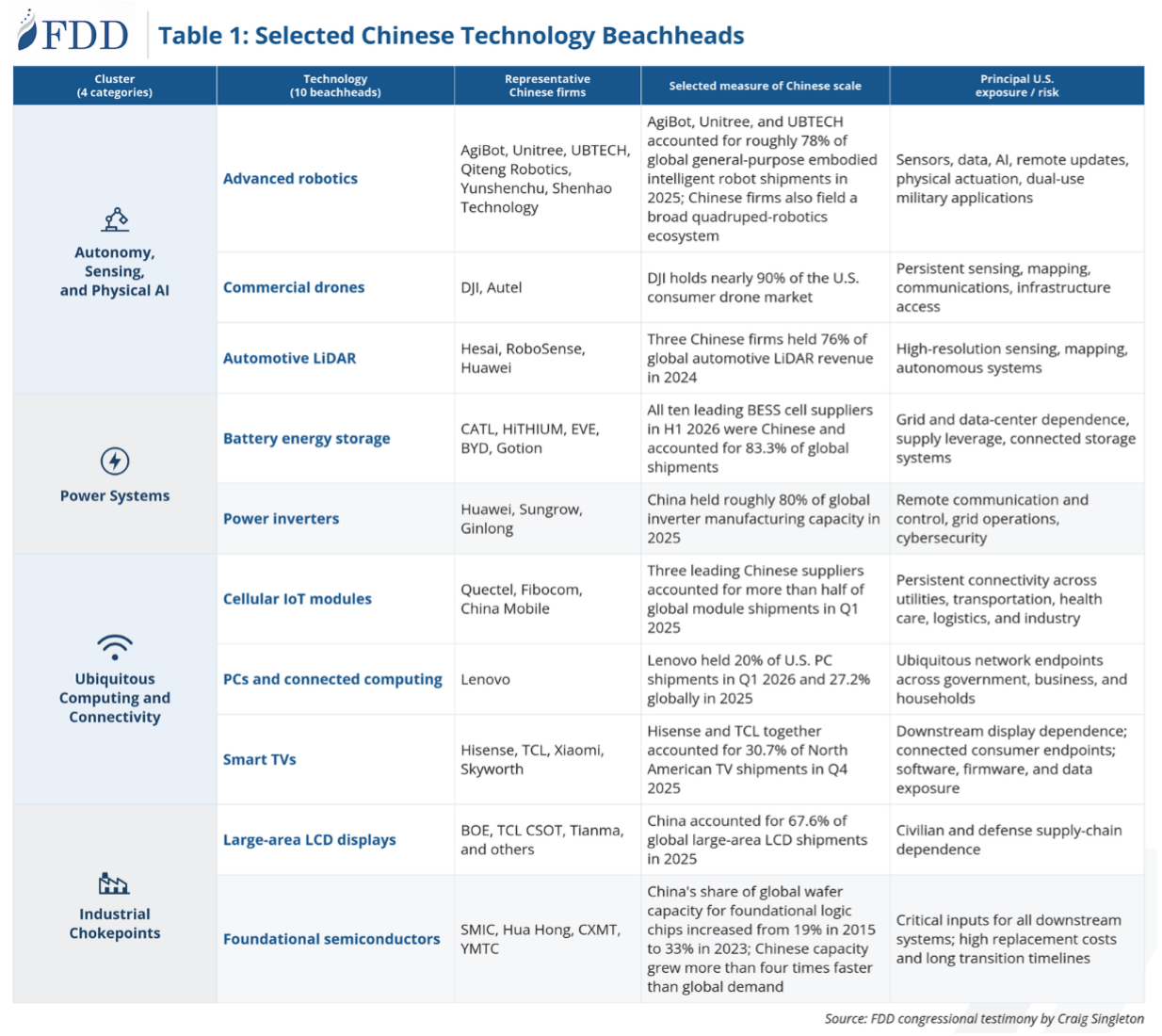
A table showing selected Chinese technology beachheads. Source: FDD. Further citation information provided below.
Autonomy, Sensing, and Physical AI
Beijing is treating physical AI as a major new arena of technological competition. China’s MIIT’s 2023 humanoid-robot strategy described humanoids as a potentially disruptive product on the scale of the computer, smartphone, and electric vehicle. The plan set concrete goals: mass production by 2025, two to three globally influential ecosystem companies, two to three industrial clusters, secure supply of core components, and, by 2027, a globally competitive industrial ecosystem deeply integrated into the real economy. It also directed Chinese industry to exploit the country’s complete manufacturing base, large domestic market, rich application environments, and a “new-type whole-of-nation system.”[25]
Beijing is now using deployment itself to widen that lead. By year’s end, Beijing wants more than 100 high-value application scenarios and the capacity for deployment at the 10,000-unit level.[26] China’s strategy explicitly links real-world use to improved embodied-intelligence models, higher-quality machine data, and faster improvement of key components. Early market data already show Chinese scale. Market research firm Omdia estimates that 13,318 general-purpose embodied intelligent robots shipped worldwide in 2025, including 5,168 from AgiBot, 4,200 from Unitree, and 1,000 from UBTECH. Those three Chinese firms alone accounted for roughly 78 percent of global shipments.[27]
China also enters robotics with strong positions in adjacent technologies. Data from Yole, another market research company, reveals that Hesai, RoboSense, and Huawei together captured 76 percent of global automotive LiDAR revenue in 2024. In passenger-car LiDAR, Chinese brands accounted for 92 percent of the market.[28] Those sensing capabilities sit alongside China’s established strengths in drones, batteries, motors, communications equipment, and high-volume electronics manufacturing. Together they give Chinese firms an unusually deep industrial base for machines that can perceive, communicate, move, and act.
That final capability makes this cluster distinct. As my recent research on China’s quadruped “robot wolves” revealed, the People’s Liberation Army (PLA) is already integrating AI, robotics, LiDAR, and unmanned systems into frontline concepts of operations.[29] Chinese exercises have paired quadruped robots with drones for reconnaissance, precision strike, and assault support. China’s physical-AI push therefore links commercial scale directly to dual-use capability. Beijing is building the industrial ecosystem, operating data, component base, and manufacturing capacity that will shape how AI moves from software into machines, including those with potential battlefield capabilities.
Power Systems: Batteries, Storage, and Inverters
Beijing is building dominance across the technologies that store, convert, and manage electricity. China’s National Development and Reform Commission (NDRC) — a powerful cabinet-level department under China’s State Council responsible for macroeconomic planning — is seeking to build on China’s existing lead by creating a huge home market for this emerging industry. China’s installed new-energy-storage capacity reached 136 gigawatts at the end of 2025, up 84 percent in one year and more than 40-fold since 2020. Beijing now describes storage as a core component of its new energy system.[30]
That domestic scale has translated into extraordinary industrial concentration. In the first half of 2026, every one of the world’s 10 largest battery-energy-storage cell suppliers was Chinese; together they accounted for 83.3 percent of global shipments. CATL led with 22 percent, followed by HiTHIUM and EVE Energy.[31] Chinese firms have also moved downstream: Market research firm Wood Mackenzie estimates that Chinese companies captured 76 percent of the global battery-energy-storage-system-integration market in 2025.[32] CATL alone supplied 30.4 percent of global energy-storage batteries that year and had systems deployed in roughly 2,300 projects worldwide.[33]
China holds a similarly commanding position in the power electronics that connect these systems to the grid. The International Energy Agency (IEA) estimates that China controlled roughly 80 percent of global manufacturing capacity for solar and battery inverters in 2025.[34] Huawei and Sungrow alone supplied 55 percent of the global solar-inverter market in 2024.[35] These advantages compound. Cheap cells make Chinese storage systems more competitive; storage deployment expands demand for Chinese power electronics and software; and massive domestic use generates operating experience and drives further cost reductions.
This cluster carries a dangerous security risk because modern power systems combine supply dependence with operational control. Batteries increasingly support data centers, advanced manufacturing, renewable generation, and grid resilience. Inverters sit at the control point between those resources and the electric grid. The IEA describes the inverter as the “brain” of a solar or battery installation: it manages power flow, monitors performance, coordinates connected equipment, and increasingly communicates over networks that permit remote control.[36] China is therefore building industrial power across both the hardware that stores electricity and the connected systems that manage it. As the U.S. races to expand electricity supply for manufacturing and data centers, reliance on Chinese technology across that power stack would give Beijing leverage over the physical infrastructure supporting American technological power.
Ubiquitous Computing and Connectivity
China has also built formidable positions in the devices and components that form the connective tissue of modern networks. Made in China 2025 explicitly prioritized high-end servers, routers, smart terminals, network-security equipment, and other information and communications technologies, while later planning documents called for the comprehensive expansion of mobile internet-of-things (IoT) across transportation, utilities, industrial parks, agriculture, and other sectors.[37] The strategic value comes from ubiquity. A router, laptop, printer, cellular module, or smart television may appear mundane, but each can sit persistently inside larger networks and, in many cases, maintain a continuing relationship with its manufacturer through firmware, software, and remote updates.
Chinese firms have achieved scale at both the device and component levels. Lenovo — which is incorporated in Hong Kong and maintains a major headquarters in Beijing — led the global PC market in 2025 with 27.2 percent of shipments and captured 20 percent of U.S. PC shipments in the first quarter of 2026.[38] In cellular IoT modules, Quectel, China Mobile, and Fibocom accounted for more than half of global shipments in the first quarter of 2025, with Quectel retaining the top position worldwide.[39] Those modules hide inside smart meters, routers, industrial equipment, vehicles, medical devices, cameras, and other connected products.[40] Their low visibility makes them especially difficult for downstream customers to assess or replace. Chinese smart television makers are also gaining ground as well: Hisense and TCL together accounted for 30.7 percent of North American TV shipments in the fourth quarter of 2025.[41]
In 2023, bipartisan congressional leaders warned that control over cellular modules could allow an adversary to access data flowing through connected devices or disable them entirely.[42] China’s advantage in ubiquitous computing therefore creates something distinct from a conventional industrial chokepoint: persistent presence inside the networks and devices on which American institutions increasingly rely.
Industrial Chokepoints: Displays and Foundational Semiconductors
China has also pursued dominance over components whose strategic value comes from their indispensability and the difficulty of replacing production capacity. China’s 15th Five-Year Plan (2026-2030) calls for “extraordinary measures” across the full industrial chain to achieve breakthroughs in integrated circuits and other critical components.[43] For instance, Chinese industrial policy has pursued display sector dominance through financing, production targets, industrial clusters, and support for successive generations of LCD and OLED technology. Beijing’s latest plans continue that push into next-generation displays and the materials, equipment, and driver chips that support them.[44]
The results in displays are stark. China went from essentially no global LCD production capacity in 2004 to 72 percent two decades later, while its share of OLED capacity rose from 1 percent in 2014 to 51 percent.[45] Market research firm Omdia estimates that China supplied 67.6 percent of global large-area LCD shipments in 2025, with Chinese company BOE alone accounting for 37.1 percent of those shipments.[46] Displays sit inside consumer electronics, automobiles, medical equipment, aircraft, command-and-control systems, drones, weapons sights, and other defense platforms. As I have written previously, the danger comes from the disappearance of trusted display alternatives.[47] A display requires no network connection to create leverage if production elsewhere cannot replace Chinese supply during a crisis.
Foundational semiconductors show the same dynamic developing deeper inside the supply chain. These mature-node chips perform basic functions across automobiles, telecommunications equipment, industrial machinery, medical devices, grid systems, and weapons. China’s share of global wafer capacity for foundational logic chips increased from 19 percent in 2015 to 33 percent in 2023, while Chinese capacity grew more than four times faster than global demand.[48] Chinese firms are projected to account for nearly half of additional mature-node capacity over the next several years.[49] A Commerce Department survey found that at least two-thirds of products sold by responding U.S. companies likely contained a chip fabricated by a China-based foundry, while 44 percent of companies could not determine whether Chinese-fabricated chips were present in their own products.[50]
That opacity is part of the beachhead. Foundational chips and displays enter the United States inside finished goods and complex supply chains, often several tiers removed from the American purchaser. Once Chinese capacity displaces competing production, substitution requires new factories, suppliers, equipment, and engineering expertise. In these markets, Beijing’s leverage comes less from what a Chinese component can do inside a system than from how much of the system can no longer be built without it.
Section IV: Securing the American Market
The United States needs an inbound technology-security regime to complement export controls and tariffs. Export controls protect capabilities America cannot safely transfer to China. Tariffs alter the economics of some Chinese imports. Neither addresses the central problem raised in this testimony: Chinese firms often retain control over critical hardware, software, firmware, data, and embedded components after those technologies enter the United States.
Congress should establish a standing process for identifying high-risk foreign-adversary technology sectors before Chinese firms achieve dominant positions. Commerce should face deadlines to review priority technologies based on market concentration, replacement time, critical-infrastructure deployment, access to sensitive data, remote-control capabilities, and exposure to foreign government direction. The Information and Communications Technology and Services (ICTS) framework already provides important authority.[51] Congress should also codify recent FCC actions and explore using the Covered List as a sectoral tool that can reach categories of high-risk equipment, rather than relying primarily on entity-by-entity designations. Moreover, Congress should ensure that its use does not depend on whether a particular administration or bureau chooses to act.
Controls should follow technologies and supply chains rather than corporate names. A prohibition on one Chinese company accomplishes little if the same technology reaches the United States through an affiliate, licensing arrangement, third-country factory, or downstream product. Sectoral controls should reach the hardware, software, firmware, cloud services, embedded components, and continuing foreign access that create the security risk. The connected-vehicle rule provides a useful precedent for regulating the foreign-adversary nexus across a supply chain. Congress should apply that model to other high-risk technology sectors before Chinese firms achieve entrenched market positions.
Common rules can also solve a collective-action problem that markets will struggle to correct on their own. American companies may understand the risks associated with Chinese components and still purchase them because they cost less and competitors do the same. Most customers do not understand component provenance. A firm that moves first therefore absorbs the cost while its competitors retain the price advantage. A common security standard changes the economics for the entire industry and creates demand for trusted suppliers, including those from allied and aligned countries in Asia.
For the highest-risk technologies, exclusion should remain the baseline. Where immediate exclusion would create a serious supply gap, the United States should allow only narrowly tailored transition measures that reduce dependence and lead to a trusted replacement. Moving final assembly to Mexico or establishing an American subsidiary does little if a Chinese parent still controls source code, firmware signing, updates, or critical intellectual property. A credible exception should require independent U.S. control over source code, firmware signing keys, software builds, update deployment, cybersecurity testing, manufacturing, and lifecycle support. The 2026 U.S.-Mexico-Canada Agreement (USMCA) joint review offers an opportunity to reinforce this principle by ensuring that Chinese-controlled technology cannot obtain trusted-market access merely through assembly or incorporation in Mexico or Canada.
Congress should also tighten procurement restrictions. Federal funds should not support the purchase of high-risk Chinese technologies, whether directly or through federal contractors, integrators, or downstream products. Agencies and departments at the federal and state level should remove covered technologies from approved procurement lists and require contractors to certify that restricted Chinese hardware, software, and embedded components are absent from sensitive systems. Procurement policy can create immediate demand for trusted alternatives while reducing the installed base of risky technology inside government networks and infrastructure.
Finally, Washington should coordinate these standards with allies and trusted partners, especially in the Indo-Pacific. Japan, South Korea, Taiwan, and other partners already possess critical manufacturing capacity that can help replace Chinese supply at scale.[52] U.S. policy should make it easier for firms to shift production to the United States, Mexico, Canada, and trusted allied markets while building interoperable standards across those supply chains. Manufacturers frequently prefer one globally compliant product to separate designs for different markets. Strong U.S. requirements can therefore reshape sourcing beyond our borders when key allies adopt compatible rules.
In conclusion, Beijing has spent years reducing China’s exposure to foreign leverage while increasing foreign reliance on Chinese technology. The United States should use access to its own market more strategically to shape those dependencies. Doing so will make the next Chinese technology beachhead far easier to prevent than to unwind.
[1] “中华人民共和国国民经济和社会发展第十五个五年规划纲要 [Outline of the 15th Five-Year Plan for National Economic and Social Development of the People’s Republic of China],” Xinhua News Agency (China), March 13, 2026. (https://www.cppcc.gov.cn/zxww/2026/03/16/ARTI1773644951646391.shtml); “Recommendations of the Central Committee of the Communist Party of China for Formulating the 15th Five-Year Plan for National Economic and Social Development,” Xinhua News Agency (China), October 28, 2025. (https://www.fujian.gov.cn/english/news/202510/t20251030_7028041.htm)
[2] U.S. Office of the Director of National Intelligence, “Annual Threat Assessment of the U.S. Intelligence Community,” March 2026. (https://archive.dni.gov/files/ODNI/documents/assessments/ATA-2026-Unclassified-Report.pdf)
[3] International Monetary Fund, Press Release, “IMF Executive Board Concludes 2025 Article IV Consultation with China,” February 18, 2026. (https://www.imf.org/en/news/articles/2026/02/18/pr-26053-china-imf-executive-board-concludes-2025-article-iv-consultation)
[4] Xi Jinping, “发展新质生产力是推动高质量发展的内在要求和重要着力点 [Developing New Quality Productive Forces Is an Inherent Requirement and an Important Focus for Promoting High-Quality Development],” Xinhua News Agency (China), May 31,2024. (https://www.nppa.gov.cn/xxfb/tt/202406/t20240603_850572.html)
[5] “习近平在中共中央政治局第十一次集体学习时强调 加快发展新质生产力 扎实推进高质量发展 [Xi Jinping Emphasizes Accelerating the Development of New Qualitative Productive Forces to Solidly Promote High-Quality Development during the Eleventh Collective Study Session of the CCP Central Committee Politburo],” Xinhua News Agency (China), January 31, 2024. (Translation available at https://interpret.csis.org/translations/xi-jinping-emphasizes-accelerating-the-development-of-new-qualitative-productive-forces-to-solidly-promote-high-quality-development-during-the-eleventh-collective-study-session-of-the-ccp-central-comm)
[6] People’s Republic of China, The State Council, “国务院关于印发《中国制造2025》的通知 [Notice of the State Council on Issuing ‘Made in China 2025’],” May 19, 2015. (https://www.cac.gov.cn/2015-05/19/c_1115334962.htm)
[7] “中华人民共和国国民经济和社会发展第十五个五年规划纲要 [Outline of the 15th Five-Year Plan for National Economic and Social Development of the People’s Republic of China],” Xinhua News Agency (China), March 13, 2026. (https://www.cppcc.gov.cn/zxww/2026/03/16/ARTI1773644951646391.shtml)
[8] “中华人民共和国国民经济和社会发展第十五个五年规划纲要 [Outline of the 15th Five-Year Plan for National Economic and Social Development of the People’s Republic of China],” Xinhua News Agency (China), March 13, 2026. (https://www.cppcc.gov.cn/zxww/2026/03/16/ARTI1773644951646391.shtml)
[9] Xi Jinping, “在全国科技大会、国家科学技术奖励大会、两院院士大会上的讲话 [Speech at the National Science and Technology Conference, the National Science and Technology Award Conference, and the Conference of Academicians of the Chinese Academy of Sciences and the Chinese Academy of Engineering],” Xinhua News Agency (China), June 24, 2024. (https://www.qstheory.cn/yaowen/2024-06/24/c_1130167528.htm); People’s Republic of China National Development and Reform Commission, Xi Jinping Economic Thought Research Center, “习近平总书记关于发展新质生产力的重要论述 [General Secretary Xi Jinping’s Important Expositions on Developing New Quality Productive Forces],” January 6, 2026. (https://www.ndrc.gov.cn/xwdt/ztzl/NEW_srxxgcjjpjjsx/jjsxyjqk/qkzk/qkzk2025/4/zyjh/202601/t20260106_1403075.html)
[10] State Council Information Office, “工业和信息化部介绍全力抓好“十五五”规划实施、加快推进新型工业化有关情况 [Ministry of Industry and Information Technology Briefs on Implementing the 15th Five-Year Plan and Accelerating New Industrialization]” August 26, 2026. (https://jxca.miit.gov.cn/xwdt/bwyw/art/2026/art_80170a38c5ce48388a6a9bf21f96a66f.html)
[11] Xi Jinping, “国家中长期经济社会发展战略若干重大问题 [Certain Major Issues for Our National Medium- to Long-Term Economic and Social Development Strategy],” Qiushi (China), November 1, 2020. (Translation available at https://cset.georgetown.edu/wp-content/uploads/t0235_Qiushi_Xi_economy_EN-1.pdf)
[12] Ibid
[13] Ibid
[14] Evelyn Cheng, “China’s ‘Dual Circulation’ Strategy Means Relying Less on Foreigners,” CNBC, September 1, 2020. (https://www.cnbc.com/2020/09/01/dual-circulation-how-china-is-preparing-for-a-new-role-in-international-trade.html)
[15] “中华人民共和国国民经济和社会发展第十五个五年规划纲要 [Outline of the 15th Five-Year Plan for National Economic and Social Development of the People’s Republic of China],” Xinhua News Agency (China), March 13, 2026. (https://www.cppcc.gov.cn/zxww/2026/03/16/ARTI1773644951646391.shtml)
[16] Ibid.
[17] Zheng Shanjie, “郑栅洁主任在十四届全国人大四次会议经济主题记者会上答记者问 [NDRC Chairman Zheng Shanjie Answers Reporters’ Questions at the Press Conference on the Economy at the Fourth Session of the 14th National People’s Congress],” Press conference at the Fourth Session of the 14th National People’s Congress, March 6, 2026. (https://www.ndrc.gov.cn/fzggw/wld/zsj/zyhd/202603/t20260306_1404063.html)
[18] Ibid.
[19] Elaine Dezenski and Joshua Birenbaum, “Unplugging Beijing: A Playbook to Reclaim America’s Advanced Battery Supply Chain,” Foundation for Defense of Democracies, July 21, 2025. (https://www.fdd.org/analysis/2025/07/21/unplugging-beijing/)
[20] Benton Gordon, “Made in China 2025: Evaluating China’s Performance,” U.S.-China Economic and Security Review Commission, November 14, 2025. (https://www.uscc.gov/research/made-china-2025-evaluating-chinas-performance)
[21] “China targets 60-trln-yuan retail sales, consumption-driven growth during 2026-2030,” Xinhua News Agency (China), July 13, 2026. (https://english.www.gov.cn/policies/latestreleases/202607/13/content_WS6a54eb75c6d00ca5f9a0c2aa.html)
[22] People’s Republic of China, The State Council, “国务院关于《扩大消费“十五五”规划》的批复 [Reply of the State Council Concerning the Expanding Consumption 15th Five-Year Plan],” July 13, 2026. (https://www.mofcom.gov.cn/zfxxgk/fdzdgknr/ztfl/gnmygl/art/2026/art_c9b4c4851de94b18809007ff90d9cce0.html); People’s Republic of China National Development and Reform Commission, “国家发展改革委、商务部有关负责人就《扩大消费“十五五”规划》答记者问 [Officials of the National Development and Reform Commission and the Ministry of Commerce Answer Reporters’ Questions on the Expanding Consumption 15th Five-Year Plan],” July 13, 2026. (https://www.ndrc.gov.cn/xxgk/jd/jd/202607/t20260713_1406478_ext.html)
[23] International Monetary Fund, Press Release, “IMF Executive Board Concludes 2025 Article IV Consultation with China,” February 18, 2026. (https://www.imf.org/en/news/articles/2026/02/18/pr-26053-china-imf-executive-board-concludes-2025-article-iv-consultation)
[24] International Monetary Fund, “People’s Republic of China: 2025 Article IV Consultation-Press Release; Staff Report; and Statement by the Executive Director for the People’s Republic of China,” February 2026. (https://www.elibrary.imf.org/view/journals/002/2026/044/article-A001-en.xml)
[25] People’s Republic of China Ministry of Industry and Information Technology, “人形机器人创新发展指导意见 [Guiding Opinions on the Innovative Development of Humanoid Robots],” November 2, 2023. (https://www.miit.gov.cn/cms_files/filemanager/1226211233/attach/20248/a14af1a12d16475881581dacc7d51366.pdf)
[26] Ibid.
[27] Lian Jye Su, “Omdia Market Radar: General-purpose Embodied Intelligent Robots, 2026,” Omdia, January 8, 2026. (https://www.agibot.com.cn/public/uploads/file/Omdia%20Market%20Radar%20-%20General-purpose%20Embodied%20Intelligent%20Robot%20-%202026.pdf)
[28] “Chinese firms maintain automotive lidar market domination,” Optics.org, April 15, 2025. (https://optics.org/news/chinese-firms-maintain-automotive-lidar-market-domination); RoboSense Technology Co., Ltd., Press Release, “RoboSense Ranked No. 1 in Global Passenger Car LiDAR Market Share, Annual and Cumulative Sales in 2024,” April 11, 2025. (https://www.prnewswire.com/news-releases/robosense-ranked-no-1-in-global-passenger-car-lidar-market-share-annual-and-cumulative-sales-in-2024–yole-annual-report-302426396.html)
[29] Craig Singleton, Jack Burnham, Duncan Lazarow, and Anika Iyer, “China’s War Wolves: From Commercial Tech to Combat Power,” Foundation for Defense of Democracies, May 3, 2026. (https://www.fdd.org/wp-content/uploads/2026/04/FDD_Memo_WarWolves.pdf)
[30] “我国新型储能规模2030年将超3.7亿千瓦 [China’s New-Type Energy Storage Capacity Will Exceed 370 Million Kilowatts by 2030],” CCTV (China), April 10, 2026. (https://www.nea.gov.cn/20260410/fe421f319b644ac8aaad55422907bf6a/c.html)
[31] Calvin Xu, “Who Shipped the Most BESS Cells and Systems in H1 2026?” Benchmark Mineral Intelligence, August 21, 2026. (https://source.benchmarkminerals.com/article/who-shipped-the-most-bess-cells-and-systems-in-h1-2026-)
[32] Wood Mackenzie, Press Release, “Chinese integrators capture 76% of global BESS market as dominance expands,” June 29, 2026. (https://www.woodmac.com/press-releases/2026-bess-market-share-chinese-integrators-76-percent-global-dominance-2025)
[33] Contemporary Amperex Technology Co., Limited, Press Release, “Zero-Carbon Technology Powers ‘All-Domain Growth’: CATL Releases 2025 Annual Report,” March 10, 2026. (https://www.catl.com/en/news/6773.html); Craig Singleton, “Beijing’s Power Play,” Foundation for Defense of Democracies, October 23, 2023. (https://www.fdd.org/analysis/2023/10/23/beijings-power-play/)
[34] Peter Levi, Leonardo Paoli, Timur Gül, and Laura Cozzi, “Inverter Supply Chains and Cybersecurity,” International Energy Agency, July 29, 2026.(https://www.iea.org/commentaries/inverter-supply-chains-and-cybersecurity)
[35] Wood Mackenzie, Press Release, “Chinese integrators capture 76% of global BESS market as dominance expands,” June 29, 2026. (https://www.woodmac.com/press-releases/2026-bess-market-share-chinese-integrators-76-percent-global-dominance-2025); Wood Mackenzie, Press Release, “Global PV inverter shipments grew by 10% in 2024 to 589 GWac,” July 10, 2025. (https://www.woodmac.com/press-releases/global-pv-inverter-shipments-grew-by-10-in-2024-to-589-gwac)
[36] Peter Levi, Leonardo Paoli, Timur Gül, and Laura Cozzi, “Inverter Supply Chains and Cybersecurity,” International Energy Agency, July 29, 2026.(https://www.iea.org/commentaries/inverter-supply-chains-and-cybersecurity)
[37] People’s Republic of China, The State Council, “国务院关于印发《中国制造2025》的通知 [Notice of the State Council on Issuing ‘Made in China 2025’],” May 19, 2015. (https://www.cac.gov.cn/2015-05/19/c_1115334962.htm); “中华人民共和国国民经济和社会发展第十四个五年规划和2035年远景目标纲要 [Outline of the 14th Five-Year Plan for National Economic and Social Development and the Long-Range Objectives Through the Year 2035 of the People’s Republic of China],” Xinhua News Agency (China), March 12, 2021. (https://wap.miit.gov.cn/xwdt/szyw/art/2021/art_86371f315d484a36811c5c94298912fa.html)
[38] “Locations,” Lenovo, accessed September 2026. (https://www.lenovo.com/hk/usd/en/about/locations); Gartner, Press Release, “Gartner Says Worldwide PC Shipments Increased 9.3% in Fourth Quarter of 2025 and 9.1% for the Full Year,” January 20, 2026. (https://www.gartner.com/en/newsroom/press-releases/2026-1-20-gartner-says-worldwide-pc-shipments-increased-9-point-3-percent-in-fourth-quarter-of-2025-and-9-point-1-percent-for-the-full-year); Scott Braverman, “US PC shipments fell 7.0% in 1Q26, marking the steepest decline since 2023,” Omdia, July 1, 2026. (https://omdia.tech.informa.com/om146681/us-pc-shipments-fell-70-in-1q26-marking-the-steepest-decline-since-2023)
[39] “Cellular IoT Module Shipments Up 16% YoY in Q1 2025,” Counterpoint Research, June 12, 2025. (https://counterpointresearch.com/en/insights/global-cellular-iot-module-market-q1-2025); Tina Lu, “Global Cellular IoT Module and Chipset Tracker by Application, Q1 2025,” Counterpoint Research, June 18, 2025. (https://counterpointresearch.com/en/reports/Global-Cellular-IoT-Module-and-Chipset-Tracker-by-Application-Q1-2025)
[40] Ibid.
[41] Omdia, Press Release, “Global TV shipments remain flat at 61.5 million in 4Q25 despite 25% decline in China,” March 3, 2026. (https://omdia.tech.informa.com/pr/2026/mar/global-tv-shipments-remain-flat-at-61point5-million-in-4q25-despite-25percent-decline-in-china)
[42] Federal Communications Commission, “Letter Concerning National Security Risks from Cellular Internet of Things Modules,” August 7, 2023. (https://docs.fcc.gov/public/attachments/DOC-396816A1.pdf)
[43] Li Qiang, “Report on the Work of the Government,” Delivered at the Fourth Session of the 14th National People’s Congress, March 5, 2026. (https://english.www.gov.cn/news/202603/13/content_WS69b4b130c6d00ca5f9a09dfc.html)
[44] “中华人民共和国国民经济和社会发展第十五个五年规划纲要 [Outline of the 15th Five-Year Plan for National Economic and Social Development of the People’s Republic of China],” Xinhua News Agency (China), March 13, 2026. (https://www.cppcc.gov.cn/zxww/2026/03/16/ARTI1773644951646391.shtml); Shanghai Municipal Commission of Economy and Informatization, “上海市经济和信息化委员会关于印发《上海市下一代显示产业高质量发展行动方案(2026-2030年)》的通知 [Notice of the Shanghai Municipal Commission of Economy and Informatization on Issuing the ‘Shanghai Action Plan for High-Quality Development of the Next-Generation Display Industry (2026-2030)’],” July 22, 2025. (https://sheitc.sh.gov.cn/cyfz/20250722/52b85de1205d47bf99be5a9706ecb048.html)
[45] House Select Committee on the Chinese Communist Party, “Letter to the Department of Defense Concerning BOE Technology Group and Tianma Microelectronics,” September 24, 2024. (https://chinaselectcommittee.house.gov/sites/evo-subsites/selectcommitteeontheccp.house.gov/files/evo-media-document/9.24.24%20DOD%20Letter%20re%20BOE%20Tianma.pdf)
[46] Omdia, Press Release, “Omdia forecasts large-area display shipments to grow 2.8% YoY in 2025, mobile PC displays lead the growth,” October 3, 2025. (https://omdia.tech.informa.com/pr/2025/oct/omdia-forecasts-large-area-display-shipments-to-grow-2point8-percent-yoy-in-2025-mobile-pc-displays-lead-the-growth)
[47] Craig Singleton and RADM (Ret.) Mark Montgomery, “The Battle for Display Dominance,” Foundation for Defense of Democracies, July 10, 2025. (https://www.fdd.org/analysis/2025/07/10/the-battle-for-display-dominance)
[48] Benton Gordon, “Made in China 2025: Evaluating China’s Performance,” U.S.-China Economic and Security Review Commission, November 14, 2025. (https://www.uscc.gov/research/made-china-2025-evaluating-chinas-performance)
[49] Ibid.
[50] U.S. Department of Commerce, Bureau of Industry and Security, “Public Report on the Use of Mature-Node Semiconductors,” December 2024. (https://www.bis.gov/media/documents/public-report-use-mature-node-semiconductors-december-2024)
[51] Executive Order 13873, “Securing the Information and Communications Technology and Services Supply Chain,” May 15, 2019, 84 Fed. Reg. 22,689 (May 17, 2019). (https://public-inspection.federalregister.gov/2019-10538.pdf; https://www.govinfo.gov/content/pkg/CFR-2025-title15-vol3/pdf/CFR-2025-title15-vol3.pdf); 15 C.F.R. Part 791, “Securing the Information and Communications Technology and Services Supply Chain;” U.S. Department of Commerce, Bureau of Industry and Security, “Commerce Finalizes Rule to Secure Connected Vehicle Supply Chains from Foreign Adversary Threats,” January 14, 2025. (https://www.bis.gov/press-release/commerce-finalizes-rule-secure-connected-vehicle-supply-chains-foreign-adversary-threats)
[52] Jonathan Oldstyle, “A Multilateral Challenge to PRC Manufacturing Dominance,” The Ledger, February 1, 2026. (https://theledgereconstatecraft.com/issues/issue-2/articles/a-multilateral-challenge-to-prc-manufacturing-dominance.html)
[i] Craig Singleton and Jack Burnham, “China’s War Wolves: From Commercial Tech to Combat Power, Foundation for Defense of Democracies, May 3, 2026. (https://www.fdd.org/analysis/2026/05/03/chinas-war-wolves-from-commercial-tech-to-combat-power); Industry and Security Bureau, Public Notice, “Notice of Request for Public Comments on Section 232 National Security Investigation of Imports of Unmanned Aircraft Systems (UAS) and Their Parts and Components,” July 16, 2025. (https://www.federalregister.gov/documents/2025/07/16/2025-13365/notice-of-request-for-public-comments-on-section-232-national-security-investigation-of-imports-of). Other data used from Benchmark Mineral Intelligence; International Energy Agency; Yole Group, as reported by optics.org; Counterpoint Research; Omdia display and PC market research; and Gartner. The measures differ by sector because public market reporting uses different metrics, including shipments, revenue, manufacturing capacity, and market share. Each figure identifies its underlying measure rather than treating these indicators as directly comparable.