July 21, 2025 | Monograph
Unplugging Beijing
A Playbook to Reclaim America’s Advanced Battery Supply Chain
Contents
- Introduction
- The Evolution of Batteries
- The Present: Current Advanced Battery Chemistries
- Case Study: U.S. Lithium Iron Phosphate innovation lost and found in China
- Chokepoints in the Advanced Battery Supply Chain Stages
- The Future: Battery Innovations and Opportunities for Disruption
- China’s Non-Market Manipulations
- Policy Recommendations
- Conclusion
- List of Acronyms
- Download
July 21, 2025 | Monograph
Unplugging Beijing
A Playbook to Reclaim America’s Advanced Battery Supply Chain
Introduction
“The global battery arms race has arrived.”
— Simon Moores, CEO, Benchmark Mineral Intelligence.1
China weaponizes capitalism against free-market nations. Under the Chinese Communist Party (CCP), China is not merely a country with different geopolitical goals and economic practices but rather the proponent of an economic model that is fundamentally incompatible with the market-based functioning of the global economy. A former director for China on the U.S. National Security Council staff calls it “brute force economics.”2 While most nations respect a basic set of rules that promotes fair competition, Beijing leverages a wide range of non-market practices to dominate supply chains, create resource dependencies, undermine foreign rivals, concentrate economic power, and destabilize emerging economies. This strategy is fundamentally parasitic, relying on the readiness of others to play by the rules even as China breaks them.
China relies so heavily on exports because creating a consumer-oriented domestic economy would risk empowering citizens at the expense of the ruling party. Yet reliance on exports creates a paradox: China depends upon the very same foreign markets it victimizes to serve as consumers of its chronically excessive production. In this instance, the parasite cannot afford to kill off its host. The United States is China’s largest export market by a substantial margin.3 Thus, the United States and other market-based economies have the power to push back against Beijing’s manipulation — if we are disciplined enough to use it. We can confront China with the unpleasant choice of accepting certain basic rules or losing access to our markets.
China’s non-market practices, including monopolization, price manipulation, subsidies, export dumping, IP theft, and knowledge transfers, affect industries and supply chains throughout the global economy.4 This report focuses on the supply chain for one critical technology — advanced batteries — to illustrate the nature of Beijing’s misconduct and identify ways to overcome it. The report is intended as a template for addressing America’s economic security vulnerabilities more broadly, especially with regard to supply chains. If we cannot access the raw materials and components that we need to drive our economy, our adversaries will be able to defeat us by simply withholding those indispensable inputs.
Advanced batteries are increasingly essential to goods ranging from cars, cellphones, and drones to factories and electrical grids. The market for advanced, high-energy batteries is growing rapidly, with breakthroughs in battery technology likely to expand usage to new fields of activity. The production of batteries depends, in turn, on a host of critical minerals — lithium, cobalt, nickel, copper, manganese, and graphite — whose extraction and processing are mainly under Chinese control. The Trump administration moved quickly to implement policies that encourage U.S. production of these minerals, but there is a need for countermeasures up and down the supply chain, jointly implemented with free-market partners.5
Even though Western scientists pioneered the lithium-ion technology that animates advanced batteries, Chinese battery makers lead the industry, while Beijing’s control of the supply chain enables it to sharply limit foreign competition. This report examines the current state of battery technology and the upstream, midstream, and downstream segments of the battery supply chain. It documents the extent of Chinese control of each segment while examining China’s non-market practices to show how they have cemented Chinese control and constrain its competitors. The report also looks at the efforts of the United States and other free-market nations to diversify advanced battery supply chains and examines potential future innovations that may disrupt market incumbents. Most critically, the report will provide a series of concrete recommendations to push back against China’s manipulations and chokeholds and reassert American leadership in the advanced battery market.
China has already demonstrated a willingness to weaponize supply chains against the United States, constraining exports of graphite6 and proposing a wide-ranging ban on the export of technology related to batteries and lithium processing.7 China has also targeted core U.S. allies, like Japan8 and Australia,9 while reportedly threatening South Korea with sanctions if it exports its own critical minerals to the United States.10 China also uses economic leverage to pressure countries to adopt diplomatic positions similar to its own.11 But this is only the beginning. As tensions with China rise, U.S. economic vulnerabilities across supply chains represent a matter of pressing national security.
To combat this manipulation of global trade by China and other adversaries, we need to develop new, more resilient, and diversified global supply lines. The success of this effort will depend greatly on the United States’ ability to forge a coalition of free-market economies prepared to challenge China’s manipulative conduct. Key partners will include Japan and South Korea (on scaling and technology), Australia, Canada, Argentina, and Chile (on mining and refining), and Mexico (on assembly and co-production). In the upstream segment of the supply chain, Washington and its partners need to break the Chinese stranglehold on both raw and processed critical minerals. There is also a need to stabilize the price of critical minerals, which Beijing manipulates to undermine potential competitors. In addition, Western companies and countries must prioritize greater investment in breakthrough battery technologies that have the potential to disrupt China’s dominant positioning across the supply chain. Finally, there needs to be a concerted effort to promote and weaponize the use of transparency across the supply chain, attacking China’s dependency on stealth and opacity to protect itself from scrutiny.
Despite China’s control of the battery supply chain, this is a time of great vulnerability for Beijing, while the United States and its core allies remain strong. Global recognition is growing that China has been unfairly stacking the economic deck in its favor over the past two decades. It is time for new guardrails, muscular statecraft, and a unified international response to non-market manipulation. Building critical supply chains that are independent of China’s coercive economic practices can help unleash a wave of cooperation among free-market nations that will lift up both established allies and emerging market partners and turn the tide against China’s parasitic economic model.
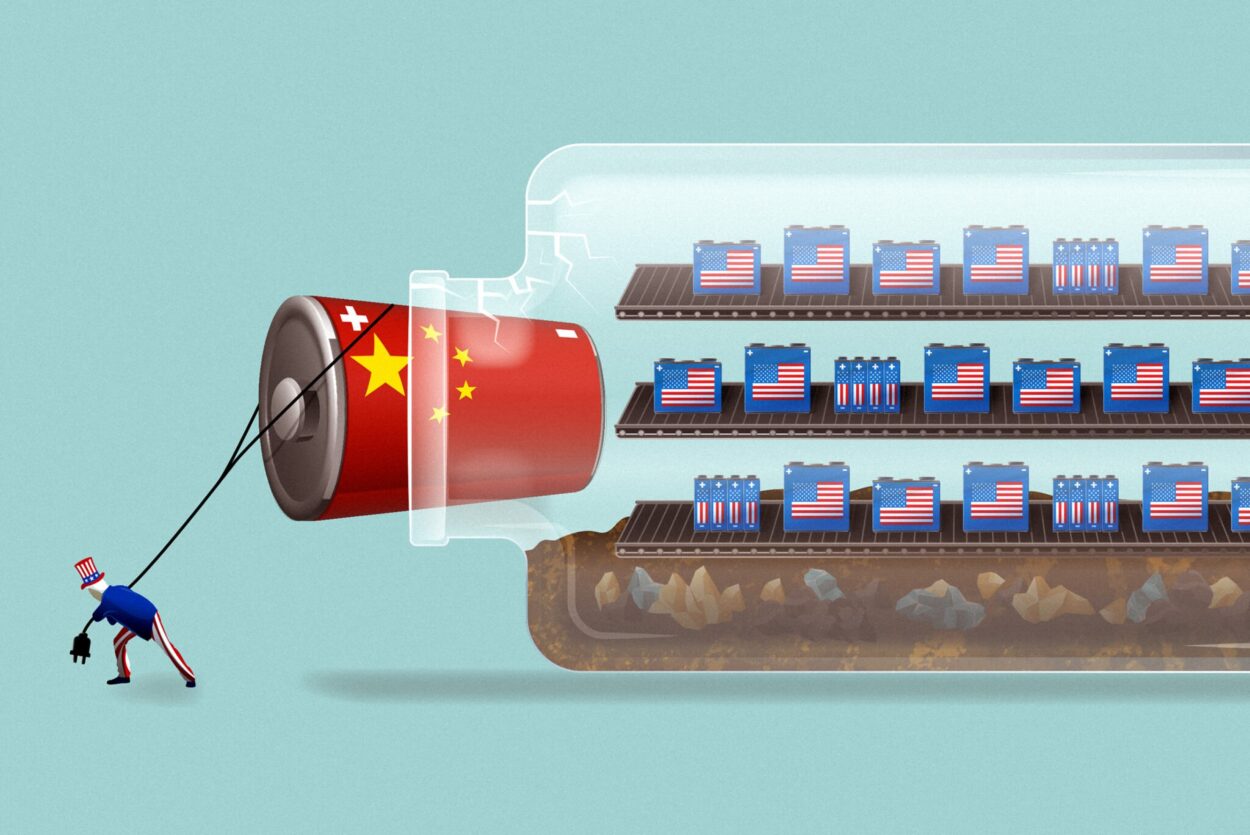
Illustration by Daniel Ackerman/FDD
The Evolution of Batteries
While humans have used machines to harness power for centuries — windmills have been in use for a thousand years and waterwheels are twice as old — the ability to store power for future use is a relatively recent innovation. Batteries, which allow for (1) stored and (2) mobile energy, are among the most important inventions of the modern era.
The first batteries, sometimes called Leyden jars, were invented in the 18th century but were little more than electrical capacitors — devices that could store high-voltage power but would discharge the power all at once. Benjamin Franklin was apparently the first person to refer to this as a “battery.” Franklin linked multiple Leyden jars together to increase their power and described them with the military term “battery,” meaning a powerful grouping of artillery cannons.12
The pivotal innovation in battery technology was the development of a storage system that could hold electricity and discharge it slowly over time and upon demand. Alessandro Volta developed a copper and zinc battery in 1800, separating the two metals with layers of a brine-soaked cloth. The brine solution acted as the first electrolyte, and these “voltaic piles,” as they were known, allowed the first continuous and stable discharge of stored electricity.
Modest improvements in design occurred over the next 50 years, with a major breakthrough in 1859 when Gaston Planté invented a rechargeable lead-acid battery. This battery used two different types of lead for the anode and cathode (positively and negatively charged electrodes), both of which were suspended in a sulfuric acid electrolyte. For the first time, the charge of the battery could be restored once the initial charge was spent. During the discharge phase, anodes sent extra electrons to the cathodes. During the charging phase, electrons were forced back the other way.
Lead batteries are still in use today, particularly where the amount of electricity needed is limited and weight is not a factor. Most nonelectric cars have lead batteries, for instance, which are continuously recharged by the alternator when the engine is running. They are excellent at discharging the brief, large electrical current needed for starting an internal combustion engine but lose their charge quickly. As electrical innovations advanced, large and heavy lead batteries became impractical.
Zinc-based alkaline batteries were developed in the 1950s, allowing major reductions in battery size and weight that propelled massive innovations in electronics — handheld electrical devices, like remote controls and radios, could now be mobile and commonplace. Zinc-alkaline batteries are the common ones we all know today, often scattered at the back of the junk drawer in our kitchens. These batteries are small and relatively cheap but generally non-rechargeable — providing limited utility for devices designed to be used often.
To unlock the communications revolution, batteries needed to be small, lightweight, long-lasting, and reusable thousands of times. Opening up the back of a cellphone to put in new AAA batteries every day is simply not feasible.
The invention of lithium-ion batteries in the 1970s and 1980s met the need for endurance and reusability, fundamentally changing the technological potential of electronics. Lithium — a lightweight metal with an easily removable electron — was discovered to be ideal for electronic applications. Developed (in part) by an American scientist with what may be the most modest name in the history of science — John Goodenough — the new lithium-ion battery used lithium-cobalt for the cathode and graphite for the anode, a chemistry that is still used today. For his work, Goodenough went on to win the Nobel Prize in Chemistry.
Not considering the cobalt- and graphite-based battery good enough, Goodenough also invented a battery that used the simpler elements of iron and phosphorus13 along with lithium to create what became known as a lithium iron phosphate (LFP) battery (from the chemical name, LiFePO4). Goodenough’s LFP battery was briefly commercialized in the United States, but complications from a recall during the rollout caused the American company that was championing the technology to go bankrupt. A Chinese company swept in to acquire the intellectual property, a story told below.
Small, powerful lithium-ion batteries transformed the computer industry in the 1980s and ’90s with the commercialization of the laptop. In the 2000s, lithium-ion batteries allowed for the widespread adoption of cellphones. By the 2010s lithium-based batteries became so powerful that they could power cars, drones, buses, and trucks. Large-scale lithium batteries now back up homes, factories, and electrical grids — evening out demand, preventing blackouts, and adding greater stability to our power systems.
Over the past five years, there has also been a rise in military applications for battery-based systems.14 Batteries will be one of the bullets of future wars. Already, countless U.S. military systems rely on advanced batteries. As former Deputy Secretary of Defense Kathleen Hicks has stated: “Battery technology and lithium ion batteries specifically, are … essential to thousands of military systems from handheld radios, to unmanned submersibles and to future capabilities like lasers, directed energy weapons and hybrid electric tactical vehicles. A healthy battery supply chain is essential to the military.”15
This is hardly surprising — soldiers need power and mobility. As the use of drones, robots, and other unmanned weapons platforms increases in importance, better batteries will mean a better fighting force. The Russia-Ukraine war demonstrates the ways in which drone warfare can transform a battlefield, with an estimated 50,000 battery-reliant attack drones used per month.16 Securing powerful and reliable American-made advanced batteries represents a critical national security priority. Many of the American military’s small drones and similar devices have dependencies upon China, with batteries being an area of particular weakness.17 During Operation Iraqi Freedom in 2003, American forces struggled to meet surging demand for the foreign-made batteries in their radios, night-vision goggles, and small drones.18 Prominent entrepreneur and investor Marc Andreesen has observed: “90 percent of all drones used by the U.S. military are made in China. We have a drone company that’s been trying to compete with a Chinese company. China is now sanctioning our drone company because the battery is made in China. And so, they have significant leverage not just for the drones but for the entire supply chain.”19 In a hot war or even a cold one, Beijing could also weaponize the battery dependence of economic sectors ranging from cars to computers, communications, and construction.
As this report demonstrates, China has the current advanced battery market dangerously cornered. It manufactures 80 percent of all lithium-ion batteries, but that dominance is only the tip of the iceberg.20 Even batteries made in other countries (mainly Japan and South Korea) are deeply and dangerously dependent upon China for the underlying components and critical minerals in battery supply chains. China makes 85 percent of the world’s lithium-based anodes and 70 percent of the cathodes.21 They also make 90 percent of the materials used in those cathodes (known as “cathode active material”) and 97 percent of the material for anodes.22 China likewise processes 65 percent of the world’s lithium,23 more than 85 percent of the world’s battery-grade cobalt, and 95 percent of the world’s battery-grade graphite.24 Across the battery supply chain, Beijing dominates.
China’s Chokehold Over Key Advanced Battery Inputs
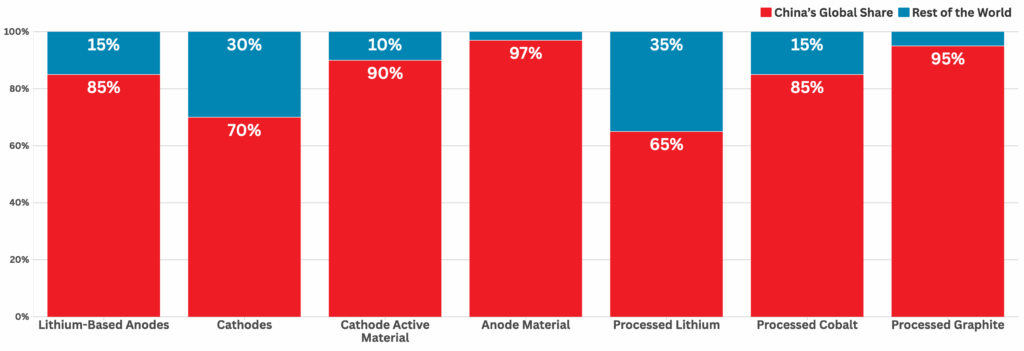
Graph depicting China’s percentage share in production of seven advanced battery inputs. Source: International Energy Agency, “Global Supply Chains of EV Batteries,” 2022; International Energy Agency, “Trends in Electric Vehicle Batteries,” 2024; Center on Global Energy Policy at Columbia University, “Fact Sheet: Lithium Supply in the Energy Transition,” 2023; U.S. Geological Survey, “The Development of China’s Monopoly Over Cobalt Battery Materials,” 2024; Fastmarkets, “CRMA ‘Toothless’ To Support European Graphite Producers,” 2024.
The Present: Current Advanced Battery Chemistries
While battery technology is still evolving, three major lithium-based chemistries dominate today’s advanced battery market and drive the bulk of current demand for lithium: lithium iron phosphate, nickel manganese cobalt (NMC), and nickel cobalt aluminum (NCA). Despite having names that emphasize their nickel and cobalt content, both NMC and NCA rely heavily on lithium as well.
These three chemistries rely on lithium from two different compounds — lithium carbonate and lithium hydroxide — which are derived via distinct extraction and processing methods. Lithium carbonate, predominantly derived from salt-water brines, can be used in all three battery types but is primarily used in LFP batteries because of its lower cost.25 Lithium hydroxide, predominantly derived from an ore called spodumene, is more expensive but allows for greater energy density — something that NMC and NCA batteries are able to take advantage of.26
The costs associated with refining lithium hydroxide and lax environmental controls in China have made LFP batteries markedly more cost-effective than NMC and NCA batteries, contributing to the sharp turn toward LFP batteries by major battery manufacturers and electric vehicle (EV) makers.27 LFP batteries are also capable of being charged and discharged more times than other chemistries, offering a lifespan of 3,000-5,000 recharge-discharge cycles compared with 1,500-3,000 for NMC28 and 1,000-2,000 for NCA.29
These edges in cost and lifespan are a major advantage.30 In 2020, NMC batteries held a 71 percent market share,31 which fell to 55 percent in the first half of 2024.32 Together with NCA batteries, nickel-based batteries represented 95 percent of the market in 2020.33 By contrast, in 2020, LFP batteries had only a 4 percent global market share but by 2024 achieved a 40 percent share in the EV sector.34 LFP batteries now dominate the Chinese market in particular, accounting for 75 percent of all new installations in China in 2024.35
Market Share of NMC vs. LFP Batteries 2020 vs. 2024
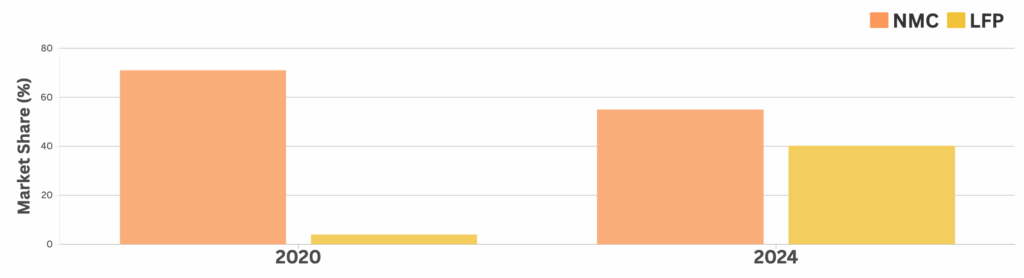
Graph depicting the 2020 and 2024 comparative percentage of the market for batteries comprising Nickel Manganese Cobalt Oxide Batteries and Lithium Iron Phosphate Batteries. Source: Robotic Vehicle Technology, “A Complete Guide for EV Battery Types,” 2025; International Energy Agency, “Global EV Outlook” 2021; IDTechEx, “Iron and Phosphate to Unlock the Mass-Market EV at Last,” 2025.
U.S. and European carmakers generally rely on NCA and NMC batteries made with Australian spodumene processed into lithium hydroxide in China but are moving toward LFP batteries.36 Tesla has equipped all standard-range Model 3 and Model Y vehicles made after October 2021 with LFP batteries, while longer-range and performance Teslas continue to utilize NCA batteries.37 Ford continues to primarily utilize NMC batteries while seeking ways to shift to LFP batteries,38 and GM is reportedly considering licensing Chinese LFP technology.39
For small applications like power tools, smartphones, laptops, and other household electronics, NMC batteries, and other chemistries relying on cobalt oxides or manganese oxides40 predominate due to their higher energy density and lighter weight.41 However, nickel-based batteries are ill-suited to large-scale applications given the risk of thermal runaway for very large nickel-cobalt batteries. In Moss Landing, California, an industrial-scale NMC battery array for grid backup caught fire, taking five days to put out and leaching pollutants and heavy metals into the surrounding region.42 Accordingly, LFP batteries are generally used in energy storage systems (ESS) for grid, factory, and home electricity backup, where a small battery footprint is less essential.43
Case Study: U.S. Lithium Iron Phosphate innovation lost and found in China
If history had followed a slightly different path, the United States might have become the global leader in advanced batteries by leveraging homegrown technology. Instead, China is leveraging LFP technology — an American innovation — to build battery dominance across industries and throughout the global battery value chain. What made this possible was Beijing’s determination to insulate Chinese companies from market forces.
LFP batteries were invented in the mid-1990s at University of Texas at Austin by a team led by Nobelist Goodenough.44 A123 Systems, a Massachusetts-based company,45 then sought to commercialize the invention.46 In 2009, the company secured a $249 million grant from the U.S. Department of Energy to build a battery manufacturing plant in Michigan.47 A123 also raised $750 million in the marketplace48 and formed partnerships with automakers BMW, Chrysler, and start-up Fisker Automotive.49 With close ties to the Obama White House, A123 was quickly becoming the poster child of U.S. battery development.50
However, in December 2011, A123 began to face setbacks. The company announced a layoff of 125 employees, citing lower-than-expected demand from major clients.51 Around the same time, a recall was announced for a number of Fisker’s vehicles after A123 flagged a potential defect in batteries used in the vehicles.52 The recall immediately sent A123’s stock plummeting.53
The layoffs and recall marked the beginning of the end for A123. The company formally declared bankruptcy in October 2012 after an agreement with Chinese auto parts manufacturer Wanxiang Group Corporation54 for an investment of up to $465 million fell through in August of that same year.55 Following the bankruptcy, Wanxiang was able to purchase it for only $257 million,56 naming the new entity Wanxiang A123 System Corp.57 To acquire A123, Wanxiang outbid American competitors, including then Wisconsin-based Johnson Controls.58 The Committee on Foreign Investment in the United States approved the deal despite concerns from members of Congress and experts who feared that the sale could jeopardize America’s energy security.59
For some, A123 Systems has become a cautionary tale about the futility of U.S. government intervention in the marketplace. Washington invested a quarter of a billion dollars and catalyzed three times as much private investment, but this could not avert A123’s failure to meet short-term profitability expectations, which ultimately doomed the company. A similar dynamic played out in Sweden with the bankruptcy of the once promising European battery champion Northvolt.60
By contrast, Beijing uses aggressive state power to shield Chinese companies from market dynamics, so short-term pressures do not derail long-term efforts to scale up new technologies and dominate the market. While Washington mobilized $1 billion of capital for A123, the Chinese government sustained and supported the nascent EV market, including core LFP technology, by pumping in more than $230 billion of subsidies and tax breaks from 2009-2023.61 As a result, Chinese battery companies made LFP into the dominant configuration, while competitors in the United States, Japan, Germany, and South Korea focused on alternative battery technologies that are theoretically more energy dense but are also far more expensive.62
The lesson of this episode is not mainly that the United States failed to subsidize sufficiently or that China subsidized too much — both are true to some extent. Rather, it is that the two subsidization models are simply inconsistent with each other. If one government’s investments are an order of magnitude greater, the result is an unbalanced system that will routinely disadvantage market-based players.
Beijing continues to reap the benefits. In 2023, Ford Motors asked the CCP-aligned Contemporary Amperex Technology Co., Limited (CATL), the world’s largest battery manufacturer,63 for a license to build and operate a new $3.5 billion LFP battery plant in Michigan.64 Both GM65 and Tesla66 are exploring the possibility of licensing Chinese LFP technology, with Tesla, which already uses CATL cells for its Megapack battery, announcing plans to build a new LFP manufacturing facility in Nevada using surplus battery manufacturing equipment from CATL.67
Chokepoints in the Advanced Battery Supply Chain Stages
The lithium supply chain has three basic stages: (1) upstream — the extraction and refining of lithium and other critical minerals; (2) midstream — the assembly of battery components, such as cathodes and anodes; and (3) downstream — the assembly of batteries into a finished product. Upstream, Chinese dominance has created particularly severe bottlenecks in lithium refining and graphite production. In the midstream, there are massive chokepoints around China-dominated cathode and anode production. Downstream, China weaponizes markets against other established sellers and new players, holding a near monopoly on the final assembly process. These acute vulnerabilities leave U.S. advanced battery supply chains exceptionally exposed to Chinese influence and manipulations.
China’s Upstream Control
The upstream portion of the supply chain includes both the extraction of lithium and the processing of lithium concentrate into battery-grade lithium carbonate or hydroxide. Minerals such as nickel, graphite, cobalt, and antimony also constitute critical parts of the chain. Australia and Chile are the leading providers of lithium concentrate, producing 51 percent and 26 percent of global output, respectively.68 Nevertheless, China exercises suffocating control over the upstream segment of the lithium battery supply chain by (1) securing raw material resources through acquisitions of foreign mining concessions or offtake agreements and (2) being the sole at-scale processor of almost all battery-grade lithium.
Extraction and Concentration
Brine
About 60 percent of unprocessed lithium reserves are found in the form of lithium brines, or saline groundwater enriched with lithium metal.69 After being pumped to the surface, the brine is spread across large evaporation ponds, where sunlight and wind help evaporate the water over several months, concentrating the lithium.70
These flats are primarily located in regions like South America’s Lithium Triangle, which includes parts of Chile, Argentina, and Bolivia. China has substantial ownership interests throughout the triangle. In Chile, Chinese companies and state-owned entities own 22 percent of Chile’s lithium mining giant Sociedad Química y Minera de Chile S.A. (SQM)71 and 26 percent of the Siete Salares-Talison Lithium Project.72
China holds varying levels of ownership stakes in Argentina’s Cauchari Olaroz Project, Tres Quebradas Project, Mariana Project, Laguna Verde Project, and the Sal de Los Angeles Project.73 Chinese companies have inked agreements to source 20,000 metric tons74 and 35,000 metric tons75 of lithium in the future from brine deposits in Argentina and Bolivia, respectively.
Russia’s uranium giant, Rosatom, is also investing in lithium brine extraction projects in the Lithium Triangle, constructing a lithium carbonate plant in the Bolivian Salar de Uyuni salt flat in partnership with China’s Citic Guoan Group.76 This operation is anticipated to produce 14,000 tons of lithium carbonate per year.77 Recent reports indicate, however, that Bolivia has suspended its contracts with Chinese and Russian lithium companies.78
Active and Planned Lithium Triangle Facilities
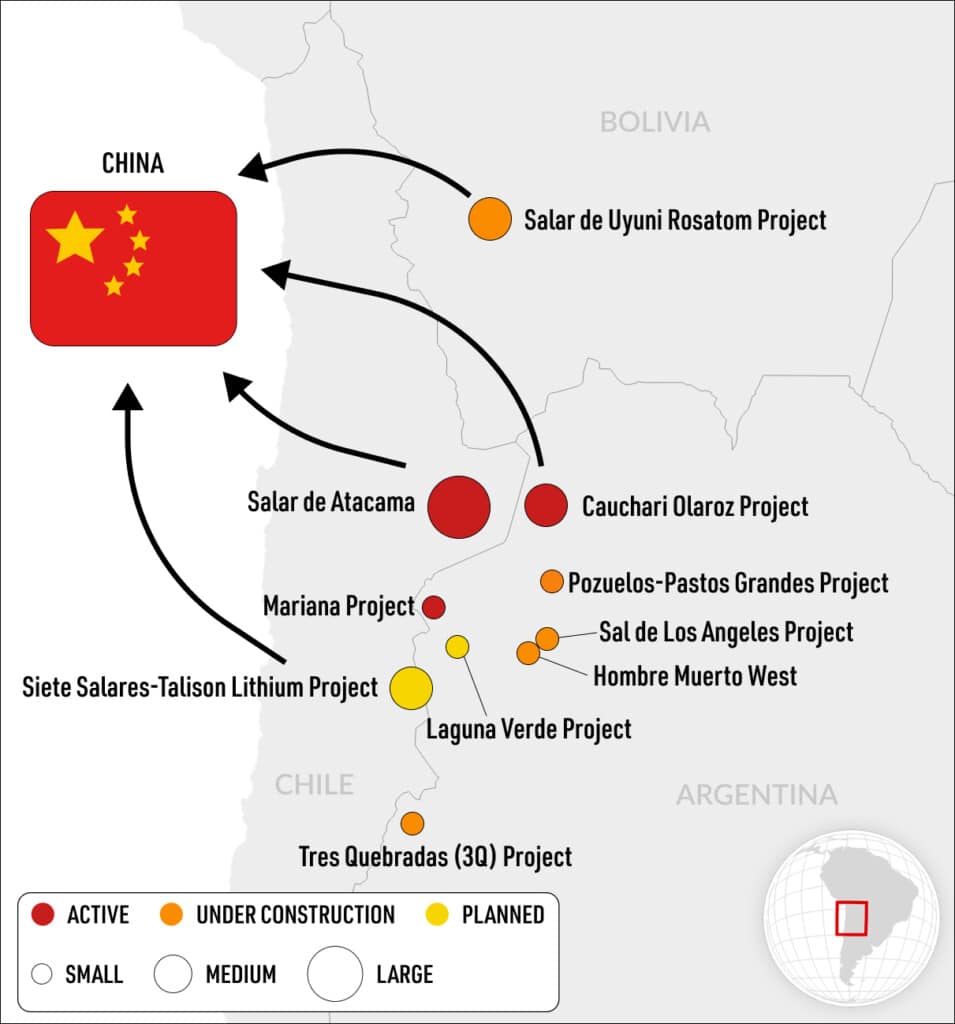
Map of active and potential lithium facilities in Chile, Bolivia, and Argentina, with arrows depicting raw material flows to China. Source: FDD.
Hard Rock
Roughly 30 percent of global lithium reserves are found in hard rock deposits,79 commonly from spodumene, which is favored for battery-grade lithium hydroxide production.80 (Lepidolite is another type of lithium ore sourced from hard rock. China’s domestic reserves of lithium are mostly low-quality lepidolite sourced from mica.81)
Hard rock ore is mined, crushed into a fine consistency, and then subjected to high-temperature roasting and chemical treatments to extract lithium.82 Australia is by far the largest source of spodumene, producing more than 3.5 million tons in 2024.83 But in Australian fiscal year 2022-2023, 98 percent of the country’s production went to China.84 Pilbara Minerals, a major Australian mining firm, has offtake agreements with Chinese lithium companies, including Ganfeng Lithium, Chengxin Lithium Group, Sichuan Yahua Industrial Group, and Yibin Tianyi Lithium.85 Ganfeng Lithium controls 50 percent of the Mount Marion Lithium Project, while the enormous Greenbushes mine — the largest operating lithium mine globally — is owned and operated by Talison Lithium, a joint venture whose 51 percent majority owner, Tianqi Lithium Energy Australia, is itself a joint venture that is 51 percent majority-owned by China’s Tianqi Lithium.86
Active and Planned Australian Lithium Facilities
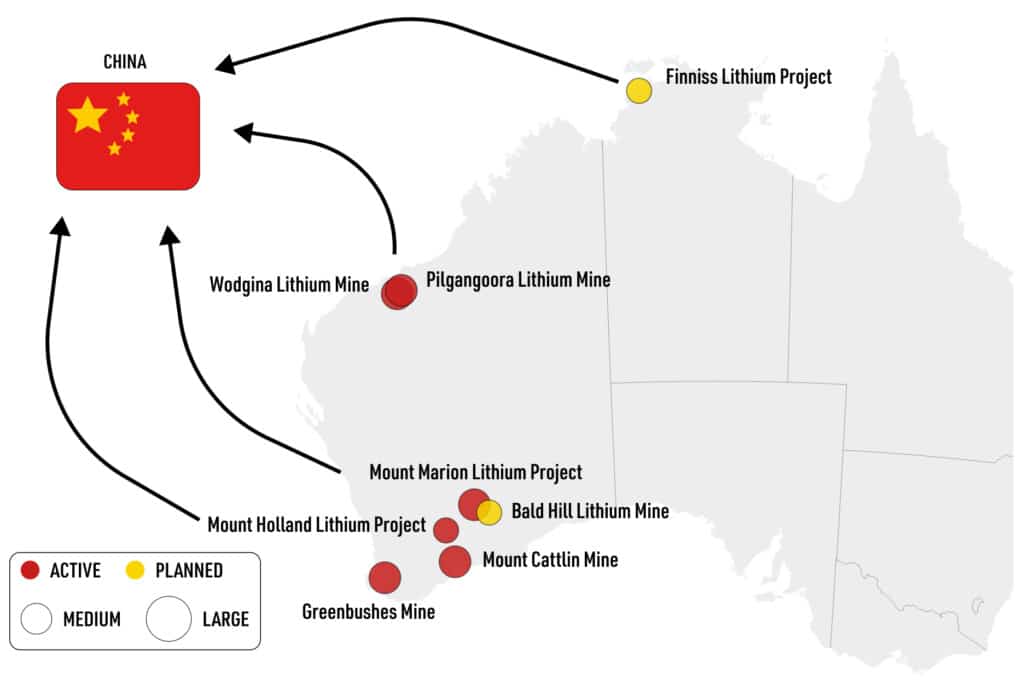
Map of active and potential lithium facilities in Australia with arrows depicting raw material flows to China. Source: FDD.
Clay
In addition to brine and rock, lithium-rich clay deposits, such as those found in Nevada and throughout Mexico, have the potential to be major future sources of lithium. Yet technical challenges to fully exploit the resources remain. Clay extraction, which uses chemicals to leach lithium from the clay, is still largely developmental in nature and not used at scale.87
New extraction processes — such as Direct Lithium Extraction (DLE) — are being tested to improve the efficiency of processing for both clay and brine deposits. DLE uses filters, membranes, and chemical solvents to selectively extract lithium without the need for evaporation ponds.88 It is faster and more environmentally friendly than traditional methods, with the potential to unlock previously uneconomical lithium sources.89 While U.S. companies are deeply invested in DLE, so are Chinese companies — CATL committed to a $1.4 billion investment in Bolivia to extract lithium using DLE methods,90 and China claims to have already launched multiple commercial DLE projects.91 Russia is also pioneering a new direct lithium sorption (DLS) process at its Rosatom lithium carbonate plant in Bolivia, in which wastewater is recycled for future extraction.92
Processing
Lithium processing — turning raw lithium products into battery-grade chemicals — is a significant bottleneck dominated by China. Chinese companies account for 65 percent of global lithium processing.93 The remainder of this capacity is largely located in Chile, with small amounts of processing done in Argentina.94 However, as mentioned above, the Chilean leader in processing is SQM, a company in which China’s Tianqi Lithium holds a substantial ownership stake and three board seats.95 There are other signs of Chinese determination to corner lithium processing operations abroad. In February 2025, Ganfeng Lithium began processing lithium at its new Mariana facility in northern Argentina while also planning further refining expansions in Argentina.96
China also controls much of the intellectual property necessary to process lithium and is considering export restrictions that may prevent American companies from licensing this technology.97
Lithium Battery Supply Chain
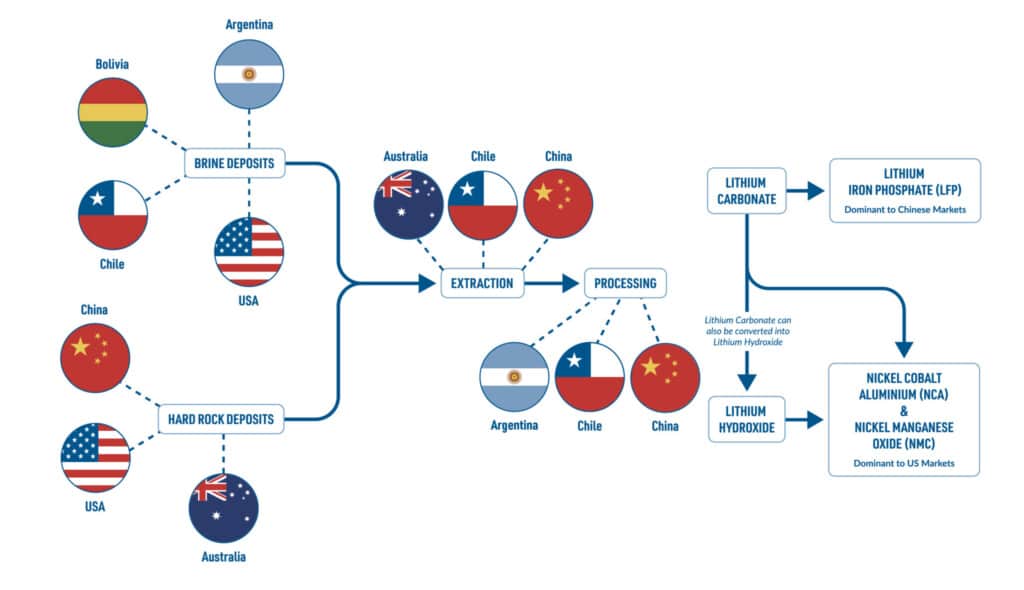
Flow chart depicting the lithium battery production supply chain. Source: FDD.
Non-Lithium Critical Minerals
While lithium is the most significant mineral needed for current-generation advanced batteries, a number of others are required in many types of batteries — particularly the NMC and NCA chemistries preferred by U.S. manufacturers. Here too, China’s mining, ownership, and processing chokehold present substantial vulnerabilities. As Tesla CEO Elon Musk once pleaded, “Please mine more nickel … Tesla will give you a giant contract for a long period of time if you mine nickel efficiently and in an environmentally sensitive way.”98 As shown in the chart titled “China’s Processing Dominance of Non-Lithium Critical Minerals,” China processes the vast bulk of global graphite, nickel, cobalt, and manganese.
Graphite represents a particularly difficult bottleneck, with China processing more than 95 percent of the world’s battery-grade graphite. Diversifying graphite processing away from China is complicated, however. Chinese graphite is cheaper than alternatives, in part because Chinese production is permitted to be highly polluting, discharging particulates into the air and dumping waste into local waters.99 Chinese graphite processing also relies on highly toxic hydrofluoric acid leaching, which can release of dangerous chlorine or hydrofluoric gas and is not used in Western countries on safety grounds.100 Replacing Chinese graphite production, therefore, may require the development of new technologies to provide safe and cost-effective alternatives to Chinese methods.
China’s Processing Dominance of Non-Lithium Critical Minerals
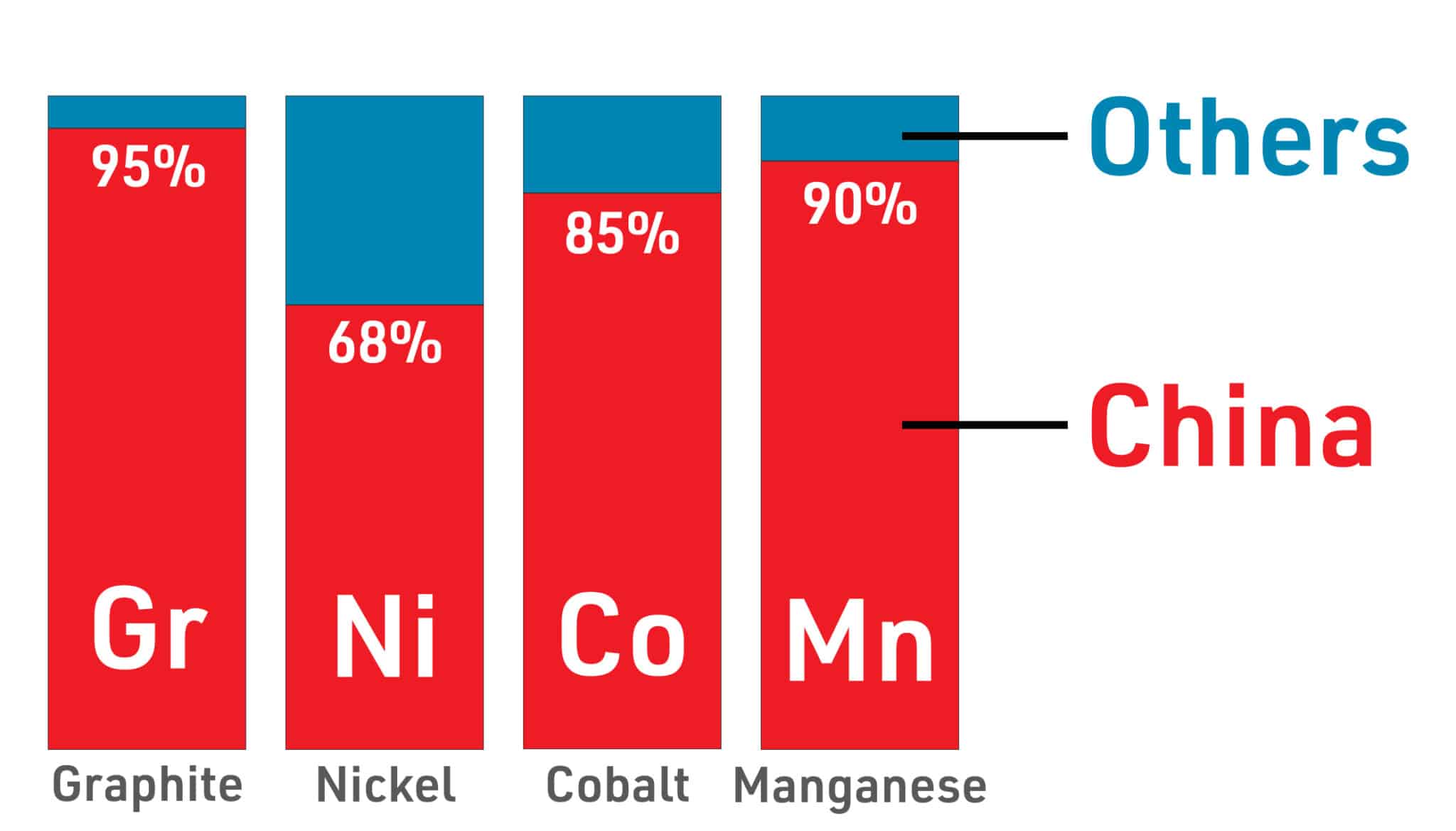
Graph depicting China’s percentage market share for the processing of graphite, nickel, cobalt, and manganese. Source: U.S. Geological Survey, “The Development of China’s Monopoly Over Cobalt Battery Materials,” 2024; Fastmarkets, “CRMA ‘Toothless’ to Support European Graphite Producers,” 2024; Brookings Institution, “China’s Role in Supplying Critical Minerals for the Global Energy Transition,” 2022; S&P Global Market, 2023.
Non-Chinese Upstream Alternatives
Lithium is not scarce. Lithium brines can be found in many places, including a potentially massive reserve in Arkansas capable of supplying all of America’s lithium needs for the foreseeable future.101 There are also large deposits under California’s Salton Sea.102 The American lithium giant Albemarle already produces 460,000 metric tons of lithium per year in Chile and has received an option that would allow it to increase its quota by 240,000 tons.103
More investment is also urgently needed to ramp up alternatives to Chinese lithium processing. With new Trump administration efforts to incentivize critical mineral processing104 and a U.S. lithium market that is expected to grow roughly 500 percent over the next five years,105 American and other non-Chinese companies are beginning to invest in domestic processing capacity. The U.S. company Piedmont Lithium is developing a lithium hydroxide processing facility in North Carolina aimed at processing spodumene concentrate from its North American deposits and supplying the U.S. battery market.106 Albermarle also announced plans to build a lithium hydroxide processing facility in Chester County, South Carolina.107
Seeking to explore new options for meeting America’s critical mineral needs for advanced batteries, President Trump issued an executive order in April to incentivize the exploration of offshore underwater mining opportunities, particularly around mineral-rich nodules that are abundant on the deep sea floor.108 These polymetallic nodules are frequently rich in minerals specifically needed for advanced batteries, including nickel, cobalt, copper, manganese, as well as rare earth elements.109 Recent research, however, suggests that these nodules may contribute to oceanic — and, perhaps, global — oxygen levels, indicating that environmental caution is needed when considering this source of minerals.110
Allied countries are recognizing the urgency of diversifying away from China as well. South Korea pledged $7.1 billion last year in policy financing to support domestic investments and diversify key mineral supply chains.111 In September 2024, Germany’s AMG Lithium opened its first lithium hydroxide refinery in Bitterfeld-Wolfen.112
Limited progress is also being made to pivot battery supply chains away from China for other critical minerals. General Motors, for instance, has entered into a multibillion-dollar agreement with Norwegian company Vianode for the supply of synthetic anode graphite.113 Similarly, Tesla has agreed to purchase nickel from Talon Metals’ Tamarack mine project in Minnesota, marking its first U.S. supply deal for nickel.114 These deals remain modest, however, in the face of China’s dominance.
The effort to expand U.S. and allied processing capacity also faces substantial permitting, financing, and scaling obstacles creating unnecessary headwinds. Permitting obstacles alone represent an estimated 40 percent of all delays in mining projects, for instance,115 and processing projects face similar constraints. That said, permitting is also an essential step — protecting American communities from the pollution and safety hazards that citizens in China frequently face. The goal should not be to eliminate those safeguards but rather to reduce needless obstacles and accelerate the process.
As Ford Motor Company noted in a letter to the U.S. Department of the Interior that the “lengthy, costly and inefficient permitting process” makes it difficult for American businesses to invest in extraction and processing projects.116 The Trump administration recognizes the challenge, and on March 20, the president signed an executive order, “Immediate Measures to Increase American Mineral Production,” seeking to bolster domestic mining and processing capacity. As the executive order states: “Transportation, infrastructure, defense capabilities, and the next generation of technology rely upon a secure, predictable, and affordable supply of minerals … Our national and economic security are now acutely threatened by our reliance upon hostile foreign powers’ mineral production. It is imperative for our national security that the United States take immediate action to facilitate domestic mineral production to the maximum possible extent.”117 The order sets out an ambitious plan to unlock public and private capital for new projects while reducing the regulations and red tape impeding current ones. It also sets out a pathway for government offtake agreements, use of public land for mining, purchasing raw material feedstock for domestic refining, and exploring the repurposing of prior mining waste for new critical mineral processing. These are all positive steps. What remains to be seen is whether such efforts can overcome obstacles that include high energy requirements for mining projects and potential resistance from community groups.
China’s Midstream Control
The assembly of battery components, especially cathodes and anodes, constitutes the midstream sector of the supply chain. Here, too, Chinese dominance represents a massive bottleneck for non-Chinese battery manufacturers and end-user companies. China produces more than 70 percent of the world’s supply of cathodes and 85 percent of the anodes.118 Chinese companies also produce almost 90 percent of cathode active material — the key building block of cathode manufacturing — and more than 97 percent of anode active material, often using raw materials (such as refined graphite) that come from China in the first place.119
The high input costs involved with cathode production tighten the bottleneck further. Cathodes frequently depend on metals that are expensive to mine, refine, and process. In lithium-ion batteries, cathode materials like nickel, cobalt, and lithium can account for roughly half of the total battery cost.120 In comparison, anode materials like graphite are less expensive, typically representing around 10 percent of the total battery cost.121
To preserve its dominant midstream position, China seeks to limit the proliferation of cathode production technologies. In January 2025, China’s Ministry of Commerce proposed new export restrictions targeting advanced LFP cathode production technologies.122 These proposed measures would require Chinese firms to obtain licenses before exporting technologies used to produce the most advanced versions of LFP and lithium manganese iron phosphate (LMFP) cathode materials.123
Despite costing less than cathodes, anode production is also a major bottleneck given China’s stranglehold on global graphite production. China accounts for roughly 95 percent of battery-grade graphite.124 Furthermore, in December 2024, China implemented export restrictions on certain graphite products, including flake graphite and spherical graphite, to the United States.125 In response, U.S. graphite miners have asked the government to impose a 920 percent tariff on Chinese graphite imports to mitigate the impact of China’s export controls.126
China’s Dominance of Battery Component and Active Material Production
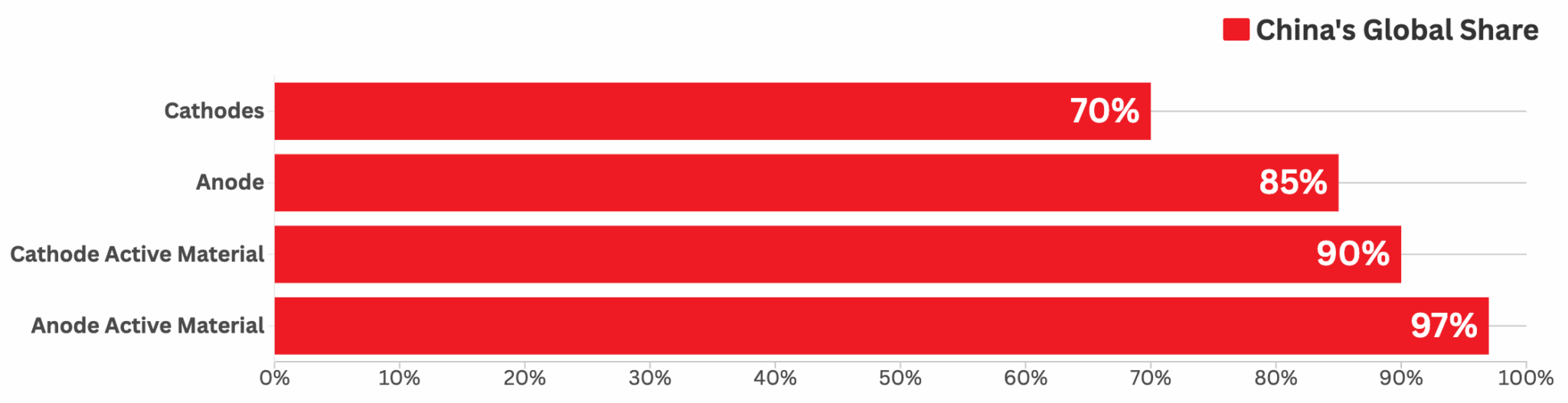
Graph depicting China’s percentage market share of global production for four battery components. Source: International Energy Agency, “Global Supply Chains of EV Batteries,” 2022.
Non-Chinese Midstream Alternatives
Historically, the United States has lacked large-scale facilities for producing cathodes and anodes, resulting in an inchoate industry that remains vulnerable to Chinese market manipulations. Recognizing this gap, the U.S. Department of Energy allocated $2.8 billion under the Bipartisan Infrastructure Law to support battery material processing, component manufacturing, and recycling projects. This money has been distributed among 20 companies across 12 states to proliferate the processing of raw materials and manufacturing of battery components.127 Additionally, the U.S. government has awarded a conditional loan of $755 million to Novonix, an Australian company, to build a synthetic graphite plant in Tennessee.128
Midstream alternatives also include novel approaches to battery recycling — Ascend Elements received $480 million to produce lithium-ion battery cathode materials from recycled battery feedstock.129 Rather than merely focusing on environmental concerns, recycling efforts are a key way to break dependency on Chinese raw materials, as former batteries can be ground into a material called “black mass,” from which highly reusable minerals can be returned to the supply chain without requiring new, Chinese-based inputs. Like battery and mineral technology in general, China already maintains a large head start with respect to battery recycling techniques and supply chains.130
EV Battery Market Share
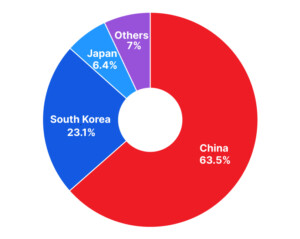
Chart showing leading countries’ market share of the EV battery market. Source: CnEVPost (China), “Global EV battery market share in 2023.”
China’s Downstream Control
Downstream, China controls approximately 77 percent of the world’s battery pack assembly, which entails the integration of battery cells into packs for use in EVs, energy storage systems, and other applications. In terms of power output, Chinese firms shipped batteries with 1,215 gigawatt-hours (GWh) of capacity in 2024 out of a global total of 1,545 GWh.131 With regard to EV batteries specifically, Chinese firms have a 63.5 percent global market share, with just two Chinese firms, CATL and BYD, controlling more than a 52 percent share between them. South Korean firms, including LG and Samsung, have a 23.1 percent share, and Japan’s Panasonic has a 6.4 percent share.132 What’s more, South Korean and Japanese producers remain heavily reliant on Chinese cathode and anode inputs since those two countries accounted for only 9 percent and 3 percent of global cathode active material production, respectively.133
China’s Share of Global Production in Terms of Battery Capacity
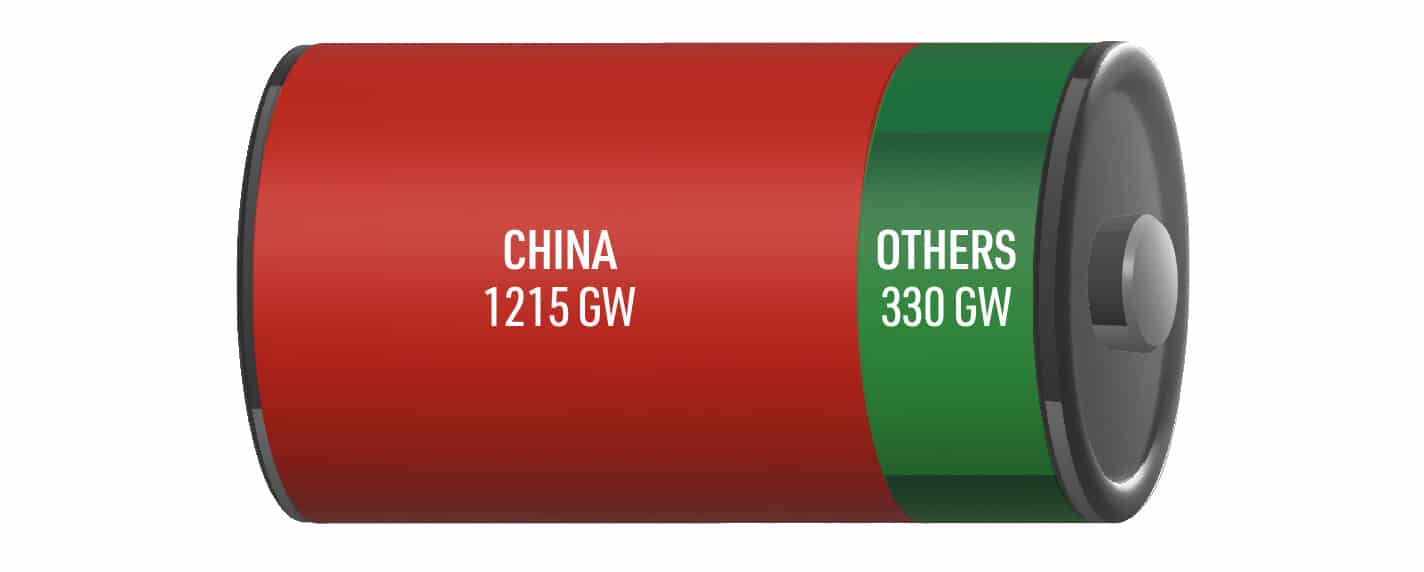
China’s market share of global battery capacity production. Source: Argus Media, “Global Li-ion battery shipments rise in 2024,” 2025.
Chinese firms send abroad much of what they produce. China’s lithium-powered battery exports surpassed $60 billion in 2024. Exports to the United States hit an all-time high of nearly $2 billion in monthly sales in December 2024.134 In Africa, China has been fueling a boom in lithium-ion battery usage, with lithium-based batteries now capturing approximately 53 percent of Africa’s battery market.135 Europe, meanwhile, is China’s largest market for EVs,136 with almost 40 percent of China’s 2023 EV exports directed to the European Union and another 15 percent going to non-EU European nations.137 Volvo, the Swedish automaker now owned by China’s Geely,138 sold 175,000 EVs in 2024,139 relying upon Chinese advanced batteries made by CATL.140
Despite rising trade barriers in Europe and elsewhere, Chinese firms are responding by making strategic investments in tariff-exempt markets. Chinese battery companies are increasingly establishing factories within the European Union to circumvent tariffs and sustain demand.141 Notable investments include major facilities in Hungary, Spain, and Germany by companies such as CATL and EVE Energy.142 In Debrecen, Hungary, CATL announced a 7.34 billion euro investment in August 2022 to build a 100 GWh battery plant, marking its largest overseas venture to date.143 Similarly, EVE Energy committed more than $1 billion in May 2023 to construct a battery plant also located in Debrecen, aiming to produce large cylindrical batteries.144
Chinese companies, especially CATL, are also making huge strides in non-EV applications, such as energy storage systems (ESS). In 2024, the ESS sector boomed — global energy storage cell shipments reached 334 GWh,145 marking a 60 percent year-over-year increase.146 China led this boom, with CATL and EVE Energy holding a combined 55 percent global market share. Other Chinese companies like CALB and BYD also shipped over 10GWh each in 2024.147
How China Corners the Battery Supply Chain
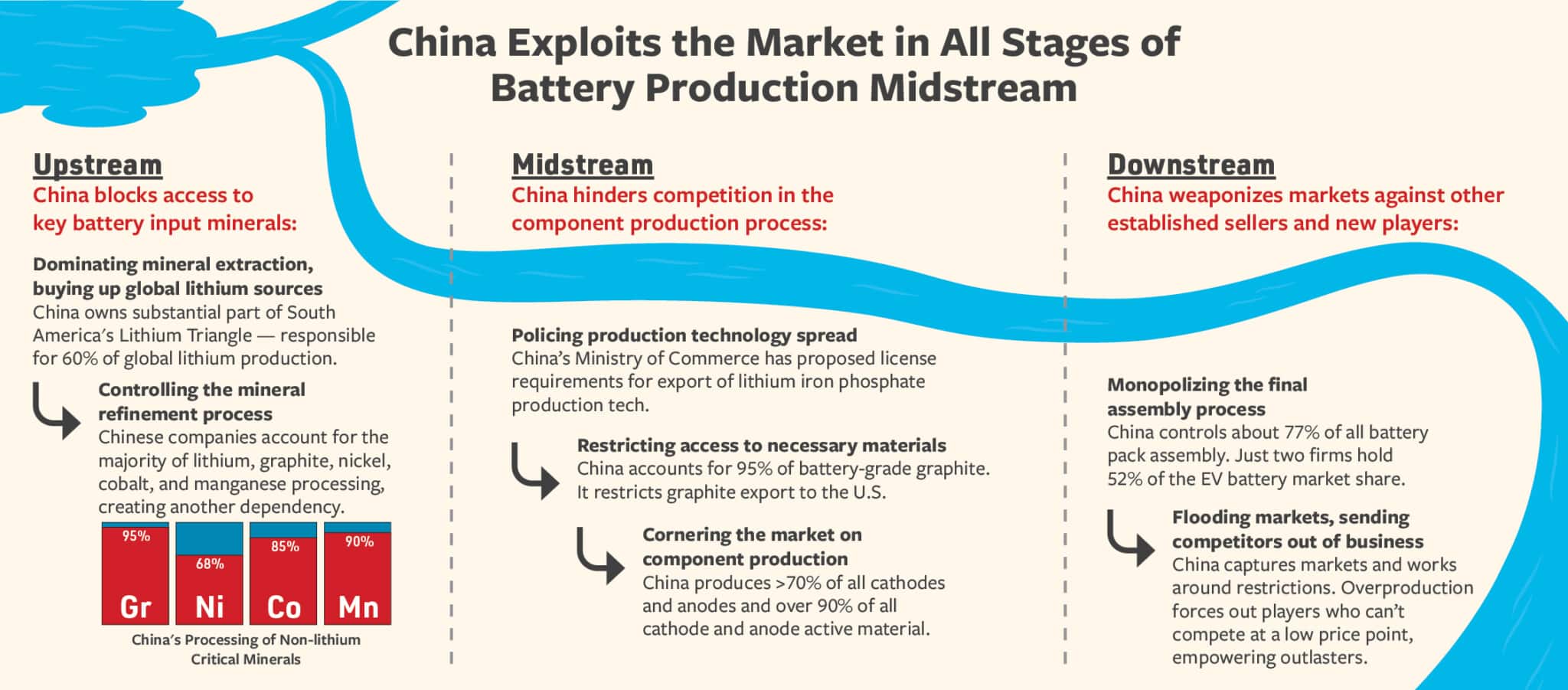
Chart detailing China’s dominance in the upstream, midstream, and downstream stages of battery production. Source: FDD.
Non-Chinese Downstream Alternatives
The United States has begun to invest in downstream production facilities. By the end of 2024, manufacturers had announced nearly $200 billion in investments dedicated to EV and battery manufacturing facilities148 — including General Motors’ partnership with LG Energy Solution through their Ultium Cells joint venture. Ultium Cells’ Ohio facility, a 2.8 million-square-foot plant located in Warren, commenced initial battery cell production in August 2022 and currently employs 1,700 people. In December 2024, the plant celebrated the production of its 100 millionth cell. Ultium Cells sources its cathode active materials from POSCO Future, a South Korean manufacturer,149 and provides its battery cells to General Motors.150
Similarly, Toyota and Samsung SDI have committed significant funds to U.S. battery manufacturing projects.151 While these projects may marginally dilute China’s control over the advanced battery market, they do not necessarily address overwhelming supply chain dependencies in the upstream and midstream segments. While Samsung sources its cathodes from South Korea’s POSCO,152 Samsung sources anode materials from China’s BTR New Material Group.153
Northvolt
Northvolt, once a beacon of Europe’s ambition to lead the world in battery manufacturing, now represents a key warning for aspiring non-Chinese battery manufacturers.154 A Swedish battery manufacturer founded in 2015, Northvolt aimed to establish Europe’s independence in lithium-ion battery production for electric vehicles. The company secured substantial investments, raising over $15 billion from prominent backers such as Volkswagen, Goldman Sachs, and BMW. Despite these financial advantages, Northvolt struggled with scaling up production to meet high-quality standards and volume targets, leading to major contract cancelations and delayed deliveries. These setbacks led to significant strain, culminating in Northvolt filing for Chapter 11 bankruptcy protection in the United States in November 2024.
The Future: Battery Innovations and Opportunities for Disruption
Despite China’s advantages in the upstream, midstream, and downstream segments of the current advanced battery market, technology is never stagnant. Today’s supply dynamics reflect today’s technology and sourcing requirements based upon specific chemistries, presently known reserves, and still-developing markets. As America’s battery demand grows and new applications are unlocked, innovative new technology may upend incumbent players in China and throughout the existing supply chains — provided that we take steps to address China’s non-market manipulations first.
One technology that disrupts the status quo might be lithium-sulfur batteries, which, like LFP batteries, do not rely upon difficult-to-source cobalt, nickel, or manganese. Initial research indicates that lithium-sulfur batteries could have five times the energy storage capacity of their traditional counterparts at a lower cost.155 Historically, lithium-sulfur batteries have faced multiple challenges to large-scale implementation, including significant volume change during operation, poor electrical conductivity of sulfur, and battery corrosion from chemical byproducts, which impacts functionality.156 However, recent developments in design appear to have significantly reduced issues related to battery corrosion while increasing energy storage capacity.157
Betting on the technology, U.S. company Lyten recently announced plans for the world’s first lithium-sulfur battery gigafactory in Nevada. The factory is set to produce lithium-sulfur battery cells and related components, with a total annual production capacity of 10 GWh of batteries.158 Nevada is also home to abundant lithium and sulfur reserves, giving Lyten convenient access to raw materials for production — if lithium from nearby Thacker Pass can be processed at scale.159 While the development of and investment in lithium-sulfur batteries is a promising step, the technology still relies on lithium and thus will suffer the same supply chain vulnerability as other lithium-based chemistries.
Newer iterations of nickel-based chemistries are also aiming to address supply chain chokepoints by significantly reducing the amounts of cobalt and nickel in the cathodes while dramatically increasing the amount of the more abundant and less expensive manganese. These “manganese rich” lithium cells, or LMRs, are being commercially developed by GM and LG Energy Solutions, for use in GM vehicles by 2028.160 By reducing nickel inputs by nearly two-thirds and limiting cobalt to negligible amounts, these batteries should be able to compete with LFP batteries on cost, with better range, U.S.- and allied-controlled IP, and fewer Chinese mineral dependencies.161
With an eye toward ending dependence on lithium, some in-development batteries are seeking to replace lithium wholesale with sodium — the plentiful metal found in conventional table salt, which is 1,200 times more common than lithium. Sodium-ion batteries utilize cathodes of sodium carbonate, a substance that can be naturally sourced or relatively easily manufactured. The primary strengths of sodium-ion batteries are their cost, which may be 20 percent lower than a lithium equivalent, and their longer lifecycles.162 For now, the technology still faces roadblocks to large-scale implementation, and the batteries themselves lack the energy density of their lithium-ion counterparts. This results in bulkier batteries with a reduced EV range and battery pricing similar to LFPs.163
Companies in Japan, South Korea, and Sweden are investing significantly in sodium-ion battery technology, but so are Chinese firms.164 For example, China’s BYD is investing around 10 billion RMB ($1.4 billion) in a sodium-ion battery plant in Xuzhou, with other Chinese companies, such as CATL and HiNa Battery, following suit.165
Solid-state batteries, which replace existing liquid lithium chemistries with a solid, more energy-rich configuration, represent another potential alternative to current technology.166 Japan, for instance, announced a subsidy of over $660 million in 2024 to advance the development and commercialization of all-solid-state batteries.167 Research suggests these batteries are less likely to fail, less flammable, lighter overall, provide a substantial increase in EV range, and have a higher energy density and faster charging times than liquid lithium-ion batteries.168 But for now, solid-state batteries are too small to power a vehicle, and some components face reliability and short-circuiting issues.169 Additionally, most solid-state batteries retain their reliance on lithium and other critical minerals, although they use less of it.
Following recent developments in solid-state battery technology, several major car manufacturers, including Honda and Mercedes-Benz, have announced plans to integrate solid-state batteries into vehicle production by the end of the decade. Both manufacturers hope to increase EV range to at least 600 miles per charge, more than double the current range of commercially available EVs.170
Innovations in battery recycling present another potential pathway to minimize critical mineral dependencies. Over time, lithium-ion battery performance degrades and can no longer meet user needs. However, these batteries still contain undiminished supplies of minerals, like lithium, cobalt, and nickel. These minerals can be recycled — with little loss or waste — and reintroduced into the supply chain, reducing the need for newly extracted raw materials.171 As journalist Harry Sanderson explained in his book, Volt Rush: “Metals, unlike fossil fuels, could be recycled endlessly, without any loss of function … Even once a lithium-ion battery was degraded after years of use, the same atoms of lithium, nickel and cobalt remained.”172 Rather than existing solely to address environmental concerns (which it does), recycling represents a powerful pathway for diminishing reliance on Chinese-dominated raw materials.
Laboratory recovery rates for lithium and other critical minerals — including copper, manganese, nickel, and aluminum — range from 75 percent to 100 percent.173 The current recovery rate for commercial lithium-ion battery recycling ranges from 80 percent to 95 percent of the entire battery depending on the company and specific recycling process.174 That includes between 95 percent and 98 percent of nickel and cobalt and upward of 80 percent of the lithium.175 Experts suggest that this rate could be improved further if batteries were designed with end-of-life recycling in mind, prioritizing recyclability over performance.176
The advanced battery recycling market remains nascent, yet China has taken an early lead thanks to central government investment and battery manufacturers, like CATL, developing in-house battery recycling operations.177
The United States and its allies have also begun to prioritize lithium battery recycling. In 2022, the Bipartisan Infrastructure Bill allotted around $700 million to increasing domestic battery recycling capabilities,178 and companies like Redwood Materials are betting billions on building circular domestic battery supply chains.179 The European Union, similarly, has invested in recycling facilities across the continent and set mandatory minimum recycled content requirements for batteries that take effect in 2031. As a result, the European Union’s lithium-ion battery recycling capacity is projected to reach 330,000 tons per year by 2026.180
China’s Non-Market Manipulations
“When a predator, unbound by the rules followed by its competitors, is allowed to operate in a free market, that market is no longer truly free.”
— Former Sen. Mitt Romney (R-UT), referring to China.181
At the core of China’s quest to dominate the advanced battery market is a set of practices designed to allow China to undercut its competitors and create market distortions that reinforce its control. China’s ability to play both sides — reaping the benefits of market participants while rejecting market constraints — gives it fundamental but unfair advantages that are ultimately parasitic in nature. Where Western stakeholders seek to develop supply chains via free-market practices that accurately reflect the value of lithium and other minerals critical to key industries like the automotive sector, China seeks to monopolize vertically integrated supply chains that enable it to manipulate prices. The blurred line between public and private industry helps make this possible. Beijing also relies on illicit trade practices like IP theft and dumping to bludgeon competitors out of the market. This section identifies key mechanisms by which China distorts the advanced battery and critical mineral supply chains, applying its own state-driven rules of global trade to sustain systemically destructive advantages over market economies.
Subsidies
In 2009, the CCP began a program of massive subsidies for EVs and batteries with a cumulative value that would reach more than $230 billion by the end of 2023.182 Chinese subsidies dwarf their U.S. counterparts, such as the $2.4 billion for EVs that President Barack Obama signed into law in 2009183 and the roughly $5 billion in federal tax credits issued to EV purchasers between 2011 and 2017.184 This difference in scale is critical. When subsidies, like those in China, reach the point where profitability is no longer a relevant consideration for an enterprise, companies are capable of leveraging a degree of power that can push out profit-based competitors and distort the efficient functioning of markets, leading to outsized economic power and monopolies. As explained by Scott Kennedy at the Center for Strategic and International Studies: “Despite the extensive government support and expansion of sales, very few Chinese EV producers and battery makers are profitable. In a well-functioning market economy, firms would more carefully gauge their investment in new capacity, and the emergence of such a sharp gap between supply and demand would likely result in industry consolidation, with poorly performing companies leaving the market entirely. In this context, given Chinese EV makers’ scale and reach, it is difficult for other countries’ producers who face tighter budget constraints to effectively compete.”185
Comparison of EV and Battery Subsidies
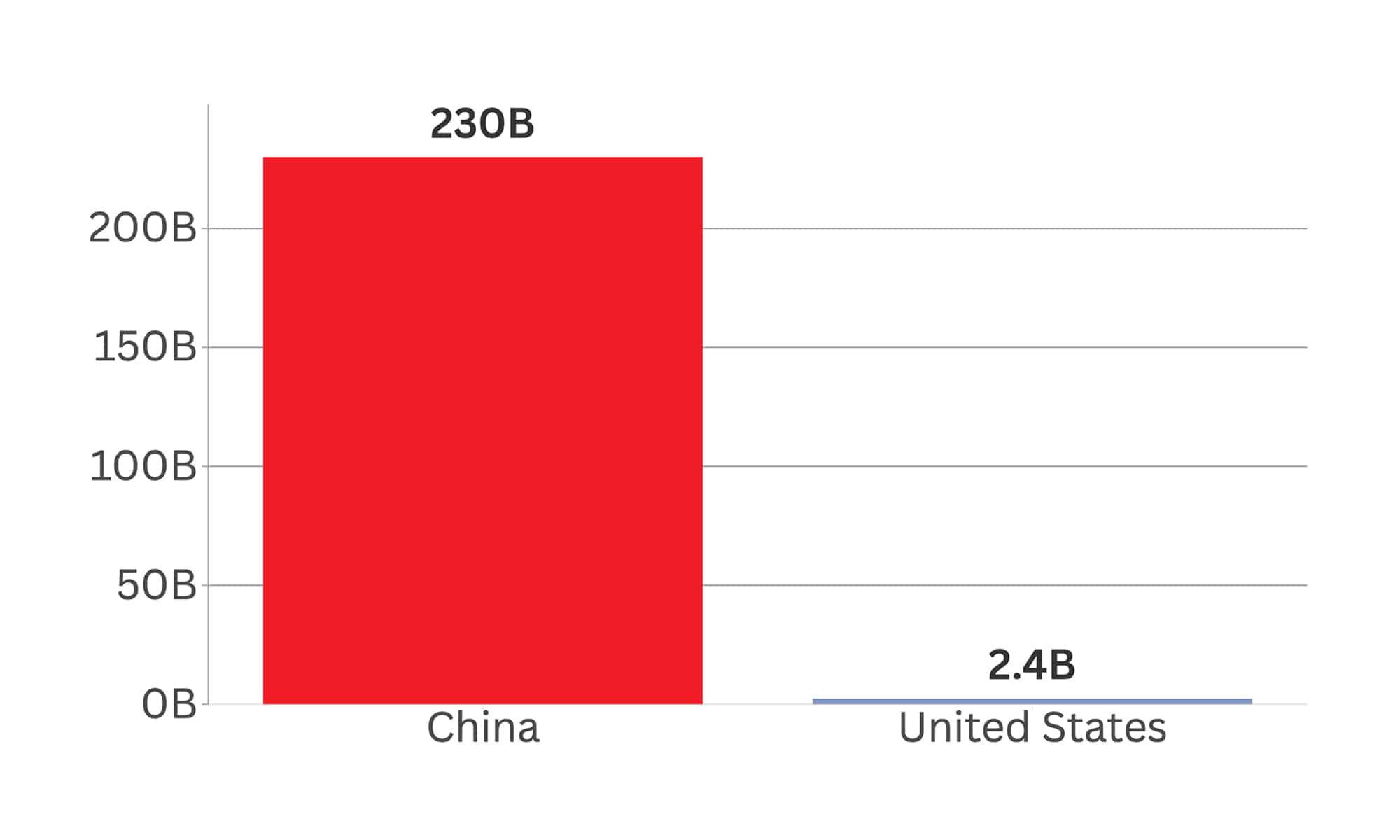
Graph comparing the amount in subsidies given by China and the United States to their respective EV and battery industries in billions of dollars. Source: Center for Strategic and International Studies, “The Chinese EVE Dilemma: Subsidized Yet Striking,” 2024; Obama White House, “President Obama Announces $2.4 Billion in Funding to Support Next Generation Electric Vehicles,” 2009.
On the manufacturing side, Beijing’s subsidies include tax exemptions, manufacturing grants, and low-interest loans aimed at reducing production costs, thereby increasing output.186 Consumer subsidies focus on direct cash rebates, registration fee waivers, and support for state and local electric fleet adoption, making EVs more affordable and accessible for buyers.187 These subsidies fundamentally contribute to overproduction as domestic manufacturers seek to take advantage of government incentives absent market demand signals.188 As a result, Chinese EVs on the market in third countries are frequently being sold at “artificially low” prices that are “distorting” markets, according to European Commission President Ursula von der Leyen.189 Fundamentally concerned with profit and fiduciary obligations to their shareholders, Western manufacturers cannot compete effectively for market share with Chinese competitors — even in their home markets. While not all subsidies are inherently problematic, the scale of Beijing’s subsidies and the goal of encouraging dependence on Chinese supply chains pose a threat to the proper functioning of markets and, ultimately, national security.
Subsidy Types
Manufacturer Subsidies:
- Tax Exemptions
- Manufacturing Grants
- Low-Interest Loans
- Development and Manufacturing Prizes
- Sales Rewards
Consumer Subsidies:
- Direct Cash Rebates
- Registration Fee Waivers
- State and Local Electric Fleet Adoption
There are some indications that Beijing recognizes the risk it assumes by propping up an entire industry. In January 2024, Chinese Vice Minister of Industry and Information Technology Xin Guobin said that there was “insufficient” external consumer demand in the EV industry and that Beijing would take “forceful measures” to address “blind” construction of new EV projects.190 Yet overproduction continues to occur throughout the Chinese economy as the CCP uses its export machine to artificially boost growth numbers for its flagging economy.191 This excess capacity directly contributes to dumping into export markets at heavily discounted prices, damaging international competitors or pushing them out of the market altogether. (See Dumping section.)
Monopolies
China has given the green light for Chinese companies to monopolize key inputs into the advanced battery supply chain across all mining, processing, component, and end-use stages. The concentration of economic power from these monopolies (or, for finance nerds, these “monopsonies”192) allows China to control competitors’ access to key inputs and set prices in ways that harm non-Chinese entrants into the market.
China, for instance, collectively controls 95 percent of the world’s battery-grade graphite,193 monopolizing the supply of a mineral essential for the vast majority of battery anodes. In 2023, China produced approximately 1.23 million metric tons of graphite, marking a 50 percent increase from 2021.194 Nevertheless, China introduced export restrictions on graphite products in late 2023 and again in 2024,195 allowing Beijing to manipulate global markets by tightening supply. The combination of these two actions led to a spike in graphite prices.196 Foreign companies frequently find themselves unable to compete on equal footing due to Chinese control over such inputs, adding to the challenge of compensating for the economies of scale that monopoly conditions provide to Chinese companies.
Despite a seeming proliferation of Chinese companies involved in mining and processing critical minerals, manufacturing components, and building batteries and cars, these firms are not true market competitors. Instead, they are better viewed as numerous subsidiaries of “CCP, Inc.”197 China lacks a clear division between the private and public sectors, and the Chinese Communist Party directs the actions of these private organizations to an extent that would be unlawful on antitrust grounds in any market economy. As a result, Beijing can align the private sector players into a cartel that wields monopoly power against foreign rivals.
Vertical Integration
Within Chinese battery supply chains, single companies often act as supplier, refiner, component assembler, and final manufacturer. Pushed forward by muscular state-led industrial policy and blurred lines between the private and public sectors, Chinese companies can collectively consolidate different portions of the supply chain in ways that market players frequently cannot because of regulatory or economic constraints. This gives those companies outsized influence against competitors and, conversely, insulation against market pressures to which competitors are subject. As the line between the state and private sector is blurred, it also gives the industrial ecosystem that codevelops198 among Chinese industrial champions an ability to boost scale in ways that market players cannot replicate.
BYD’s Vertical Integration
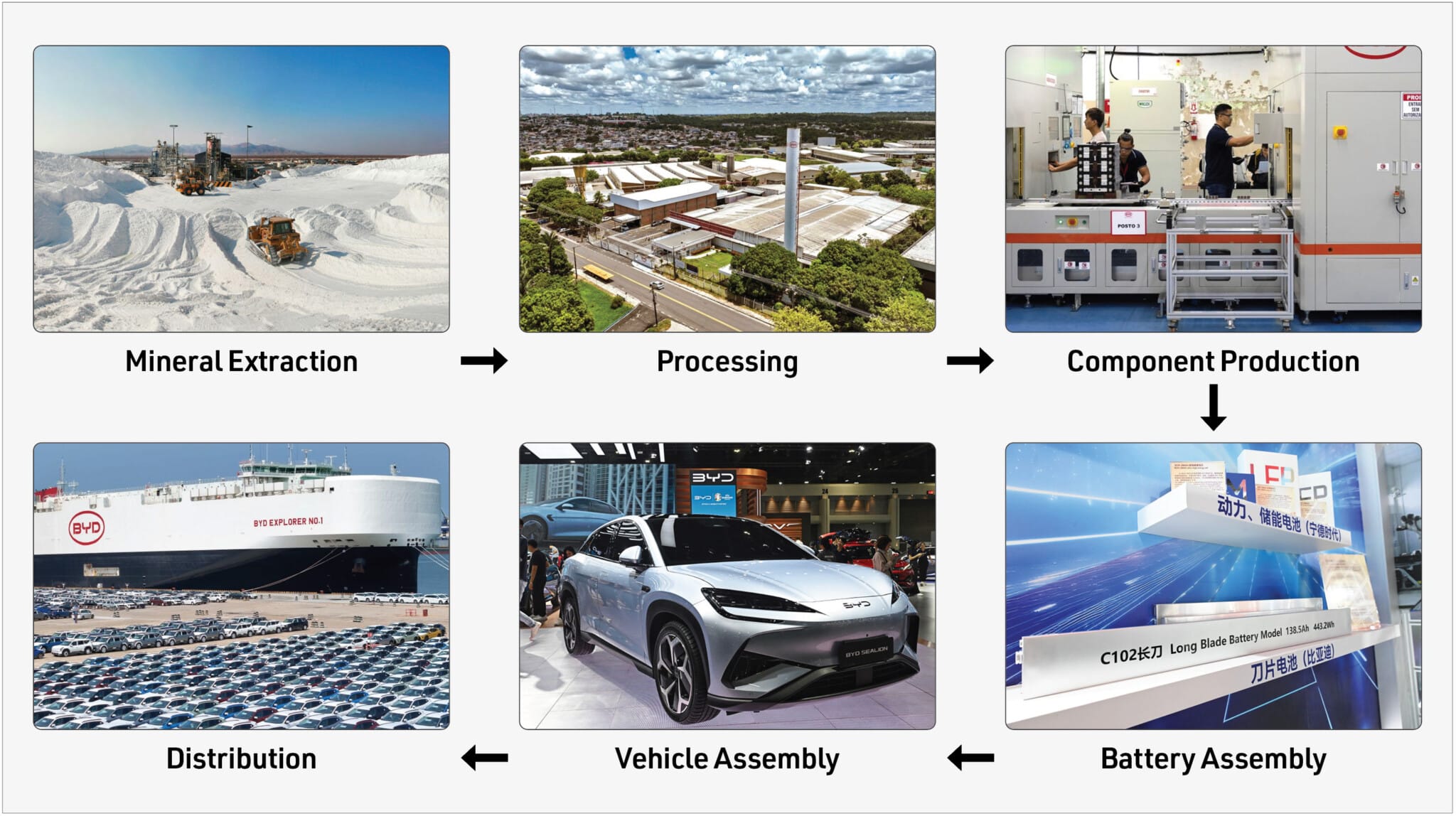
Flow chart depicting BYD’s vertical control of several stages of EV. Source: FDD. Pictures from Getty Images.
As one example of this, China’s BYD controls its own supply chain from mineral extraction to complete vehicle assembly. In January 2022, BYD secured a contract with Chile’s Ministry of Mining that grants BYD the rights to extract up to 80,000 metric tons of lithium over a 20-year period.199 Independently, BYD has set up processing facilities in Guangxi, China, to refine spodumene into lithium carbonate, as well as making other cathode active materials, such as iron phosphate.200 BYD also controls all facets of battery assembly — BYD assembles its Blade Batteries at its cornerstone Chongquing factory before putting them into cars in BYD factories in China, the United States, Brazil, Thailand, Indonesia, Canada, and Uzbekistan.201 This control, including extraction, straight-through processing, componentry production, assembly, and distribution, insulates BYD from chokepoints in its supply chain, creating a level of integration that market players would have difficulty replicating. (Tesla is largely an exception in this regard.202)
Market economies thrive on decentralization, competition, and open access to resources — factors that are threatened by aggressive vertical integration when combined with monopolies. Moreover, the private sector’s focus on returns in market economies leads to natural fragmentation, while China’s prioritization of national economic growth and the state’s incentivization of production over profits contributes to companies seeking to expand into adjacent industries.
This difference in economic structure leads to systemic advantages for China. By controlling all supply chain inputs, BYD has distinct advantages over competitors who must secure sufficient inputs from limited suppliers under volatile pricing conditions. Across the supply chain, one often sees minerals extracted at Chinese mines, processed at Chinese facilities, transported by Chinese rail to Chinese ships at Chinese-operated docks, sent to Chinese battery manufacturers, and then installed in Chinese cars. When combined with Beijing’s other non-market manipulations, this level of control makes competition from non-Chinese companies nearly impossible.
Price Manipulation
Given the degree of monopoly power that China possesses, it is not surprising that China can, and does, manipulate prices in ways that protect domestic industry champions while strategically boxing out market competitors. Indeed, China has weaponized price volatility both because of its monopoly power and to sustain its monopoly power.
China’s Tsingshan Holding Group is one of the world’s largest nickel producers,203 with massive factories in Indonesia that process the local nickel ore into minerals suitable for batteries and stainless steel. In 2019, Indonesia — the world’s largest nickel-producing country — instituted a ban on the export of unprocessed nickel ore and put it into effect just a month after Indonesian President Joko Widodo had met with the CEO of Tsingshan and the heads of Chinese companies Huayou Cobalt and CATL — the world’s largest cobalt and battery manufacturing firms, respectively.204 A source indicated that the Chinese delegation had “lobbied very intensely [for Indonesia] to completely ban exports.”205 Such a ban would be a boon to China, as Chinese companies control roughly 75 percent of Indonesia’s nickel refining capacity.206 Since Tsingshan processed its ore within Indonesia, the ban affected only non-Chinese competitors that lacked Indonesian refining capacity.207 Thus, Tsingshan could continue to supply China’s voracious battery and steel industries. Yet foreign battery and steelmakers would feel the pinch of a substantially restricted supply of nickel ore.
In theory, international stockpiles — most notably, the large nickel inventory at the London Metals Exchange (LME) — are supposed to cushion the impact of supply disruptions. Curiously, however, on the eve of the Indonesian announcement of the ban, an unknown party had begun buying up nickel inventory from the LME at a furious pace. The purchases were made using over-the-counter (OTC) trades that hid the identity of the purchaser from the LME.208 This $1.8 billion buying spree took 25,000 tons of nickel off the market immediately — the largest withdrawal in the four-decade history of nickel at the LME — and snapped up futures on another 75,000 tons.209 Once the dust had settled, the primary nickel purchaser came forward — Tsingshan Holding Group.210 Estimates are they may have bought as much as 80 percent of the haul.211
As soon as the 2019 Indonesian nickel ore ban went into effect, Tsingshan’s competitors took a massive hit. Outokumpu, a Finnish steel producer heavily reliant on nickel, saw earnings drop by nearly 50 percent because of the high prices.212 Then Sen. Mitt Romney (R-UT) saw the market manipulations and lamented: “Another near-monopoly is born, thanks to [China’s] anti-competitive tactics.”213
It would not be the last time Tsingshan substantially altered nickel prices via the LME. In 2022, large Tsingshan OTC purchases led nickel prices to surge nearly 400 percent in three days,214 causing the LME to take the unprecedented step of canceling $12 billion worth of trades.215
China’s control of lithium supplies allows Beijing even greater power to set prices than in the case of nickel. The pricing mechanism for lithium markets is deeply flawed because global prices for both the underlying commodity and derivative futures depend on prices set by China, not market transactions.
The Chicago Mercantile Exchange, for instance, bases its price for lithium derivatives on Chinese pricing as relayed by the Fastmarket pricing feed.216 LME also relies on prices relayed by Fastmarket.217 Those Fastmarket prices reflect pricing information that Beijing directs state-controlled Chinese mining, shipping, and processing companies to share.218 The prices are not based on any underlying contracts — all of which remain confidential and opaque regarding actual price. As a result, China can set global lithium prices by fiat, and non-Chinese companies have no visibility into the pricing mechanisms.
Lithium prices have fluctuated wildly over the past decade, tracing a path that follows Chinese interests. When demand for lithium batteries spiked in 2021 due to subsidies introduced by the Biden administration’s Inflation Reduction Act, supply became scarce. Chinese producers Ganfeng Lithium and Tianqi Lithium reduced their supply of processed battery-grade lithium and prioritized deliveries to Chinese battery manufacturers with long-term contracts like BYD and CATL. In the months that followed, the price of lithium carbonate rose tenfold from $7,000 per metric ton in January 2021 to over $75,000 per metric ton by the fourth quarter of 2022, harming U.S. battery makers.219
On the flip side, low prices and China-driven volatility undermine non-Chinese efforts to raise funds for capital-intensive processing facilities that would increase the supply of processed lithium and dilute Beijing’s control. After hitting record highs that boosted Chinese automakers at the expense of rivals, Chinese firms then drove lithium prices to record lows, with battery manufacturers like CATL starting up mining operations to “dramatically” reduce the price of lithium, according to CATL founder Robin Zeng.220 This has squeezed non-Chinese lithium producers. According to American mining giant, Albemarle, as of May 2025, around 40 percent of all global lithium projects are at or below the threshold for profitability at current prices, with one-third of the global capacity having been pulled offline.221 Chris Ellison, the managing director of western Australian mining company Mineral Resources, suggests the situation is even worse, stating, “no one is making money in this market … let’s be really, really clear on that, there’s no lithium companies making money.”222 The resulting delays, cancellations, and idling of unprofitable projects is occurring at the very time that new projects should be ramping up to address a lithium supply that will need to double by 2030 to meet anticipated demand, according to Albemarle.223
Price Volatility in Global Cobalt, Lithium, and Nickel Markets (2015-2024)
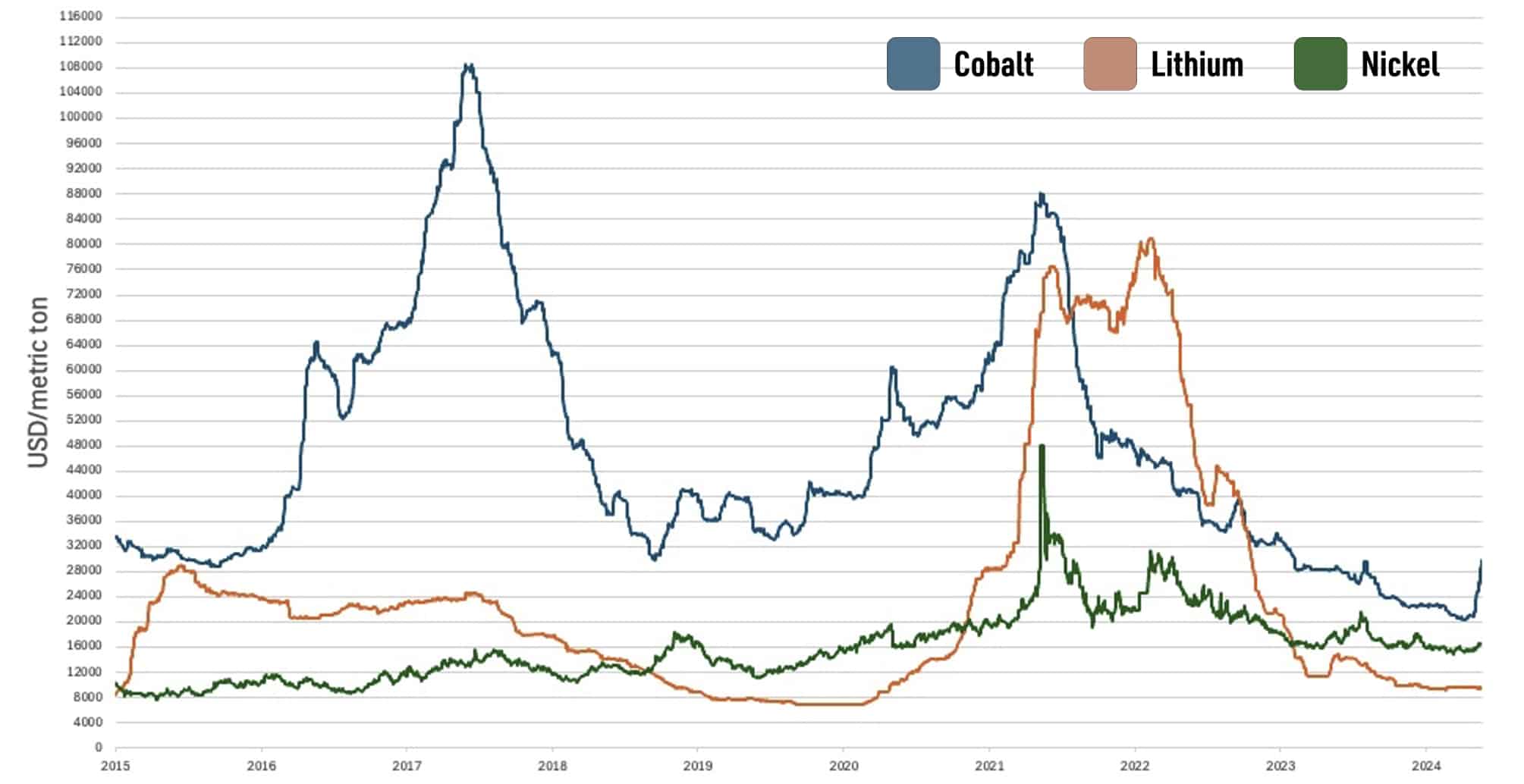
Graph of the prices for cobalt, lithium, and nickel from 2015 to 2024 in dollars per metric ton. Source: MetalMiner Insights (https://agmetalminer.com).
The uncertain returns from a market with low or unstable lithium prices render such investments less attractive, particularly since processing facilities can take as long as a decade to build. In 2018, for instance, Canadian firm Nemaska Lithium announced plans to operate the largest spodumene deposit in North America, attracting around $1 billion from funders like SoftBank224 and Investissement Québec.225 Shortly thereafter, global lithium prices fell by more than 60 percent.226 This price collapse heavily affected Nemaska’s financial projections, and the project closed. Absent an independent, non-Chinese pricing mechanism for lithium, China can comfortably drive competitors out of the market at will.227
Dumping
China is making way too much of everything. This is particularly true of sectors that the government is prioritizing, like EVs and batteries. This year, China is likely to make more than twice the total global demand for EVs last year. For 2025, Chinese sources indicate that the country is on pace to manufacture more than 36 million new EVs in 2025228 despite only 17 million EVs being sold worldwide last year and anticipated global demand of just 20 million electric cars in 2025.229 Western sources suggest 2025 production may reach only 25 million — still far more than global demand.230
This overproduction was not merely a market quirk created by overzealous manufacturers but rather an anticipated consequence of intentional government policy. As early as 2021, Chinese analysts were anticipating massive overproduction from China’s 14th Five-Year Plan, which mandated the production of seven times more EVs than expected domestic demand for 2025, as projected by the Ministry of Public Security.231
This wild distortion of market dynamics derives from China’s artificial approach to manufacturing growth. In China, GDP growth figures are not simply reflections of past economic activity. Rather, Beijing announces growth targets a year in advance and the municipal governments establish parameters and incentives that ensure those targets are met. Chinese companies adjust their behavior accordingly.
For 2024, the GDP growth target was set at 5 percent. (China has also announced a target of “around 5 percent” for 2025.)232 For Chinese companies, that means that the government is expecting them to produce an average of 5 percent more goods than the previous year, irrespective of demand. By delinking production objectives (that is, Chinese supply) from actual demand and putting pressure on Chinese producers to always be supplying more, China ends up making too much of just about everything, depressing global prices.
Beijing cannot absorb this oversupply at home because it has kept its own consumer market undeveloped by design. As the former present of the EU Chamber of Commerce in China has explained: “Overcapacity is the result of domestic policy choices that have led to the rapid, often economically nonviable, expansion of investment and production. This cycle has been sustained by China’s local governments, which have long been incentivized to expand investment and production over all else. These incentives have been compounded by fears of the widespread unemployment that might result from taking production offline.”233 Building a true consumer economy would require giving consumers more economic power and would necessitate shifting power away from the CCP234 — a trade that party leaders are unwilling to make.
The combination of China’s weak domestic consumer demand and state-mandated oversupply of goods means that enormous amounts of goods must be sent overseas, flooding international markets with cheap products — sometimes even at prices that are below the production cost, a practice known as “dumping.” By selling at or below cost, Chinese companies often drive local producers outside China out of business, creating dependence on Chinese imports and potentially inflicting long-term damage on local economies. Many scholars refer to the sharp increase in Chinese imports to the United States in the early 2000s as the “China Shock”235 and hold it responsible for the majority of jobs lost in that period in the U.S. manufacturing sector.236
Around the world, countries have opened investigations into Chinese dumping practices and are trying to construct trade barriers to combat it. This pushback extends well beyond cars and batteries to steel, aluminum, solar panels, shipbuilding, cement, paper, glass, fertilizers, chemicals, footwear, frozen warmwater shrimp, and more.237 The United States, the European Union, India, Argentina, Turkey, Mexico, Australia, Canada, Japan, and South Korea have all launched investigations.238 Even countries friendly to China, such as Brazil, Vietnam, and South Africa, are pushing back.239 From 1995 to 2022, China was the subject of 1,565 anti-dumping investigations, nearly one-quarter of all such investigations initiated by WTO members.240 That represents more than three times the number of investigations initiated against the second-most investigated country, South Korea.241 In 2024, China accounted for nearly half of all of the global dumping investigations.242 Facing artificially low prices, importing nations have ample reason to put tariffs on Chinese goods, forcing their prices up to economically sustainable levels.
WTO Members by Number of Anti-Dumping Investigations (1995-2022)
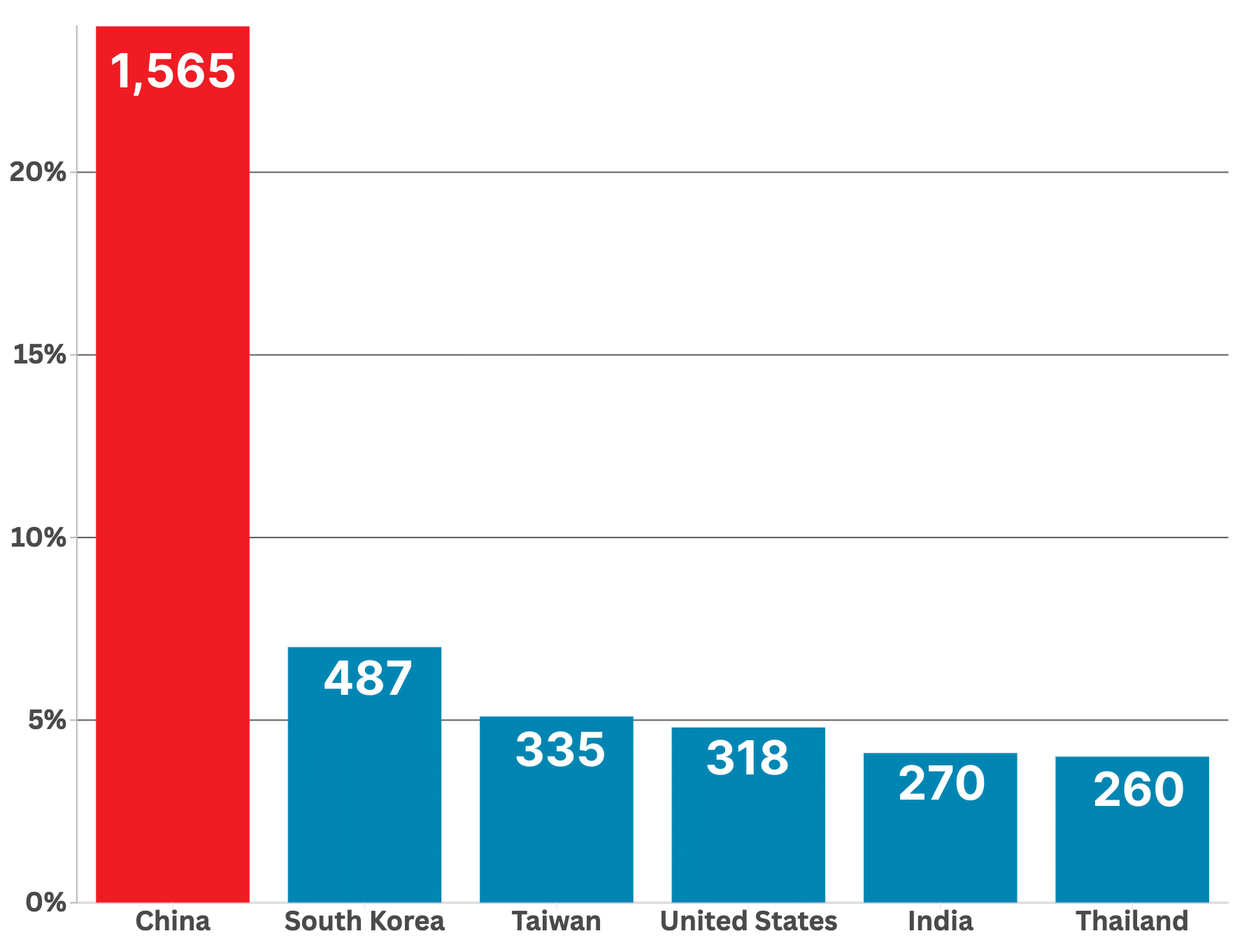
Graph depicting the countries facing the most anti-dumping investigations under the World Trade Organization, along with the total number of anti-dumping investigations from 1995 to 2022. Source: Vietnam National Trade Repository, “Anti-Dumping Investigations Are Strongly Initiated by Many Countries,” 2025.
Knowledge Transfer
China has used its economic weight to extract technology and intellectual property from Western companies, avoiding costly and time-consuming investments in research and development.243 Beijing’s “Made in China 2025” initiative, which seeks to reduce dependence on foreign manufacturers by developing domestic alternatives, is a major driver of this practice — pushing Chinese companies to coopt foreign tech by both legal and illegal means.244
As the Office of the U.S. Trade Representative (USTR) has put it, “China’s regime of technology regulations forced U.S. companies seeking to license technologies to Chinese entities to do so on non-market-based terms that favor Chinese recipients.”245 USTR also concluded that China uses the acquired technology to develop new domestic champions that drive out Western competition.246 The Trump administration’s America First Investment Policy explains the practice:
Certain foreign adversaries, including the People’s Republic of China (PRC), systematically direct and facilitate investment in United States companies and assets to obtain cutting-edge technologies, intellectual property, and leverage in strategic industries. The PRC pursues these strategies in diverse ways, both visible and concealed, and often through partner companies or investment funds in third countries.247
Often, foreign companies seeking to do business in China have been explicitly or tacitly required to form joint ventures with local partners. On the surface, this arrangement appeared mutually beneficial: Foreign firms gained access to local expertise to navigate China’s notoriously complex market and byzantine bureaucracy,248 while China’s economy received a boost249 and its firms received a share of the profits. In practice, these joint ventures have largely served as a conduit for transferring proprietary knowledge and technology from foreign companies to domestic firms.250
With expertise and intellectual property acquired from foreign firms, Chinese companies often develop independent production capabilities, eventually dominating the domestic — and, in many cases, international — markets, often displacing the very partners from whom they had obtained the technology.251 The case of wind turbines illustrates this point. Xinjiang Goldwind Science and Technology Co. (Goldwind) is the largest wind turbine supplier in the world.252 Between 1989 and 2001, Goldwind partnered with three European wind-turbine manufacturers — Bonus Energy A/S, Jacobs Energie GmbH, and Repower Systems AG — all of which transferred their proprietary technology to Goldwind in compliance with Chinese law.253
Between 2005 and 2023, China’s total cumulative wind power capacity surged from just 1.26 GW254 to 474.6 GW,255 an increase from 2 percent to 45 percent of global capacity.256 This staggering [DR1] increase in global share was driven by China rapidly seizing the lead in global wind turbine production. Chinese companies contributed 65 percent of total new wind turbine manufacturing in 2023.257 Goldwind was the leading wind turbine manufacturer that year, producing 16.3 GW of new capacity.258
Mandatory technology transfer and related practices may collectively cost foreign competitors upward of $600 billion per year.259 This is both parasitic and unsustainable, as it undermines the incentives for foreign firms to invest both in China and in R&D out of fear that their proprietary tech will be handed over to competitors without adequate legal recourse or protection.
Intellectual Property Theft
Despite its dominant position across the supply chain, Beijing also resorts to state-sanctioned commercial spying and outright theft to reinforce its advantages. It is impossible to get clear data on how widespread this practice is, but the record of federal prosecutions suggests it may be a well-entrenched practice endorsed by the CCP since “80 percent of all economic espionage prosecutions brought by the U.S. Department of Justice (DOJ) allege conduct that would benefit the Chinese state,” according to DOJ.260 U.S. companies have also filed more than a thousand lawsuits against Chinese firms alleging IP theft, and of the 224 publicly reported Chinese espionage incidents inside the United States, the majority were aimed at acquiring commercial technology.261
The battery supply chain is clearly among the targets of espionage. In June 2024, for instance, an individual pled guilty in U.S. federal court to conspiring to steal trade secrets from Tesla to benefit a China-based business specializing in battery technology for electric vehicles.262 In 2022, a former Apple engineer pleaded guilty to stealing trade secrets from Apple’s autonomous vehicle project.263 In 2019, a Chinese scientist pled guilty to stealing IP valued at more than $1 billion from Phillips 66 Petroleum Company relating to next-generation battery and energy storage solutions. The theft sought to benefit China’s state-owned Xiamen Tungsten Co., which focuses on battery-related metals research.264
The impact of IP theft goes beyond immediate financial losses for affected companies. It disrupts the incentive structure of a competitive market. Companies that know their intellectual assets may be stolen without repercussion are less likely to invest heavily in breakthrough technologies, less likely to enter otherwise important foreign markets, and less likely to hire potentially beneficial foreign employees. This manipulates the development of a genuinely innovative and competitive global battery industry, creating an uneven playing field in which Chinese firms dominate at the expense of rule-abiding competitors.
Policy Recommendations
Supporters of the free market need not accept China’s non-market, parasitic practices. China depends on America in a way that America does not depend on China, from its reliance on America’s security guarantee for global shipping to investing in American financial assets as a stable store of value. If China continues to harm the American-led global economy, Beijing should find itself on the outside of it, looking in.
If Beijing wants to maintain access to U.S. and allied markets, it must play by market rules: stop dumping heavily subsidized goods on foreign markets, enforce the property rights — especially intellectual property rights — of foreign companies and individuals, sharply curtail corporate subsidies, require greater transparency from Chinese firms, and stop manipulating its currency while restraining the free flow of capital. China must make structural reforms to reverse the suppression of consumer spending and wages. Beijing also needs to create a clear separation between its public and private sectors, to include measures that prevent cartel-like behavior, monopolization, and other anti-competitive practices. Lastly, Beijing must repeal its National Intelligence Law, which effectively requires Chinese companies to cooperate with espionage operations.
While U.S. economic security fundamentally depends on countering China’s non-market practices, much additional work is necessary to create resilient supply chains. Now is the time for Washington to show how the United States and other market economies can use the power of our markets to defend our markets. If necessary, the United States should take the lead in forming a “near-global economy” that creates low trade barriers between market players but erects high trade walls against non-market manipulators.
This free-trade fortress against non-market players should begin in North America, with a renewed United States-Mexico-Canada Agreement (USMCA) that closes the door on China’s parasitic practices and imposes restrictions on Chinese companies operating within the trade zone. The United States should also impress upon other nations in Latin America, Asia/Oceania (particularly, India, Japan, South Korea, Taiwan, Philippines, and Australia), and Europe that their survival as free economies is at stake.
While tough negotiations will be necessary to ensure China changes its behavior, the United States should take six sets of actions now to strengthen its advanced battery and critical mineral supply chain resilience and reduce dependencies.
1. Step Up Extraction of Critical Minerals
The Trump administration’s March 2025 executive order for “Immediate Measures to Increase American Mineral Production”265 recognizes the need to bring more mining and processing assets online. It takes steps to support domestic mining and processing projects by seeking to reduce regulatory bottlenecks, boost public and private financial support, and establish potential offtake and purchase agreements with federal agencies. These are important steps, but there is more that could be done.
- Incentivize Private Investment: Private capital has been hesitant to invest in long-term, capital-intensive domestic mining projects due to volatile prices, heavily subsidized Chinese competition, political headwinds for key technologies, and uncertain returns.
- To address this, the U.S. government should promote investment through matching funds with equity stakes, low lease rates for public land, public sector-backed risk insurance, and pricing mechanisms independent of Chinese influence.
- Revisions to Bureau of Land Management and U.S. Forest Service land use regulations, leases, and permits could allow for private mineral extraction on public lands.
- Streamline Permitting and Regulations: Permitting and environmental regulations are critical, improving projects and making them safer for American workers and communities, but inefficient bureaucratic steps can be eliminated or consolidated without sacrificing oversight.
- The executive branch should consolidate permitting and environmental regulations into a single process that simultaneously addresses federal, state, and local concerns, leveraging the FAST-41 process that Congress created in 2015.266
- Congress should establish a pilot program that provides new litigation rules under the Administrative Procedure Act or a new statute to (a) limit the initiation of lawsuits challenging new projects to between 90 and 180 days post permit filing, (b) expedite such cases via a “rocket docket,” (c) and process lawsuits in a statutorily approved uniform federal venue.
- Congress should amend the Defense Production Act to establish federally supported, industry-funded environmental risk insurance for new mining projects.
- Congress should provide funds to surge resources for rapid agency permitting initiatives.
- Permitting agencies should implement “approval sharing” for similar projects in the same region.
- The U.S. Department of the Interior should proactively conduct preliminary federal environmental assessments of known critical mineral reserves to build a fast-tracked project pipeline.
- New laws and regulations should prioritize environmentally low-impact technologies, enhanced permitting transparency, and early and continuous community engagement to minimize obstacles and mitigate potential hazards.
- Establish a Critical Minerals Stockpile: Congress should authorize the creation of a critical minerals stockpile, amending the Strategic and Critical Materials Stock Piling Act to support both civil and military needs. This stockpile would backstop industry against global shocks and Chinese export constraints, provide offtake guarantees to incentivize domestic projects, and help establish stable, non-Chinese pricing mechanisms.
- Develop Talent Pipelines: Federal and state funds, prioritized through the Workforce Innovation and Opportunity Act, could support training programs at trade schools, community colleges, and state schools to develop skilled workers, including heavy machinery operators, engineers, geologists, and others needed to sustain a world-leading mining and processing industry.
- Create Special Economic Zones: The executive branch should establish special economic zones around known critical mineral reserves, leveraging Opportunity Zones and Accelerated Cost Recovery System provisions within the tax code. These zones could take advantage of colocation synergies around large reserves, such as the Salton Sea, and could feature pre-vetted environmental analysis and rigorous safety protocols to localize mining, on-site processing, downstream fabrication, energy, and water needs for all related infrastructure.
- Critical requirements for mineral processing and battery manufacturing — including energy, power transmission lines, water, chemical inputs, rail, road, and ports — should be mapped to determine ideal locations for such special economic zones.
- Build Infrastructure: The executive branch should develop transportation and energy infrastructure near major critical mineral deposits, prioritizing projects through agency directives or supplemental appropriations aligned with recent executive orders.267
2. Counter China’s Processing Chokehold
There is an urgent need for non-Chinese processing capacity across key mineral supply chains. Developing greater refining capacities in extracting countries (such as Argentina and Chile) and with partner countries (such as Canada or Mexico) should be paired with processing investments in end-product countries, like the United States.
- Develop Non-Chinese Processing Techniques: The executive branch should subsidize R&D for cleaner, more efficient processing techniques to reduce reliance on Chinese intellectual property.
- Support U.S. Processing Capacity: To facilitate domestic processing, it will be necessary to provide limited economic support, tax incentives, subsidies, or guarantees to protect against price volatility.
- Congress should fully reinstate the Section 45X Advanced Manufacturing Production Tax Credit to support domestic critical mineral processing efforts.268
- Federal authorities should assist with sourcing non-Chinese inputs of raw materials from allied countries to act as feedstock for U.S.-based processing efforts until North American raw materials can be obtained.
- The executive branch should make current Superfund locations and select public land, such as idle areas on military facilities, available for domestic refining sites.
- The executive branch should incentivize the domestic or allied manufacture of essential equipment and chemical inputs (including caustic soda, sulfuric acid, and ammonia) necessary for domestic mineral processing.
- Support Allied Processing Capacity: The U.S. Development Finance Corporation (DFC) and other executive branch entities should assist in establishing mining efforts in allied nations, such as Argentina (lithium and copper); Ukraine (lithium, graphite, manganese, and nickel); the Philippines (nickel, copper, and cobalt); and the Democratic Republic of the Congo (cobalt and copper).
- DFC financing should be conditioned on the unwinding of Chinese investments, supply chains, and debt entanglement.
- Support should include financing for new processing facilities, knowledge transfer, investment for infrastructure and energy, transparency tools to ensure non-compromised supply chains, and logistical support to bring refined minerals to market without reliance on China.
- The United States should partner with Mexico to exploit and process its abundant clay-based lithium reserves and to assist with establishing North American processing for a wide range of critical minerals.
- The DFC should work with Congress and the Office of Management and Budget to reform its equity scoring model. Current rules treat equity investments as total losses against DFC’s budget, discouraging DFC equity investments in capital-intensive processing projects. A risk-adjusted model, like those used by other development finance institutions, would unlock significantly more capital.
- DFC should expand the use of its political risk insurance program for U.S. offtake projects, especially for new or non-investment-grade suppliers. U.S. buyers need credit insurance to reduce exposure in long-term offtake agreements. DFC political risk insurance has proven effective in other contexts and should be applied to processing and offtake deals more broadly.
- The U.S. Export-Import Bank (EXIM) should work with Congress to raise its 3 percent default cap for strategic mineral deals. The cap, which limits the percentage of financing that can enter default EXIM-wide, discourages the long-term risk-taking required for critical mineral investments and offtake agreements, which, by their nature, involve substantial risk.
- The U.S. Department of Defense’s Office of Strategic Capital (OSC) now has $5 billion in lending authority. However, due to the government-wide hiring freeze, it lacks the staffing capacity to provide loans in allied countries. The administration should unfreeze hiring at OSC. Once that is done, Congress and the Defense Department should add authorities to allow OSC to issue risk insurance or first-loss guarantees, enabling new partnerships with private lenders and international development finance institutions.
3. Innovate and Scale Battery Technology
Emerging technologies offer opportunities to disrupt China’s supply chain dominance. And yet, despite numerous promising battery types, Western firms have struggled to develop solutions at scale and frequently trail China’s R&D investments by orders of magnitude. Public sector and industry-supported incubators should amplify private sector investments in research and development while providing support for scaling to avoid the startup “valley of death.”
- Foster Private Sector Collaboration: The executive branch should encourage technology collaboration and shared cost models to de-risk market entry for smaller innovators.
- The executive branch should provide public sector financing under such authorities as the America COMPETES Act, the Energy Policy Act, or the CHIPS Act to offset collaborative R&D costs.
- The executive branch should pursue antitrust exemptions for technical cooperation and pricing of shared innovations.
- The executive branch should establish industry-wide standards for interchangeable inputs and flexible manufacturing processes.
- The executive branch should offer publicly owned modular scaling facilities for lease, with customizable assembly-line orientations to test commercial viability.
- The executive branch should fund scientific and technical academic research in battery science, with grants conditioned on no-cost or low-cost licensing of resulting technology to U.S. companies.
- Expand Federal Support for Innovation: The federal government should offer targeted, time-limited subsidies for promising new technologies that reduce dependence on Chinese-dependent minerals or that improve mineral processing or recycling.
- Congress should amend the tax code to provide full cost recovery for R&D and equipment investment.
- Congress should develop mechanisms under the Defense Production Act for the U.S. government to acquire promising technology from bankrupt companies, such as providing the U.S. Department of Energy (DOE) with a right of first refusal to purchase subsidized intellectual property.
- Prioritize Safe and Clean Processes: The executive branch should offer prizes and public funding to incentivize the development of mineral processing and manufacturing technologies that can cost-effectively replace the highly polluting and dangerous techniques that China uses to lower costs and undercut high-quality American competitors.
- Leverage Research Consortiums: The executive branch should create public-private research consortiums, modeled on SEMATECH (created in 1987 to advance the semiconductor industry) with substantial U.S. and allied subsidies in exchange for no-cost licensing for consortium members and low-cost licensing for non-members from participating member countries.
4. Stabilize Prices for Key Inputs
Erratic market prices for critical minerals have deterred investment in new processing facilities, protecting China’s monopoly power and distorting market signals. Even worse, China often deliberately manipulates supplies and prices. Beijing can shock the market at will, discouraging competition, driving startups into bankruptcy, and pushing investor interest elsewhere.269 Stabilizing critical mineral prices is essential to fostering competition and diversifying supply chains.
- Develop New Non-Chinese Pricing Mechanisms: It is critical that stable and transparent pricing be established in an environment free from manipulation, off-the-books trading, excessive speculation, and attempts to corner the stocks of globally essential commodities. Non-Chinese pricing mechanisms are urgently needed.
- Congress should legislate the creation of a new critical minerals and metals exchange backed by physical assets and the U.S. strategic stockpile. This may require legislative changes under the Commodity Exchange Act and/or SEC regulatory changes for pricing transparency.
- The executive branch should work with existing exchanges to improve their pricing transparency and prevent sovereign manipulation.
- Guarantee Offtake: Government stakeholders (such as the Departments of Defense and Energy) should guarantee offtake for specific projects.
- Set Price Floors: The United States and its allies should align to set temporary price floors on selected minerals (notably, lithium, nickel, cobalt, and graphite) acquired from non-Chinese sources. The floors would apply as needed to government procurement, offtake agreements, defense contractors, and government-funded energy projects to incentivize further capital investments.
- As a first step, the Defense Logistics Agency (DLA) should revise its stockpiling procurement model. Instead of relying solely on lowest price bids, DLA could adopt a “minimum sustainable production cost” standard for critical minerals from allied nations over five to 10 years. Comparable approaches exist in U.S. energy and agriculture markets (e.g., Department of Agriculture-guaranteed pricing for biomass and DOE solar power purchasing agreement frameworks).
- Punish Market Manipulation: The executive branch should lead efforts to develop global regulations to impose consequences and penalties for market cornering.
- This could involve mechanisms for “graylisting” companies like Tsingshan Holding Group if they were to engage in price manipulation in the future and “blacklisting” repeat violators via U.S. and allied sanctions.
- The United States should lead efforts to enhance transparency in OTC trades and demand the disclosure of beneficial ownership information for all corporate entities engaging in global critical commodities trade.
- Impose Tariffs: The executive branch should impose new targeted tariffs, including under Section 232 of the Trade Expansion Act, on base materials, processed minerals, intermediate products (e.g., pCAM and CAM), and battery components sourced from China or from any company that includes substantial (more than 10 percent) Chinese ownership. This effort should be coordinated with governments in other key markets, including all of North America, as well as Europe, Australia, and East Asia.
5. Promote Transparency to Blunt China’s Non-Market Practices
Chinese dominance often depends upon illicit dealings — bribery, debt traps, forced labor, lopsided contractual terms, IP theft, and trade manipulation — that fundamentally depend upon secrecy and opacity to shield the actors from public scrutiny. Transparency is a powerful tool — not only for defending against Chinese manipulation of markets but also as a weapon that blunts the impact of covert Chinese statecraft. Laws and regulations that demand transparency for multinational supply chains — such as the Uyghur Forced Labor Prevention Act (UFLPA) — should be extended to a wider range of behavior to impose consequences on companies that hide behind Chinese opacity and ignore problematic and oftentimes criminal behavior by Chinese suppliers.
- Protect the USMCA Against China: The executive branch should demand stricter rules of origin for North American goods under a renewed USMCA and prevent China from taking advantage of the trade zone.
- The renewed USMCA should impose clearer and stricter North American content and labor requirements during the USMCA review and for all future free trade agreements.
- The renewed USMCA should use genetic tagging and other tracing tools to verify supply origin.
- The renewed USMCA should require Chinese companies with operations in North America to certify noncompliance with China’s National Intelligence Law270 to qualify for USMCA benefits.
- Enhance Disclosures: Congress should create a disclosure obligation for U.S.-listed companies to report investments by companies from select adversarial nations, including China, and disclose any information about those investments that might have national security or economic security implications, such as veto rights and board control.
- The executive branch should condition access to American markets upon the use of digital customs information and trade data transparency and verifiability, particularly with respect to China.
- Encourage Foreign Direct Investment Reviews: Washington should encourage emerging markets and U.S. trading partners to pass foreign direct investment laws, patterned after the protocols of the Committee on Foreign Investment in the United States (CFIUS), that review problematic investments and allow for the blocking or unwinding of harmful deals.
- Combat Forced Labor: Congress should amend the Tariff Act of 1930271 to require all large multinationals doing business in America to map and review their supply chain and address any instances of forced or child labor.
- Congress should introduce legislation authorizing private rights of action to give victims and civil society the right to sue companies that ignore known or disclosed instances of forced or child labor in their supply chains. Similar laws already exist in Germany,272 France,273 and other countries, so the additional regulatory and legal burden of a similar U.S. law would not be substantial.
- Unwind Bad China Deals and Debt: The United States should assist developing countries that agreed to coerced, one-sided, or bribery-tainted infrastructure or mineral deals with China, like the Democratic Republic of the Congo,274 to unwind those agreements or arbitrate them in an independent forum.
6. Allies and Partners Matter, a Lot
Ally-shoring is “the process of creating and deepening economic partnerships, supply chains, and co-production with economic allies of the United States — those who align with our values, strategic interests, and commitment to free markets.”275 Ally-shoring is a critical tool for supporting market-based economies and pushing back against Beijing. Modest ally-shoring efforts and “China plus one”276 policies have already been initiated by some multinationals like Apple, Black & Decker, and Microsoft.277 Yet to fully unlock the potential of ally-shoring, there is a need for firm leadership from Washington, greater alignment with core allies, and enthusiastic buy-in from the private sector. Fully realized, ally-shoring has the potential to: (1) diminish China’s influence in the global south; (2) provide a pro-capitalist pathway to equitable growth in emerging markets; and (3) move the global economy away from China’s orbit. It will take time to build new factories, develop necessary infrastructure, and create an ecosystem of supporting industries to feed into final manufacturing — which is exactly why we must prioritize ally-shoring immediately.
- Ally-Shore Critical Mineral Supply Chains: The United States should take the lead in securing commitments around subsidies, regulations, transparency, and necessary infrastructure to build complementary and diverse non-China supply chains.
- The Minerals Security Partnership278 could form the basis of such a system, but it must move from the discussion phase to concerted action. Congress should fully fund such mechanisms and demand that other partners similarly invest capital and capacities to fast-track non-Chinese mineral projects.
- To unlock private investment from market economies, this partnership should also have a role in de-risking projects via political risk insurance, assistance addressing regulatory issues, and targeted government equity stakes to allow investors to mitigate the exposure to heightened risk.
- Improve Allied Regulatory and Policy Alignment: The United States should lead efforts to coordinate market regulations and trade, investment, and sanctions policies with allies to constrain China’s manipulative non-market practices.
- Coordinating foreign direct investment reviews is necessary to prevent Beijing from exploiting inconsistent review processes.
- Outbound investment regulations should also be coordinated to limit the flow of Western capital supporting China’s non-market companies and state-owned enterprises.
- Allies should also agree to a tariff wall around their collective markets to prevent the dumping of Chinese minerals, chemical inputs, components, and final products.
- Invest in Emerging Market Allies: The United States should provide financial and technical assistance to bring new mines and processing capacities online for emerging market economies.
- The DFC should provide capital and take equity stakes in emerging market mineral operations while also financing the infrastructure necessary to support the extraction, processing, and shipment of minerals.
- Government experts should also work with local authorities to provide basic technical assistance to establish operations and train workers.
- Prioritize the Western Hemisphere: The Western Hemisphere has the potential to turn into a critical mineral processing and battery powerhouse. Washington should leverage key partners like Argentina, Chile, Canada, and Mexico.
- The United States should consider expanding favorable trade terms to select other nations in Latin America in exchange for critical minerals access, economic security and transparency commitments, and concrete steps to reduce exposure to China.
- DFC should prioritize infrastructure and energy projects in the Western Hemisphere to encourage greater regional trade and economic integration.
Conclusion
America can — and should — use its trade power to force the creation of a better system, starting with more secure, reliable, and fair supply chains for advanced batteries and the critical minerals that underlie them. That means investing in transparency for the benefit of free and market-based countries and supporting the private sector’s natural appetite for innovation with public assistance for scaling and project de-risking.
Advanced lithium batteries were invented in the United States.279 We were once the global leader in the production and processing of lithium.280 We once determined the economic rules of the global economy. We once demanded a free market built upon transparency and fairness.
Regaining our leadership is not an impossible task. It will take hard work, but hard work is what Americans do best. And we have every incentive to do the labor of strengthening our economic security. After all, our national security depends upon it.
List of Acronyms
AMG — Advanced Metallurgical Group
BYD — Build Your Dreams
CALB — China Aviation Lithium Battery
CAM — Cathode Active Material
CATL — Contemporary Amperex Technology Co., Limited
CCP — Chinese Communist Party
CFIUS — Committee on Foreign Investment in the United States
CME — Chicago Mercantile Exchange
DFC — U.S. Development Finance Corporation
DLA — Defense Logistics Agency
DLE — Direct Lithium Extraction
DLS — Direct Lithium Sorption
DOE — Department of Energy
DOJ — Department of Justice
ESS — Energy Storage System
EU — European Union
EV — Electric Vehicle
EXIM — Export-Import Bank of the United States
GDP — Gross Domestic Product
GM — General Motors
GW — Gigawatt
GWh — Gigawatt/hour
IP — Intellectual Property
LFP — Lithium Iron Phosphate
LME — London Metals Exchange
LMFP — Lithium Manganese Iron Phosphate
LMR — Lithium Manganese-Rich
NCA — Nickel Cobalt Aluminum Oxide
NMC — Nickel Manganese Cobalt Oxide
OSC — Office of Strategic Capital (Defense Department)
OTC — Over-the-Counter
pCAM — Pre-cathode Active Material
POSCO — Pohang Iron and Steel Company
PRC — People’s Republic of China
R&D — Research and Development
SEMATECH — Semiconductor Manufacturing Technology
SQM — Sociedad Química y Minera de Chile S.A.
UFLPA — Uyghur Forced Labor Prevention Act
USMCA — United States-Mexico-Canada Agreement
USTR — Office of the U.S. Trade Representative
WTO — World Trade Organization
