May 11, 2026 | Memo
Time to Stop the Music: How Terrorists Exploit Music Streaming Platforms
May 11, 2026 | Memo
Time to Stop the Music: How Terrorists Exploit Music Streaming Platforms
Executive Summary
A terrorist attack in New Orleans left 15 people dead and more than 30 wounded on January 1, 2025.1 The perpetrator was an American citizen inspired by ISIS. His online activity on Facebook and audio-sharing platform SoundCloud confirmed his affinity for the terrorist group — he had liked songs and posted his own audio content promoting extremist jihadi views.2
While audio-sharing sites generally attract less attention than social media and messaging services as an avenue for spreading terrorist ideology, these platforms are used by extremists to spread their messages globally. Favorable recommendation algorithms and the ease with which users can upload and repost audio content enable widespread dissemination of extremist rhetoric. The data show the extent of the self-radicalization threat — of the 16 mass-casualty Islamist-inspired attacks in the United States since 2006, social media radicalization played a role in half.3
Audio content platforms are attempting to address the problem, but terrorists continue to exploit them. There is a sizeable streaming ecosystem praising and promoting the terrorist activity of Hamas, the group responsible for the October 7 massacre in Israel. Tracks contain phrases like “Death to Israel” and “Death to America” and glorify murder and terrorism. The propagation of this content — some of which has millions of listens and hundreds of comments supporting jihadist narratives — contributes to the existing dangers of online radicalization.
This report details the contours of the ecosystem, its content, and the tactics it uses to evade SoundCloud’s content moderation. These tactics include the use of codewords to evade simple keyword searches — for example, replacing the “H” in Hamas with a 7 (7amas) to bypass keyword limitations. Both experienced listeners and terrorism experts are familiar with these codes, but the content moderation algorithm appears not to be. The problem is not unique to SoundCloud. A limited search of other popular streaming platforms, including Apple Music, Spotify, YouTube Music, Amazon Music, Tidal, Deezer, and Pandora, also revealed terrorist content. The problem is widespread.
This report provides a series of recommendations to audio-sharing platforms to improve their capabilities to stem the spread of extremist content. SoundCloud and its peers should improve their analysis of potentially violative content, leverage agentic AI to improve existing moderation models, and engage in community forums for cross-platform content removal. Additionally, law enforcement should investigate the creators and disseminators of terrorist content to identify potential courses of legal action.
Key Features Used To Spread Extremist Content
Extremist groups have long recognized the potential of social media sites — audio content in particular — to broaden their support base and spread their messages. Despite government action and international attention to this problem, extremist and terrorist content continues to proliferate on social media and audio content platforms like Facebook, X, YouTube, Spotify, and SoundCloud, among other sites.4 The recommendation algorithms used by social media and audio sharing platforms create favorable conditions for the spread of terrorist content.
The late Anwar al-Awlaki, leader of external operations for al-Qaeda, wrote in 2009 that a nasheed — a religious song without instrumentals — can be infused with extremist content and “spread so far it can reach an audience that you could not reach through a lecture or a book.” He emphasized that jihadist nasheeds are critical elements in forming a “jihadi culture.”5 Jonathan Pieslak, scholar of music theory and music’s intersection with extremism, notes that the internet has created an ecosystem for the spread of these songs. Websites provide links to download and disseminate content and create forums for users to exchange commentary that reinforces jihadist attitudes.6
Meanwhile, the business model of music streaming platforms like Spotify, Apple Music, and SoundCloud creates the means for extremists to reach new audiences. These platforms use algorithms and discoverability measures to recommend new songs and audio content (like podcasts) to users based on their listening history. This not only keeps listeners on the platform but also supports artists who are trying to reach new audiences. For extremists, such algorithms also help them find sympathetic listeners. A 2022 investigation by the Anti-Defamation League (ADL) into extremism on Spotify found that the site’s algorithm created custom playlists with white supremacist content for listeners who had not sought out the content but rather listened to songs in a similar musical genre.7
For two decades, governments and international bodies have raised the alarm about terrorist content online. In 2006, then FBI Director Robert Mueller first warned that individuals were “being ‘self-radicalized’ through the Internet.” 8 Five years later, Europol, the European Union’s central criminal intelligence agency, similarly warned that the rapid and far-reaching information exchange enabled by social media and the internet had become a tool for self-radicalization.9 A 2024 report by the U.S. Government Accountability Office reiterated that conditions on social media and gaming platforms have created a forum for extremists to recruit new members.10
While the U.S. government tends to avoid regulating social media content due to free speech concerns, U.S. allies are pushing companies to create more robust policies to take down extremist content. Australia’s eSafety commissioner, for example, has called for cooperation from social media companies in efforts to protect citizens from extremist content.11 EU regulations like the 2022 Digital Services Act (DSA) require yearly transparency reports from content platforms detailing their efforts to moderate illegal content on their platforms.12 The European Union also compiles data from organizations into the DSA Transparency Database, providing open access to statements of reason for content removals. However, these generally lack specificity regarding the type of content platforms have removed.13
Enforcement Is the Hard Part
SoundCloud prohibits and endeavors to remove content related to the glorification of extremism or terrorism. However, these policies do not appear to be having the desired effect, as shown by the continued presence of banned content on the platform.
In 2020, researchers at the Counter Extremism Project (CEP) released a report calling for the removal of several nasheeds containing ISIS content on SoundCloud.14 CEP identified tracks containing ISIS propaganda imagery with content in Arabic, French, German, and English. The same year, a Europol task force working in collaboration with SoundCloud flagged more than 1,100 songs and profiles containing jihadist content, including chants in multiple languages promoting violent extremist groups.15
Since then, SoundCloud has developed content moderation guidelines and systems to remove content related to the glorification of extremism or terrorism. SoundCloud’s community guidelines state that the company “strictly prohibit[s] the dissemination of terrorist content” and give examples of content the company will remove, including graphic images of real or dramatized violence, content inciting violence, comments supporting terrorist attacks, and endorsement of hate groups. The guidelines specifically state that Nazi and ISIS content is prohibited.16
SoundCloud uses both automated tools and human review to moderate its platform. The company partners with third-party vendors to develop and refine automated moderation tools that identify violative content, some of which these automated systems remove.17 Human moderators on SoundCloud’s Trust and Safety team and a contracted third-party team also evaluate content for compliance with SoundCloud’s terms. The team manually monitors and labels content violations to train the platform’s models to identify prohibited content.
SoundCloud also removes content based on user reports. Since 2018, SoundCloud has received progressively larger numbers of violation reports, from 106 in 2018 to more than 100,000 in 2025 across multiple categories.18 This growth can be partially attributed to the increase in traffic on the platform but is also a result of the introduction of easier reporting mechanisms.19
Since 2023, in line with EU regulations, SoundCloud has published annual transparency figures, which state that the company has removed a growing number of files for violating restrictions on terrorist content — from 15,766 removals in 2023 to 42,523 in 2025.20 In its 2025 report, SoundCloud explained that automated systems accounted for slightly more than half of its terrorist content removals. SoundCloud does not use automation to assess content that users report as violative. Rather, it reviews all user requests manually.
Additionally, SoundCloud partners with international groups to improve content moderation. The company works with Europol to prevent online radicalization and has historically participated in its “referral action day,” when partners across the European Union collaborate to identify terrorist and extremist audio content.21 In 2025, SoundCloud joined the Global Internet Forum to Counter Terrorism (GIFCT), an international group that coordinates cross-platform content removal.22 SoundCloud is also a member of BitKom, a digital industry association in Germany that engages with EU regulators on issues like the DSA.23
Despite these efforts, SoundCloud remains a particularly attractive platform for terrorist content. It is a self-described “artist-first, fan-powered platform where discovery starts early.”24 The company focuses on promoting up-and-coming artists to wide audiences. Accordingly, SoundCloud has one of the shortest content upload processes of any platform, meaning that users can upload content and make it accessible to millions of users in minutes. This is beneficial not just for new artists but also for extremists. While SoundCloud uses keyword identification, audio and image matching systems, and other automated checks to screen content during this upload process, these controls are far from foolproof.
‘Hit Them With Rockets’: Explicit Calls for Violence
While SoundCloud’s moderation systems appear to be working to remove content supporting other terrorist groups, the systems are failing to identify Hamas-related content. This section addresses the study’s methodology and its findings regarding the type of content available, the tactics used to evade content moderation mechanisms, and the off-platform source of much of the content.
Basic searches for nasheeds on SoundCloud surfaced terrorist symbology and references to extremist groups like ISIS, al-Qaeda, and Hamas. Using SoundCloud’s “related songs” feature to further explore references reveals a limited amount of al-Qaeda and ISIS content but a plethora related to Hamas. Searching Hamas-related keywords yielded hundreds of examples of content with unfiltered imagery of guns, tanks, Hamas flags, and terrorist group symbols. Track titles, cover art, descriptions, and user comments all contribute to identifying banned content. This report details a sample of more than 550 unique songs shared across more than 100 playlists violating SoundCloud’s content guidelines based on the above characteristics. Out of a sample of 30 songs in which the audio content was analyzed, each explicitly glorified violent terrorism; 22 explicitly referenced Hamas, and eight referenced other terrorist factions.
A brief search of other popular audio content platforms, including Spotify, Apple Music, Amazon Music, YouTube Music, Tidal, Deezer, and Pandora, revealed a number of content examples referencing Hamas. Not all references contained explicitly violative content in the audio, but much of the content referred to the October 7 attacks or included images of Hamas fighters.
One track, found across all of the listed platforms, was titled “طوفان أكتوبر [October Flood]| Al-Aqsa Flood,” and praised the October 7 massacre, comparing it to the 1973 Egyptian attack on Israel.25 (See Figure 1.) Some content promoted ISIS and the Democratic Front for the Liberation of Palestine (DFLP) — both U.S.-designated foreign terrorist organizations. Other content used images of Hamas militants but was accompanied by unrelated music, potentially indicating that users drew inspiration from Hamas’s attacks. (See Figure 2.26) Not all sites contained content with the same explicit terrorist and extremist rhetoric found in the content on SoundCloud, as described below.
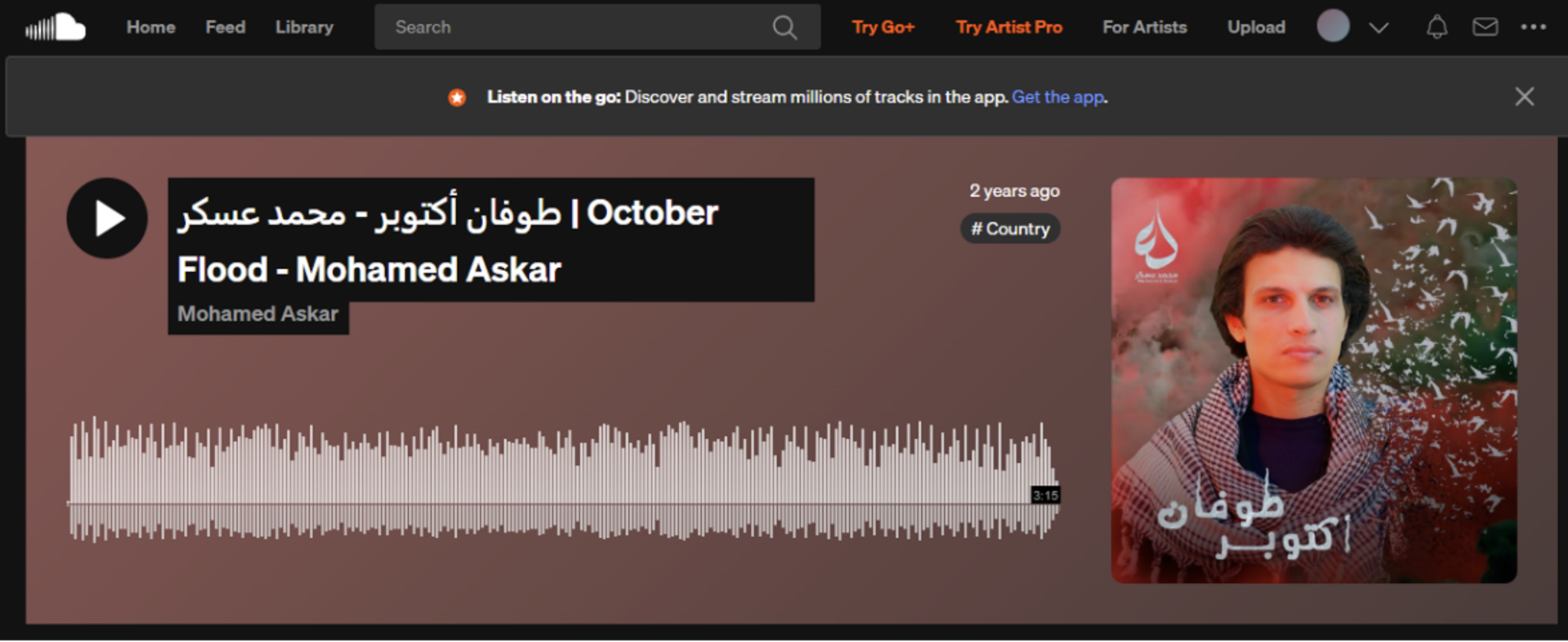
Figure 1: Screenshot from SoundCloud of a track praising the October 7 attack by Hamas, also found on Spotify, Apple Music, Amazon Music, TIDAL, YouTube Music, Deezer, and Pandora.
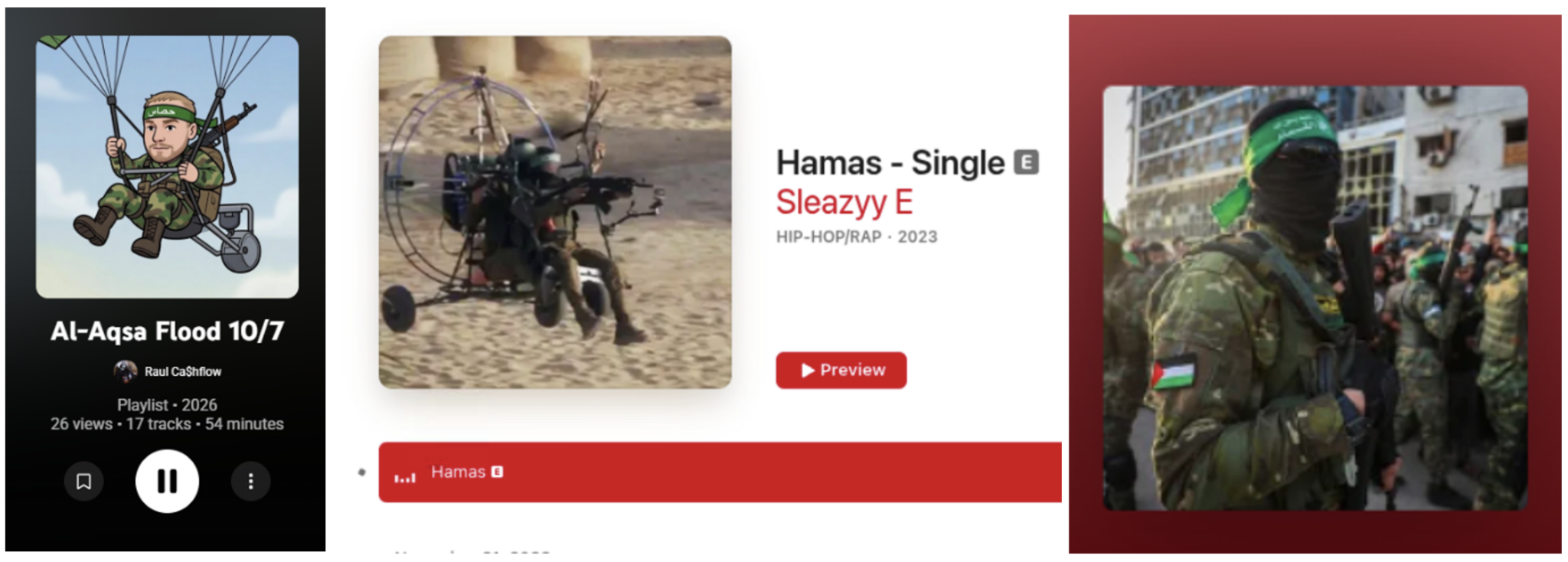
Figure 2: Content using imagery and text related to Hamas fighters with unrelated audio or playlist content. From left to right: The first image shows the cover of a playlist on YouTube Music with a Hamas paraglider titled “Al-Aqsa Flood 10/7.” The songs on the playlist relate to Irish terrorist groups. The second image depicts a track on Apple Music titled “Hamas” with a photo of Hamas paragliders. The song does not contain terrorist rhetoric but references Hamas bombings. The third image depicts the cover art of a Spotify playlist titled “war nasheed” and shows a Hamas militant.
Types of Pro-Hamas Content on SoundCloud
SoundCloud features a wide array of content aimed at spreading Hamas rhetoric and generating wider support. Songs honor terrorist leaders and martyrs and praise and encourage terrorist attacks. (See Figure 3.27) Users also upload clips of speeches from Hamas leadership.
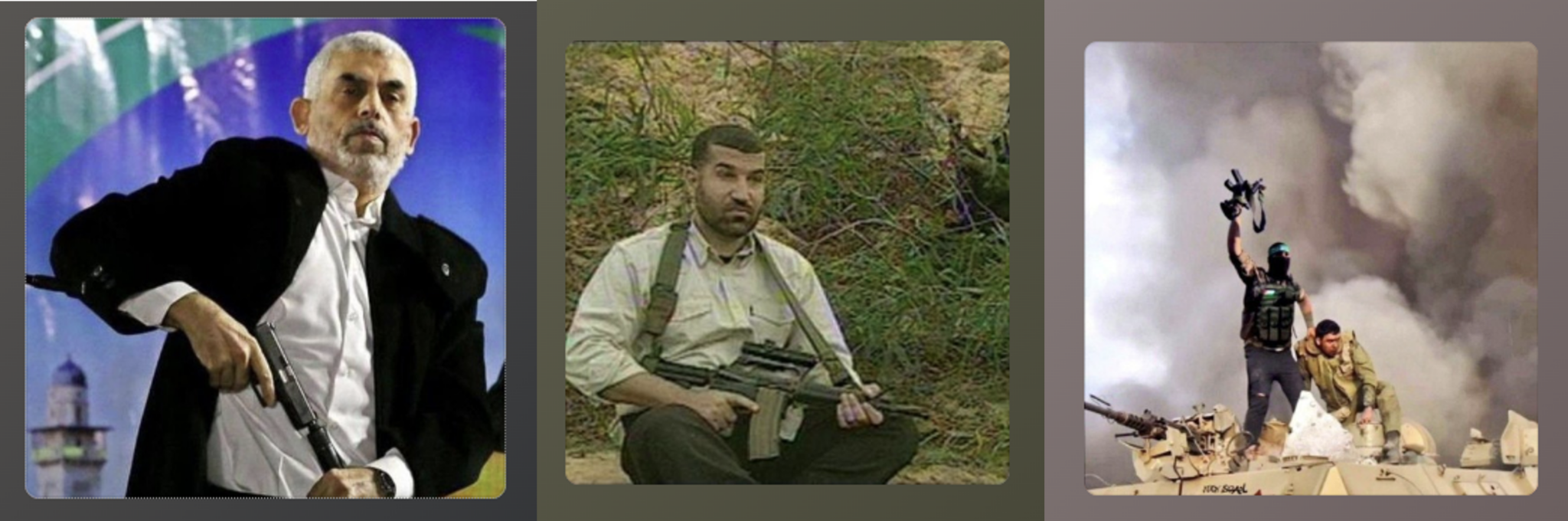
Figure 3: Screenshots of song cover photos featuring Hamas leadership and missions. From left to right: Fourth Chairman of Hamas’s Political Bureau Yahya Sinwar, Hamas Military Commander Ahmed al-Jabari, and an image from October 7 with a photoshopped Hamas soldier.

Figure 4: Screenshots of song cover photos found through Hamas keyword searches, including symbology of groups designated by the United States as Foreign Terrorist Organizations. Al-Aqsa Martyrs’ Brigades (left) and Palestinian Islamic Jihad (right).
One song with more than 303,000 listens has cover art featuring an Israeli tank being lit on fire and former Hamas spokesperson Abu Obaida, who was eliminated by Israel, displayed above it. (See Figure 5.28) On the right is a Hamas fighter, and on the left is the red triangle used by Hamas to represent targets in videos featuring the Israel Defense Forces (IDF). Its title, “October, mother of all wars,” makes a clear reference to the October 7 attacks, of which the lyrics recount specific details, including the targeting of Israeli tanks and the killing of their occupants at point-blank range.29 Comments posted on this track are supportive of Hamas. “It is a jihad, victory or martyrdom. May God protect our leader and role model, the Mujahid Abu Ubaidah,” one user writes.
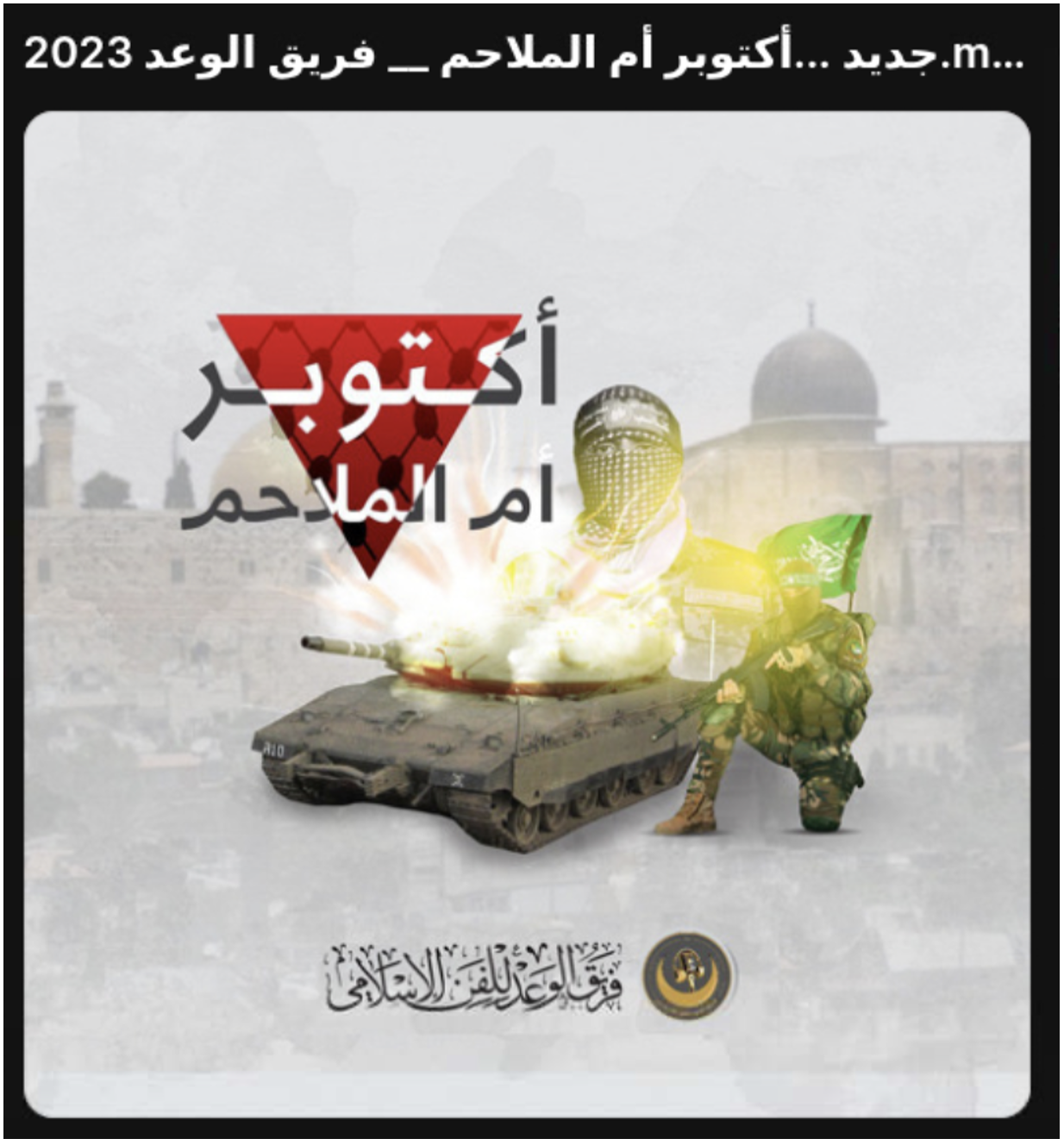
Figure 5: Cover art with Hamas imagery, including an Israeli tank being lit on fire, with Hamas spokesperson Abu Obaida displayed above it.
Another song eulogizes chief Hamas bombmaker Yahya Ayyash, whom Israel killed in 1996.30 The speaker details how Ayyash prepared and organized suicide bombings in Israeli cities. The song has received only about 5,000 listens, but the fact that it has remained on SoundCloud’s platform for 10 years indicates that the platform’s content moderation is not effective in removing all content that violates its policies.
Another song with more than 2.3 million listens utilizes imagery replete with Hamas references in its cover art, featuring the silhouette of Mohammed Deif, former commander of the al-Qassam Brigades, Hamas’s military wing. The Arabic phrase “May God prolong his shadow” covers an outline of Israel, referring to a common phrase used by Deif’s followers to inspire the continuation of his violence. (See Figure 6.31) The lyrics glorify the October 7 attacks, saying, “Hit them with rockets and look at Beersheba. With locally made rockets, we destroyed buildings … The enemy’s security is gone, between those dead and those wounded.”
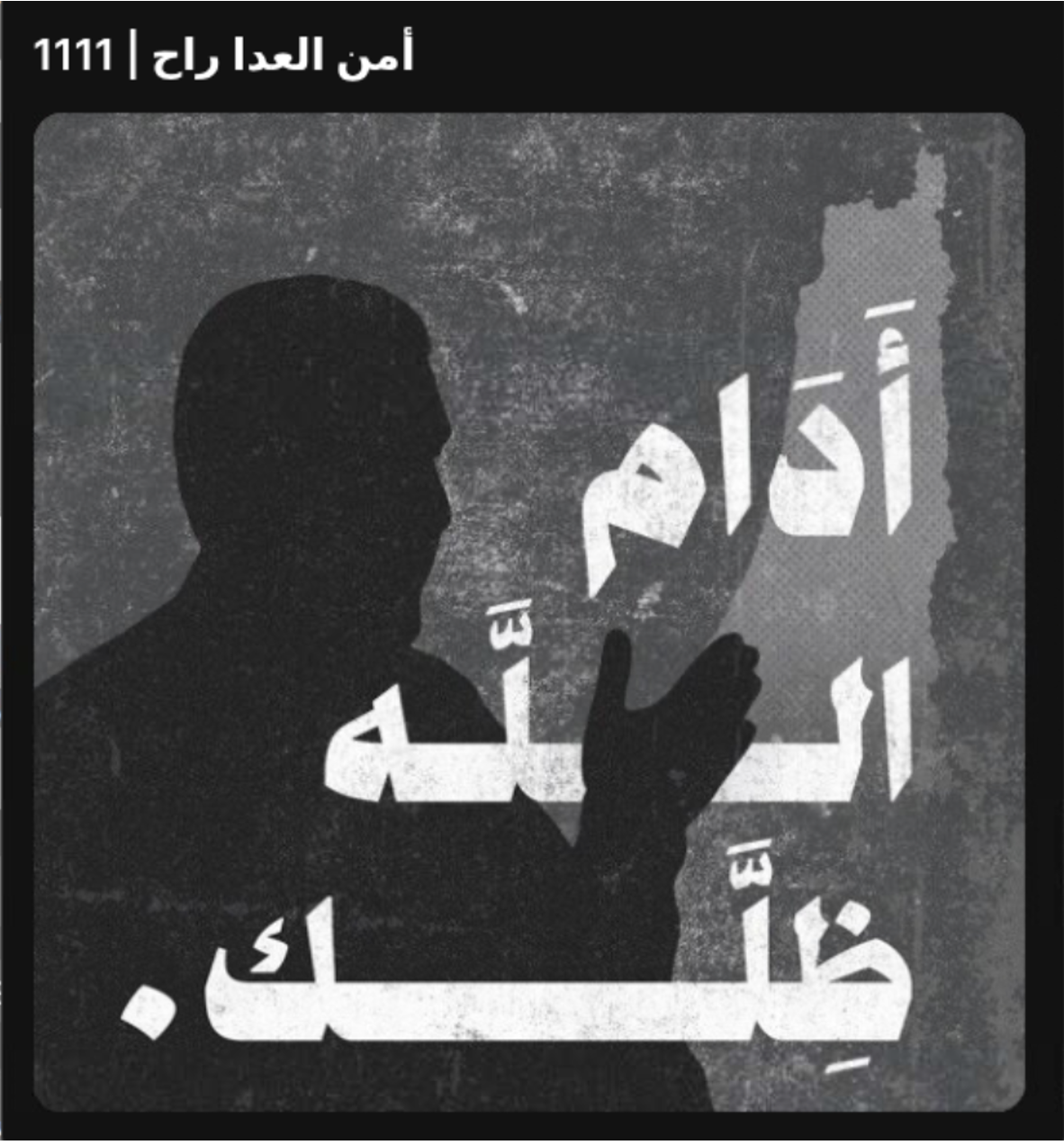
Figure 6: Cover art with Hamas imagery honoring former Hamas leader Mohammed Deif.
Multiple tracks contain audio of speeches given by Hamas leadership that encourage supporters to engage in jihadist pursuits, including violence and terrorist activity. One track consists of segments of various speeches by Yahya Sinwar, the fourth chairman of Hamas’s Political Bureau, Hamas’s political decision-making body.32 In these speeches, Sinwar prays for Israel’s destruction and threatens Gazans who collaborate with Israel. Multiple comments mourn Sinwar and Mohammed Deif. “May Allah have mercy on Yahya Sinwar, Al-Deif, all the soldiers of the resistance … men who believed what they promised God, real men, I swear I love them,” wrote one user last year.
Tactics for Evading Content Moderation
Since August 2025, SoundCloud has taken down around 70 percent of the extremist content identified — a testament to the platform’s ability to identify and remove harmful material. Much of that content, however, had been present on the platform for months or years prior to its removal, and much of it remains accessible. The following section details observed techniques used to evade efforts by the platform to remove terrorist content.
Codewords and Keyword Distortion
As with many communities, Hamas supporters employ idiosyncratic terms whose meaning is clear to them but not to outsiders. By using such language, users can evade automated content moderation reliant on simple keyword searches.
Many of the violative tracks referenced “Al-Aqsa Flood,” the Hamas term for the October 7 attacks. Others reference branches of Hamas, such as “The Story of al-Qassam,” a Hamas military wing, rather than use the word “Hamas.”
Users also distort codewords and phrases to bypass limitations. As some letters in the Arabic alphabet have no English counterpart, Arabic internet users have created a system of numbers to replace them. For example, many use a chat alphabet known as Arabizi, replacing ح (“Ha”), the first letter in the Arabic word Hamas, with the number seven. While keyword searches for “Hamas” produce negligible results, searching for “7amas” content yielded numerous songs. (See Figure 7 for an example.)33
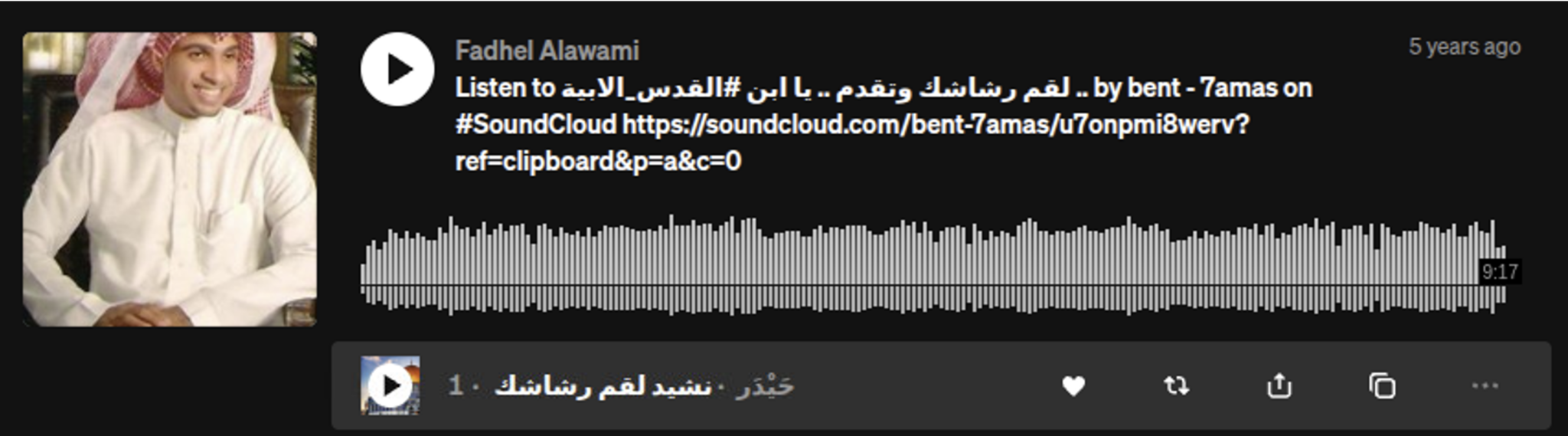
Figure 7: Use of Arabizi “7amas” in the title of a song.
Track Title Modification
To evade SoundCloud’s automatic detection of attempts to reupload removed content, users simply adjust the name of the track. For example, after SoundCloud removed the song “The Era of Leaders,” which glorified Hamas violence, users simply reuploaded the song with the track name changed to “The Era of Leaders 3.” (See Figure 8.34)
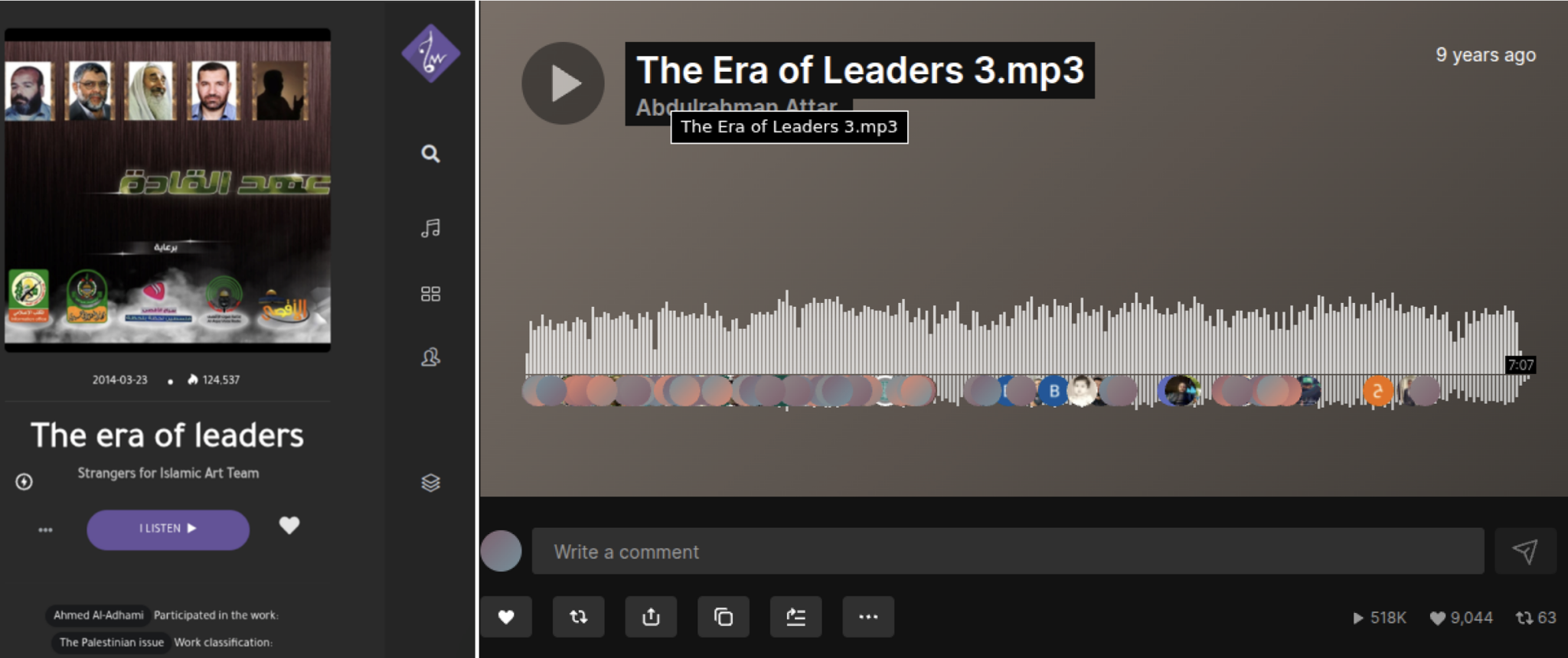
Figure 8: The image on the left is of the Samaa Network website and shows a page that provides an external link to a song titled “The Era of Leaders,” which voices support for Hamas.[note]“فريق غرباء للفن الإسلامي [Ghorabaa Islamic Art Band],” Samaa Network, accessed August 15, 2025. (https://archive.ph/y99ZU)[/note] While the original SoundCloud audio file linked on the Samaa Network webpage has since been taken down, the image on the right shows the same song uploaded in 2015 with a slightly different title by another user.
Users also change track names to something innocuous to evade automatic detection tools. Yet posters and cover art on playlists and individual tracks still convey the content. Cover art of these audio files contains pictures, portraits, and imagery of known terrorist leaders and jihadist soldiers, as well as symbols of terrorist groups.35 Some of the uploaded cover art contains direct references to violence, including AI-generated images of Hamas gliders flying into Jerusalem. (See Figure 10.36)
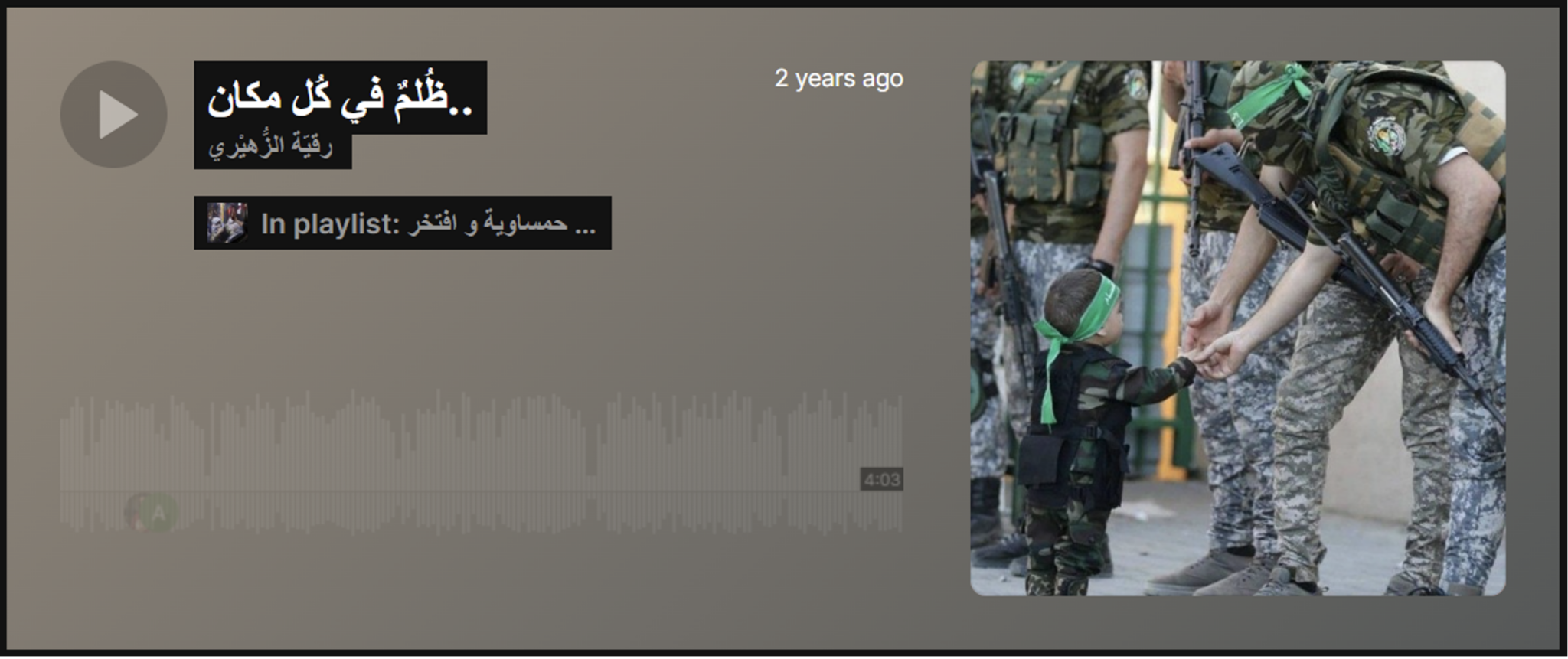
Figure 9: The translated song title is “Injustice is everywhere,” lacking explicit references to Hamas. The image shows Hamas militants.
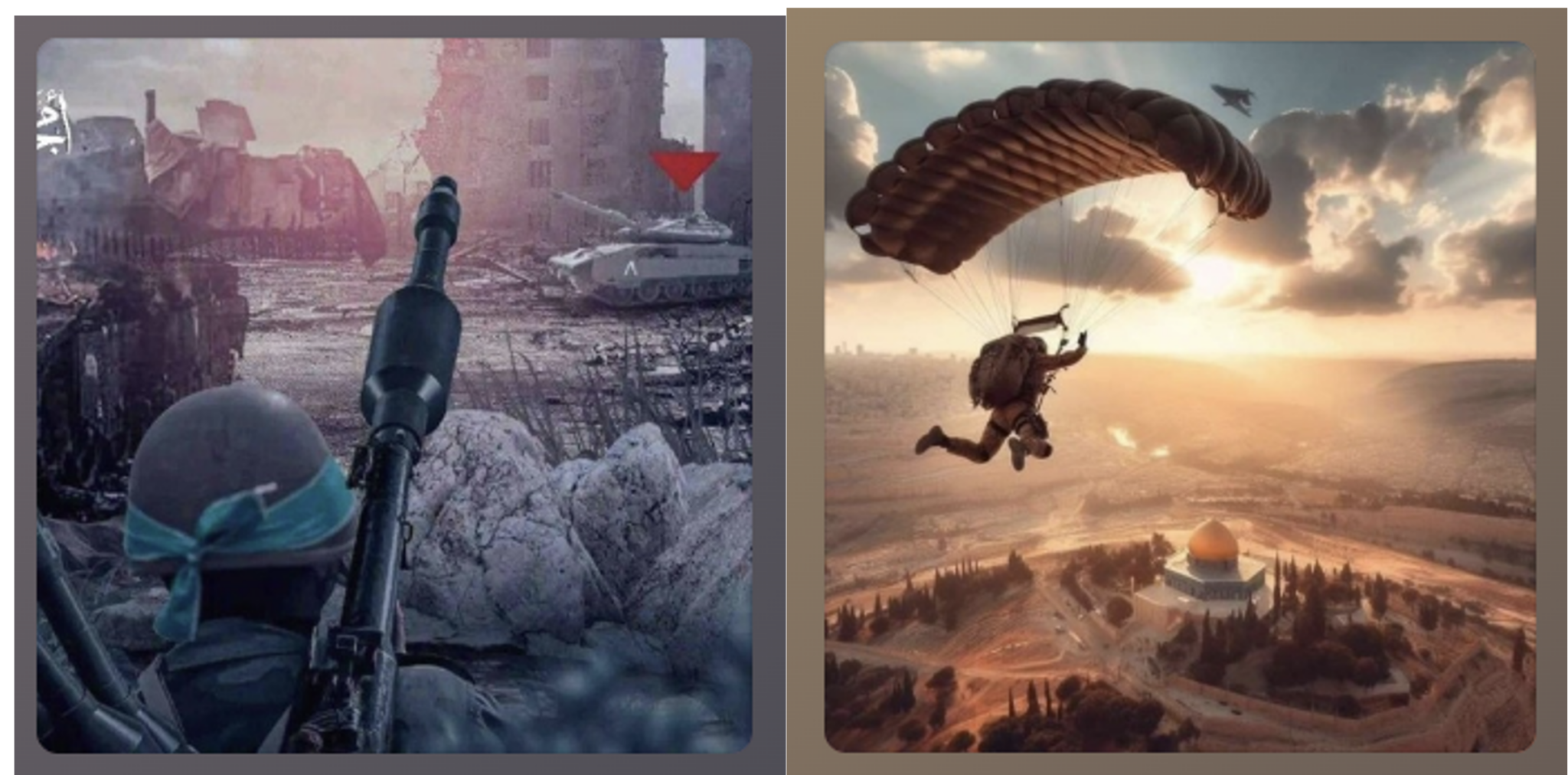
Figure 10: Examples of AI-generated images serving as cover art for SoundCloud tracks, depicting violence against Israel. The first image shows a Hamas fighter taking aim at an Israeli tank, which has the red triangle used by Hamas above it. The second image shows a paraglider flying into Jerusalem. Hamas fighters used paragliders on October 7 to surprise Israel.
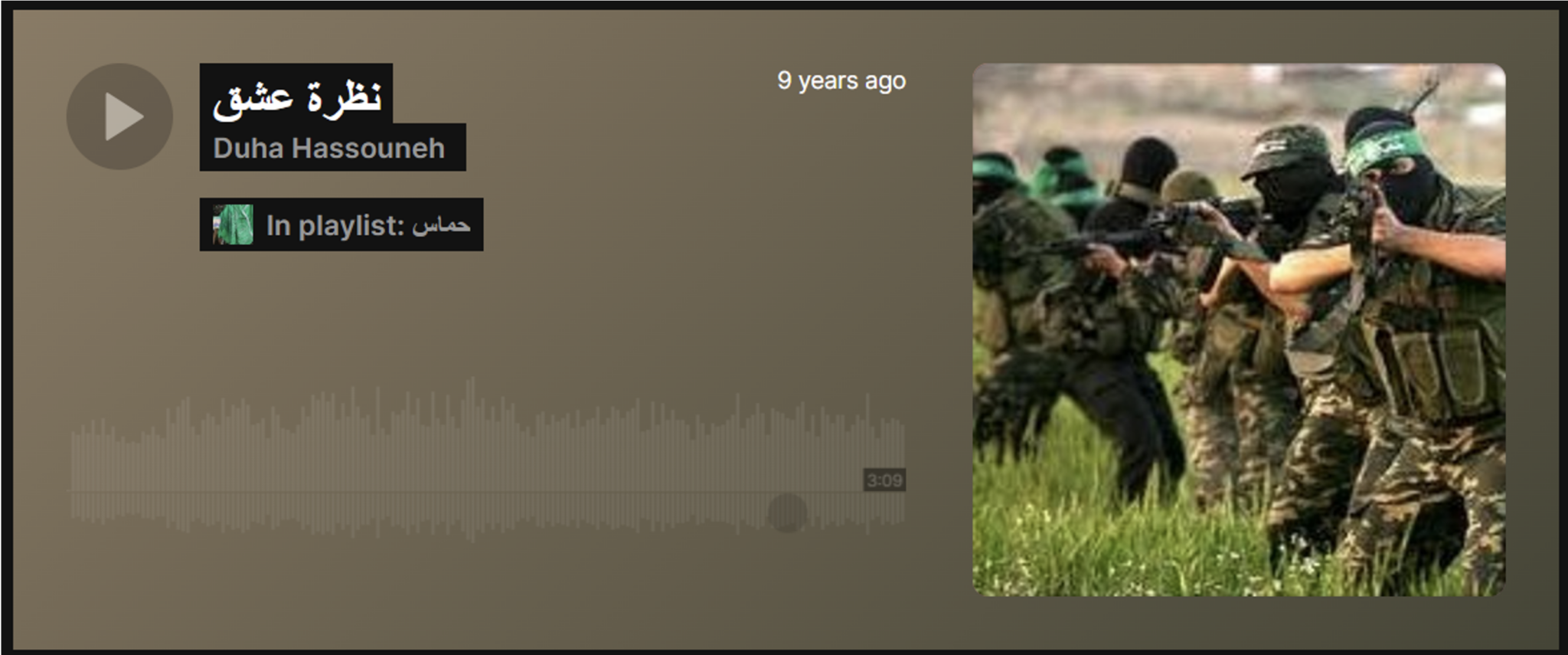
Figure 11: Track title translates to “A look of love,” lacking explicit terrorist references. But the track cover art shows Hamas militants aiming rifles.
Some examples use different titles in English and Arabic. As shown in Figure 12, while the track’s imagery and Arabic title refer to the Democratic Front for the Liberation of Palestine, the English title implies the content is about basketball.37
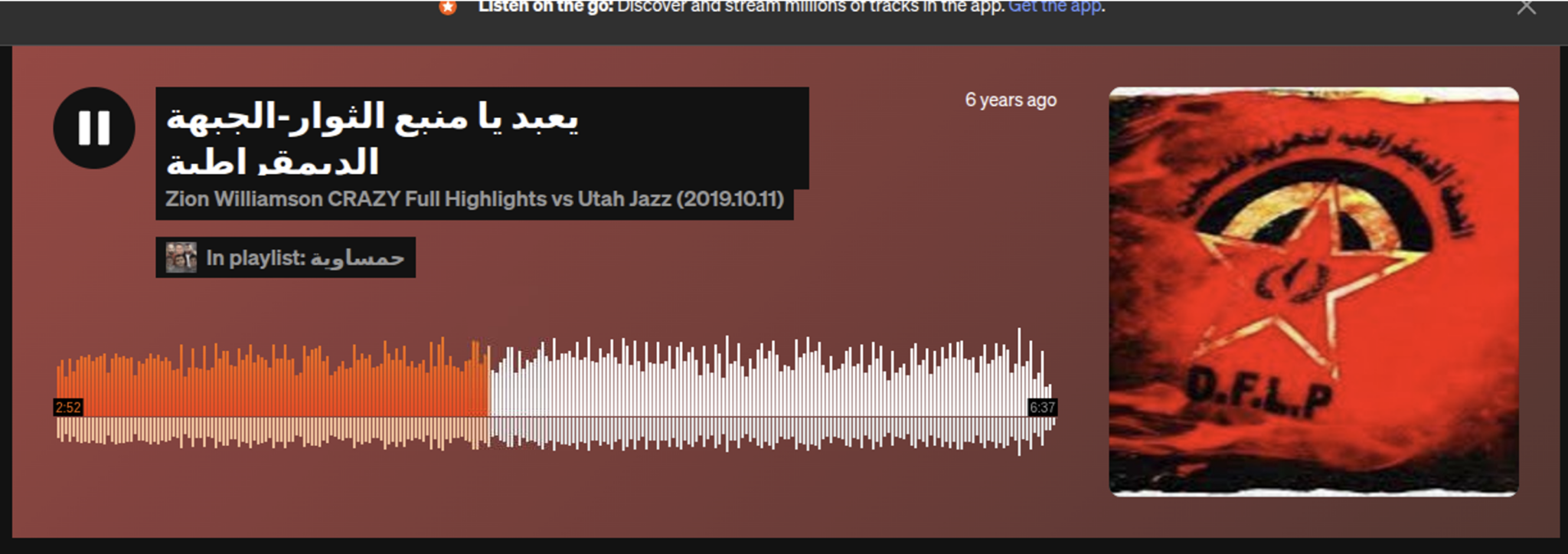
Figure 12: Track with English artist title “Zion Williamson CRAZY Full Highlights vs Utah Jazz (1019.10.11),” referencing American NBA basketball. The Arabic title reads, “Ya’bad, the source of the revolutionaries – Democratic Front,” with imagery referencing the Democratic Front for the Liberation of Palestine (DFLP).
Global Reach of Pro-Hamas Content
The evasion tactics described above appear to be working. While some extremist songs have a few thousand listens, others have millions. Beyond just the track itself, comments sections provide forums for listeners to express their support for terrorism and to share other songs with each other. Multiple songs have hundreds of comments voicing support for terrorist leaders and their ideas.
The song “Jordanian Flood” has more than 600,000 listens. It calls on Jordanians to join Hamas in its war against Israel,38 with lyrics including “Go to [the] border and arm yourself” and “The Temple is Fake … There is no Jewish State,” sung in a Palestinian dialect. In the comments section, many users voice support for this message, for example, celebrating Jordanian citizen Maher Al-Jazzy, who killed three Israelis in September 2024. (See Figure 13 for other examples of posted comments.)39 The comments are not universally supportive of the song’s messages, with other Jordanian users resisting an association with Hamas, writing, “when you claim that all of Jordan is Hamas-affiliated, it is as if you are saying that all of Jordan is a terrorist organization, even though they are not.”

Figure 13: Comments on “Jordanian Flood” (translation) track. The first (left) translates to “May God bless Hamas! My children are Hamas supporters, I am a Hamas supporter, and my neighbors are foreigners who adore Hamas.” The second (right) translates to, “This song is addictive! God bless Hamas! 💚 From the Latin American continent.”
The song mentioned above praising Hamas commander Mohammed Deif and the October 7 attacks has almost 800 comments, primarily in support of Hamas, from users in Morocco, Kurdistan, South America, and other regions.40 These comments include providing fellow listeners with names and links to other pro-Hamas songs.
Origins of SoundCloud’s Pro-Hamas Content Includes 3 Islamic Art Bands
After identifying the terrorist content, FDD’s Center on Cyber and Technology Innovation (CCTI) sought to find the origins of the songs. Image searches of logos present on multiple tracks revealed information about bands that produced some of the content, their websites, and the streaming platform where many of the songs originated.
Connections Between Art Bands and Hamas
Many of the tracks included common logos. A reverse Google Image search revealed associated Islamic art bands — musical groups producing content with Islamic traditions, including nasheeds and contemporary music. At least three bands — Ghorabaa Islamic Art Band, Al-Waad Islamic Art Band, and Ajnad Band — produce Hamas-related content that could be found on SoundCloud and other platforms.
Each of these bands has voiced support for extremist views, explicitly supporting Hamas. Ten Palestinians and seven Lebanese members founded the Al-Waad band in 1992 in Lebanon.41 The band performed at Hamas-sponsored concerts in Gaza in 2011 and 2012.42 In an interview with pro-Hamas media, Al-Waad leader Mohammed Al-Asadi stated that his band seeks to combat “musical normalization,” which refers to “any dramatic or musical artwork that promotes the idea of coexistence with Jews in Palestine and that they have rights just like the Palestinians.”43 To resist efforts to normalize coexistence, Al-Asadi said that Al-Waad has produced “several artistic and chanting productions that mobilize the people … and complement all efforts to confront normalization.” He concludes this interview by emphasizing the power of the medium: “Words and songs have always been a primary source of mobilization … No one can underestimate this important tool in our battle against the Zionist enemy.”
Similarly, the leader of the Ghorabaa Band has spoken to the group’s goals, saying in an interview that its music seeks “to spread the message of resistance” to Israeli forces, with the express purpose of inciting violence.44 He further stated that those who take part in Islamic art music are playing their role in the resistance against Israel.
The Ajnad Band has repeatedly demonstrated public support for Hamas, notably through its Instagram account. The account contains multiple video posts depicting, honoring, and praising Hamas leaders and includes references to the October 7 attacks.45 The account also features violent imagery, including weapons and armed Hamas fighters.46
Samaa Network as an Origination Point for Content
Much of the content from the bands appears to originate on a website called Samaa Network, a Yemeni music-streaming site designed to share Islamic music. Users download the songs from Samaa Network and then upload them to SoundCloud.47
While other streaming sites ban terrorist content, Samaa Network allows content supporting terrorist groups. Many popular songs on the site feature explicitly pro-Hamas messaging.
CCTI identified multiple tracks cross-posted on the Samaa Network site and SoundCloud by comparing titles, artists, and descriptions. Multiple tracks also included “.mp3” as part of the track title, indicating that the track may have been uploaded after being downloaded elsewhere.
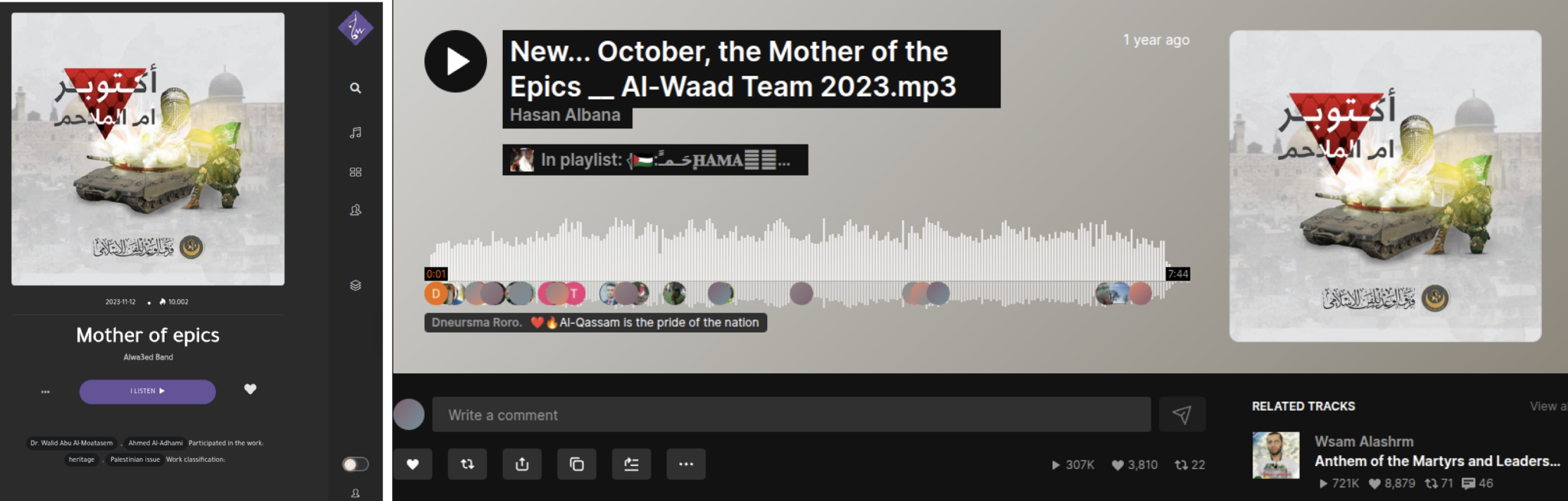
Figure 14: The first image is of the webpage of “play.samaanetwork[.]net,” a streaming website allowing users to listen to “Mother of Epics,” a song supporting Hamas and describing the events of October 7. The same song is posted on SoundCloud, crediting the Al-Waad Team in the title and cover art.
Samaa Network also maintains multiple SoundCloud accounts to post content on the site, including a general account and a Samaa Network Without Music account specifically for tracks without instrumentals.48 These accounts have posted content violating SoundCloud’s terms, including violent imagery. (See Figure 15.) Samaa Network also maintains accounts on YouTube and X, including a subscription option on YouTube through which it possibly profits from terrorist content banned by the platform.49
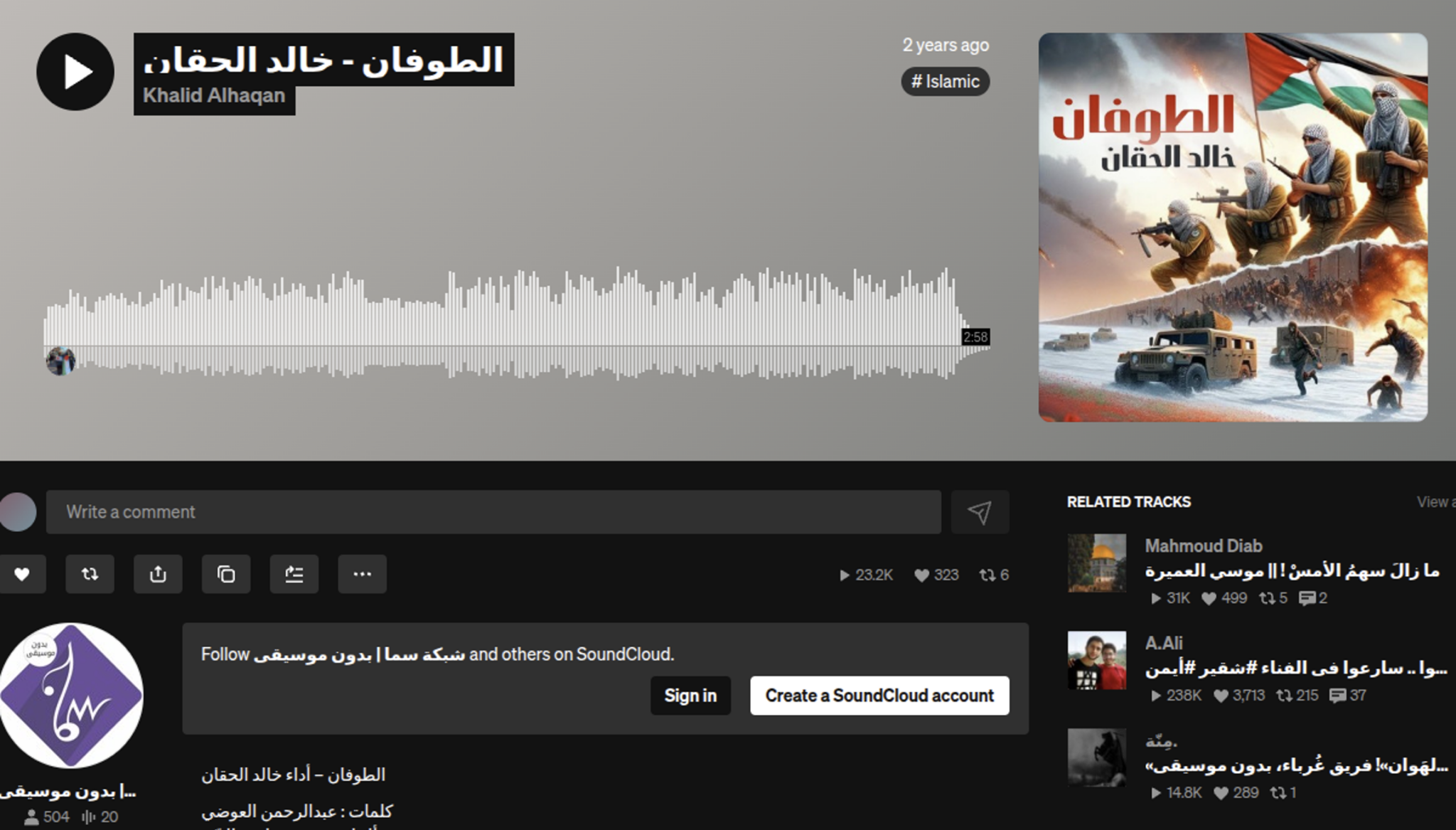
Figure 15: Track posted in 2024 by Samaa Network Without Music titled “الطوفان – خالد الحقان,” translated, “The Flood – Khalid Al Haqan.” Cover art contains AI-generated violent imagery depicting Palestinian forces with the title “Flood,” a reference to the October 7 attacks on Israel by Hamas.
Recommendations
CCTI has shared its list of 500 violative songs, including the users posting them, with SoundCloud for investigation and removal. A whack-a-mole approach will not put a dent in terrorist content. SoundCloud and its peers need to do a better job removing content that violates their guidelines. The recommendations below can help prevent the spread of terrorist and extremist rhetoric through online platforms.
- Law enforcement should investigate whether the creators, producers, and distributors of terrorist content also provide material support to global terrorist organizations.The Department of Justice and the Department of the Treasury should investigate whether organizations like the Samaa Network are engaged in business practices that involve providing material support to Hamas or other designated terrorist groups or sanctioned entities.Private companies and streaming platforms that discover banned content should work with law enforcement to provide relevant information on the individuals and entities that upload and promote terrorist-related content on their platforms. As SoundCloud is based in Germany, the platform should work with the German government to identify users violating German Criminal Code Section 86, which prohibits the dissemination of propaganda material and the use of logos representing terrorist organizations as classified under EU Regulation 2021/138, which includes Hamas, the Al-Aqsa Martyrs’ Brigade, and Palestinian Islamic Jihad.50 The respective federal agencies should then enforce sanctions or appropriate legal action based on their investigations.
- SoundCloud and its peers should improve context-based analysis and expert engagement to identify and moderate content based on more extensive keyword databases.Platforms must consider the evasion tactics used by content creators and take steps to incorporate this knowledge into their moderation tools. Without including emerging languages like Arabizi, automated moderation systems appear to overlook content that violates the site’s terms of service.51 Platforms must also constantly update their classifications for banned content to account for evolving user evasion efforts. Platforms should regularly perform red-teaming exercises aimed at testing the effectiveness of their monitoring tools, working to understand how terrorist supporters circumvent the restrictions and adapt their protections accordingly.
- SoundCloud and its peers should leverage agentic AI to build upon existing content moderation models.As AI has advanced in recent years, it is increasingly useful as a content moderation tool.52 AI-enabled automation tools help perform proactive content checking during the upload process. Platforms should expand the use of these capabilities, including emerging technology like agentic AI systems, which combine tools into a more simplified workflow, requiring less human engagement. Gaming companies are already using agentic AI effectively to moderate disruptive content — in one study reducing disruptive behavior by up to 70 percent.53 Audio content platforms like SoundCloud should similarly leverage the adaptive abilities of agentic AI to support human content moderation efforts. Agentic AI could aid platforms in proactively identifying emerging patterns used by terrorists to evade content moderation guidelines.54
- SoundCloud and its peers should engage community forums for cross-platform content removal.Many terrorist information campaigns cross-post content on platforms. Therefore, information sharing among platforms is important for stemming the flow. The Global Internet Forum to Counter Terrorism, GIFCT, of which SoundCloud is a member, maintains a database containing hundreds of thousands of unique signatures of content examples identified as violating platform guidelines, providing a forum for joint access and easing the burden on individual trust and safety teams to identify massive amounts of content.55 Through engagement with organizations like GIFCT and Europol, platforms gain access to training materials, community engagement, hash-sharing databases, and targeted content removal events.56 By contributing to hash-sharing databases of identified terrorist content and contributing to joint efforts to identify content that violates guidelines, platforms can increase the effectiveness of their own moderation approaches.57
Conclusion
Despite the efforts of platforms to ban and remove terrorist content, users continue to successfully share and engage with it. Further collaboration among governments, regulators, and industry is necessary to continue fighting the presence of terrorist content online and minimize the spread of terrorist rhetoric — ultimately reducing the threat of online radicalization.
