November 19, 2025 | Policy Brief
China Keeps the Axis of Aggressors Afloat With Oil Imports
November 19, 2025 | Policy Brief
China Keeps the Axis of Aggressors Afloat With Oil Imports
Beijing continues to import oil from key U.S. adversaries. According to TankerTrackers, China imported 8.31 million barrels per day (bpd) of crude oil in October, only slightly lower than its September level. Forty-one percent of the imports originated from three countries — Iran, Russia, and Venezuela — all of which are subject to oil sanctions by the United States and the European Union.
Beijing, Tehran, Moscow, Caracas, and Pyongyang form an Axis of Aggressors, a coalition aiming to alter the international order and undermine the Western bloc led by the United States. Sanctions have limited the ability of Iran, Russia, and Venezuela to sell their oil to key consumers in Europe, Asia, and North America. By purchasing crude oil from them at a significant discount, China helps these countries remain stable and thereby challenge U.S. interests.
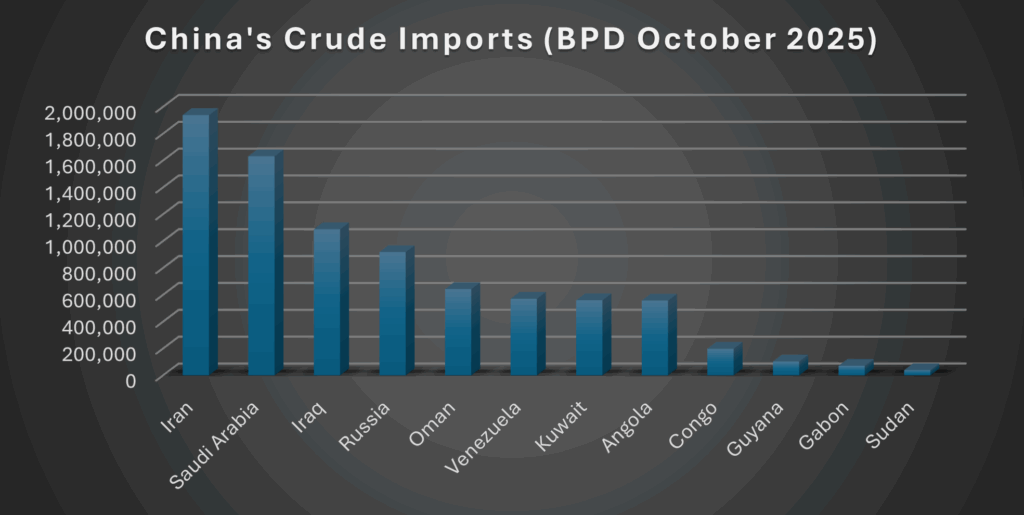
China’s Total Oil Imports
TankerTrackers shows that China imported oil from 12 countries in October. Iran leads the group, having exported 1,938,443 bpd, accounting for 23.3 percent of the total share. Following closely is Saudi Arabia, which exported 1,631,205 bpd, representing 19.8 percent of the total. Iraq and Russia are the next largest exporters — Iraq exported 1,088,224 bpd (13.1 percent) and Russia exported 918,318 bpd (11 percent).
Venezuela sent 559,955 bpd, or 6.7 percent, while seven other countries provided the remaining 2.17 million bpd, or 26.1 percent of the total.
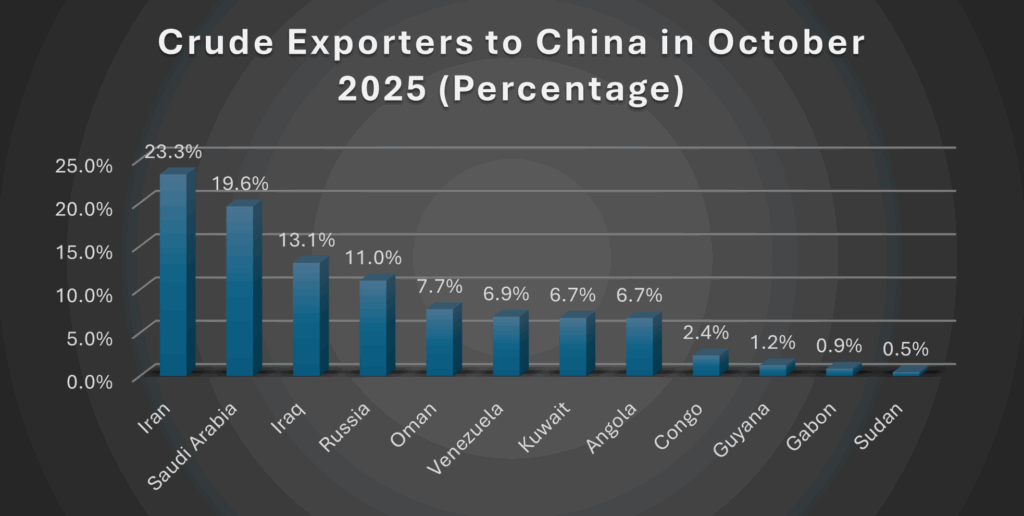
Iran Replaces Saudi Arabia as China’s Top Source of Oil
China remains Iran’s top buyer of crude oil. According to TankerTrackers, China was the only country to buy Tehran’s crude in October.
To date this year, China has imported 1.72 million bpd of crude from Saudi Arabia, 21.1 percent of its total imports. Iran ranks as the second largest crude exporter to China in 2025 as a whole, with 1.61 million bpd and 19.6 percent of China’s total imports. However, in September and October, Iran’s crude exports to Beijing surpassed Saudi’s.
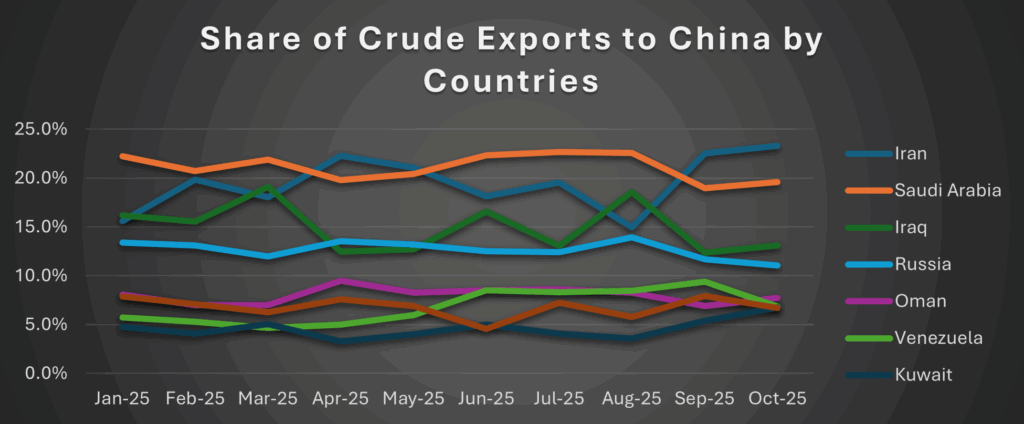
China’s Imports From Russia Reach Its Lowest Share in 2025
Russia ranked fourth among crude exporters to China in October, accounting for 11 percent of China’s total imports. The total quantity of imports, 918,000 bpd of crude oil, was the lowest monthly volume from Russia in 2025. China is the second-largest importer of Russian crude after India.
Washington initiated a new effort to reduce Russia’s oil exports this fall. This approach includes more significant designations, such as sanctioning major Russian energy companies like Lukoil and Rosneft. Washington has also threatened to impose a 100 percent tariff on major buyers of Russian oil. However, it is still too early to conclude the decline in Russian oil imports will persist.
China Continues Importing Crude From Venezuela
In October, China imported 570,000 bpd of crude from Venezuela, well below its September level of 800,000 bpd but slightly above its 2025 average of 568,000 bpd. The only other importer of Venezuelan crude was the United States, which imported 117,000 bpd. Meanwhile, tensions between the United States and Venezuela are escalating, and speculation about Washington’s plan to topple the Maduro regime through the use of force is intensifying.
U.S. Must Enforce Sanctions With a Focus on China
Sanctions without credible and effective enforcement are of limited use. China is the heart that is pumping money and materials to the sanctioned members of the Axis of Aggressors. Logically, sanctions enforcement should focus on China first and foremost. This includes designating Chinese front companies, businessmen, and banks that facilitate this trade, Chinese refineries that use the oil, and Chinese ports that offload the crude.
Saeed Ghasseminejad is a senior Iran and financial economics advisor at the Foundation for Defense of Democracies (FDD). For more analysis from Saeed and FDD, please subscribe HERE. Follow Saeed on X @SGhasseminejad. Follow FDD on X @FDD and @FDD_Iran. FDD is a Washington, DC-based, nonpartisan research institute focusing on foreign policy and national security.