September 16, 2025 | Policy Brief
With Snapback of UN Sanctions Pending, Tehran Continues To Export Oil
September 16, 2025 | Policy Brief
With Snapback of UN Sanctions Pending, Tehran Continues To Export Oil
Tehran continues to export oil and acquire new customers despite approaching deadlines for the snapback of United Nations sanctions. Although Iranian oil exports reached their lowest level of the year in August, data for the first half of September indicate a significant increase. Despite its commitment to impose “maximum pressure” on Tehran, the Trump administration is failing to meet its goal of disrupting Iranian oil exports.
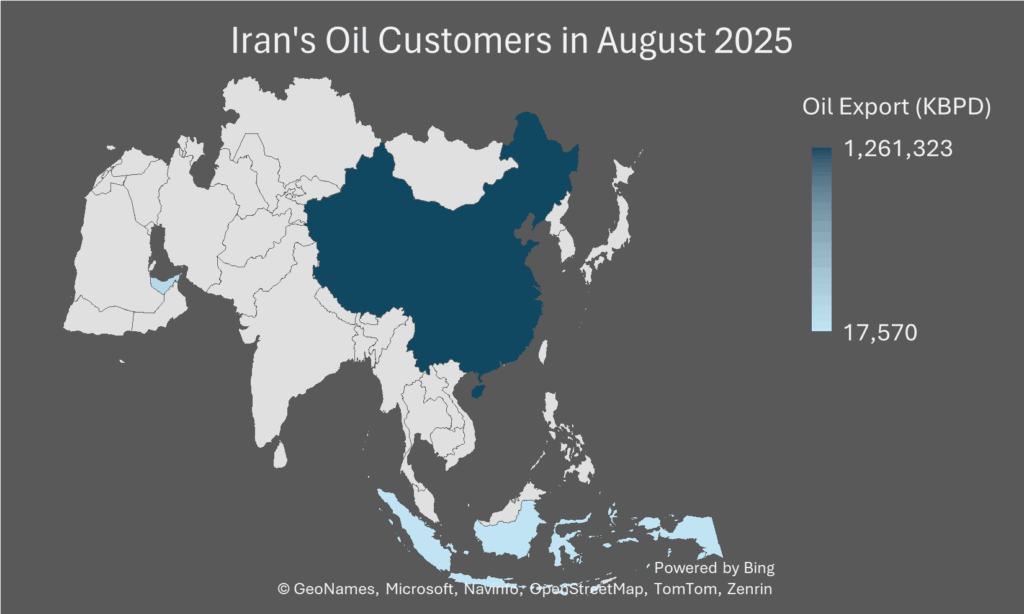
According to TankerTrackers, in August, Tehran exported 1.4 million barrels per day (mbpd) of condensate, crude oil, and fuel oil, primarily to China, the United Arab Emirates (UAE), Singapore, and Indonesia. China was the largest recipient, taking 90 percent of Iran’s total exports. The UAE accounted for 7 percent, while Indonesia and Singapore received 2 percent and 1 percent, respectively.
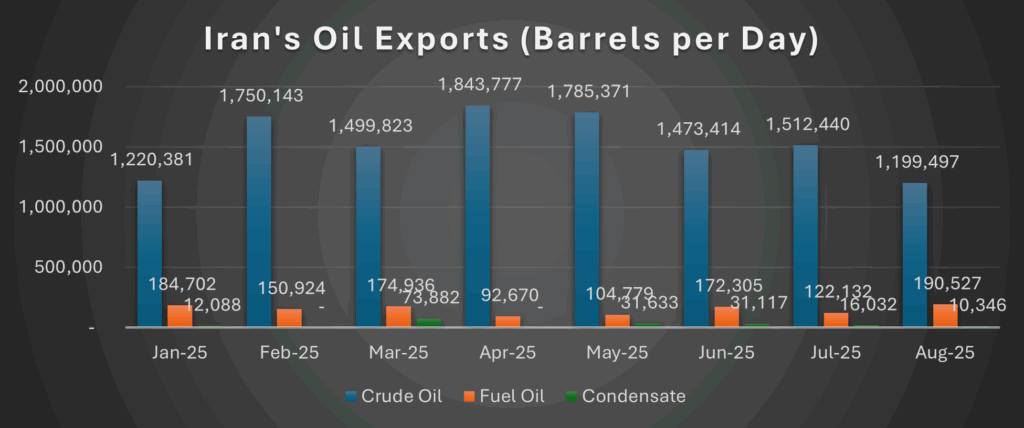
Iran’s Oil Exports Declined in August, But Is It Sustainable?
Of the total 1.4 mbpd exported, 86 percent was crude oil, 13 percent was fuel oil, and 1 percent was condensate. Notably, Iran’s exports in August dropped to their lowest level for 2025, falling 15 percent from July and 18 percent below its highest level in April.
However, this decline may be due to routine monthly fluctuations, as the data from the first half of September shows a substantial increase in exports to around 2.4 mbpd. If this trend continues in the second half of September, Iran may see its highest level of exports this year.
The Chinese ports of Lianyungang, Ningbo, and Zhoushan, along with the Emirati port of Fujairah, the Indonesian port of Karimun, and the port of Singapore, are the primary destinations for Iranian oil. Kharg Island, on Iran’s Persian Gulf coastline, remains the main hub for exporting Iranian crude. Tehran also uses other ports such as Bandar Abbas, Lavan, Mahshahr, Bandar Imam Khomeini, Sirri Island, and Asaluyeh to export its crude, condensate, and fuel oil.
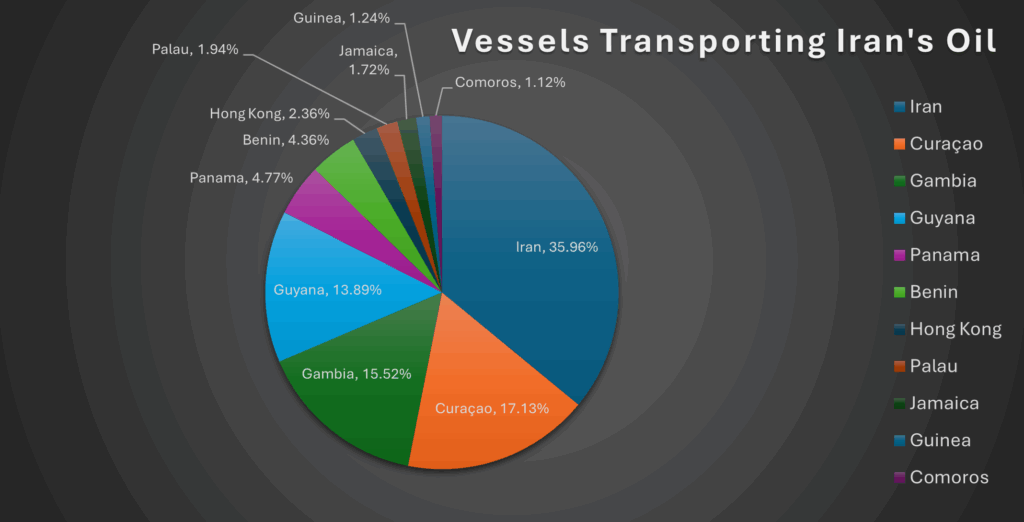
Ten Countries Directly Involved in Transporting Iran’s Oil in August
Iran continues to use vessels registered under the flags of 10 different countries to transport its oil, including Curaçao, Gambia, Guyana, Panama, Benin, Hong Kong, Palau, Jamaica, Guinea, and Comoros. Iranian vessels themselves transported 36 percent of the country’s oil, while vessels flying the flags of Curaçao, Gambia, and Guyana transported 17 percent, 15 percent, and 14 percent of Tehran’s oil exports, respectively.
Iranian media and officials boast that the Trump administration’s maximum pressure strategy has failed to impact the regime’s oil trade. They also claim that the snapback mechanism will not lead to a reduction in oil exports.
Promise Made, But Not Kept
At the beginning of the year, Treasury Secretary Scott Bessent promised to reduce Tehran’s oil exports to 100,000 barrels per day. “Promises made, promises kept” has been a key pillar of President Trump’s administration, but Washington has yet to successfully uphold Bessent’s promise. This failure has not only emboldened the regime in Tehran but also encouraged other countries to not comply with Washington’s demands, as they see that non-compliance with U.S. requests carries no cost.
Removing Iran’s 1.6 mbpd of oil from the market will not significantly impact the United States, as there is enough excess capacity to offset it. Allowing Tehran and China to continue their trade, despite Washington’s clear objectives set earlier this year, undermines U.S. prestige and credibility. This is something that America cannot afford, especially as it seeks to prevent the Axis of Aggressors from disrupting the U.S.-led international order.
Saeed Ghasseminejad is a senior Iran and financial economics advisor at the Foundation for Defense of Democracies (FDD). For more analysis from the author and FDD, please subscribe HERE. Follow Saeed on X @SGhasseminejad. Follow FDD on X @FDD and @FDD_Iran. FDD is a Washington, DC-based, nonpartisan research institute focusing on foreign policy and national security.