October 21, 2026 | Memo
Foreign Funding and Influence in America’s K-12 Education System
October 21, 2026 | Memo
Foreign Funding and Influence in America’s K-12 Education System
Foreword
By Jonathan Schanzer
In the wake of the October 7, 2023, attacks, it became abundantly clear that a serious problem existed in American higher education. Dramatic congressional hearings and chaotic board meetings felled one university president after the next. And for good reason. They had allowed, or even enabled, the rise of virulent antisemitism on their campuses.
But a more systemic question lingered: how had so many universities become susceptible to the antisemitic rhetoric and violence that rocked the country for the first full year of the war in the Middle East, if not longer?
This question was answered, in part, with the revamping of the Department of Education’s Section 117 Foreign Gift & Contract Reporting dashboard.1 The portal revealed some shocking numbers. The State of Qatar, a state sponsor of Hamas, the Taliban, and a host of other jihadist organizations, was the number one patron of institutions of higher learning in the United States. This autocratic microstate with a mere 330,000 citizens had contributed a whopping $9 billion dollars to top American schools. China, a country that seeks to upend America’s global dominance, contributed more than $7 billion. Saudi Arabia contributed $4.6 billion.
Why do these countries make charitable donations to American higher education? It’s certainly not for the tax break. It’s also not because their governments care deeply about whether American students are adept at calculus or have a good grasp of Chaucer’s The Canterbury Tales. The most cynical interpretation of their donations is that they want to buy influence in the United States. More to the point, they seek to influence malleable American minds while they are still young and formative.
To be clear, we cannot possibly know the extent to which these foreign powers have stoked antisemitism directly. However, we can say for certain that American alumni seeking to curb antisemitism at their alma maters will collectively struggle to match the purchasing power of sovereign states. The huge sums donated by Qatar (and other powers) enable university administrators to comfortably shrug off their concerns. To put it another way, most individual donors are decidedly less important to the universities than the foreign powers who continue to cram millions upon millions into swelling endowments.
As Americans struggle to digest this discomforting fact, they must also ask another crucial question: where else are these foreign powers buying influence? This was the question that guided the research you are about to read.
The guiding assumption of FDD’s Education and National Security Program was simple. If foreign funding and foreign influence are a problem in higher education, then it stands to reason that there might be a similar problem in K-12 schools. And that is exactly what the team found. Millions of dollars, donated by Qatar Foundation International, have found their way into American schools.
The estimated $10 million documented in this report is merely a representative sample. The team managed to uncover these funds through Freedom of Information Act (FOIA) requests filed in school districts across the country. The percentage of districts that responded was low, but some released rich troves that expose the extent of Qatari influence. A wider survey of American schools will undeniably yield documentation of even greater spending and influence.
But the FDD study does not end there. The team found evidence pointing to persistent Chinese government influence in K-12 classrooms. It also documents how a multilateral Islamic bank has pumped more than $17 million into Muslim schools in the United States. Alarmingly, one of the bank’s largest stakeholders is the Islamic Republic of Iran.
None of this portends well for American education. All of it must be addressed at the state and federal levels. It would be helpful if individual school districts addressed the problem, too. The first challenge is transparency: Only one of the 50 states has a requirement to disclose foreign funding in public schools, and there is no federal requirement. That is why the authors of this paper had to submit reams of public records requests. Yet transparency alone is not enough. We need a robust discussion of whether the time has come to preclude foreign influence — especially that of hostile dictatorships — in America’s K-12 classrooms.
Of course, foreign influence is a much wider problem. From social media to political donations to artificial intelligence, America is getting pummeled with messages that derive from foreign influence operations. The response from Washington up until now has lacked any sense of urgency. That is simply unacceptable. Our hope is that the information in this report serves as a wake-up call. If generic foreign influence is not alarming enough, then perhaps foreign influence in America’s kindergarten classrooms will be.
Introduction
America’s primary and secondary schools have become targets of foreign influence campaigns. Qatar Foundation International (QFI), an organization with ties to Qatar’s royal family, has spent more than $10 million on K-12 public school programming in nearly two dozen major districts, mainly to support Arabic language and culture instruction. In federal filings, Qatari authorities insist QFI is exclusively a grant-making organization that “has no role in setting or influencing classroom content or management.”2 Nevertheless, QFI’s grants are used by recipients to pay for teaching material whose Arabic programs include maps that falsely label Israel as “Palestine.”3
Across the United States, K-12 Islamic private schools received over $17 million in funding from the Islamic Development Bank (IsDB),4 a Jeddah-based multilateral institution whose shareholders include the governments of Iran, Qatar, and Turkey.5 Many of these schools also received accreditation from the Council of Islamic Schools based in North America (CISNA), a standards-setting body supported by IsDB. Textbooks at Brighter Horizons Academy, a Texas school that received $995,000 from IsDB, offer praise for a wide range of extremist clerics who have justified suicide bombing and defended Hamas. The textbook also offers advice such as, “Girls should not e-mail boys, and boys should not e-mail girls, unless they have a good, Islamic reason to communicate.”6
The Chinese government once supported more than 100 Confucius Institutes on American college campuses, promoting Beijing’s agenda under the banner of educating students about Chinese language and culture. A backlash both in Congress and at the grassroots level led to the closure of most institutes. However, there was less scrutiny of the roughly 500 “Confucius Classrooms” in K-12 public schools that the institutes supported.7 Beijing’s influence in K-12 education may be continuing today, albeit with a lower profile. The former head of the Confucius Institute U.S. Center — the de facto headquarters of Beijing’s influence campaign — now serves as executive director of the Center for Bridging Cultures (CBC), a new nonprofit that assumed responsibility for the K-12 programming of at least one shuttered Confucius Institute as well as grants to public schools and trips to China for public school administrators.
There are few guardrails to prevent foreign funding or influence from shaping K-12 education. Whereas federal law requires institutions of higher education to report foreign gifts or contracts whose value exceeds $250,000, there is no comparable requirement for primary or secondary schools. At the state level, there are nascent efforts to require transparency, but lawmakers have not moved to block foreign funding or influence.
Given the lack of transparency, it is difficult even to document the extent of foreign influence in American schools. To learn more, FDD’s Education and National Security Program filed more than 260 public records requests, while working with a partner, Open The Books, to file an additional 1,200 requests in school districts across the nation. These requests yielded extensive information about QFI programs as well as substantive material about CBC initiatives, yet private schools are not subject to such disclosures.
This research shows that several vectors exist for foreign influences in K-12 education. They reflect the interests of foreign powers, not those of American students. At both the state and federal level, there is an urgent need to strengthen transparency requirements and to ask why anyone other than Americans could be shaping K-12 education.
Influencers and Schemes
Qatar Foundation International Influence and Funding
The Qatar Foundation (QF) is a de facto arm of the Qatari government, founded in 1995 by the previous ruler of Qatar, Sheikh Hamad bin Khalifa al-Thani, and his wife, Sheikha Moza bint Nasser.8 Sheikha Moza is the mother of the current emir, Tamim bin Hamad al-Thani, and continues to serve as chairperson.9 QF has sunk billions into American universities, including Georgetown, Cornell, and Texas A&M, to establish branches in Doha’s Education City. Despite federal disclosure laws, much of this funding went unreported until the U.S. Department of Education exerted pressure on the schools.10
Launched in 2009, QFI describes itself as “a U.S.-based affiliate of Qatar Foundation (QF) dedicated to advancing QF’s mission and Her Highness Sheikha Moza bint Nasser’s vision of connecting cultures and advancing global citizenship through education.”11 In June 2026, QFI suddenly announced it would conclude operations “after more than 17 years of pioneering work to advance the teaching and learning of Arabic globally.”12 The brief announcement provided no explanation for the change of plans. Initially, QFI operated as a tax-exempt nonprofit organization under Section 501(c)(3) of the U.S. tax code, but then pivoted in 2012.13 Subsequently, QFI re-registered as a limited liability company (LLC), with the effect of narrowing QFI’s required disclosures to the IRS and to the public about its sources of income.14 QFI did not publicly disclose the reason for the change to its status.
Given Doha’s long record of promoting Islamist ideology, and the fact that QFI was created to advance the “vision” of the Qatari royal family, there is ample reason for concern.15 For example, Qatar hosts the International Union of Muslim Scholars (IUMS), which issued a religious edict, or fatwa, in March 2025 calling on Muslim governments to support Hamas “militarily, economically, and politically.”16 The longtime head of IUMS was the late Egyptian cleric Yusuf al-Qaradawi, the de facto spiritual leader of the Muslim Brotherhood.17
Qatar’s actions also provide ample reason for concern. Doha has hosted the senior leadership of Hamas for more than a decade while funding the group in Gaza.18 Qatar also has a long record of supporting jihadi forces, including the Taliban and the Syrian branch of al-Qaeda, while turning its own territory into a permissive jurisdiction for terror finance.19 Doha has also deployed its wealth to burnish its image, whether by employing bribes to secure hosting rights for the 2022 World Cup or to convince U.S. and European lawmakers to dampen criticism of the regime.20 Lastly, Qatar’s policies toward women and same-sex relationships hardly align with American values.21
Claims That QFI Seeks no Influence
In a 2024 disclosure report required by the Foreign Agents Registration Act (FARA), Qatari officials described QFI as a “grant-making organization” that “has no role in setting or influencing classroom content or management.”22 Citing research by FDD’s Education and National Security Program, a Georgia lawmaker asserted that QFI’s educational initiatives promoted “anti-Israel behavior” through “antisemitic school assignments.”23 This prompted a response from Qatar’s ambassador to Washington, Meshal bin Hamad al-Thani, who claimed, “Qatar Foundation International has a single, narrow philanthropic mission: to provide grants to schools and teachers engaged in Arabic language instruction. That’s it.”24 Similarly, the ambassador’s deputy asserted, “all QFI grants are fully transparent and come with no restrictions.”25 In response to claims of politicization, the deputy added that “Qatar does not provide curriculum, control classrooms, or determine what teachers say.”26 Public records allow members of the public to assess his claims.
Uncovering the Evidence
QFI has never published a full list of grant recipients, the amounts awarded, the purpose of those grants, or the conditions attached to its funding. Public schools are subject to state-level freedom of information laws, but a separate request is required for each district. In partnership with Open The Books — a nonprofit dedicated to transparent government — FDD’s Education and National Security Program filed more than 1,425 public records requests across both K-12 public school districts and universities that received QFI funding for projects related to primary and secondary education. The fulfillment of these requests typically required several months, and many are still outstanding. One district initially requested enormous fees to cover the cost of translating Arabic-language materials used in its QFI-funded Arabic program — an indication that the district may not know what was taught in QFI-funded classes.27 Ultimately, FDD secured thousands of pages of teaching materials, funding documents, and correspondence between QFI staff, school officials, and teachers.
Public records received as of August 5, 2026, yield documentation of 177 grants or similar allocations with a total value of $10,600,049. The recipients include 24 school districts across 19 states, two charter schools, and three universities that use QFI funding to train K-12 teachers or run Arabic programs for high school students. The districts include major cities such as New York, Chicago, Houston, and Washington, DC. In a majority of districts, QFI has helped fund the salaries of Arabic language and culture teachers. QFI also funded student trips to Qatar and Jordan and teachers’ travel to Qatar, Jordan, and Oman. Documents show one Chicago-area teacher’s March 2023 trip to Doha included a stay at a five-star hotel and a tour of Al Jazeera.28 QFI also funded student scholarships, teacher trainings, and related workshops.29
QFI Across America — Classroom Content and Instructors
Public records requests resulted in the release of extensive curricular materials purchased by QFI-funded programs, in addition to financial and administrative documents. The curricular material includes both innocuous content and clear instances of anti-Western and anti-Israel messaging, as well as lessons that may cross the line between teaching about Islam and promoting Islamic beliefs and practices.30 QFI-funded activity in seven key states illustrates these trends.
Specific state-level data found below shows the results of FDD’s research into potential sources of foreign influence or funding in public and private schools across the United States in Florida, Georgia, Illinois, Michigan, New Jersey, New York, Ohio, Pennsylvania, Texas, and Washington.
Islamic Development Bank (IsDB)
IsDB has given over $17 million to at least 50 Islamic private schools in the United States.31 Along with these grants, IsDB works with the Council of Islamic Schools based in North America (CISNA).
IsDB is closely tied to the Organization of Islamic Cooperation (OIC), whose 57 member countries control the bank. The bank is headquartered in Jeddah, Saudi Arabia, where it commenced operations in 1975. Its mission is to foster economic development and social progress in member countries and Muslim communities across the globe, within “the principles of the Shari’ah.”32
The bank’s top 10 shareholders include the Islamic Republic of Iran, Qatar, and Turkey. Iran is the bank’s third-largest shareholder. It “also holds significant stakes in other IsDB Group entities and is among the top six borrowing clients of the IsDB Group financing.”33 As leading shareholders, Iran, Qatar, and Turkey each hold seats on the bank’s 19-member Board of Executive Directors, which determines “the direction and general operations and policies of the Bank.”34
IsDB’s Communities Outreach Programme is the bank’s vehicle for assistance to Muslim minority communities in nonmember countries, with a focus on education and health.35 In 2023, the bank launched a project for the purpose of “Enhancing the quality of education in Islamic schools in the USA through the Council of Islamic Schools in North America (CISNA).” Among the project’s goals was to “increase the number of CISNA-accredited schools by 25%” by the end of 2024. It also provided training for school leaders and board members, with a goal of reaching 250-300 of them in the United States.36
In a letter dated April 16, 2023,37 CISNA leaders wrote that IsDB had contacted them and expressed an interest in improving “the quality of education and governance at Islamic schools.”38 IsDB invited CISNA’s executive director to attend the bank’s annual board meeting in Jeddah the following month. That December, CISNA members attended a “Muslim Communities Dialogue” meeting at IsDB in Jeddah, expressing interest in “cooperating and collaborating with other organizations to uplift our communities through improving education opportunities.”39 Subsequently, the bank provided at least partial funding for several CISNA workshops and seminars for teachers and administrators.40
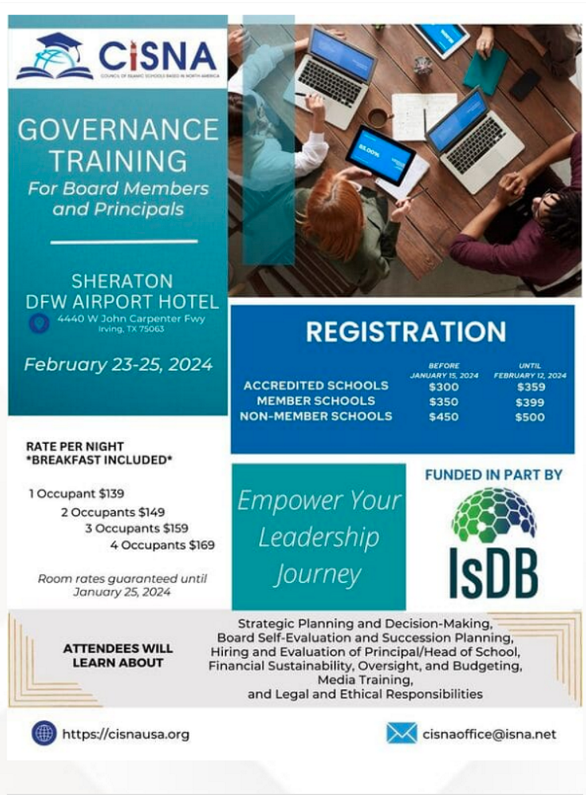
CISNA school administrator professional development training, partially funded by IsDB.
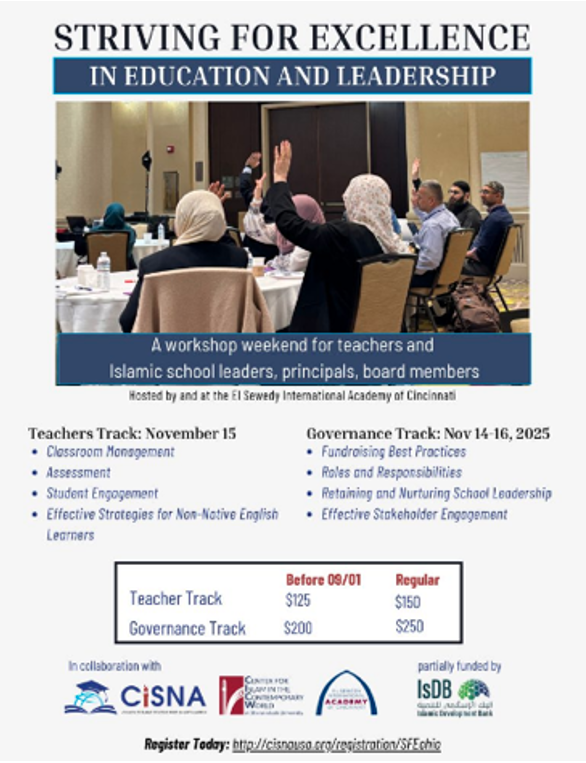
CISNA educator and administrator workshop, partially funded by IsDB.
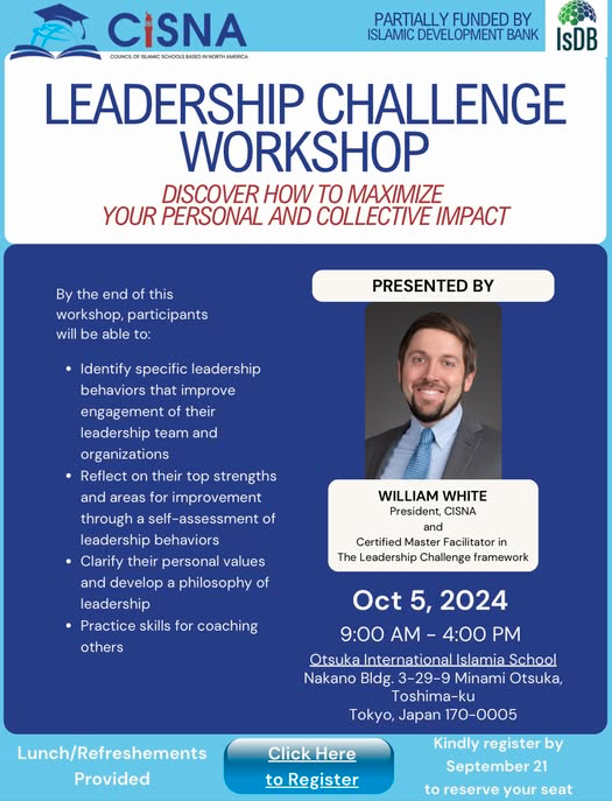
CISNA Leadership Challenge workshop, partially funded by IsDB.
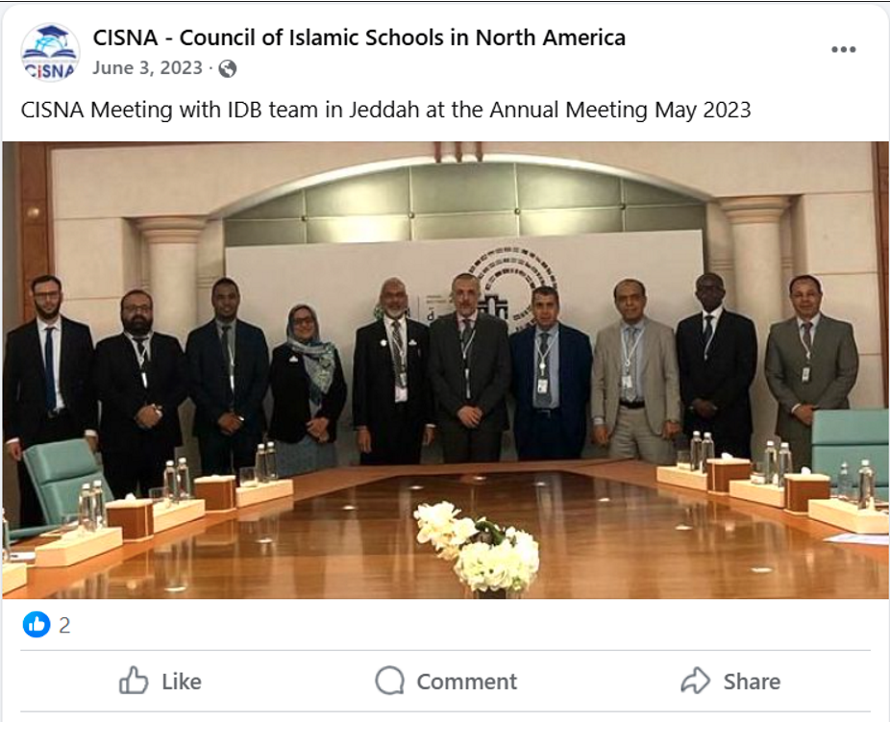
CISNA meeting with IsDB team in Jeddah, Saudi Arabia, May 2023.
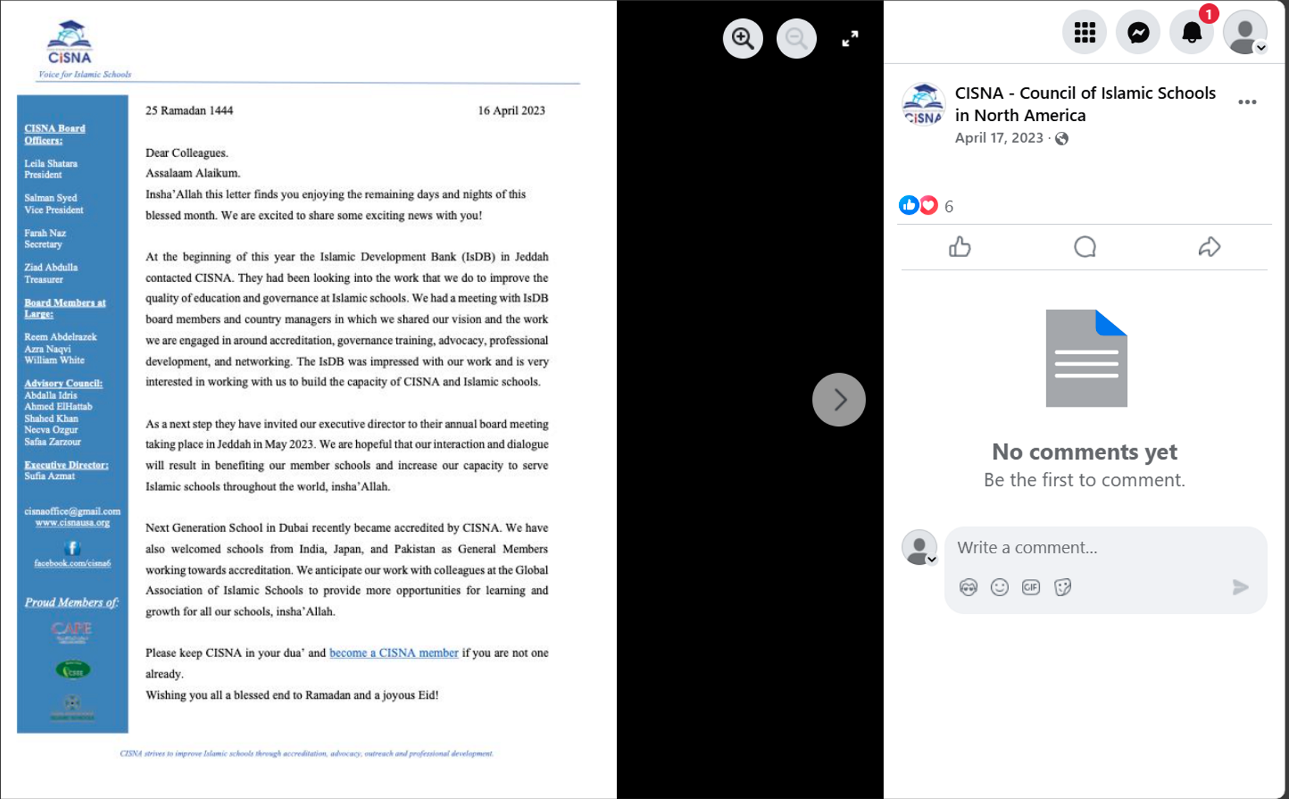
CISNA letter confirming IsDB’s interest in building CISNA capacity, April 2023.
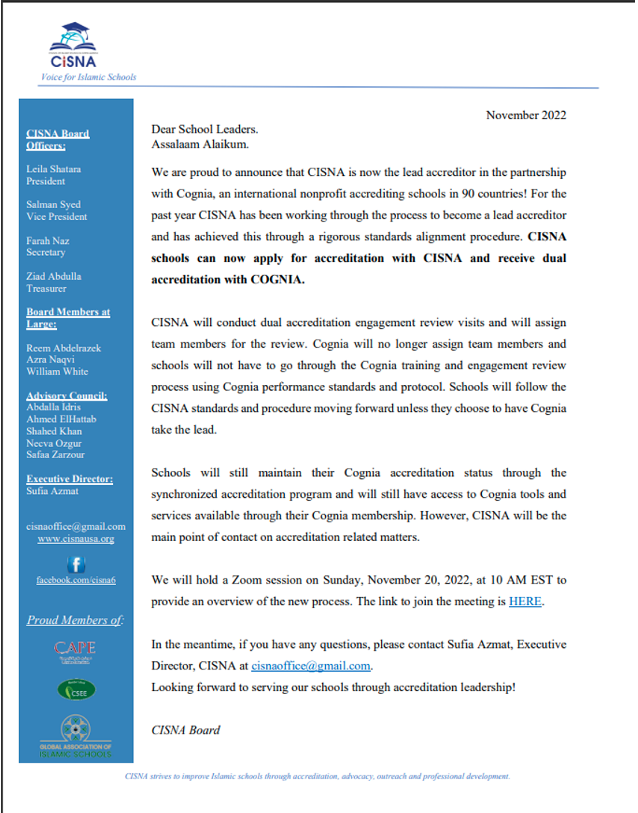
CISNA letter confirming its lead accreditor status in partnership with Cognia, November 2022.
CISNA’s Founding and the Muslim Brotherhood
In the United States, as in Europe, the Muslim Brotherhood has encouraged the creation of organizations, even if it does not exercise formal authority over them. Extensive information about the Brotherhood in the United States became public after the Holy Land Foundation (HLF) terror finance trial, which concluded in 2008 with the conviction of all defendants for providing support to Hamas.41
In the United States, Brotherhood members played an integral role in establishing the Muslim Students Association (MSA) in 1963, followed in 1973 by the North American Islamic Trust (NAIT), whose purpose was to support MSA financially. Next came the Islamic Society of North America (ISNA), an umbrella group for the growing Brotherhood network. An associated think tank, the International Institute for Islamic Thought (IIIT), launched in 1980.42
In 1989, ISNA hosted a symposium that birthed the idea of “a mechanism for cooperation and communication among full-time Islamic schools” across North America. This led to the formation of CISNA in 1991.43 Today, CISNA is the only global accreditation organization for Islamic schools. As the organization’s website explains, “CISNA Accreditation provides a means to review and evaluate all aspects of a school’s program with an Islamic lens.”44
During the HLF trial, prosecutors included NAIT and ISNA on their list of unindicted co-conspirators, along with the Council on American-Islamic Relations (CAIR). Both NAIT and ISNA denied any wrongdoing associated with the HLF trial, stating that they “had not criminally conspired with the defendants or anyone else.”45 In a statement, “Dispelling Rumors About CAIR,” the organization claimed that “CAIR is an independent American institution. CAIR is not and has never been an affiliate, offshoot, chapter, or agent of any foreign movement, organization, political party or government.”46
There is no indication CISNA was investigated as part of the HLF trial.
Private School Accreditation
In 2008, CISNA collaborated with AdvancED, a global accrediting body, “to identify unique religious and academic program requirements for Islamic Schools to provide Islamic Organizational Context for Standards Assessment and Quality Assurance Review Visits.” In 2011, CISNA and AdvancED, now rebranded as Cognia, developed a partnership to “accredit Islamic Schools with an added Islamic component.” CISNA began accrediting schools outright in 2012, and in 2022 CISNA achieved “lead accreditor status with Cognia (previously AdvancED).”47 This resulted in several important changes:
- CISNA schools are now eligible for dual CISNA-Cognia accreditation by applying solely through CISNA
- CISNA will be the sole authority providing accreditation review services for Islamic schools
- Schools will follow CISNA standards and procedures related to accreditation unless they opt to have Cognia take the lead
- CISNA “will be the main point of contact on accreditation related matters”48
Schools that hold Cognia accreditation maintain that status. Yet CISNA now has power and control over academic standards and school governance, even for Islamic schools that have Cognia accreditation. There are approximately 58 K-12 Islamic schools that hold Cognia accreditation and 32 that hold dual Cognia-CISNA accreditation. Prior to seeking accreditation, a school must become a CISNA member, a status that provides schools with discounts on webinars and conferences, supports schools in seeking available state and federal funding, allows schools to advertise job openings on the CISNA website, offers eligibility to apply for CISNA accreditation, and provides the ability to vote in CISNA board elections.49 There are an estimated 300 K-12 Islamic schools in America, serving 50,000-60,000 students.50
CISNA Timeline
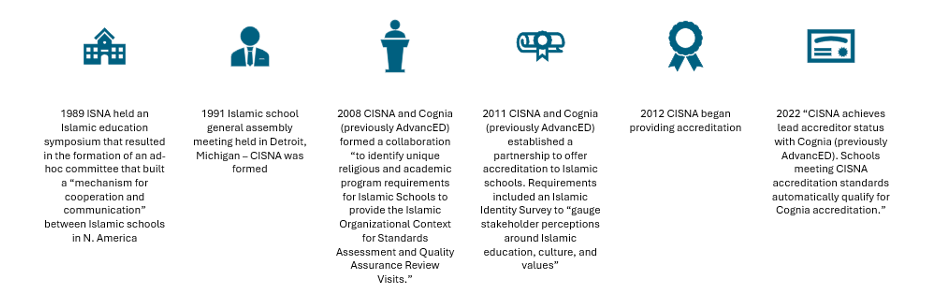
Timeline of CISNA’s organizational history. Source: Image created by FDD using text from CISNA’s website.
School Choice Programs
There are 75 school choice programs in 34 states and Washington, DC, serving more than 1.5 million students.51 The broad purpose of these programs is to enable more families to afford tuition at private schools, including religious schools. The programs work differently from state to state, relying on mechanisms such as tuition vouchers or tax credits and deductions. On July 4, 2025, President Donald Trump signed the first federal school-choice program, the Freedom Scholarship Tax Credit (FSTC), into law. So far, 29 states have opted into the FSTC program.52 According to estimates, state private-school-choice programs have spent more than $10 billion over the past year.53
Unfortunately, school choice programs may have the unintended effect of using taxpayer dollars, directly or indirectly, to subsidize tuition at schools subject to foreign influence. The beneficiaries of school choice programs have included institutions that received grants from IsDB or accreditation from CISNA. Of the states listed above, Florida, Georgia, Ohio, Pennsylvania, and Texas have school choice programs, while Michigan, New Jersey, New York, and Washington do not.
Florida has offered a school choice program since 2001, when Florida Tax Credit (FTC) legislation became law, allowing low-income families to access private schools of their choice. In 2002, the Islamic Academy of Florida (IAF) received approximately $300,000 in public funding. In 2003, the state removed IAF from the voucher program after terrorism charges were filed against Sami al-Arian, the school’s co-founder.54 A new state law expanded Florida’s school choice program to all Floridians, not just low-income families, in March 2023.55 Florida school choice participants receive an average of $8,000 per student.56
Georgia offers three school choice programs:57 The Georgia Promise Scholarship Act,58 Qualified Education Expense Tax Credit,59 and Georgia Special Needs Scholarship Program.60 All three of the state’s CISNA accredited schools participate in Georgia’s QEE program.61 The 2027 Georgia state budget allocates $100 million for the state’s Promise Scholarship program, which serves 8,000 students.62
Ohio offers eight private-school choice programs for students, including school voucher programs, tax-credit scholarships, and individual tax credit programs.63 The state spends over $1.1 billion annually on school choice programs,64 serving over 100,000 students.65
There are two private school choice programs in Pennsylvania: the Pennsylvania Educational Improvement Tax Credit and Pennsylvania Opportunity Scholarship Tax Credit.66 Tax credit scholarships reach over 100,000 students, amounting to over $575 million per year.67
The Texas Education Freedom Accounts (TEFA) school voucher application opened on February 4, 2026.68 The following month, three Islamic schools, along with parents, filed a religious discrimination suit because the schools could not participate in TEFA.69 This stemmed from their alleged ties70 with CAIR, which Texas designated as a foreign terrorist organization the previous November.71 Shortly before the TEFA application process opened, the state attorney general gave the state comptroller “full authority to stop taxpayer funds from going to schools illegally tied to terrorists or foreign adversaries.”72 As a result of legal challenges, the comptroller approved the participation of two Islamic schools,73 including Brighter Horizons Academy.74 The school received almost $1 million from IsDB and used textbooks that praised extremist clerics.75
Chinese Influence in American K-12 Classrooms
On November 17, 2004, the University of Maryland opened the first Confucius Institute in the United States, with the stated goal of promoting the study of Chinese language and culture.76 Within a little over a decade, the number of Confucius Institutes shot up to 118, hosted by 110 colleges and universities, seven school districts, and one private organization.77 Yet, these institutes soon wilted even more rapidly than they sprouted up. By the end of 2023, only 10 remained.78
What drove this reversal was a backlash against the growing influence of the Chinese government in U.S. higher education. In 2014, as new institutes continued to open, the American Association of University Professors warned:
Confucius Institutes function as an arm of the Chinese state … Most agreements establishing Confucius Institutes feature nondisclosure clauses and unacceptable concessions to the political aims and practices of the government of China. Specifically, North American universities permit Confucius Institutes to advance a state agenda in the recruitment and control of academic staff, in the choice of curriculum, and in the restriction of debate.79
Few schools heeded this warning until Congress forced administrators to choose between Chinese government funds and U.S. government support. In 2018 and 2020, Congress inserted provisions in the National Defense Authorization Act that barred universities with Confucius Institutes from receiving certain types of federal funding, in particular from the Defense Department.80
The legislation did not directly impact Confucius Classrooms — Chinese language and culture programs in K-12 public schools, often supported by a nearby campus-based Confucius Institute. Much less is known about Confucius Classrooms than about the institutes. A 2017 study by the National Association of Scholars found 501 Confucius Classrooms operating in U.S. primary and secondary schools.81 An investigative report by the Senate Committee on Homeland Security and Governmental Affairs found that Confucius Institutes exercised substantial control over classroom programming. According to one agreement for a Michigan classroom, the partner institute would be “responsible for the management of the Confucius Classroom, including developing annual activity plans, budgets and final accounts for the Confucius Classroom and submitting to the Headquarters for approval.”82 In 2020, Secretary of State Mike Pompeo and Secretary of Education Betsy DeVos sent a letter to top school officials in the 50 states warning them:
Over the last decade, the authoritarian government of the People’s Republic of China (PRC) has sent curriculum and PRC-trained teachers into hundreds of U.S. K-12 schools through a program called Confucius Classrooms. Styled as a language and culture program, Confucius Classrooms are in reality an important element of the PRC’s global influence campaign, now reaching tens of thousands of U.S. schoolchildren every day.83
The shuttering of Confucius Institutes affected the 500 classrooms in different ways. There are documented cases where the institute handed off responsibility to a new, off-campus partner. The names of some of these partners, such as the Greater Miami Asian Business Coalition, provide little indication of whether they are involved in K-12 education or have any connections to Beijing.84
New information continues to emerge about nonprofits assuming the role that Confucius Institutes once played in managing Confucius Classrooms.85 The Center for Bridging Cultures (CBC) is a K-12 education nonprofit based in northern Virginia, just outside the nation’s capital. CBC helps to bring teachers from China into American classrooms, provides teaching resources and curricula, and organizes student exchange trips to China, according to K-12 public school documents.86
CBC does not advertise whether it has any connections to Beijing, but there are multiple signs suggesting it could. The executive director of the center is Gao Qing, the longtime director of the Confucius Institute U.S. Center, which the State Department described as “the de facto headquarters of the Confucius Institute network.” In August 2020, the State Department designated the headquarters as a foreign mission of the People’s Republic of China, calling it “an entity advancing Beijing’s global propaganda and malign influence campaign on U.S. campuses and K-12 classrooms.”87
When Alfred University in New York was in the process of closing its Confucius Institute in 2023, administrators worked with Gao Qing and CBC to preserve the university’s ties to China University of Geosciences. An email released in response to public records requests shows that the university turned to CBC to help arrange visas for Chinese instructors and preserve its Chinese language program.88
Beijing Language and Culture University (BLCU) lists the Center for Bridging Cultures as one of its “global institutes” — a category that previously included many campus-based Confucius Institutes in the United States — and refers to CBC filling the roles that the Confucius Institutes once played.89 According to the BLCU website, CBC “plays a crucial role in continuing and expanding the Chinese language programs for K-12 schools and communities that were previously offered by Confucius Institutes and Confucius Classrooms.”90 The center’s tax filings show that it has distributed funds across several public-school districts, as well as Washington, DC’s Chinese-immersion charter school.91
Buying in to America’s Private Schools
The Spring Education Group (SEG), a subsidiary of Hong Kong-based Primavera Holdings, has built a sprawling network of over 200 schools across 19 U.S. states. It has acquired schools from at least 27 different brands, including Montessori schools and BASIS Independent Schools, which have been celebrated for their top-tier STEM programs.92
Primavera previously owned the Princeton Review and Tutor.com and provided capital to ByteDance, the parent company of TikTok.93 Tutor.com holds a longstanding Pentagon contract to provide tutoring services to American service members and their families, which prompted Senator Tom Cotton to write to then-Secretary of Defense Lloyd Austin warning that Chinese national security laws could compel the company to hand over user data directly to Beijing.94 Tutor.com was later sold to an American company. However, there is cause for concern about Primavera and SEG having access to student and family information at elite private schools.
The founder of Primavera Holdings, Fred Hu, was reported by the New York Post to have previously been a senior member of the Chinese Communist Party (CCP). Both Primavera and SEG have denied that Hu holds party membership.95 However, according to the state of Florida, SEG-owned schools serve as a vector for Beijing’s influence. After a Florida Department of Education probe, four schools owned by SEG were suspended from school-choice scholarships. Governor Ron DeSantis declared, “We will not put up with any attempt to influence students with a Communist ideology or allow Floridians’ tax dollars to go to schools connected to foreign adversaries.”96 What exactly the Florida probe uncovered remains unclear. The four schools denied ties to the CCP.97
Policy Recommendations
There is no system in place to monitor or preclude foreign influence in K-12 education in the United States. Yet as awareness of this problem grows, so have nascent efforts to address it.
At the federal level, the House of Representatives passed the Transparency in Reporting of Adversarial Contributions to Education (TRACE) Act in December 2025 by a vote of 247-166. The Senate has yet to act. The bill would make federal K-12 funding contingent on schools giving parents a right to request information about funding from “a foreign country or foreign entity of concern” as well as any conditions attached to that funding. Parents would also be able to examine curricular or professional material purchased with foreign funds. This requirement would be a step toward greater transparency.
Still, even if the TRACE Act were signed into law, it may be possible for foreign governments to evade scrutiny by establishing U.S.-based nonprofits that distribute funding and monitor it. To address that concern, Congress could mandate greater transparency for tax-exempt nonprofit organizations. For example, it could direct the IRS to identify nonprofits with defined connections to entities on the Pentagon’s 1260H list, which identifies Chinese military firms, or the 1286 list, which covers foreign universities whose activities threaten national security. This identification could deter schools from accepting any funding from these entities, or states could require schools to report such funding.
Georgia became the first state to require disclosure of foreign funding in K-12 schools. In March 2026, its General Assembly passed HB 1379, the Foreign Funding Transparency and Accountability Act,98 which the governor signed into law in May. HB 1379 requires Georgia public schools to submit reports regarding “funding received from foreign sources.”99 The legislation was introduced after reports documented Qatari funding in Georgia K-12 public schools.100
Another potential means to increase transparency in the nonprofit sector would be for Congress to amend the Foreign Agents Registration Act (FARA) so it no longer exempts foreign agents from the requirement to register if they engage in educational activities. Congress is beginning to address this loophole with proposed legislation such as the Preventing Adversary Influence, Disinformation, and Obscured Foreign Financing (PAID OFF) Act, which lawmakers introduced in both the House and Senate and was included in the Senate version of the National Defense Authorization Act for 2027. The bill would limit exemptions for agents of five “countries of concern” — namely China, Russia, Iran, North Korea, and Cuba — listed in the State Department Basic Authorities Act. The bill would also increase transparency for any entity claiming an exemption. If these provisions become law, they should expand to cover additional countries seeking influence in the U.S. education sector via nonprofit entities.
To ensure transparency not just in education, but across the nonprofit sector, it is also important to reform the fiscal sponsorship system, in which one tax-exempt nonprofit provides financial oversight and accepts donations for others. In practice, this arrangement can obscure who exerts de facto influence over an organization. The Fiscal Sponsorship Transparency Act, introduced in both the House and Senate, would increase reporting requirements for nonprofits with opaque fiscal sponsors. The House Ways and Means Committee marked up the bill in July and voted it out of committee, so it may proceed to a vote.
Lastly, to prevent foreign countries from buying influence via investment in private educational institutions, the federal government should consider utilizing the Departments of State and Education to review such investments. The process could draw on the model of the Committee on Foreign Investment in the United States (CFIUS), which evaluates foreign investments to assess their national security risks. The Treasury Department and the Commerce Department could detail staff to help evaluate the foreign influence behind educational investments.
Conclusion
The American K-12 education system is vulnerable to foreign influence. Neither federal nor state governments have developed mechanisms to ensure the transparency, or even rigorous scrutiny, of foreign funding and related programs. Foreign entities have taken advantage of this to extend their influence without raising alarms among either parents or lawmakers. Yet as awareness of the problem grows, so have calls for transparency and oversight. Ultimately, the best way to protect K-12 education from foreign influence is to prohibit all foreign funding in America’s elementary and secondary classrooms.
Findings by State
Florida
Qatar Foundation International
Florida teachers have attended trainings hosted by QFI. For example, Jessica Furiosi, an advanced-placement (AP) world history teacher at Hagerty High School in Oviedo, Florida, posted online about how she attended the 2019 QFI Summer Institute, presented in partnership with the Duke Islamic Studies Center and Duke University Middle East Studies Center. Titled “Dimensions of the Middle East,” the five-day program was, according to its description, “… designed to introduce teachers to different dimensions of the Middle East. From social movements to geopolitics to cultures and more…”101
One session,102 “Mapping the Middle East,” was led by Professor Akram Khater, director of the Khayrallah Center for Lebanese Diaspora Studies at North Carolina State University.103 QFI’s teacher training programs often partnered with university professors who specialize in the Middle East. In a blog post describing what she learned, Furiosi wrote that “the modern nation-state of Israel was created post-World War II as a ‘homeland’ for the Jews but that mean kicking out the Muslim Palestinians who were living there to make room for the diaspora fleeing Europe post-Holocaust.”104 As part of the workshop, Furiosi developed a lesson plan related to the Middle East and feminism. In describing a photograph depicting a Muslim woman wearing a veil, Furiosi wrote, “while many Muslim women find this practice empowering and affirmative of their religious identities, the veil has been coded in Western eyes as a sign of Islam’s oppression of women.”105 The plan does not mention Islamist regimes’ reliance on coercion, including violence, to enforce veiling requirements.
Furiosi, who is Catholic,106 also said teachers went to the Islamic Center of Raleigh and prayed: “It was also a wonderful experience to pray in the mosque for the afternoon prayers,”107 she wrote.
Islamic Development Bank
IsDB provided money directly to at least four private K-12 Islamic schools in Florida.
The Islamic Academy of Florida (IAF) received $284,000. The purpose of the funds was not disclosed. IAF was cofounded by Sami al-Arian. In May 2006, al-Arian was sentenced to 57 months in prison for “conspiring to violate federal law that prohibits making or receiving contributions of funds, goods or services to, or for the benefit of the Palestinian Islamic Jihad (PIJ).”108 After al-Arian’s arrest, IAF parents and school administrators developed a plan to dissolve IAF and found a new school. In 2004, the American Youth Academy (AYA) opened in the same location, using the same desks and books.109 AYA received $390,000 from IsDB to construct and equip a new building.110
IsDB gave the Muslim Academy of Central Florida (MACF) $279,000 for construction.111 MACF was renamed Leaders Preparatory School (LPS) and “moved into a new building constructed in 2000,” becoming the first “accredited private Islamic School in Central Florida,” according to its website.112
The Islamic Foundation of South Florida (IFSF) received $283,000 from IsDB for construction of a school building. IFSF, previously known as the School for Islamic Studies in Broward, opened a weekend school in 1989 to serve the growing Muslim community.113 As the school population grew, IFSF purchased 11.5 acres to develop a campus that includes a full-time school, a mosque, and other community space.114
China
Spring Education Group
SEG runs eight schools in Florida: the Chesterbrook Academy preschools in Palm Beach Gardens, Coconut Creek, and Port St. Lucie; Park Maitland Preschool; two Sagemont Preparatory Schools with a total enrollment of 398 students; and Park Maitland North Campus and Park Maitland South Campus with a total enrollment of 756.115 The Sagemont and Park Maitland schools were the target of Governor DeSantis’ probe.
Post-Confucius Classrooms
As noted above, the Greater Miami Asian Business Coalition (GMABC) has assumed responsibility for several programs previously administered by the shuttered Confucius Institute at Miami Dade College. A Chinese Ministry of Education official even asked the institute to transfer any remaining funds to GMABC, which went on to launch its “Language Bridge 2 Life Program” to place teachers from China in K-12 schools.116 On its website, the coalition highlighted scholarships for Chinese-language teachers through the Beijing Language and Culture University.117 According to the application, the scholarship is provided by the Center for Language Education and Cooperation (CLEC), which runs China’s Confucius Institute program worldwide.118
Georgia
Qatar Foundation International
QFI provided Amana Academy, a Fulton County charter school, a $30,000 grant in 2019 that funded “student travel award for global exchange” and another $46,600 grant in 2020 for additional student travel overseas.119 In a 2023 message on LinkedIn, Amana noted that its “relationship with QFI began more than a decade ago” and thanked QFI for the grant that enabled 14 students and three staffers to go on a nine-day cultural tour of Qatar.120 QFI also paid $995 for classroom books and Arabic games, which were used by at least 750 students.121
From 2021 to 2025, QFI gave five grants totaling at least $202,342 to Georgia State University to fund the Arabic Teachers Council of the South, which is made up of K-12 Arabic teachers and college-level instructors.122 During a March 2024 teacher workshop, attendees discussed how to protect themselves from parental criticism when introducing social justice lessons in their classrooms. One participant described how she teaches at a Christian school, and if she wants “to broach a topic that I am nervous about,” she “will talk to [the school’s] Diversity, Equity, and Inclusion coordinator first,” who can act as a “buffer” with parents.123
Islamic Development Bank
Hamzah Science Academy, a PK-7 school in Alpharetta, and Dar Un Noor, a PK-12 school in Atlanta, are both CISNA-member schools. Three schools are accredited by CISNA: Al Falah Academy in Norcross, ILM Academy in Roswell, and Mohammed Schools of Atlanta.
China
Spring Education Group
SEG runs six schools in Georgia, including five Carrington preschools and the Wood Acres School with 428 students.124
Post-Confucius Classrooms
According to the Beijing Language and Culture University’s website, Georgia is one of the states where CBC operates. However, there is no indication in any of CBC’s annual federal tax filings of money going to Georgia schools.
Illinois
Qatar Foundation International
Fadi Abughoush teaches Arabic at Chicago’s Lindblom Math and Science Academy high school, which received a $154,109 grant from QFI for the 2025-2026 academic year to support Arabic instruction. Most of the funding covers the salary and benefits of the position of an unnamed Arabic teacher.125 Abughoush is also very active in the QFI-funded Chicago Arabic Teachers Council.126 He has also been training other teachers for multiple organizations,127 including the Council of Islamic Schools based in North America (CISNA).128 In addition, several State Department-funded student exchange programs have worked with Abughoush, including NSLI-Y, iEARN, and Global Nomads.129
In 2024, QFI honored Abughoush with its Teacher Excellence Award.130 His Instagram posts from that period show his consistent support for Hamas.131 On October 7, 2023, the day Hamas butchered 1,200 people in southern Israel, Abughoush posted a graphic showing Israeli armaments on one side and a Hamas assault glider on the other. The text asks why Israeli arms count as a form of self-defense while the actions of Hamas constitute terrorism. On October 21, 2024, five days after Israeli forces killed Hamas military chief Yahya Sinwar, Abughoush posted a sketch of Sinwar’s reported final moments132 with a quote attributed to Sinwar that reads, “The world expects us to be well behaved victims.” Another post features a cartoon with the title “Kosher,” in which Israeli Prime Minister Benjamin Netanyahu eats the flesh of Palestinian children while U.S. President Joe Biden pours him a glass of blood — echoing a blood libel that for centuries provided a pretext for antisemitic violence.133
In April 2024, Abughoush posted on Facebook about his class’s yearly visit to a Chicago-area mosque, the Mosque Foundation, run by Sheikh Jamal Said, who has discussed his support for Muslim Brotherhood members. Along with photos of the excursion, Abughoush thanked QFI “for always supporting us making these beautiful field trips.”134 In 2007, in prosecuting the Holy Land Foundation for funneling more than $12 million to Hamas, the Justice Department identified Jamal Said as an unindicted coconspirator.135 During a deposition of Mosque Foundation leadership, Said denied being a member of the Muslim Brotherhood or the Palestine Committee.136 However, Said admitted to signing checks from the Mosque Foundation to HLF. He also acknowledged that in his role as chairman of the Mosque Foundation’s zakat, or charity, committee, he was responsible for vetting organizations that received these funds.137
Also in Chicago, Lincoln Park High School (LPHS) received an $88,510 grant in August 2021 to fund teaching staff in the Arabic Language Education Program.138 Emails between school officials and QFI show that LPHS struggled to attract students into the program.139 In the 2024 progress report it submitted to QFI, LPHS said it tried to recruit students from three nearby elementary and middle schools.140 QFI suggested that LPHS apply for an Arabic Afterschool Enrichment Grant to attract students who could later enroll in a full-time in-school program. QFI then awarded a $24,181 grant for afterschool programming for the 2024-2025 academic year.141
Lincoln Park High School reported to QFI that the after-school program had lessons on how Qatar is a “modern Arab nation” and one about Sheikha Moza bint Nasser’s advocacy.142
Illinois teachers also attended QFI-funded teacher trainings where they created lesson plans for the classroom using what they learned during the sessions.143 Zack Crandall, a social studies teacher at Buffalo Grove High School, was part of QFI’s Teacher Leadership Program (TLP) in 2018-2019. The program partnered with University of Texas at Austin’s Center for Middle Eastern Studies. One of TLP’s major goals was to help K-12 teachers “develop the classroom-ready curricula …[on] themes related to the Middle East and the Arabic language.”144
A 2022 TLP training in Chicago was headed by James Gelvin, a UCLA professor who previously said he supports the Boycott, Divestment, and Sanctions (BDS) campaign, raising questions about the content of the messaging provided to trainees.145
As a TLP participant, Crandall attended a two-day workshop at the University of California, Berkeley in May 2019.146 QFI offered to pay the school district for a substitute teacher so Crandall could attend, which it often did to facilitate participation.147
Crandall subsequently used QFI funds to purchase classroom books148 including Palestine Inside Out: An Everyday Occupation by Saree Makdisi, which does not refer to Hamas as a terrorist organization and attributes Hamas’s rise to popularity to its ability to grasp the “Palestinian language of self-determination and national liberation.”149 The book also asserts the disputed claim150 that Israel engaged in the ethnic cleansing of Palestinians in 1948.151 Crandall developed multiple lesson plans on the Middle East while enrolled in the QFI program and sent QFI his lesson plan on the Palestinian-Israeli conflict.152 The plan refers to “Palestinian Resistance to Israeli Rule,” without reference to Hamas or terrorism.153
Islamic Development Bank
Four private Islamic K-12 schools received a total of $1,529,000 in funding from IsDB.154 The American Islamic College of Chicago received $460,000, with no listed purpose for the funds. The Universal School in Bridgeview received $389,000 for construction. Aqsa School in Bridgeview, a PK-12 girls’ school, received $190,000 for construction, while the Islamic Foundation School in Villa Park was granted $300,000 for its extension. IsDB did not list a purpose for its $650,000 grant to IQRAA Academy in Rockford.155
There are five schools in Illinois with CISNA accreditation and an additional six that hold CISNA membership.156
China
Spring Education Group
SEG owns the seven Chesterbrook Academy preschools in the towns of Wheaton, Westmont, Lisle, Bartlett, Naperville, Shorewood — all in the Chicago area — as well as in Champaign.
Post-Confucius Classrooms
The Confucius Institute in Chicago (CIC) was established in 2006 as a three-way partnership between the City of Chicago/Chicago Public Schools (CPS), East China Normal University (ECNU), and the Chinese Ministry of Education-affiliated office known as Hanban. This makes CPS one of the earliest K-12 district-level Confucius Institutes in the country, and notably, one of the few institutes hosted by a school district rather than a university.157 ECNU, like many Chinese universities, partners with defense-related entities as part of Beijing’s military-civil fusion program.158
The CPS Chinese World Language Program has seemingly absorbed the Confucius Institute’s K-12 programming. A single individual, Jane Lu, served simultaneously as both director of the Chicago institute and the CPS Chinese World Language Program.159 Public records from CPS confirm grants to the Office for Multicultural-Multilingual Education in support of the World Language Program for the 2025-2026 school year coming directly from the Confucius Institute of Chicago, which amounted to over $290,000 for fiscal year 2026.160 Despite reports of the Chicago institute’s closure in 2020, public records list the institute as a source of grants for CPS for the 2025-2026 academic year. This suggests the institute remains active, even though it has no public presence online or elsewhere.161
Michigan
Islamic Development Bank
Three Michigan schools received a total of $745,000 from IsDB. Michigan Islamic Academy in Ann Arbor received $200,000, and the Greater Lansing Islamic School in East Lansing received $250,000 — the IsDB website does not indicate the purpose of the money. Crescent Academy International in Canton received $295,000 from IsDB for expansion.162 There are six CISNA-affiliated schools across Michigan, all of which receive direct financial support from IsDB or indirect support thanks to the IsDB partnership with CISNA.
China
Post-Confucius Classrooms
The former director of Western Kentucky University’s Confucius Institute, Terrill Martin, now runs BG Education Management Services (BGEMS), a nonprofit focused on language education. According to the BGEMS website, it provides language instruction, places foreign-language teachers in schools, and supports “35 foreign language teachers across Kentucky, Michigan, Minnesota, and Louisiana, impacting over 14,000 registered students.”163
BGEMS’s website indicates it has an active partnership with North China Electric Power University (NCEPU), which had previously served as the Chinese partner supporting the Confucius Institute at Western Kentucky University (WKU). A timeline on the BGEMS website indicates that BGEMS came into existence after the closure of the WKU institute, “To continue [its] Mandarin Language Teacher Program and Cultural Exchange Programs.”164
New Jersey
Islamic Development Bank
At least a dozen New Jersey K-12 private Islamic schools receive direct financial support from IsDB or indirect support thanks to the IsDB partnership with CISNA. Al-Ghazaly High School in Wayne, a CISNA member school, received $270,000 directly from the bank to purchase a school building.165
China
Spring Education Group
SEG operates four Chesterbrook Academy preschools in New Jersey with campuses in Voorhees, Sewell, Moorestown, and Marlton, all near Philadelphia.
Post-Confucius Classrooms
According to the Beijing Language and Culture University (BLCU) page for CBC, New Jersey is one of the states where CBC operates.166 CBC’s federal tax filings show that it has given money to the Elite Preparatory Academy in Hopatcong.167
New York
Qatar Foundation International
Rita Lahoud, an Arabic teacher at PS 261 in Brooklyn’s Boerum Hill neighborhood, received QFI’s Teacher Excellence Award for 2023.168 From 2015 to 2024, QFI gave the school at least $608,943, mainly to cover salary costs. In its citation for the award, QFI noted Lahoud’s founding of “social justice program that provides opportunities for her students to connect with children living in refugee camps.”169 In partnership with Lahoud’s nonprofit, Go Project Hope, students prepared hygiene kits with Arabic messages for refugees in Greece, mainly from Syria.170 During the war that began with the Hamas-led October 7, 2023, attack on Israel, Go Project Hope has established soup kitchens across Gaza,171 while setting up a food distribution center,172 an early childhood learning center,173 and a tent school.174
Go Project Hope frequently accuses Israel of genocide and ethnic cleansing175 on its Facebook page. In an appeal for donations, Lahoud’s group asserts Israeli responsibility for “a man-made famine” in Gaza.176
In 2023, QFI posted an image from Lahoud’s classroom, showing a map on the wall in which Israel is labeled “Palestine.” Lahoud did not respond to a journalist’s request to comment on the map. Attention from journalists and parents led QFI to delete its post and the school to take down the map.177
Separately, in December 2023, a federal judge sentenced NuDay Syria, a partner of Go Project Hope, to five years of probation and a $25,000 fine after the group pled guilty to three federal counts of failure to file export information.178 According to an FBI investigation, the group knowingly lied about the value and destination of the goods it shipped and failed to disclose items it sent to Syria. Go Project Hope posted photographs showing activities in which it partnered with NuDay Syria in Syria up until four weeks before the U.S. Justice Department announced NuDay Syria had pled guilty.179 Go Project Hope was not named in the announcement.
Also in Brooklyn, QFI gave PS/IS 30 in Bay Ridge at least $960,930 from 2017 to 2025. Most of the funding went to pay for teaching assistants and paraprofessionals in the school’s Dual Language Arabic Program for students from kindergarten through fifth grade.180
Islamic Development Bank
New York is home to at least five schools with CISNA accreditation. In addition, two schools received funds from IsDB. The Bronx Muslim Center’s Andalusia Islamic School received $250,000 for renovations and supplies, and the Al-Ihsan Academy in Queens was granted $280,000 for renovations and upgrades.181
China
Spring Education Group
SEG owns two schools in New York: BASIS Independent Upper and Lower School in Brooklyn with 676 students and BASIS Independent Upper and Lower School in Manhattan with 292 students.182
Post-Confucius Classrooms
The China Institute in America is a New York City-based nonprofit founded in 1926 that operates gallery programs, cultural events, and K-12 teacher training programs that reach into American classrooms.183 Since 2019, the institute has housed the ECNU Center, a collaboration with East China Normal University (ECNU), a Shanghai institution. ECNU is a state-administered institution co-funded by China’s Ministry of Education and the Shanghai Municipal People’s Government, and it maintains ties to China’s defense and military establishment, including links to the Chinese military-civil fusion program.184
In 2006, the institute and ECNU established the China Institute’s Confucius Institute (CI@CI), which operated inside the nonprofit’s New York headquarters until the wave of Confucius Institute closures. Rather than ending the partnership, the institute established the ECNU Center in April 2019, erasing all mention of CI@CI on its website. That same year, the China Institute stopped filing Schedule F (“Statement of Activities Outside the United States”) with the IRS, suggesting that the ECNU partnership is now operating solely as a domestic entity within the China Institute in America.185
The China Institute’s Teacher Certificate Program, launched in March 2023, awards a joint credential, issued by both the China Institute and ECNU, to K-12 teachers who complete monthly cultural seminars led by ECNU faculty.186 The program is funded by the same Ministry of Education office that oversees the global Confucius Institute network. Another initiative, Project CLL, recruits cohorts of 25 K-12 Chinese-language teachers from New York schools and awards Continued Teacher and Leadership Education (CTLE) professional development credits recognized by New York State.187 At least one New York City Department of Education public school teacher at PS310 in Brooklyn is a participant in the program.188 Further, the China Institute’s New York International Conference on Teaching Chinese, now in its 24th year, is co-sponsored in 2026 by an entity within the Ministry of Education.189 Finally, the ECNU Center and the Center for Language Education and Cooperation (CLEC) — the alleged successor to Hanban as the manager of Confucius Institutes190 — are sponsoring the 2026 China Institute Teacher Certificate Program, underlining their continued ties to the Confucius network.191
In addition to the China Institute in America, the Center for Bridging Cultures (CBC) is active in several school districts across New York. As noted above, it has taken over Alfred University’s Chinese-language instruction program.192 According to CBC’s federal tax filings, it funds programs in both private and public K-12 schools and Bard College in New York.193
Ohio
Qatar Foundation International
Documents from the Shaker Heights school district show that QFI tried to recruit teachers for training sessions and trips abroad. It is unclear whether they were successful in doing so. QFI described one 2019 program in Jordan as a “funded cultural immersion trip” for K-12 educators during the summer. The nine-day trip had participants from the United States and Qatar “exchange ideas and teaching strategies.”194
QFI advertised another “funded cultural immersion trip” to Qatar and Oman set for March 2020.195 A press release196 from a Kentucky high school said one of its Spanish teachers was selected for an earlier version of the trip, which planned to include visits to the Grand Mosque of Oman, Al Jazeera in Qatar, and trips to local schools. QFI ran a similar trip the previous year, partnering with the Center for Middle Eastern Studies at the University of Texas at Austin. The 2019 itinerary shows that teachers visited the Sultan Qaboos Grand Mosque in Oman, Qatar’s State Mosque, and Qatar Foundation’s headquarters.197
Islamic Development Bank
The Cincinnati ISL Center School received $190,000 from IsDB to purchase a building.198 Ohio is home to at least three other schools with CISNA accreditation or membership: Al Bayan Academy in Middletown, Ohio Ihsan Academy in Dublin, and El-Sewedy International Academy of Cincinnati in West Chester.199
China
Spring Education Group
SEG owns seven schools in Ohio, including six Enchanted Care Learning Center preschool campuses and one Ready Set Grow preschool campus.
Post-Confucius Classrooms
The East Central Ohio Educational Service Center (ECOESC) is a publicly funded regional education agency headquartered in New Philadelphia, that delivers Mandarin Chinese instruction to K-12 students across the region via Interactive Video Distance Learning, a summer study program in China, and a weekend Chinese immersion trip to Flushing, New York.200 What ECOESC’s own current website omits is a third-party course catalog published in 2018 that still says ECOESC is “one of just five K-12 Confucius Institutes within the United States.”201 All Confucius Institute branding has been scrubbed from ECOESC’s public-facing materials, but the courses, the programming, and the infrastructure appear intact.
According to BLCU’s website, Ohio is one state where the Center for Bridging Cultures operates.202 CBC’s federal tax filing show that it has given money to the Global Ambassadors Language Academy in Cleveland.203
Pennsylvania
Islamic Development Bank
Pennsylvania is home to two CISNA member schools, Al Aqsa Islamic Academy in Philadelphia and Manarah Islamic Academy in Whitehall.204 Al Aqsa Islamic Society, an umbrella organization that includes Al Aqsa Islamic Academy, received a $5 million Redevelopment Assistance Capital Program grant from Pennsylvania Governor Josh Shapiro’s administration to expand classrooms and a gym.205 Universal Academy of Pittsburgh and Revival Ihya School in Macungie hold CISNA accreditation.206
China
Spring Education Group
SEG owns 24 Chesterbrook Academy preschools throughout Pennsylvania.
Post-Confucius Classrooms
According to the BLCU page for CBC, Pennsylvania is one of the states where CBC operates.207 CBC’s federal tax filing show that it has given money to Central High School in Langhorne.208
Texas
Qatar Foundation International
QFI awarded over $1.1 million to the Arabic Immersion Magnet School (AIMS) in the Houston Independent School District from 2015 to 2026. The money funded teaching staff, teaching consultants, classroom materials, and cultural events. After the partnership was launched in 2015, school officials in accordance with the contracts, allowed QFI staff and consultants to sit in on classroom instruction.209 This provision is common in QFI contracts for K-12 school districts.210 Emails between Houston school officials and QFI show that classroom observers went to AIMS multiple times from 2017 to 2019.211 QFI also asked to see teachers’ lesson plans prior to visiting.212 Another email shows that a QFI staffer shared criticism with an AIMS teacher after a classroom observation session, recommending that she have one-on-one coaching.213
From 2016 to 2022, QFI spent more than $462,000 in the Austin Independent School District to fund the Arabic Language and Culture program. Contracts show that QFI paid for Arabic instructors at Austin High School and at Burnet Middle School along with curricular materials and instructional resources.214
Teaching materials for QFI-funded program in Austin include an all-Arabic textbook published in 2008 by the Kingdom of Saudi Arabia Ministry of Higher Education. The book’s introduction warns against Zionist influence: “A man’s ignorance of Arabs and Arabic may lead him to hate Arabs, avoid them, or stand in the ranks of their enemies; this is precisely what we see today from many Westerners whose ignorance of Arabs allowed Zionists to manipulate them.”215
The teaching materials also include a guide to Arabic with examples from the Quran and politicized language in Arabic, such as, “Why does the West launch those unjust campaigns against the Arabs and Muslims?”216 Similar to the material from many other major U.S. cities, the Austin material includes multiple maps that label all of Israel as Palestine.217
Starting in 2020, QFI funded an annual summer Arabic culture and language camp hosted by Culturingua, a San Antonio nonprofit, in partnership with various schools across the San Antonio Independent School District. According to the Culturingua website, students were taught about the Arab world with a focus on six countries including Palestine, despite its lack of statehood.218
Islamic Development Bank
The Islamic School of Irving received $200,000 for construction, and Brighter Horizons Academy received $995,000 for construction, technology enhancement, and teacher training.219 Texas is home to more than a dozen schools with CISNA accreditation.
Texas is set to operate one of the largest school-choice voucher programs in the United States, which will offer IsDB-supported schools access to taxpayer funds.220
China
Spring Education Group
SEG owns the Honor Roll School with 578 students, Paragon Prep with 189 students, Merryhill School with 147 students, Paragon Prep preschool, and seven Xplor preschools in Texas.221
Post-Confucius Classrooms
ILTexas Global is a nonprofit “that operates the ILTexas Private High School in partnership with the International Leadership of Texas (ILTexas) charter school district to support and facilitate cross-cultural educational models and methods,” and has several partner schools in China.222 ILTexas Global also administered Confucius Classroom programming on behalf of China’s Ministry of Education until June 30, 2023, when according to a public financial statement, “the organization terminated the facilitation of the Confucius Classroom program.”223 Correspondence between ILTexas Global and a Chinese official indicates that, as late as May 2023, the former anticipated the signing of a new memorandum of understanding (MOU) with CLEC, the ministry arm responsible for Confucius networks, to replace the MOU previously held with IL Texas’s “Confucius Classroom Coordination Office.”224 There is no confirmation that a new MOU was later signed. Until at least September 2025, the ILTexas Global website stated, “Through our partnership with the Chinese Ministry of Education, ILTexas Global acted as an intermediary between the Ministry and school districts.”225 After receiving a request from FDD pursuant to the Texas Public Information Act for the release of records related to Confucius Classrooms, ILTexas Global removed this language.226
Washington
Qatar Foundation International
QFI has allocated at least $166,000 in funding for Seattle Public Schools, including Chief Sealth International High School. Contracts show that most of the funding was spent on teacher salaries, curricular materials, and teacher trainings.227
Islamic Development Bank
Medina Academy in Bellevue holds CISNA accreditation, and Risalah School of Excellence in Mill Creek is a CISNA member school.228
China
Spring Education Group
SEG owns four Evergreen Academy schools with 447 students, the Brighton School with 327 students, and two BASIS Independent schools in Washington with 593 students.229
Post-Confucius Classrooms
The Confucius Institute of Washington (CIWA) describes itself as “an international partnership involving Pacific Lutheran University (PLU), Sichuan University in China, Seattle Public Schools, Chongqing Jiaotong University, and The Alliance for Education.”230 CIWA’s Confucius Institute Education Center is located on the premises of a public school, the Chief Sealth International High School.231 The Australian Strategic Policy Institute notes that Sichuan University, PLU’s CI partner, is a high security risk considering its defense labs and military ties.232
The director of CIWA, Thad Williams, is an employee of Seattle Public Schools who works in language instruction and international education.233 In his role as a school official, Williams was also listed as the project director on QFI contracts for Seattle Public Schools’ Arabic programs from 2022 to 2026.234
Another intersection between CIWA and QFI is their support for OneWorld Now, a nonprofit that provides after-school foreign language classes to Seattle public school students. The group’s 2024 annual report listed both CIWA and QFI as institutional supporters.235 The 2019 edition listed CIWA and QFI as “partners and funders.”236
