May 4, 2026 | Memo
A Gameplan for American Economic Security:
Supercharging U.S. Statecraft, from an Economic Pentagon to the Near-Global Economy
May 4, 2026 | Memo
A Gameplan for American Economic Security:
Supercharging U.S. Statecraft, from an Economic Pentagon to the Near-Global Economy
“The conflicts of this age are likely to be fought with markets, not just militaries, and in boardrooms, not just battlefields. Geopolitics is now a game best played with financial and commercial weapons.” – Treasury’s War, Juan Zarate1
Introduction: Unleashing America’s Economic Power
The United States wields tremendous economic power. It is the largest economy in the world, issues the de facto international reserve currency, is home to the most important consumer market, and has the most dynamic private sector.
And yet, despite unparalleled strengths, American economic power has been both chronically underutilized, inadequately coordinated, and poorly operationalized. As former National Security Advisor H.R. McMaster has written, “U.S. administrations consistently undervalue the degree to which strategic application of economic power is essential for advancing US vital interests.”2
The 2025 National Security Strategy correctly states that the American economy is “the bedrock of our global position.”3 America must build upon that bedrock if we aim to protect that position. The Gameplan for American Economic Security proceeds from the core belief that we must use the power of our markets to defend our markets.
For decades, the United States felt little pressure to coordinate its economic statecraft capacities or develop new tools to support core national and economic security goals. With overwhelming military strength and no true economic rivals, Washington has generally used only a small fraction of its vast arsenal of economic power, implementing tools in isolation rather than as part of a unified strategy.4 Although the use of certain tools like sanctions has numerically increased over time, the United States has yet to develop a comprehensive approach to economic security, opting to rely on piecemeal strategies and often outdated doctrine. In particular, the United States has chronically underutilized economic power to address non-economic threats or to advance geopolitical interests.5
The world, however, has changed. Adversarial nations are increasingly unleashing economic attacks against American interests, taking advantage of vulnerabilities in our financial system, destabilizing trade, disrupting supply chains, undermining markets and industries, and laundering cash for cartels, cybercriminals, and corrupt regimes. A coercive China now acts as an economic pacing threat to the United States, while Iran, Russia, and North Korea actively deploy illicit economic weapons against us. Our adversaries are also growing their influence — through bribes or bullying — with third-party countries, pulling those countries into their orbit at America’s expense.
America can no longer accept a passive and reactive approach to economic security. It can no longer be satisfied with fragmented and siloed structures of economic power. America’s lack of economic imagination has cost it allies, influence, and opportunities for impact. A new approach to economic statecraft is long past due.6
Washington needs a comprehensive, coherent, and actionable plan to address threats to our economic security, constrain the agents of economic chaos, and build an economic playing field of fair rules and enforced consequences.
The Gameplan aims to provide policymakers with one such approach, laying out a vision for the application of unfettered U.S. economic power — resourced, coordinated, and intentionally designed — to protect national security, advance American interests, and support the prosperity of American citizens and companies.7
To realize that vision, the economic dogma of recent decades needs to evolve. America must rethink its role as the first-resort issuer of debt and last-resort purchaser of goods.8 America must reawaken and strengthen its manufacturing capacity. America must reinforce its supply chains — making them resilient, flexible, and free from foreign threats and intimidation. America must look towards new trade partnerships. And the world economy, under American leadership, must operate with more transparency and clear constraints on corruption, coercion, and criminal behavior that undermine market stability, fairness, and competitiveness.
These objectives, although ambitious, can be achieved. But to do so, America will need new policies, authorities, resources, and institutional capacity. America will also need its allies and partners.
To that end, the Gameplan is structured to address four key subjects: the Why (the principles we must defend), the What (the tools we must employ), the Who (the international alignments we must strengthen), and the How (the capacities we must develop) of coordinated, efficient, and impactful American economic statecraft.
The goal is to add creative and compelling ideas to contribute to a growing debate about what systems and strategies must come next. Not every question of implementation is answered in this document and not every proposed structure is set in stone. That is by design. We want the Gameplan to be the starting point of an important conversation, not the last word.
One Integrated Concept or a Menu of Options
The Gameplan is designed to provide pathways for either holistic or incremental approaches.
When viewed as a single, unified, and integrated concept, the Gameplan seeks to provide a comprehensive and coherent vision of how unshackled American economic power could be reoriented to better serve America’s interests. At the same time, not every policymaker and planner is looking for a grand reorientation. While the elements of the Gameplan are meant to interlink and reinforce one another, no single idea is essential to the operation of the rest.
Among the many midsized and modest suggestions we propose, there are four Big Ideas that we lay out in detail — concepts that could help America defend its supply chains, amplify America’s offensive economic power, support America’s allies and partners, extend the influence of America overseas, and improve the impact of America’s actions against its adversaries. The Big Ideas are:
- The Near-Global Economy — a vision for geopolitical alignment around shared economic principles and policies;
- Ally-shoring — a framework for building resilient supply chains with core allies while developing the adversarial off-ramp;
- The Economic Strike Force — a toolkit of options to support potential new partners by bolstering economic stability for countries undergoing political transition; and
- The Economic Pentagon — an economic security and statecraft control center for advancing American power and countering global threats.
These four mutually reinforcing ideas can work together to form a coherent blueprint for the strategic, and potentially maximalist, application of American economic power.
The Why: Economic Principles for American-Led, Near-Global Prosperity
In order to rethink how America should deploy its economic power, it is critical to establish why economic power should be used in the first place: to what ends, in what conditions, and with what limitations.
America’s failure to articulate its core economic principles and apply economic power in support of those principles has contributed to countless geopolitical missteps over the last 80 years, lengthening the Cold War and undermining the War on Terror. If American policymakers are not careful, they will run a high risk of replicating mistakes made after the fall of the Soviet Union or the rise of the Arab Spring. The lack of a cogent and credible gameplan has too often let potential allies fail and new adversaries rise, harming America’s interests and imperiling national security.
This is not a call for America to do everything, everywhere. American power cannot uphold every ethical nicety, police minor cultural preferences, or realize grand aspirational visions of a vague “global order.”
In other words, economic principles should not be moral precepts alone, unconnected to American interests or U.S. economic security.
America’s economic principles must explain — clearly and convincingly — the ideas behind our national interest. These principles should guide both what America can achieve (realistically) and what America must achieve (strategically).
We propose that America deploy its economic power to uphold four fundamental principles that enable true economic vitality: Stability, Freedom, Openness, and Fair Play. These principles are simple, and inherently beneficial for companies and individuals who work hard and follow the rules. Moreover, they represent a return to the basic values behind the great American experiment and to the fundamental concepts that underpin market economies.
Stability
Economic growth depends on stability.
Stability enables companies to plan, invest, hire, and innovate. Stability increases predictability, lowers risk, increases the relevance and value of collected data, and is a vital underpinning for property rights and enforceable contracts. Stability helps workers plan for retirement, helps families make life choices, and is critical for the budgets of people, companies, and countries.
War is tragic but also destabilizing. Using statecraft tools to constrain wars of aggression (that is, the offensive use of war to alter national boundaries) provides clear economic benefits.
Wars of aggression are an obvious rationale for forceful economic statecraft, but many other destabilizing actions could be similarly treated. It will require, however, more than the application of reflexive sanctions. Instead, agents of instability should face the full-scale deployment of coordinated economic power.
The application of forceful economic statecraft should be directed at eliminating:
- Threats of offensive or tactical use of nuclear weapons
- Support and funding terror or proxy violence
- Coups
- Civil wars
- Piracy and attacks on shipping and trade lanes
- State-sanctioned criminal activity, including drug trafficking, corruption, or cyberattacks
- Nuclear, biological, or chemical weapons proliferation
Freedom
Freedom is a core American principle. It is also a universal one. Authoritarian regimes twist logic and contort reality to claim that “freedom” is only a culturally contingent practice and that their repressive practices are a kind of freedom, if viewed through the right lens.9 We disagree.
No one chooses to be enslaved. No one chooses to be disenfranchised. No one chooses to be silenced or repressed.
But freedom is more than a political right. It is a key ingredient of economic growth for market economies. Freedom promotes economic development, entrepreneurial dynamism, supply chain diversification, and fair competition. Innovation derives from the freedom to dream big, think unconventionally, and act based on a business vision unconstrained by overbearing government intrusion. Limits on the rights of women to own property or on ethnic minorities to choose their occupation constrain economic potential. Forced labor undermines competitiveness and monetizes human suffering.
This does not mean that the United States should serve as the world’s morality police. But America must not timidly refuse to use its enormous economic power to punish stolen elections, disincentivize violent suppression of peaceful protests, or cut off trade with regimes that jail opposition leaders.
The application of forceful economic statecraft should be directed at eliminating:
- Slavery
- Child labor
- Human trafficking
- Stolen elections or citizen disenfranchisement
- Repression of civilians
- Refusal to protect the right to dissent
- Constraints on the property and political rights of certain groups
Openness
Economic growth thrives with open and accurate information, clear rules, and constraints on illicit behavior. By contrast, crime, corruption, money laundering, and secrecy all sap countries, companies, and citizens of economic potential.
The United States has the power and the opportunity to establish new mechanisms for transparency that reward rule followers, and to impose new limits on opacity that constrain our adversaries. Secrecy is an essential feature of kleptocratic regimes, organized crime, and unfair economic practices. The United States can wield transparency not merely as a shield, but as a sword against our economic adversaries and criminal enemies.
The offensive use of transparency against opaque adversaries benefits American companies, consumers, and citizens. Requiring transnational companies to map their supply chains can expose forced labor practices in Xinjiang that provide Chinese companies with unfair price advantages against competitors. Requiring companies to disclose their controlling owners can expose secret attempts by foreign companies to buy U.S. companies and assets critical to national security.10 Requiring art dealers and auction houses to collect basic identifying information about the buyers and sellers of high-value art can expose the facilitators of drug cartels and terrorists who use the opaque art market to launder their cash.
The free flow of information is a critical tool that favors a dynamic private sector and disadvantages our adversaries’ lumbering state-led monopolies. Opaque trade, customs, procurement, and pricing data distorts efficient flows of capital and goods, harms American companies, and handicaps market players to the benefit of those who cheat, manipulate currencies, bribe, and use trade-based money laundering to fuse criminal organizations with state power.
The application of forceful economic statecraft should be directed at eliminating:
- Money laundering, including trade-based money laundering
- Terror financing
- Bribery and kleptocracy
- Tax evasion and tax havens
- Opaque state-led investment, debt financing, and surveillance
- Secrecy jurisdictions and secrecy vehicles11
Fair Play
When the global economy is fair, America thrives. The United States has ingenious innovators, excellent workers, unparalleled geographic advantages, first-rate educational systems, abundant capital, leading research facilities, and the de facto international trade currency. We do not need to cheat. When we permit cheating, we provide a ready pathway for our adversaries to circumvent our natural advantages.
America’s vast economic power means that we have the leverage to insist on new rules and guardrails that are not intended to suppress or benefit any one player, but rather to set general terms that reward innovation, efficiency, and capacity over monopolies, manipulations, and theft.
The application of forceful economic statecraft should be directed at eliminating:
- Price manipulation and market cornering
- Monopolization and the overconcentration of market power
- Refusal to enforce property rights, creditor rights, and contracts
- Subsidy-fueled overproduction and dumping
- Bribery, kickbacks, and corruption
- Intellectual property theft and forced knowledge transfers
- Destabilizing levels of debt financing
- Currency manipulation and unilateral capital controls
China’s current economic model, for instance, wields these non-market practices in ways that asymmetrically lower its costs or provide systemic advantages at the expense of market-based countries. Moreover, China’s trading strategy aggressively forces exports on other countries while simultaneously minimizing corresponding imports. If America and its allies do nothing, China will continue to grow its overall dominance of the world’s manufacturing — increasing Beijing’s supply chain control and geopolitical leverage.
The 2025 National Security Strategy states that the United States “can no longer afford, free-riding, trade imbalances, predatory economic practices, and other impositions on our nation’s historic goodwill that disadvantage our interests.”12 Tools of economic statecraft that reimpose the costs that China is avoiding — such as large tariffs — would allow the international trading system to continue to function properly.
The four principles of stability, freedom, openness, and fair play are all core American values, but they are also preconditions for efficient and prosperous markets, at home and abroad. The use of economic statecraft to promote these principles can boost growth, foster resilience, promote the free flow of information, deter illicit conduct and help to build a coalition of market economies prepared to uphold their common interests.
A New Economic Pact: The Near-Global Economy
The Near-Global Economy (NGE) is an economic, financial, trading, and customs union built to uphold the four principles within participating market-based economies. It is comprised of those countries that respect economic guardrails and contribute to global stability; that prioritize economic growth over imperial ambitions; and that are willing to promote a system of international trade that is balanced, sustainable, and resilient. The NGE depends upon coordinated action among a set of aligned nations: common trade barriers, sanctions, export controls, financial constraints, and enforcement mechanisms that collectively strangle the economies of authoritarian, kleptocratic, and non-market countries undermining international stability and damaging free economies.
At its most fundamental level, the NGE seeks to operationalize the concept of using the power of our markets to defend our markets. Designed correctly, the NGE would be self-reinforcing — exerting a gravitational pull on those who support clear rules, fair terms, and market competition, while actively repulsing those who seek to destabilize international relations or attack the America-led system. The larger the core of countries supporting the NGE, the more those countries will be economically rewarded and the greater the cost to the rule-breakers — creating a virtuous cycle that aligns market incentives with economically productive behavior.
The NGE is a Big Idea, but it does not need to be a complex one.
The NGE is not designed to be an executive body or an intergovernmental entity with its own bureaucratic infrastructure. Sprawling multilateral bodies that purport to encourage economic cooperation already exist — but their open door to both allies and adversaries, along with their dependence on consensus, has made them vulnerable to gridlock, rigidity, and manipulation.
In contrast, the NGE does not need a charter or bylaws, does not need to employ a dedicated workforce, and should never occupy its own building. It is not based on military commitments or political promises but shared economic interests.13
The NGE is, fundamentally, an understanding among autonomous and sovereign nations to act unilaterally in a coordinated fashion. It seeks to supplement or replace formal alliances with practical alignment.
Trade agreements and multilateral organizations can continue to perform important functions alongside the NGE, but the NGE itself does not depend upon a signed agreement, a negotiated compact, or a ratified treaty.
In practical terms, the NGE would function more like the G7 than the UN.
The NGE begins with a proposal. As the world’s largest economy, the United States could kick off the process by proposing an initial slate of rules and guardrails for the NGE. The more that America’s proposed rules meet the needs of other nations, the more likely those nations are to join and the more effective the system will be. Other countries are free to accept or reject the proposal, make counterproposals, or negotiate individual terms as they wish. A natural equilibrium based on the relative economic power of each participant should check the imperial drives of any single country.14
A basic starting offer could be something like:
The United States will extend preferential trade and investment terms; open access to its financial system and consumer market; and lower regulatory scrutiny and ease-of-business operations to all NGE countries.
In exchange, countries that sign on to the NGE will offer the same terms to the United States and other participants in the NGE; obey market principles and provide transparent information to confirm compliance; follow U.S. sanctions, tariff and trade barriers, export control, and inbound investment rules on rogue nations; cooperate on transnational law enforcement and trade enforcement efforts; enforce shared rules to choke off money laundering, secrecy jurisdictions, and the flows of illicit finance;15 and refrain from state-sanctioned behavior that is destabilizing, repressive, opaque, or systemically unfair.16
A host of additional advantages could be devised for compliant NGE members, such as: pooled investment funds to advance research and development (R&D) for high priority issues; low-interest sovereign-debt finance; cost-sharing for trade-related infrastructure; expedited process for both inbound and outbound foreign direct investment review; emergency liquidity and expanded humanitarian assistance in a crisis; visa prioritization; streamlined customs processes; greater access to U.S. capital markets; additional immigration pathways or lottery slots; greater access to universities, cultural exchanges, or health care; shared defense and security costs; eligibility for federal research grants when partnered with a U.S. entity; or conditional access to sensitive technology.
Once a core of countries builds general agreement around sufficiently balanced terms, the NGE comes into existence.
Consent to the terms of the NGE is demonstrated by acting in accordance with its terms. Instead of a system based on watered-down compromises, verbal consensus, and unenforceable promises, only a country’s transparent and verified behavior establishes whether a country is, in fact, within the NGE. In other words, membership in the NGE is based not upon the declarations of leaders, but upon the actions of nations.17
Full access to the benefits of the NGE would only be permitted for those countries whose actions demonstrate that they are upholding the core terms of the NGE for themselves, while also enforcing the agreed economic constraints on non-compliant countries.
Of course, some countries may want to join the NGE, but face constraints that make full compliance difficult. Countries may, for instance, lack the resources to enforce sanctions evasion violations, may not have the institutional capacity to prosecute money laundering, may not have the judicial independence to crack down on illicit finance, or may face domestic economic conditions that make U.S.-aligned trade barriers unduly burdensome. In those situations, the solution lies in providing the necessary support to uphold the rules, not in compromising, diluting, or building exceptions to those rules. The Economic Strike Force, discussed below, is one mechanism for delivering that support, but there should be a suite of support options on offer from both the United States and the NGE community of countries more broadly.
The NGE should not function as a simplistic on/off switch. For countries that meet a predetermined minimum threshold, limited participation in the NGE — under clear conditions and subject to substantial constraints — could be allowed. Such countries would be subject to gradations of penalties — such as steep tariff rates, limits on investment, higher regulatory scrutiny — that incentivize economically productive behavior. The farther a country is from full compliance, the higher the penalties … until a limit is reached and full exclusion is necessary.18
In order for the NGE to operate effectively and remain mutually beneficial, there must be the meaningful threat of penalties and ejection for previously compliant countries that begin to adopt harmful non-market practices. The NGE must, therefore, have a mechanism to terminate the participation of countries that fall prey to authoritarian takeovers, increased corruption, or governance backsliding and a true willingness to use that mechanism, if necessary.
Predictable and meaningful consequences are essential for establishing the virtuous cycle that makes the NGE so valuable. Those who uphold the common rules should be richly rewarded with access to the international economic commons of the NGE and its accompanying benefits. Those who reject those rules would gain both their independence and the opportunity to build trading partnerships with the economic basket cases of the world. The larger the gulf between the participants and the outcasts, the more powerful the self-sustaining incentives toward compliance will be.
Of course, economic exile or steep penalties are not intended to be life sentences or moral judgments, but simply consequences for specific failures — failures that can be remedied. The ultimate goal is not punishment or political messaging, but incentivizing actions that contribute to prosperity, peace, and well-being for the citizens of all nations within the NGE. When actions change — and those changes are verified — the NGE member countries must respond with a prompt but conditional reduction of penalties.19
Crime pays. So does corruption, repression, price manipulation, slavery, and war. By establishing and enforcing rules to promote stable, free, open, and fair economic behavior, the NGE seeks to set the conditions to make them unprofitable.
The Who: Building Alignment for the Coalitions of the Future
American economic power is tremendous. That power, however, derives from American centrality to international trade, finance, and investment, not from economic isolation. The value of our financial markets; the gravitational force of our consumer demand; the power of our currency and our capital; and the appeal of our technology, service, and military exports all depend upon our linkages and trade with the wider world. A cloistered economy has few tools to impact its rivals or lift up its friends. In other words, America’s unparalleled economic power is based upon, and can be amplified by, our trade partners, our market-based allies, and other economically aligned nations.
America is strong alone, but together with other countries, our punitive capacities become overpowering, while the magnetism of positive engagement becomes irresistible. The Gameplan has already explained how the American-led NGE could establish a comprehensive economic alignment framework. But there are many ways in which new economic partnerships could yield benefits for American economic security, while simultaneously boosting our allies at the expense of our adversaries.
Even in the absence of a full-fledged NGE, new economic alliance mechanisms are urgently needed. To that end, America should propose new, fit-for-purpose economic security and trade coalitions, including new trading blocs; increased statecraft and enforcement coordination; collaborative investment screening and supply chain integration; and infrastructure finance.
New Trading Blocs and Barriers
The United States should lead the development of new trading blocs with no-tariff (or mutually low-tariff) rates between market-based countries, paired with high tariff rates and trade barriers for non-market and economically disruptive countries.20 Developing consistent trade policies on China and other non-market participants will be essential to promote free, fair, and efficient trade that benefits all parties.
China’s non-market practices — export-driven overproduction, currency and price manipulation, suppressed wages and forced labor, monopolization of critical chokepoints — harm the economic security of America and its allies. But China is, at the same time, parasitically dependent on external consumer markets, particularly in America and other wealthy economies.21 Unwilling, and structurally unable, to absorb its own overproduction at home, China must export to survive. This gives America and other market economies tremendous power over China — particularly if we can use that power collectively.
Developing shared economic rules and trade barriers, therefore, can give America and its partners the power to shield their industries from unfair Chinese competition, while maintaining dynamic trade relationships with allied countries.
The United States’s economic center of gravity should always be a powerful and self-sufficient North America, anchored by a trade deal like the U.S.-Mexico-Canada Agreement (USMCA) that prioritizes coproduction, labor dynamism, energy independence, and the exchange of goods, skills, and innovation. To protect what is often, rightly, called Fortress North America, the U.S., Mexico, and Canada must: establish new guardrails against adversarial manipulation; devise rules of origin, dumping, and surveillance; increase cooperation on trade and law enforcement efforts; and develop meaningful constraints on money laundering, illicit finance, and opacity.22
North America should only be the beginning. The Western Hemisphere is filled with economic potential, democratic countries, abundant resources, motivated human capital, and shared interests in stable and autonomous regional strength. The USMCA could provide the fundamental terms for secure and enforced trade engagement that, over time, could be extended southward. Conditional offers to join the trade bloc to select countries — perhaps Chile, Argentina, Costa Rica, Paraguay, and Panama — would be a powerful driver of economic security and prosperity in the Western Hemisphere.
Outside the Americas, China’s overproduction, monopolies, and coercion are economically damaging numerous allied countries, creating additional opportunities for developing common barriers against non-market practices. Chinese dumping is pushing Europe and East Asia toward existential economic crises. China’s grip on supply chain chokeholds holds the world hostage.23 For Europe, Oceania, East Asia, and the Global South, an aligned trade and tariff shield against non-market coercion and trade distortion will be increasingly vital for all market-based countries to protect domestic manufacturers, secure their supply chains, and resist adversarial economic coercion.
Increased Statecraft, Law Enforcement, and Trade Enforcement Coordination
As the lines between malign state and non-state actors progressively blur, national security threats will increasingly require law enforcement responses. It is vital, therefore, that the U.S. lead a coordinated international crackdown on cartels, global extremists, cybercriminals, corrupt officials, scammers, and the illicit financial flows that support them all. Unified enforcement efforts with core allies are urgently needed to combat cross-border sanctions and export control evasion, illicit transshipment, shadow banking, shell companies, and dark fleets.
Iran’s state sponsorship of terrorism, for instance, was financed by a shadow banking system spread across Hong Kong, the United Arab Emirates (UAE), Singapore, the United Kingdom, Switzerland, and the United States24 that allowed Tehran to circumvent sanctions.25 According to Gholamreza Mesbahi-Moghaddam, a senior politician and member of Iran’s Expediency Council, these covert exports and secret transactions brought $80 billion a year into Iran.26 Shadow banking, in turn, depends upon opaque jurisdictions, hidden ownership, empty front companies, weak cryptocurrency regulations, and a host of corporate obfuscations and financial secrecy that America no longer has the luxury to permit.
It is critical that the U.S. crack down on its own opacity loopholes and demand that allies do the same — aligning around forceful anti-money laundering regulations, serious beneficial ownership tracking, improved technology for due diligence and know-your-customer compliance, and other financial integrity tools to lock terrorists out of our financial system. Safe havens for dirty money or countries with weak banking compliance practices should face significant consequences, including potential designation as a jurisdiction of “primary money laundering concern” under Section 311 of the USA PATRIOT Act.27
The crackdown on sanctions evasion and terror finance should be paired with multijurisdictional law enforcement and trade enforcement efforts. Adversarial actors — from state-owned enterprises to transnational criminal organizations — take advantage of the movement of goods and money across jurisdictions to frustrate law enforcement and trade enforcement. It is critical, therefore, that laws, regulations, policies, and enforcement resources are more consistent across allied countries.
America should anchor a plurilateral effort to enhance collective defenses and organize offensive campaigns against transnational crime, smuggling and trafficking, kleptocratic asset flight, cybercrime and hacking, and international money laundering. Trade enforcement efforts should also be synchronized across allied countries to better detect and disrupt customs fraud, tariff evasion, abuse of “free trade zones,” imports of forced labor goods, and trade-based money laundering. These efforts should increase both the quantity and quality of information exchanges with allied countries on adversarial evasion, trade data, criminal trends and typologies, and financial flows.
Collaborative Investment Screening and Supply Chain Integration
Since President Gerald Ford established the Committee on Foreign Investment in the United States (CFIUS) in 1975, the screening of foreign investment has been a key tool to protect American national security.28 However, two factors — the advent of China’s aggressive state-driven investment strategy and the rise of anonymous corporate vehicles that hide the foreign control of companies — have combined to overwhelm America’s screening tools.29 With the passage of the Foreign Investment Risk Review Modernization Act (FIRRMA) in 2018, more transactions became eligible for CFIUS review, but this has inadvertently compounded the problem.
Chinese and adversarial investment in allied countries add an additional layer of complication — and necessitate coordinated allied screening standards and mechanisms. Chinese companies that set up factories in Mexico can import their non-market practices along with their brand. China’s massive subsidies, price manipulation, and state-driven monopolization provide inherent benefits that still accrue to Chinese companies operating outside of China. Once established in Mexico, those Chinese companies can also export into the United States under the USMCA (as currently drafted), spreading artificially low non-market prices throughout the trade zone and harming U.S. competitors.
While foreign investment is often a lifeline to an emerging economy, it can also be a key entry point for surveillance, intellectual property theft, or uncontrollable market dumping.30 America should respond by bringing its own investment offers to the table in exchange for the creation of CFIUS-like investment review mechanisms in partner countries that constrain dangerous or economically destabilizing investment by entities from adversarial nations.31
U.S.-led investment in partner countries should also be a key mechanism for creating more resilient and diversified supply chains among aligned market countries. These efforts should be complemented by other allied supply chain resilience strategies, such as: mutually derisking private sector investment in shared supply chains for critical technologies; assessing demand across partner countries for materials, minerals, and components supplied by market-based producers to signal offtake opportunities; and coordinated tariff barriers for strategic sectors where dependence on adversarial nations poses security risks.
Infrastructure Finance and Connectivity Initiatives
When China announced the Belt and Road Initiative (BRI) as a trillion-dollar investment in infrastructure throughout the Global South, Beijing was celebrated as filling an enormous infrastructure gap for emerging markets. With now more than $2 trillion disbursed in questionable loans and ill-conceived projects, that infrastructure gap remains as large as ever.32 China has used the BRI to build debt dependency, export corruption, encourage wasteful vanity projects, create captive markets for dumping, and extract resources and wealth from countries at exploitative rates that leave them poorer, less developed, more financially fragile, and with diminished economic security.33
America must show the world what real economic partnership looks like. The United States should establish an economic alliance mechanism for pooling funds and sharing financial responsibility for digital, energy, trade, and transportation infrastructure invested in compliant market participants. Washington should similarly propose a mechanism for pooling funding, facilities, and expertise for R&D, scaling, and innovation in critical sectors.
The U.S. has empowered public sector entities, such as the Development Finance Corporation (DFC) and Export-Import Bank of the United States (EXIM), to take leading roles in overseas investment. But much more can be done to bring viable infrastructure and innovation projects to aligned countries. America and partner governments should provide substantial political risk insurance to unlock private capital for projects that would be economically productive if not for unstable domestic conditions.34 Additional infrastructure alliances should be considered, like public-private infrastructure consortia for specific sectors (e.g., energy or telecom) or special purpose infrastructure funds established by allied sovereign wealth funds and institutional investors, to support a pipeline of high priority projects.
To protect its economic security, America must ensure that the world’s vital trade and shipping arteries can no longer be controlled, manipulated, or cut off by malign adversarial ownership.
But America should also demonstrate to emerging market countries the value proposition of partnering with the United States on infrastructure: ports, roads, and rail systems that get domestic goods to international markets, rather than just absorbing Chinese overproduction; minerals and metals production that is sold on international markets, not cornered under opaque contract terms and stolen at non-market rates; energy projects that power development and local industry, not Chinese factories displacing local competitors.
For countries seeking to leave China’s orbit, America should bolster existing efforts to rip-and-replace defective or surveillance-laden Chinese installations and provide high-quality alternatives. The U.S. should also establish a forum to assist countries laboring under mountains of Chinese-fueled sovereign debt, bringing together aligned countries and financial stakeholders to develop a workable system of writing off odious debt in circumstances where lenders use bribes or coercion to impose low-value sovereign loans on high-risk countries.35
Resilient Supply Chains and the Adversarial Off-Ramp: Ally-shoring
After decades of outsourcing its industrial power to China, America’s manufacturing capacity is diminished, its supply chains are vulnerable, and its heavy reliance on Chinese goods has significantly damaged its economic and national security. By depending upon adversarial countries for minerals, materials, and components, America’s critical industries are held hostage, constantly susceptible to disruption and coercion.
It is past time for the United States to regain control over the economic inputs for advanced manufacturing, high tech innovation, the defense industrial base, and the delivery of essential goods. To dislodge Chinese dominance across sectors, America must break Beijing’s supply chain chokeholds, end China’s processing and production monopolies, and provide support for market-based competitors.36
If the NGE challenges the notion that every country has an equal right to drive on the international economic highway, then Ally-shoring — a decoupling strategy to move critical supply chains out of adversarial nations and relocate them with trusted partners — is how we build the off-ramps. To do that, we must commit to the process of adversarial unwinding — withdrawing economic, financial, and trading benefits from harmful and destabilizing regimes while reinvesting at home or with economic allies.
To be secure, the ingredients and components for essential goods should be reshored and America should always manufacture the most sensitive and important products at home. There are also sectors where America should maintain industrial leadership, and other areas where domestic manufacturing provides substantial economic benefits to American workers.
But a wide range of supply chain inputs currently sourced from China can be made efficiently and effectively in allied countries, allowing the U.S. to maintain cost advantages, diversify supply lines, and take advantage of local expertise without exposing its economy to manipulation.
When one of the report authors first laid out the concept of Ally-shoring in 2020, the world was focused on COVID-related shortages and supply chain disruptions from a ship wedged in the Suez Canal.37 Since then, the rising adversarial use of overt economic coercion has made Ally-shoring a national security imperative. Over the last two years, China has repeatedly used its critical mineral monopolies as a geopolitical cudgel — constraining or cutting off the supply of critical minerals and rare earths.
China’s decision to weaponize supply chain dependencies was not a surprise. Since 2010, when China cut off rare earth exports to Japan in response to a fishing boat dispute, American policymakers have been on notice that China was prepared to leverage supply chain chokeholds for geopolitical ends. Then, in 2020, Xi Jinping made the point unequivocally: “We must tighten international production chains’ dependence on China, forming a powerful countermeasure and deterrent capability against foreigners.”38
There is no time to waste. To break the Chinese supply chain stranglehold, America will need commitment, it will need investments, it will need prioritization, it will need innovation, and it will need a good bit of luck. More importantly, it will need its allies.
Ally-shoring accomplishes five essential economic security needs simultaneously: (1) it makes America’s supply chains more resilient, diversified, and flexible; (2) it economically defangs a key weapon used by China against us; (3) it imposes consequences on adversarial countries for using supply chains coercively; (4) it makes commercial outcomes more predictable and less subject to geopolitical winds, improving business planning; and (5) it provides an opportunity for America to use positive economic power to promote American interests and influence abroad.
Over the last few years, U.S. companies and multinationals have made progress, implementing modest China de-risking strategies and adding supply chain hedges for their Chinese dependencies.39 The steady outflow of foreign capital investment from China is partially reflective of these trends.
Despite these efforts, significant Chinese dependencies remain in:
- Critical mineral/rare earth extraction and processing
- Batteries, components, and materials
- Pharmaceuticals, ingredients, and health care supplies
- Legacy semiconductors and permanent magnets
- Motors, switches, sensors, circuit boards, and other electric/electronic components
- Machinery, tooling, and precision equipment
The Trump administration has also prioritized mining and refining projects, both domestically and overseas — a welcome step, but one that will require time to bear fruit. Many supply chains may take more than a decade to adequately diversify. Others will be easier and quicker to solve. Across critical chokepoints, however, efforts can be substantially boosted and timelines accelerated by working with allies, many of whom have been steadily working on their own solutions to Chinese monopolies. This is particularly true of the ecosystem of small and medium enterprises that will be needed to fill gaps in second- and third-tier supplier bases as the commercial disengagement from China gains speed.
Ally-shoring should begin at home, with America leaning into the co-production experience, resource abundance, labor flexibility, and innovative capacity of North America. Prioritizing supply chain and economic integration with Latin America, more broadly, also has several economic security advantages: constraining Chinese influence in our hemisphere, reducing transportation costs, improving political stability, and reducing immigration pressure.40 But Ally-shoring should find partners wherever they are — leaning on Japan and South Korea to break the battery monopoly; leaning on Australia, Chile, and Argentina to break the lithium monopoly; and leaning on India to break the pharmaceutical and health care monopoly. America’s relationship with Europe is both vital and increasingly at risk — realigning around a new Ally-shoring framework could give a pathway for economic revitalization of the transatlantic partnership. Collectively, allied partners are the core of an NGE that is stable, free, open, and fair. Ally-shoring is an essential step to get there.
The What: America’s Economic Statecraft Toolkit
America’s economic power is vast, multifaceted, complex, and chronically underutilized. Leaving economic power on the table does not just waste opportunities for geopolitical impact — it also sends a message to our adversaries that American economic statecraft does not need to be taken seriously, encouraging the very behavior that statecraft is designed to constrain. To maximize the potential impact of U.S. statecraft, the federal government should explore new tools and capacities that leverage our deep capital and consumer markets, our invaluable currency, and our financial infrastructure to reward stability, freedom, openness, and fairness.
As we seek to fortify American economic power, we should bolster U.S. capacities in four spheres of economic statecraft: (1) strengthening punitive economic tools to constrain adversaries and punish malefactors; (2) expanding positive economic tools to invest in allies for resilient domestic supply chains and dynamic international markets; (3) authorizing an expansive set of trade tools to box out cheaters and reward companies and countries that play by the rules; and (4) unleashing transparency tools to track the dirty cash and unmask the illicit actors who weaponize the financial system against American interests.
Punitive Tools
Much analysis of current U.S. economic statecraft begins and ends with the use of sanctions. That is understandable — presidents and policymakers have increasingly reached for sanctions as a tool of first resort. There are more than 18,000 individuals, entities, and jurisdictions currently subject to U.S. sanctions.41 But sanctions can be far more effective — with sufficient resources for meaningful enforcement, with secondary sanctions applied to the enablers of evasion, with sufficient flexibility when adversaries are willing to compromise, and with integration into a larger strategy with other statecraft tools. Leaving economic power on the table does not just waste opportunities for geopolitical impact — it also sends a message to our adversaries that American economic statecraft does not need to be taken seriously, encouraging the very behavior that statecraft is designed to constrain.
Beyond sanctions, the United States employs other punitive statecraft tools, each isolated in its own silo: import restrictions (such as the Uyghur Forced Labor Prevention Act), export controls, and inbound investment review (CFIUS review). Visa restrictions and personal sanctions against corrupt officials and human rights abusers (Magnitsky sanctions) exist as well, though they are used sparingly.
The United States could do much more to impose real-world economic consequences on its adversaries. To achieve its statecraft objectives, America’s punitive toolkit must be enhanced. That will entail both developing new tools as well as using existing ones more aggressively.
New punitive tools could include developing a system for expedited civil freeze-and-seize authorities42 for the overseas assets of adversarial actors or mechanisms to block access of adversarial actors to high-prestige U.S. touchpoints, such as events, awards, and naming opportunities. In addition, the United States could significantly increase its use of designations of “primary money laundering concern” under the PATRIOT Act, and could increase the use of secondary sanctions on the financial enablers of malign activity.43
Appendix 1 includes an expanded list of potential new or amplified punitive tools.
Positive Tools
America’s economic statecraft has long been defined more by its restrictions than its inducements, with sanctions and export controls taking precedence over positive tools like investment, infrastructure funding, and targeted foreign aid. In a world of intensifying geoeconomic competition, this punitive bias is a strategic liability. It cedes the initiative to authoritarian powers peddling state-led growth models or vanity-project investments greased with bribes. America must provide a compelling counter-offer, thereby supplying fragile or emerging democracies with a genuine pathway to prosperity.
The U.S. private sector, with its unrivaled ability to create jobs and generate wealth, is a key component of American economic statecraft. From Ally-shoring to the NGE, America advances its economic security through greater private sector integration with trusted allies. Similarly, bringing American capital and commercial expertise to partner countries in emerging markets is a valuable tool for promoting international growth, reinforcing alignment within the NGE, developing markets for U.S. goods, and diversifying options for America’s supply chains.
Public sector statecraft must also prioritize positive economic tools — investing in infrastructure, establishing offtake agreements and price floors for critical resources, promoting trade and exports, and supporting foreign governance and public health. Many public sector entities already exist for positive economic statecraft, like the DFC and the EXIM. However, some of the existing tools remain hamstrung by outdated authorities or missions, and with overly constrained capacities and resources. Other entities and initiatives will need to be created.
New positive economic tools could include developing an “Economic Security Vanguard” of economic statecraft and resilience specialists within the diplomatic corps, or establishing cross-border public-private partnership to invest in science, research, technology, and health. In addition, the U.S. could significantly expand the role for existing federal entities, such as the U.S. and Foreign Commercial Service; the Commercial Law Development Program, and the U.S. Trade and Development Agency.
Appendix 1 includes an expanded list of potential new or amplified positive tools.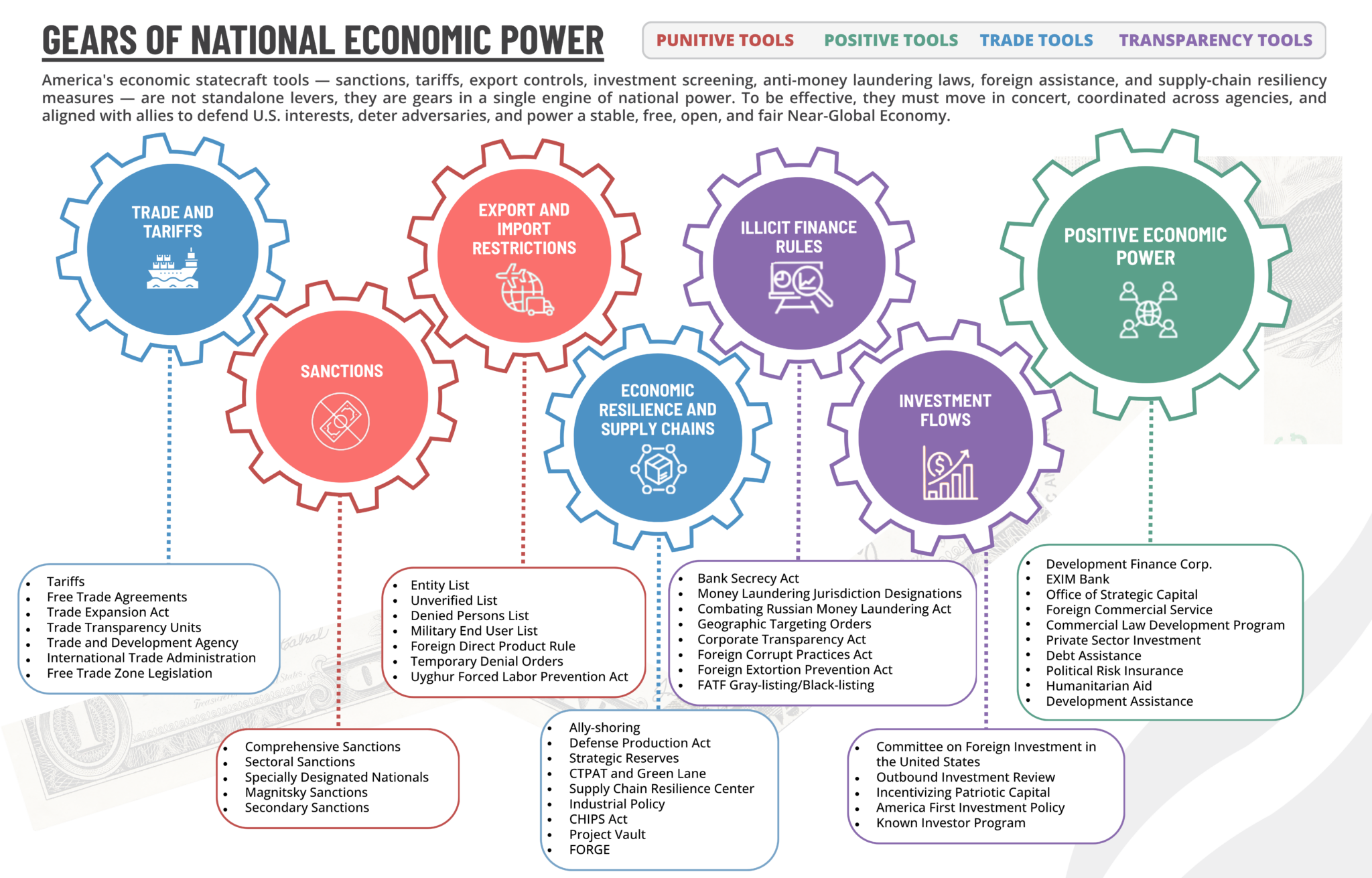
Trade Tools
The U.S. economy is the largest in the world, and the United States is the world’s leading importer. Given America’s huge consumer market, it has acted as the primary recipient of goods for many of the world’s export-dependent economies, most notably China. While systemic bilateral trade imbalances can have negative consequences over the long-term, they also provide the United States with substantial leverage over exporting nations, including adversaries.
The Trump administration’s elevation of tariffs and secondary tariffs as mechanisms of economic statecraft has been a significant — albeit chaotic — contribution to the economic power toolkit.44 In light of the Supreme Court’s 2026 decision limiting the president’s ability to unilaterally impose tariffs under the International Emergency Economic Powers Act,45 Congress should establish explicit authorization for the strategic use of tariffs and other trade enforcement mechanisms as economic statecraft tools, with explicit limits to prevent executive overreach and sufficient resourcing for enforcement.46 Congress and the administration must work together to institutionalize the use of U.S. trade power but also professionalize the practice with analysis and calibration to the specific threats we face.
New trade-related tools could include shadow fleet “gray lists” providing increased monitoring for vessels coming to the end of their predicted lifespan; stricter “rules of origin” terms in trade agreements; enhanced compliance for international free trade zones; and modernized “green-lane” prioritization providing expedited customs and streamlined regulations for low-risk entities and cargo.47 The customs and trade enforcement infrastructure built after 9/11 — including trusted trader programs, advance screening of cargo, and risk-based targeting — provides a foundation, but must be modernized to address the scale and complexity of today’s adversarial trade dynamics.
Appendix 1 includes an expanded list of potential new or amplified trade tools.
Transparency Tools
The true, muscular, and uncompromising use of transparency has the potential to be one of America’s most powerful weapons in the fight against illicit finance, transnational criminal organizations, and adversarial nations.48 America’s enemies have one thing in common — they depend on opacity to survive, to raise and move money, to embezzle funds that support terror and corruption, and to operate in the shadows of our financial system. For decades, we have protected that secrecy, underappreciating the impact that well-designed transparency tools could have on cutting off the cash that sustains illicit actors. As stated previously, transparency is not just a shield; it should be America’s sword.
Secrecy is a necessary precondition for crime and corruption — cloaking the actions and transactions of rogue actors and making them functionally invisible to law enforcement. Drug cartels flood our streets with fentanyl hidden behind walls of secrecy and opacity. Corrupt Chinese officials sign mega-deals for ports in Sri Lanka and mines in the Democratic Republic of the Congo in smoky backrooms shielded by secrecy. Forced labor has proliferated throughout international supply chains leveraging the secrecy of complexity and unasked questions. Hamas and Hezbollah launched a relentless campaign of terror while raising funds and buying bombs via shadow banking networks protected by secrecy. Transparency tools, when applied aggressively and enforced consistently, attack the secrecy that adversarial nations and criminal actors depend on.
Capitalist financial and trade systems function well in a transparent environment; organized crime, corruption, and terror cannot. Fundamental transparency, therefore, must be the price of admission for economic engagement with America.
Much of the opacity of the current system is sustained by America’s own outdated laws and regulations — a self-imposed blindfold that needlessly harms our ability to constrain dangerous countries and stop illicit financial flows. America must lead by example, elevating our own anti-money laundering efforts, demanding corporate supply chain transparency, and enforcing beneficial ownership disclosure requirements. We need to disable the favorite tools of criminals and kleptocrats: anonymous shell companies, secrecy jurisdictions, and tax havens.49 We must impose comprehensive due-diligence obligations on the enablers of trafficking, money laundering, and criminal activity.
New transparency tools could include an enhanced CFIUS review process that covers investment in new developments from adversarial nations (e.g., “greenfield” investment);50 bolstering outbound investment review mechanisms;51 establishing registries for sovereign debt instruments that require disclosure of all terms and conditions; imposing penalties on maritime flags-of-convenience countries52 that refuse to police the vessels registered under their laws; and developing a system of Unexplained Wealth Orders for high-value purchase by individuals with no known financial means.53
Appendix 1 includes an expanded list of potential new or amplified transparency tools.
Bolstering Governments in Transition: The Economic Strike Force
Combining positive, punitive, trade and transparency statecraft elements, the Economic Strike Force (ESF) is a concept for providing multidimensional economic support to fragile countries undergoing a shift from authoritarian, corrupt rule or distorted command economies to governance that is stable, free, open, and fair.54
Too often during homegrown transitions to democracy — in Russia, Myanmar, or Tunisia — the United States has sat passively on the sidelines as countries undergoing political transformation struggled under massive economic headwinds.55 If a government cannot pay state expenses, power its economy, feed its people, stabilize its currency, or prevent the corrupt diversion of state assets, it will fail — no matter how compelling its beliefs, how open its elections, or how clever its constitutional provisions. Just as the emergence of a new ally furthers American foreign policy interests and bolsters the gravitational power of the NGE, the reversion of juvenile democracies to sclerotic dictatorships — ones that potentially harbor criminal organizations, fund terrorist groups, or align with our adversaries — harms America’s national security.
The Economic Strike Force is designed to keep transitioning countries in America’s win column. One by one, we could pull countries out of the orbit of our enemies.
An Economic Strike Force should consist of two elements within the executive branch:56 (1) a permanent staff of proactive strategists and planners who gather intelligence, anticipate potential threats, and develop playbooks to operationalize plans quickly when openings occur and (2) reserve surge capacity — like an economic national guard — made up of finance specialists, economists, forensic accountants, infrastructure experts, anti-corruption lawyers, and other needed experts. The surge team should include officials from across the interagency that would be seconded to the ESF in a crisis, as well as private sector experts who could be called up when the need arises.
The ESF would not merely react to revolutions, election surprises, and collapsed governments, but prepare for them — developing flexible strategic plans, prepositioning support capacities, and coordinating contingent action plans with regional partners.
Once an opportunity arises — ranging from overt regime change to the election of a committed reformer — the Strike Force should be ready to deploy immediately with an offer of a conditional support package in phased tranches. A first phase — conducting an economic assessment while providing emergency humanitarian aid, emergency liquidity, judicial and law enforcement assistance, or other case-specific needs — could be provided based solely on the consent of the new or interim government. Additional, more comprehensive tranches of assistance — like sovereign debt assistance, infrastructure investment, or industrial support — would require the new government to meet certain verified thresholds on issues such as transparency, market-based reforms, protection of core freedoms, and dismantling legacy patronage systems.
While each offering and tranche should be tailored to a country’s specific circumstances and requirements on the ground, the ESF should maintain an extensive menu of financial, legal, commercial, and governance support tools to stabilize economic conditions. (See Appendix 2 for sample list of potential ESF offerings.)
While not every tool would be needed in every circumstance, these flexible tools, rapidly deployed, would provide the short-term stability needed for new leadership to fund, fuel, and finance a government that is likely inheriting broken institutions and crumbling infrastructure.
All of these offerings, however, must come with conditions that must be powerful, feasible, and meaningfully enforced. For regimes that came to power outside of the democratic process, a framework for elections, a constitution enshrining the protection of basic freedoms, and an independent judiciary that can predictably uphold property rights, enforce contracts, and prosecute unlawful behavior are essential. Recipients of ESF assistance must also agree to provide the United States with all information, access, and support necessary for a U.S. inspector general to verify compliance with the terms of the arrangement. (See Appendix 2 for sample conditions for ESF recipient countries.)
The United States is the most powerful country in the world, but it is too frequently not prepared to win. An Economic Strike Force could help change that. When regimes fall or reformers are elected, the ESF would allow the federal government to react quickly, decisively, and with moral clarity to ensure the rise of resilient allies.
How: Methods and Mechanisms
We cannot navigate accelerating geoeconomic competition with outdated economic policymaking structures designed for a bygone era of rigid separation between international economic policy and national security. Rather, we must modernize the cumbersome, siloed, and largely passive U.S. bureaucratic apparatus for a world in which economics and security are fused, where threats are anticipated and analyzed, and where action can be immediate.
Fit for Purpose: An Economic Pentagon
Since the opening of the Pentagon in 1943, America has understood that effective military action requires unified leadership and a centralized structure for planning, tactics, and operations.57 Although conflicts increasingly involve economic warfare, we have failed to create the institutional economic capacity necessary to meet the evolving threat landscape. Instead, we respond to crises with a fragmented economic toolkit and capacities that are — too often — disconnected, delayed, and diluted. Economic power is not maximized, economic enforcement is not prioritized, and economic intelligence is not operationalized.
To respond to today’s national security risks, America needs an Economic Pentagon — a centralized and coordinating command center for U.S. economic statecraft.58
An Economic Pentagon should not replicate the size, scope, bureaucracy, or budget of the military Pentagon.59 The concept does not depend upon the development of a new agency, nor does it require a vast new building.60 While we do provide some potential options for how an Economic Pentagon might be structured in Appendix 3, it is beyond the scope of the Gameplan to take a final position on that issue.
Rather, the concept of an Economic Pentagon is introduced to highlight the urgent need for an empowered center of gravity for the strategic thinking, tactical planning, and operational deployment of the weaponry — and the inducements — of America’s potentially vast economic statecraft arsenal.
Despite the fact that America is currently involved in multiple active economic skirmishes, financial battles, and trade wars, the economic tools to support U.S. overseas interests and bolster domestic resilience are scattered across the executive branch. The statecraft authorities are spread and siloed across dozens of agencies from the Departments of State and Commerce to Treasury and War with poor interagency synchronization and inconsistent communication. Coordination mechanisms are often ad hoc and ephemeral. Intelligence gathering is inadequate and unconnected to overarching goals. Planning capacities are limited. Analytic resources and anticipatory wargaming targeted for economic statecraft are lacking.
It is essential to centralize America’s geoeconomic planning and policy. Congress needs to provide the authorities and the budget for new structures, new positions, and new approaches. The executive branch must develop greater linkages across agencies and between economic and national security policy functions.
Addressing the current institutional deficits is not a luxury — it is an essential prerequisite for a resilient domestic economy, strong national security, and a foreign policy capable of effectively advancing U.S. interests.
Simply establishing a unified government command center for economic security, without simultaneously altering the federal government’s approach to economic statecraft, will have a limited impact. In other words, geopolitical outcomes will be driven far more by how America uses its economic power, rather than on the size of the bureaucracy that houses it.
So how can the United States do more to amplify and effectively deploy American economic power? To fully unlock the full potential of the Economic Pentagon, we propose four key recommendations:
Geoeconomic Policy Innovation
Too often over the last several decades, economic statecraft consisted of a handful of isolated sanctions (e.g., Russia after annexing Crimea), ineffective blockades (e.g., Cuba since 1962), or poorly enforced export controls (e.g., targeting Chinese Civil-Military fusion) — primarily used to send messages of disapproval or to display the appearance of action to voters. If America was lucky, such steps caused a change in an adversary’s behavior. More often, they did not.
America’s economic security can no longer depend upon a limited economic toolkit to set the guardrails that protect our national and international interests. We need new and innovative weapons, inducements, and capacities.
The U.S. military has countless unique types of explosive ordnances and munitions deployed by a vast arsenal of bombers, fighters, helicopters, drones, carriers, destroyers, frigates, cruisers, littoral combat ships, field guns, howitzers, mortars, autocannons, and tanks that can be minutely calibrated for destroying a target with maximum effectiveness. Moreover, through Defense Advanced Research Projects Agency (DARPA), the Defense Innovation Unit, and countless private sector partners, the Department of War is constantly developing, evolving, and testing new capabilities.
Economic statecraft requires a similarly diverse arsenal and its own innovation incubators, along with the ability to rapidly deploy new capabilities when and where they are most needed. Yet while the military has the statutory authority to develop new tools or devise new techniques, the executive branch is constrained from doing the same thing for economic statecraft weaponry. When the Trump administration attempted to use tariffs as a geopolitical lever, the Supreme Court pointed out the obvious — that Congress had not provided the executive branch the tools to geoeconomically innovate. Congress should do just that.
The future of economic statecraft must involve continuously scanning the technological and policy horizon for new geoeconomic tools and strategies. Congress should provide the Economic Pentagon with authorities that allow economic innovation units to run experiments and simulations to test the efficacy of new economic weapons, piloting novel approaches when possible, and rapidly scaling the most promising approaches.61 In addition to new and flexible authorities, however, there must also be clear guardrails, limits against abuse, and meaningful oversight.
In addition, the government should work closely with the private sector, academia, and allied countries to identify emerging technologies and policy mechanisms that could enhance U.S. economic power in ways that constrain our adversaries and benefit our partners. The Departments of War, Energy, Health, and Homeland Security already have that capacity —economic statecraft officials should have it as well.62
Geoeconomic Intelligence, Forecasting, and Analysis
The United States must move from a reactive posture on economic security to an anticipatory model that operates based on cutting-edge economic intelligence analysis of adversary strategies and vulnerabilities, combined with a deep understanding of our own resilience and long-term market consequences. Economic security analysts should be continuously modeling the geostrategic impacts of economic policy options and providing early warning of emerging geoeconomic risks and opportunities.
This means investing in the capacity to track international trade flows and suspicious trade anomalies; conduct real-time monitoring of sanctions evasion networks; identify emerging financial risks, novel techniques, and new illicit actors; predict which ships might enter the shadow fleet; anticipate and disrupt illicit finance and money laundering efforts; and forecast adversarial and market responses to U.S. economic measures.
New economic security processes should take full advantage of the growing capabilities of financial technology and digital innovations in tracking and identification. Financial law enforcement needs to better leverage AI, synthetic data, blockchain analysis, and machine learning for novel economic sensemaking. The sheer volume of trade data, financial transactions, and corporate relationships requires sophisticated analytical tools to identify patterns, detect irregularities, and generate actionable insights. FinCEN, for instance, should begin a pilot program to train AI on past Suspicious Activity Reports within a sandbox environment, and then assess the AI’s capacity for pattern recognition of new illicit typologies or for developing potential new leads for human investigators to review.
The intelligence community should also dedicate substantially more resources to economic intelligence — not just monitoring threats but actively identifying opportunities to deploy economic power for strategic advantage. An Economic Security Vanguard within the State Department’s diplomatic corps, discussed in Appendix 1, could be a key conduit for collecting country-level economic intelligence that can be used to inform policy in Washington.63
Demanding transparency and data fidelity as a condition for full participation in the NGE permits an increase in deep intelligence based on verifiable open information, rather than cloak and dagger guesswork. In parallel, new systems for customs processing and trade enforcement should incentivize disclosure and openness, resulting in greater speed, fewer obstacles, and improved outcomes. The increased availability of reliable information will ultimately lead to easier monitoring and should reduce the massive compliance burden currently shouldered by the private sector, significantly reducing business costs.
Geoeconomic Strategic Planning, Targeting, and Wargaming
Innovative tools and increased intelligence gathering, of course, are not sufficient on their own. The government must have improved strategic planning capacities to leverage new intelligence and tools into proactive strategies ready for deployment when geopolitical challenges emerge.
This requires fusing geostrategic foresight with deep sectoral economic expertise, creative policy design, and savvy alliance management. Regular and sustained economic wargaming and planning must be a core activity for the government’s economic security apparatus.
This could involve the creation of a Professional Planning Cadre within the Economic Pentagon to develop and continuously update flexible playbooks anticipating emerging threats — preparing for flashpoints, forecasting and mitigating adverse market impacts, and drafting provisional response packages.64 The cadre could recommend, for instance, proactively imposing sanctions on Russian oil tankers set to enter the shadow fleet while the ships are still under construction or imposing anticipatory sanctions on adversarial infrastructure projects when they are announced, rather than after they have been completed. The cadre could also help prepare for a potential crisis by monitoring and developing redundant supply lines for vital goods, making sure that the United States can continue to source pharmaceuticals and precursors, fertilizer and other agriculture supplies, critical minerals and key industrial inputs, and essential components for America’s defense industrial base.
Economic wargames should simulate various crisis scenarios — from a Chinese invasion of Taiwan to a collapse of the Putin regime to a major cyberattack on U.S. energy infrastructure — and test how different combinations of economic tools might be deployed or how economic dynamics may impact U.S. policy options. The Trump administration’s seeming surprise regarding the oil market’s reaction to Iran’s closure of the Strait of Hormuz suggests that economic wargaming is either being inadequately prioritized or is insufficiently integrated into executive branch decision-making.65
It is also critical that economic exercises involve not just government officials, but also private sector leaders, foreign allies, and subject matter experts who can provide realistic assessments of how markets, companies, and foreign governments would respond to various economic attacks. In addition, financial systems should be stress-tested and economic security readiness examined with regularity.
The goal is to develop a library of preplanned economic response options and a prioritization of day-one actions that Washington can quickly implement when crises emerge, rather than reactively scrambling in real-time under pressure.
Prioritizing Geoeconomic Enforcement
Every proposal or policy in the Gameplan — new security strategies, innovative statecraft tools, or collaborative policy plans — will be meaningless if the threat of economic consequences is not credible. Credibility depends on enforcement. And enforcement depends upon resources.
More resources does not always mean more money. Developing new technologies, making existing capabilities more efficient, and leveraging the power of private sector capacities can amplify enforcement efforts.66 But novel technology and approaches will go only so far— there must also simply be far more financial cops on the beat.
Washington needs to direct resources toward sanctions, export control, and tariff enforcement, with substantial penalties for those who circumvent American rules, and coordination with other nations to close loopholes and punish non-complying jurisdictions.
Current enforcement agencies are dramatically under-resourced relative to the scale of sanctions evasion, trade-based money laundering, and other illicit financial activity.
- The Treasury Department’s Office of Foreign Assets Control (OFAC), which administers U.S. sanctions, has around 200-300 employees despite overseeing a sanctions regime affecting trillions of dollars.
- Customs and Border Protection struggles to detect more than a fraction of trade fraud, forced labor imports, and sanctions or tariff evasion occurring at U.S. ports.
- Treasury’s Financial Crimes Enforcement Network (FinCEN) receives millions of Suspicious Activity Reports (SAR) annually, but lacks the resources to thoroughly analyze or act upon them.67
- The Department of Justice has only a handful of lawyers working to enforce U.S. laws on foreign corruption, and has never even used a 2023 law that criminalize bribe demands of U.S. entities by foreign officials.68
- No federal agency is comprehensively monitoring and disrupting the widespread use of trade-based money laundering by cartels, terror groups, and adversarial nations.
Economic statecraft only works if the threat of consequences is credible and the risk of punishment is meaningful.
Increasing enforcement resources and technology is, arguably, not a particularly novel recommendation. No recommendation, however, is more vital.
In failing to adequately prioritize enforcement, we have diminished the current efficacy or potential power of America’s economic statecraft. Sanctions are systemically evaded by Iran,69 export controls have been chronically circumvented by Russia,70 and hundreds of billions of dollars are being laundered in America by Chinese gangs on behalf of Mexican drug cartels.71 America must do better.
Conclusion
The Gameplan is, admittedly, ambitious. It should be.
The United States and its allies are facing unprecedented economic security challenges. The intentions of our enemies are clear and the threats they pose are real. Our geoeconomic counteroffensive will require every tool in the box.
The evolving trade realignment also presents a generational opportunity — not seen since Bretton Woods in 1944 — to reorient the world economy to promote American interests, defend our national security, uphold our core principles, and boost our prosperity. By placing our economic might unambiguously in the service of our values, the United States can shape the defining geoeconomic struggles of the coming era. We can demonstrate that economic stability, freedom, openness, and fair play can be drivers of market-based growth, and that boxing out the cheaters can make the whole Near-Global Economy stronger.
By integrating disparate actions into a unified strategy, the United States can maximize the effectiveness of its economic statecraft. The time has come for Washington to align its domestic and international policies, enhance interagency coordination, strengthen alliances, and establish international norms that strengthen our shared economic framework.
Ultimately, developing a coherent economic security Gameplan will ensure that the United States not only defends its interests but also uplifts the companies and countries that play by a common set of rules.
America’s economic power is immense — it is time to unlock its full potential and supercharge American statecraft.
Appendix 1: Expanding the Economic Statecraft Toolkit
This appendix lists potential new tools of economic power or ways to amplify current tools.
Punitive Tools
The United States could increase the quantity and quality of its punitive economic weapons by:
- Sanctioning entities involved in the development of adversary-sponsored or adversary-led currency systems, financial messaging systems, or other cross-border payment mechanisms that seek to circumvent the U.S. dollar.
- Imposing arms export bans and dual-use export controls on any country that (1) threatens the use of military action to alter the status quo of de jure or de facto international borders; (2) threatens the offensive use of nuclear, biological, or chemical weapons; (3) aids the proliferation of nuclear, biological, or chemical weapons; or (4) promotes violence through the funding of terror groups or insurgencies against democratic governments.
- Increasing the number of determinations of jurisdictions of “primary money laundering concern” pursuant to Section 311 of the USA PATRIOT Act for countries that fail to exercise meaningful oversight of their: (1) free trade zones; (2) banks and financial institutions; (3) entity formation process, including corporate registry; and (4) information sharing process with the United States. America should not be scared to designate major banking centers that pose systemic risks, such as Hong Kong or the UAE, if circumstances warrant it. Section 311 designations should be paired with other forms of economic statecraft such as sanctions, export controls, and tariffs on continuously noncompliant jurisdictions.
- More aggressively utilizing secondary sanctions to target third-party enablers of malign activity. This includes, but is not limited to, the lawyers, bankers, brokers, dealers, and intermediaries that (1) assist transactions involving money laundering, tax evasion, or sanctioned goods, services, and commodities; (2) establish vehicles, mechanisms, or financial tools for the purpose of obscuring ownership, concealing the illicit source of funds, or evading laws or regulations; or (3) fail to conduct minimal levels of due diligence or compliance.
- Replicating authorities such as Section 9714(a) of the Combatting Russian Money Laundering Act to isolate and require additional reporting on transactions involving malign cryptocurrency exchanges.
- Establishing new, expedited civil authorities to aggressively freeze and seek to seize overseas assets connected with leaders and key enablers of adversarial regimes, with a particular focus on countries and political actors who actively facilitate national security threat vectors, such as: terror networks; drug cartels and other transnational criminal organizations; nuclear, biological, and chemical weapons proliferation; and cyber-criminals and state sponsored hackers. Similar expedited authorities could be used for known transnational criminal actors, terrorists, or corrupt foreign officials.
- Cutting off adversarial leaders, criminal groups, and non-state rogue actors from non-financial touchpoints in the United States and allied countries to high-prestige institutions, events, awards, and naming opportunities. This could include access (or the access of children and other family members) to universities, sporting organizations, charitable boards, or high-profile events outside their home countries.
Positive Tools
The United States could increase the quantity and quality of its positive economic tools by:
- Developing well-resourced public and public-private partnership investments in science, research, technology, and health that elevate recipient countries, advance American interests, unlock new American-led innovations, and demonstrate the value and goodwill of engagement with the United States.
- Increasing the connectivity, resourcing, and empowerment of the DFC and EXIM, with higher thresholds for taking on risk in a wider range of countries.
- Expanding the function of the U.S. and Foreign Commercial Service (USFCS) to assist U.S. businesses abroad, aligned with economic security priorities, strategic sectors, contested markets, and trade opportunities.
- Empowering the USFCS to proactively collect expansive market and supply chain intelligence for greater commercial transparency, improved information flows, and to mitigate economic and national security risks — providing key data for the private sector, law enforcement (e.g., Customs and Border Protection and the Drug Enforcement Agency), and the intelligence community. Intelligence gathering must be paired with expanded analytic capabilities.
- Authorizing the Commerce Department’s Commercial Law Development Program to establish or verify legal and regulatory environments that prioritize threshold levels of fair play, free competition, and transparency as a precondition for NGE inclusion.
- Creating an Economic Security Vanguard within the State Department’s diplomatic corps and developing a cohort of economic statecraft and resilience specialists that could translate Washington’s strategies into country-level action and feed local intelligence back into policy, thereby generating a cycle of implementation and refinement. In support of positive statecraft, Vanguard officers would collect information on local economic needs and opportunities, oversee investment, appoint inspectors general, monitor risks of waste and corruption, and connect local stakeholders with private American companies, U.S. capital, or relevant public sector agencies.
- Establishing a National Security Capital Forum that brings together U.S-based investors, companies, suppliers, insurance providers, and public sector stakeholders to coordinate greater U.S. investment in key overseas allies and to facilitate the process of Ally-shoring supply chains away from adversarial nations.72 Incentivizing U.S. private sector investment in global infrastructure with national security implications should be a particular point of emphasis.
- Revitalizing foreign aid that prioritizes local job creation and entrepreneurship by providing liquidity and governance support, while pushing back against local corruption and instability that saps private sector efforts. Foreign aid also must revitalize the delivery of public health to countries around the world, establishing greater local capacity, but also monitoring emerging health threats and facilitating the provision of basic services. Addressing local health needs in emerging markets is an inexpensive and effective investment that provides the baseline condition necessary for future economic growth.
- Expanding the role of the U.S. Trade and Development Agency to identify and assess investment opportunities abroad that feed into an integrated pipeline of bankable projects.
- Establishing a U.S.-led plurilateral critical minerals and commodities strategic reserve with offtake guarantees from key supply companies within the NGE.
- Providing public sector-backed incentives, derisking, and support to facilitate high-priority private sector Ally-shoring to NGE countries.
Trade Tools
The United States could increase the quantity and quality of its trade-based economic tools by:
- Using tariffs to impose costs and consequences on countries that engage in or facilitate malign activity, sanctions evasion, or money laundering.
- More effective data collection and monitoring to address tariff evasion and transshipment risks, with the imposition of secondary tariffs or sanctions on violators.
- Developing trade logistics systems that are wholly independent of adversarial software or platforms, like China’s LOGINK.73
- Supporting U.S. private sector acquisition of strategic ports and trade infrastructure through loan guarantees, U.S. government equity stakes, or similar mechanisms.
- Increasing export credit support and trade facilitation services with strategic investments, technical training, and research partnerships in key countries.
- Establishing stricter rules of origin under existing and new trade agreements to cut down on adversarial circumvention of tariffs and other trade barriers.
- Demanding inbound investment review (CFIUS-like mechanisms) for all trade partners to monitor and reject adversarial investment in critical sectors or companies, backed by the imposition of tariffs on noncompliant countries.
- Instituting the use of verifiable electronic shipping manifests for international trade by America and all U.S. trade partners. Trade enforcement efforts should be substantially increased, with a greater number of cargo inspections, better use of scanning technology, and routine, random, and unannounced audits of manifest information, with substantial penalties for violations.
- Creating a tiered system for enhanced compliance, monitoring, and disclosure requirements for international free trade zones, with substantial penalties for jurisdictions housing free trade zones that raise significant money laundering concerns.
- Prohibiting the trade of foreign adversary nation equities and securities on U.S. exchanges.
- Aggressively investigating, and enforcing rules against, currency manipulation and other non-tariff trade barriers.
- Maintaining a “black list” and imposing sanctions on all ships known to participate in ghost fleets or to regularly turn off their transponders. Secondary sanctions should be imposed on any port hosting a black-listed ship. In addition, real-time maritime sanctions capacity should be developed to impose immediate sanctions for suspicious vessels in transit that turn off their transponders without explanation.
- Maintaining a “gray list” of vessels that meet the criteria for potential future participation in a ghost fleet, requiring said vessels to report their beneficial ownership information to U.S. authorities.
- Maintaining supply chain “white lists” for international entities that agree to use a U.S.-issued digital corporate ID and that submit sufficient information verifying beneficial ownership, corporate structure and key personnel, operational licenses, insurance information, location of operations, number of employees, and basic financial data.
Transparency Tools
The United States could increase the quantity and quality of its economic transparency tools by:
- Developing a comprehensive system of outbound investment review to prevent U.S investment in core industries necessary to the defense industrial base of adversarial nations. Particular attention should be paid to the role of passive investment vehicles and institutional investors, which often invest funds in adversarial nations by default in response to international benchmarks.74
- Imposing substantial penalties on countries that issue maritime flags-of-convenience but refuse to police vessels registered under their laws.
- Establishing an international registry for sovereign debt instruments that requires the disclosure of all contracts, terms, amendments, conditions, and side agreements — with enforcement mechanisms built into the NGE that declare unregistered instruments as “odious debt” and not collectable.
- Replacing the Corporate Transparency Act with a total ban on the use of anonymous companies and corporate vehicles within the United States and in commercial engagements with a U.S. nexus, irrespective of the country of incorporation.
- Surging resources, expertise, and increased data collection to uncover and stop trade-based money laundering.
- Collecting beneficial ownership information for all government registrations, such as registrations of planes with the Federal Aviation Administration.
- Collecting basic know-your-customer identifying information for luxury item purchases over $100,000, including cars, boats, artworks, collectibles, jewelry, and similar items. Congress should also create a pathway for judicially approved Unexplained Wealth Orders, requiring verification of legitimate source of funds for purchases over $100,000 where there are indicators of illicit activity.
- Improving intelligence and information gathering mechanisms for trade, customs, and investment data.
- Establishing new supply chain transparency obligations to ferret out forced labor and child labor in all U.S. supply chains. This could include providing for a private right of action for victims of forced and/or child labor where a company fails to make a reasonable effort to map its supply chains or where it neglects to investigate credible claims that forced labor and/or child labor is occurring within its supply chain.
- Requiring disclosures of foreign money in politics, media, and lobbying, with limits and constraints on foreign actors from adversarial countries. Applicable laws, such as the Foreign Agents Registration Act, should be amended to focus on disclosure on financial flows, with limits on lobbying financed by adversarial foreign entities and a complete ban on lobbying on behalf of opaque entities (such as anonymous shell companies or trade associations representing undisclosed members).
- Requiring disclosures for all foreign contributions to nonprofits, universities, research institutions, think tanks, political action committees, and others that claim to act for the public good. Anonymous donations should be permitted only to the extent that the donor is wholly unknown to the recipient organization and the funding has no conditions attached to it.
- Instituting the use of e-procurement systems by the United States and all countries in the NGE.
- Mandating registration and disclosure requirements for Chinese-owned companies indicating any data that they collect from American citizens, entities, and locations under China’s National Intelligence Law. In addition, Congress should mandate that Chinese-owned companies submit a report indicating the steps that they are taking to protect American data from disclosure to any government or quasi-government body of the People’s Republic of China.
- Requiring Chinese nationals in the United States to disclose the legitimate source of funds for any expenditures that exceed the Chinese capital control limits. Chinese money laundering gangs, often operating on behalf of drug cartels, are laundering billions in the United States by selling dollars to Chinese expatriates. As of 2026, Chinese citizens are only permitted to take $50,000 out of China per year. Chinese students paying full price at Harvard (currently $59,320 without room and board), for instance, should be required to disclose how they are paying for their expenses exceeding the capital control limit.
Appendix 2: Offerings and Conditions for the Economic Strike Force
Depending on the needs of the target country, an Economic Strike Force should be empowered to provide the following types of support:
- Immediate liquidity and banking to support government operations, large and small businesses, and individual consumers to meet basic needs and address balance-of-payment risks.
- Infrastructure stabilization (for damaged or destroyed roads, rail lines, and ports) and long-term infrastructure improvements to support energy, trade, and transportation.
- Debt assistance and management to address fiscal irresponsibility from the government and prevent imminent default risks. Determination of “odious debt,” in verifiable circumstances where the lenders of sovereign debt engaged in corruption or fraud.
- Training and knowledge transfer to support industry, create jobs, and build sustainable growth.
- Development aid and financing to support health, education, and agriculture.
- Logistics and industrial support to help get products to market and source key raw materials.
- Emergency commodity purchases or offtake agreements to provide consumers for core industries. Conditional offers of participation in American-led critical mineral stockpiles.
- Temporary free trade deals and tariff exemptions with the United States and core allies to support the development of juvenile export industries, with a pathway to a permanent favorable trade deal.
- Temporary credit guarantees backed by the United States to lower the cost of capital.
- Time-limited provision of political risk insurance to encourage American private sector investment.
In addition, Economic Strike Force assistance should depend on the recipient country’s willingness to meet certain conditions, such as the following:
- Agreement to match U.S.-led tariffs and other trade barriers for adversarial countries, such as those outside the core of the NGE.
- Agreement to follow U.S.-led sanctions and export controls, share intelligence about potential circumvention or illicit transshipment, and support the prosecution of evasion.
- Establishment of an inbound investment screening mechanism, similar to the U.S. CFIUS, to prevent the acquisition of key assets by adversarial regimes.
- Agreement to share intelligence on transnational criminal organizations, terror groups and terror finance, and issues related to illegal trade or illicit finance.
- Cooperate with the United States on law enforcement and anti-corruption cooperation to root out systemic linkages to organized crime, kleptocratic structures still embedded in the government, and establish long-term good governance practices.
- A U.S.-appointed inspector general on site to ensure transparency and the proper use of all U.S. funds to reduce the possibility of corruption, fraud, and waste. All accounts, payments, disbursements, and budgetary information must be fully available for inspector general review and should be made publicly available to the extent feasible.
- Establishing e-procurement systems, electronic shipping manifests, and other digital government services to reduce the face-to-face opportunities for government officials to demand bribes and assist fraud.
Appendix 3: Potential Structures for an Economic Pentagon
As a first step towards developing an Economic Pentagon, the executive branch should — as soon as practicable — bring together senior officials from across the government into a unitary policy body to align priorities, begin simulations and planning to address foreseeable near-term crises, and harmonize execution. This could take the form of an enhanced National Economic Council with a clear mandate for economic security, or a new Economic Security Council that sits alongside the National Security Council.
Over the longer term, a more institutionally empowered Economic Pentagon will need to be established — with permanent staffing, sufficient resourcing, and authority to deploy coordinated economic statecraft planning, policy, and execution.75
To fully support America’s economic and national security, the Economic Pentagon should be given:
- Clear authority to coordinate economic policy across all relevant agencies or to absorb those functions into the new entity;
- Direct access to the president, National Security Council, and the intelligence community;
- Sufficient appropriations to support substantial analytical and planning capacity;
- Beefed up enforcement capacity for the broad range of financial crimes, economic threats, trade violations, sanctions evasion, and illicit finance;
- The ability to rapidly deploy economic measures in response to emerging threats;
- The remit to develop relationships with both allied governments and the private sector on issues of economic statecraft, economic security, and aligned economic foreign policy.
One design for an independent body could be the concept of an Interagency Economic Command Center, which one of the report authors proposed in written testimony before the House Foreign Affairs Subcommittee on East Asia and the Pacific. As Elaine Dezenski described this concept:
Modeled on the Joint Chiefs of Staff, this interagency body would be a principals-level engine for strategic economic security planning and coordination. The command center would be chaired by the deputy national security advisor for international economics and the proposed deputy secretary of state for economic security, with designees from the Departments of Defense, Commerce, Treasury, Justice, Homeland Security, and Agriculture and the Intelligence Community. Offices represented should include but not be limited to DoD’s Office of Strategic Capital, Treasury’s Office of Foreign Assets Control and Financial Crimes Enforcement Network, Commerce’s Bureau of Industry and Security, the U.S. Trade and Development Agency, the U.S. Trade Representative, the International Trade Administration, the Committee on Foreign Investment in the United States, Customs and Border Protection, and the Development Finance Corporation. The command center would coordinate America’s economic security objectives, set enforcement priorities, and align actions to support a stable, free, open, and fair Near-Global Economy.76
Alternatively, the government could pursue a hybrid approach, as we have elsewhere proposed, by creating an Economic Security Coordination Office with both a short-term and a long-term function.77 The initial task would be to align and operationalize a coherent, whole-of-government — but temporary — economic statecraft strategy. But that office could also have a longer-term purpose to consider and propose the next-stage governmental body that would permanently take on the economic statecraft and security portfolio. The determination of the ultimate structure and bureaucratic home of the Economic Pentagon will require careful consideration and should be based upon a comprehensive study of available expertise, capabilities, authorities, and resources.78 What is certain, however, is that the current fragmented approach is inadequate for the challenges we face and that changes are urgently needed.
