March 12, 2026 | Senate Committee on Health, Education, Labor, and Pensions
Transparency and Trust
Exposing Malign Foreign Influence in Higher Education
March 12, 2026 | Senate Committee on Health, Education, Labor, and Pensions
Transparency and Trust
Exposing Malign Foreign Influence in Higher Education
Hearing Video
March 12, 2026
Full Written Testimony
Section I: Introduction
Chairman Cassidy, Ranking Member Sanders, and distinguished members of the committee, thank you for inviting me to testify today regarding foreign influence in American higher education. I am pleased to offer policy insights from the Foundation for Defense of Democracies, a nonpartisan research institute focused on national security and foreign policy. My work focuses on Chinese grand strategy, military-civil fusion, emerging technologies, and the growing intersection between geopolitical competition and the global research ecosystem.
America’s higher education system remains one of our country’s greatest strategic assets. U.S. universities anchor the world’s most dynamic research environment, producing breakthroughs in science, medicine, engineering, and technology that drive economic growth, strengthen national security, and reinforce the United States’ global leadership in innovation. The openness, collaboration, and intellectual exchange that define American academia are enduring strengths.
At the same time, those same strengths have made American universities attractive targets for exploitation by foreign adversaries, especially China. Beijing and other authoritarian regimes understand that U.S. universities sit at the center of America’s innovation base, talent pipeline, and advanced research ecosystem. They have sought to take advantage of that access for a range of purposes: acquiring sensitive knowledge and technology, shaping research relationships, building influence, monitoring students, and advancing broader strategic objectives that run counter to U.S. national security interests.
Addressing these challenges requires balance, but it also requires clarity. Not every foreign relationship is problematic, and the United States benefits enormously from international academic collaboration. At the same time, partnerships, funding arrangements, and opaque institutional ties involving foreign countries of concern, hostile authoritarian regimes, or entities linked to them warrant far greater scrutiny than they have historically received. The question is not whether American universities should remain globally engaged. They should. The question is whether the United States has adequate safeguards in place to ensure that openness is not exploited by malign actors.
One of the most serious obstacles to addressing these challenges has been a longstanding lack of transparency, accountability, and institutional capacity. For years, policymakers, regulators, and, in many cases, universities themselves lacked the tools necessary to fully understand the scale, origin, and strategic implications of foreign funding and foreign-linked partnerships in higher education. Reporting requirements have been incomplete. Enforcement has been inconsistent. Public visibility has been limited. And universities have often operated without clear standards or sufficient federal guidance for identifying and managing risk.
Encouragingly, that picture is beginning to change. The Department of Education’s recent efforts to improve foreign funding transparency, including the launch of its new public-facing reporting portal, represent an important step forward. Better data alone will not solve the problem, but better data make it harder to ignore. They give Congress, the executive branch, universities, and the public a clearer view of where foreign money is coming from, which institutions are receiving it, and whether some of those ties involve counterparties already identified elsewhere by the U.S. government as posing national security, compliance, or strategic concerns.
My testimony today makes three core points. First, American universities are indispensable national assets, but foreign adversaries are exploiting gaps in transparency and oversight to gain access, influence, and, in some cases, strategic advantage. Second, recent disclosures underscore the scale of the challenge and the need for stronger tools, clearer standards, and better accountability. Third, Congress has an opportunity to modernize transparency requirements and oversight mechanisms in ways that protect both U.S. national security and the openness that makes American higher education exceptional.
Section II: The Transparency Gap in Foreign Funding
For many years, policymakers and regulators lacked a clear picture of the scale and nature of foreign funding flowing into American universities. Section 117 of the Higher Education Act requires U.S. institutions of higher education to disclose certain foreign gifts and contracts exceeding $250,000.[1] In practice, however, the reporting system has long suffered from significant limitations. Disclosures have often been incomplete, inconsistent, or difficult to analyze.[2] Enforcement has been uneven. And until recently, the public and policymakers had limited tools to meaningfully evaluate the data that universities submitted.
These transparency gaps have made it difficult to assess the scope of foreign engagement in higher education and to identify relationships that may warrant additional scrutiny. In some cases, universities themselves have struggled to determine the ultimate source of foreign funding, particularly when donations or research contracts pass through intermediaries, affiliated foundations, or joint research entities. Without clear and accessible data, both policymakers and institutions have operated with an incomplete understanding of the broader landscape.
Recent steps taken by the Trump administration, specifically the Department of Education, to improve foreign funding transparency represent an important development. The department’s new public transparency portal provides a more accessible view of foreign gifts and contracts reported by U.S. universities, allowing policymakers and the public to better analyze patterns in foreign funding flows.[3] By consolidating and visualizing these disclosures, the portal offers a clearer starting point for understanding how foreign actors engage with American higher education institutions.
The early data emerging from this transparency effort underscore why improved reporting and visibility are necessary. According to the Department of Education’s portal, U.S. universities have reported roughly $405 million in transactions involving counterparties that appear on various U.S. government watchlists or restricted entity lists.[4] These include approximately $213 million tied to entities appearing on the Commerce Department’s Entity List, roughly $184 million connected to institutions identified under Section 1286 of the National Defense Authorization Act, and about $49 million associated with firms appearing on the Department of Defense’s Section 1260H list of Chinese military companies.[5]
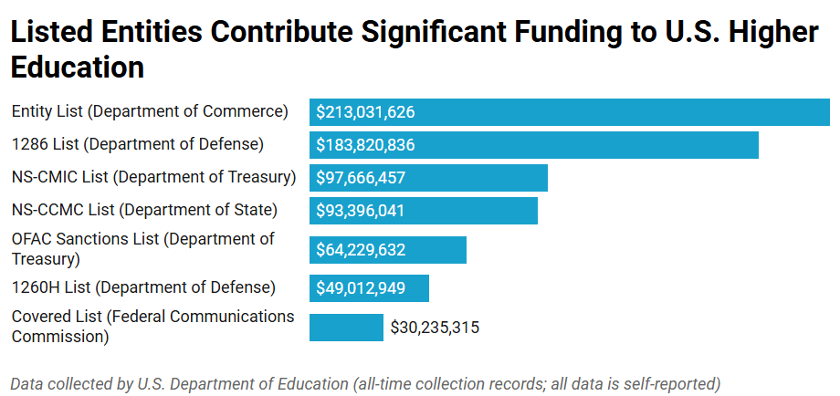
In many cases, foreign companies do not engage with universities out of altruism. They do so because access to American campuses can support their own commercial, research, or strategic objectives, whether through talent pipelines, research collaboration, reputational benefits, or proximity to cutting-edge innovation.
On the one hand, these figures do not necessarily imply wrongdoing by the universities involved. In some cases, institutions may have entered into these relationships without a full understanding of the counterparties’ government affiliations or strategic relevance. On the other hand, the data highlight a broader structural challenge: universities are often expected to navigate complex national security risks without consistent federal guidance, standardized due diligence expectations, or adequate transparency tools.
Another important takeaway from the available data is that foreign funding frequently concentrates in the very institutions that anchor America’s advanced research ecosystem. Leading research universities — many of which conduct cutting-edge work in science, engineering, artificial intelligence, and other emerging technologies — are also among the institutions most engaged with foreign partners and donors. These universities play a critical role in the U.S. innovation system, which makes ensuring transparency and appropriate safeguards all the more important.
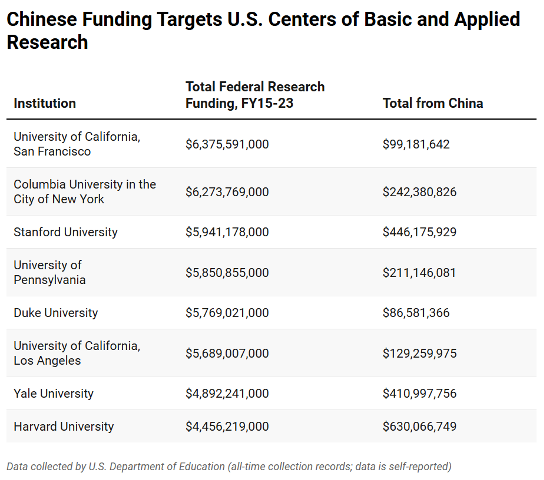
China represents a particularly instructive case in this regard. Over the past two decades, Chinese government entities, companies, and affiliated organizations have directed substantial financial resources toward engagement with American universities. While some of these interactions involve legitimate academic collaboration, they also take place against the backdrop of Beijing’s broader strategy to leverage global academic networks in support of its technological and military development.[6] China’s military-civil fusion system, which explicitly integrates civilian research institutions with the country’s defense industrial base, complicates efforts to distinguish between purely academic collaboration and activities that may ultimately support strategic state objectives.[7]
Taken together, these dynamics highlight why improved transparency must be the starting point for any effective policy response. Universities cannot manage risks they cannot see, and policymakers cannot design effective safeguards without reliable data. Strengthening visibility into foreign funding relationships is therefore not about restricting legitimate collaboration. Rather, it is about ensuring that universities, regulators, and the public have the information necessary to make informed decisions about how those relationships are structured and managed.
Section III: China as the Most Systematic Case of Academic Exploitation
While foreign engagement with U.S. universities takes many forms and involves a wide range of countries, China represents the most comprehensive and strategically coordinated case of foreign interaction with the American higher education system. Beijing has spent decades building policies designed to leverage global research networks, foreign universities, and overseas talent to accelerate China’s economic development and military modernization.[8]
Central to this effort is China’s military-civil fusion strategy, a national policy that seeks to eliminate barriers between China’s civilian research sector and its military and defense industrial base. Under this system, students, universities, research institutes, and private companies are expected to contribute to the country’s national development and defense priorities.[9] In practical terms, this means that technologies and knowledge developed through ostensibly civilian research institutions can be made available to support China’s military modernization efforts.
This structure complicates traditional assumptions about academic collaboration. In most Western countries, universities operate with a high degree of institutional independence from the state and the military. In China, however, universities are integrated into a national innovation system that is ultimately directed by the Chinese Communist Party.[10] As a result, research partnerships that appear purely academic on the surface often exist within a broader framework designed to support national strategic objectives.
Evidence from U.S. government reporting increasingly underscores these concerns. Several Chinese universities that maintain partnerships with American institutions have also been identified by U.S. government agencies as supporting China’s defense industrial base or military research programs.[11] The Department of Defense, for example, has published lists of foreign research institutions linked to foreign military or intelligence activities, while other U.S. government lists identify companies and entities involved in activities contrary to U.S. national security interests.[12] Yet many of these institutions continue to maintain research collaborations, exchange programs, or institutional partnerships with American universities, often without clear public visibility into the nature of those relationships.[13]
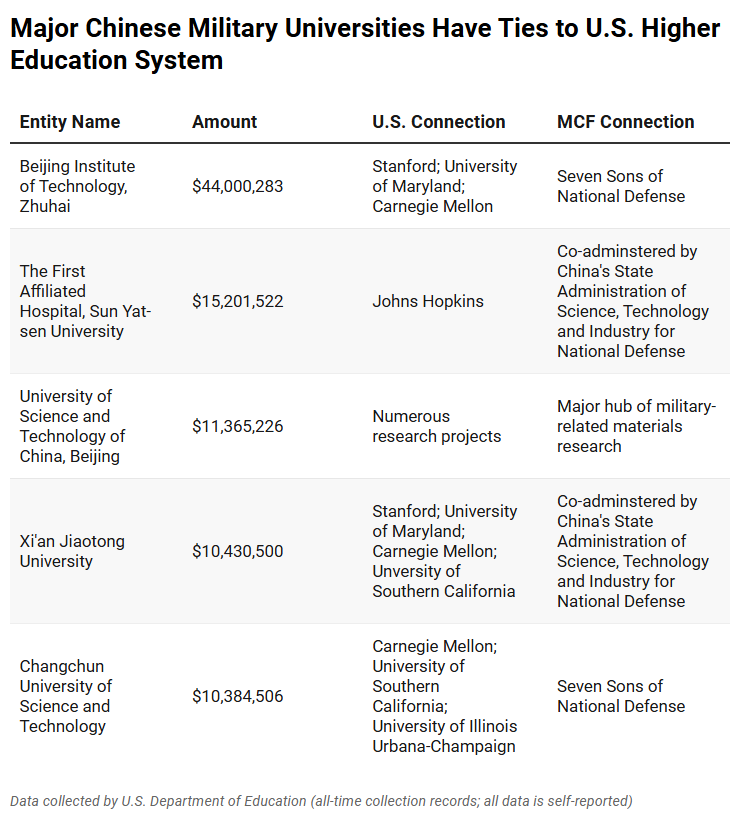
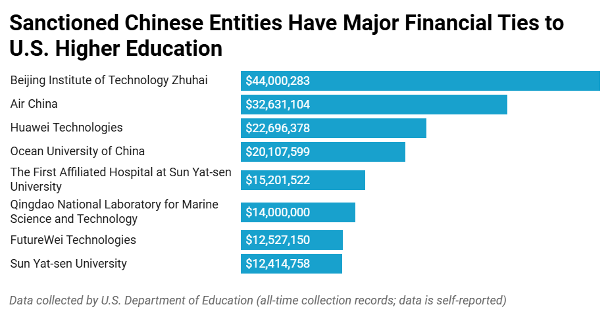
Recent data from the Department of Education’s new foreign funding transparency portal further illustrate the scope of the challenge. This is particularly evident as it relates to entanglements with Chinese entities that appear on U.S. watchlists or other restricted entity lists.
For example, some Chinese entities appearing on U.S. watchlists and restricted entity lists, including Huawei and other technology firms tied to China’s national security apparatus, have been publicly identified by the U.S. government as posing concerns related to technology transfer, military collaboration, or surveillance.[14] These designations are not obscure, nor do they arise from speculative reporting. Yet they do not categorically bar universities from accepting funds or entering into certain relationships with such entities. That gap matters. Many of these firms are embedded in China’s military-civil fusion system, where ostensibly civilian innovation can be redirected to strengthen capabilities that may one day be used against the United States and its forces.
China’s efforts to engage with foreign universities also extend beyond research partnerships. For many years, Beijing has invested heavily in talent recruitment programs designed to attract scientists, engineers, and researchers working in advanced fields overseas.[15] These programs encourage overseas scholars and students to maintain close ties with Chinese research institutions and, in some cases, to transfer knowledge and technical expertise back to China.[16] While some participants in such programs engage in legitimate academic exchange, the programs themselves are embedded within China’s broader strategy to accelerate technological development by leveraging global talent networks.
In addition to technology acquisition and research collaboration, China has also sought to shape the broader academic environment in which these exchanges take place. Programs such as the Confucius Institute network historically provided Chinese government-supported cultural and language programming on U.S. campuses.[17] Although many Confucius Institutes have since closed, a number of successor arrangements and affiliated partnerships remain in place in various forms.[18] These programs have raised legitimate concerns among policymakers and academic leaders about the potential for foreign governments to influence curriculum, shape campus narratives, or limit open discussion of politically sensitive topics.[19]
Similarly, organizations such as Chinese Students and Scholars Associations operate on many American campuses and typically receive funding, direction, or other support from Chinese Communist Party-linked entities, including Chinese diplomatic missions.[20] While many student organizations perform legitimate community-building functions for international students studying abroad, investigative reporting and government analysis have documented instances in which CSSAs and other CCP-backed groups have also been used to monitor campus activities, mobilize political pressure, or report on events viewed by Beijing as politically sensitive.[21]
Taken together, these activities illustrate how engagement between Chinese institutions and U.S. universities can span multiple domains simultaneously: research collaboration, financial contributions, talent recruitment, student networks, and influence on campus discourse. Many individual interactions between universities and foreign partners are benign. However, when viewed collectively and in the context of China’s broader state-directed strategies, they reveal a more complex landscape that warrants careful attention from policymakers.
Importantly, recognizing these dynamics does not mean that Chinese students or scholars should be treated with blanket suspicion. Many Chinese students come to the United States to pursue education, research, and professional opportunities, and many contribute enormously to American universities and to the U.S. economy by remaining in the United States after their studies.
At the same time, it would be unrealistic to ignore the national security risks that can arise in certain circumstances. U.S. law enforcement has documented cases, under both Republican and Democratic administrations, in which Chinese students, visiting researchers, or academic collaborators were accused of improperly transferring sensitive technology, research data, or other know-how.[22] Moreover, China’s national security and intelligence laws require Chinese citizens and organizations to support state intelligence work when requested, creating legal obligations that can place some individuals in difficult positions if approached by Chinese authorities.[23]
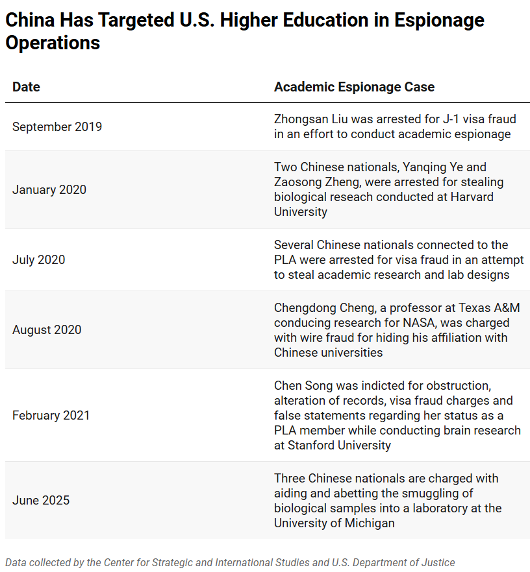
For these reasons, policymakers may wish to consider more targeted risk-management measures that focus on institutional affiliations rather than nationality. In particular, students and researchers affiliated with Chinese universities known to support China’s military-civil fusion system — or that appear on U.S. government watchlists — warrant additional screening and review during the visa process. Such an approach would allow the United States to continue welcoming talented students from around the world while ensuring that appropriate safeguards are in place for research environments involving sensitive technologies.
For that reason, the issue before Congress is not simply one of foreign influence. It is ultimately a question of governance. Universities operate in a complex global research environment in which geopolitical competition increasingly intersects with scientific collaboration. Ensuring that institutions have the information, transparency requirements, and federal guidance necessary to navigate that environment responsibly will be essential in the years ahead.
These challenges also highlight that questions surrounding foreign engagement in education are not limited to China or to higher education alone. For example, Beijing has sought to expand its presence in the U.S. K-12 space through programs such as Confucius Classrooms, many of which were initially supported by China’s former network of Confucius Institutes on university campuses.[24] Publicly available disclosures also suggest that other countries maintain significant financial engagement across the U.S. education system. According to federal reporting data, Qatar has directed substantial funding to American universities in recent years — approximately $8.8 billion in reported gifts and contracts, compared with roughly $6.8 billion from China.[25] In addition to higher education partnerships, publicly reported agreements indicate that Qatari entities have supported Arabic language and cultural programming in 16 school districts across multiple U.S. metropolitan areas, including New York, Los Angeles, Chicago, and Houston.[26] Taken together, these examples underscore a broader point: foreign engagement in American education occurs at multiple levels, and the limited transparency surrounding some of these relationships warrants continued attention from policymakers.
Section IV: Strengthening Transparency and Oversight in Higher Education
The goal of policy reform in this area should not be to restrict legitimate academic collaboration or isolate American universities from global engagement, although it may be necessary for universities to sever ties with the most problematic foreign entities, especially those linked to China’s military-civil fusion ecosystem or broader defense industrial base. Many international research partnerships and student exchanges remain vital to the continued strength of the U.S. higher education system.[27] The objective, then, should be to ensure that universities, policymakers, and the public have the tools and transparency necessary to understand and responsibly manage foreign partnerships and funding relationships.
Several practical steps could help modernize the current framework.
First, Congress should strengthen transparency requirements governing foreign gifts and contracts to U.S. universities. Existing disclosure rules under Section 117 of the Higher Education Act were developed in a very different technological and geopolitical environment. Lower reporting thresholds, clearer donor attribution requirements, and more consistent reporting standards would improve visibility into foreign funding flows while reducing ambiguity for universities seeking to comply with the law.
These requirements should not be viewed as unduly burdensome. Universities already track incoming funds, contractual relationships, and compliance obligations as a matter of routine administration. Requiring clearer disclosure of foreign money is not an extraordinary new burden; it is a basic accountability measure commensurate with the scale and sensitivity of the research enterprise many of these institutions oversee.
Second, policymakers should consider measures that improve public access to foreign funding data and strengthen the federal government’s ability to analyze those disclosures. The Department of Education’s new foreign funding transparency portal represents an important step forward in this regard and should be permanently institutionalized. Sustained public disclosure of this information is an essential transparency measure that enables policymakers, researchers, and the public to better assess patterns of foreign influence in higher education.
Congress should therefore ensure that the portal receives consistent funding and support so it can be maintained and improved over time, including through enhanced data visualization, streamlined reporting processes for universities, and stronger analytical tools that provide greater visibility into the types and structure of foreign gifts and contracts flowing to American universities.
Third, universities would benefit from clearer federal guidance and due diligence tools for evaluating foreign partnerships. Many institutions currently lack standardized frameworks for assessing potential national security risks associated with research collaborations or funding arrangements involving entities linked to foreign governments or defense industrial systems. Establishing mechanisms for federal agencies to share relevant risk information with universities — while protecting sensitive intelligence sources — would help institutions make more informed decisions when evaluating foreign engagements.
Policymakers may also wish to consider more formalized intergovernmental coordination on foreign influence risks in higher education. A structured mechanism for information sharing among the Department of Defense, the intelligence community, the departments of Treasury and State, and the Department of Education could help ensure that emerging threats are identified and communicated more effectively. Information disclosed through the foreign gift transparency portal could help inform this process by flagging potentially problematic gifts, contracts, or partnerships and enabling the federal government to work with universities to address national security concerns when they arise.
Fourth, policymakers should strengthen oversight of research collaborations involving institutions or companies that appear on U.S. government watchlists or are affiliated with foreign countries of concern. Major research universities — particularly R1 and R2 institutions that receive significant federal research funding — possess the administrative capacity and compliance infrastructure necessary to conduct rigorous due diligence on foreign research partners.
Institutions that benefit from U.S. taxpayer-funded research should therefore be required to maintain formal research integrity or research security offices and to publicly disclose material research partnerships with entities from countries of concern. These disclosures should include sufficient detail about the partnership and the due diligence conducted to determine that the collaboration does not present national security risks. Simply put, institutions that accept federal research dollars should meet clear transparency and research security standards. Universities unwilling to implement these safeguards should not expect to continue receiving federal research funding.
Fifth, policymakers should consider greater transparency and oversight for U.S.-based foundations and nonprofit organizations that provide funding or support to universities, student groups, or campus programs. Foreign governments and affiliated actors can at times route support through intermediary entities, obscuring the true source of funding and complicating disclosure. Requiring nonprofits and foundations that receive substantial foreign government support to disclose those relationships publicly, including on relevant tax filings and websites, would help close an important transparency gap and provide universities and the public with a clearer understanding of foreign-backed influence channels.
Finally, targeted improvements to the student visa review process may also warrant consideration. The United States has long benefited from welcoming talented students and researchers from around the world, and that openness should remain a defining strength of the American higher education system.[28] At the same time, additional screening mechanisms focused on institutional affiliations — particularly for applicants connected to universities involved in military-civil fusion or appearing on relevant U.S. government lists — could help mitigate risks in research environments involving sensitive technologies.
Taken together, these measures would help modernize the transparency and oversight framework governing foreign engagement in American higher education. Importantly, they would do so in a way that preserves the openness and global collaboration that make U.S. universities among the most productive and respected institutions in the world. Strengthening transparency is not about restricting academic exchange. It is about ensuring that openness is matched by accountability and that policymakers, universities, and the public have the information necessary to protect the integrity of the American research enterprise in an era of increasing geopolitical competition.
[1] U.S. Department of Education, “Section 117 Foreign Gift and Contract Reporting,” January 2, 2026. (https://fsapartners.ed.gov/knowledge-center/topics/section-117-foreign-gift-and-contract-reporting)
[2] Executive Order 14282, “Transparency Regarding Foreign Influence at American Universities,” April 28, 2025. (https://www.federalregister.gov/documents/2025/04/28/2025-07379/transparency-regarding-foreign-influence-at-american-universities)
[3] U.S. Department of Education, Press Release, “U.S. Department of Education Releases Latest Foreign Funding Disclosures from Federally-Funded American Universities,” February 11, 2026. (https://www.ed.gov/about/news/press-release/us-department-of-education-releases-latest-foreign-funding-disclosures-federally-funded-american-universities)
[4] U.S. Department of Education, “Foreign Funding Higher Education Database — ‘Total Value of Transactions involving Counterparties of Concern by U.S. Government List,’” accessed March 6, 2026. (https://www.foreignfundinghighered.gov)
[5] Ibid.
[6] Craig Singleton, “The Middle Kingdom Meets Higher Education,” Foundation for Defense of Democracies,
December 9, 2021. (https://www.fdd.org/analysis/2021/12/09/the-middle-kingdom-meets-higher-education)
[7] Cole McFaul, Sam Bresnick, and Daniel Chou, “Pulling Back the Curtain on China’s Military‑Civil Fusion,” Center for Security and Emerging Technology, September 2025. (https://cset.georgetown.edu/publication/pulling-back-the-curtain-on-chinas-military-civil-fusion); Emily de La Bruyère and Nathan Picarsic, “Defusing Military-Civil Fusion,” Foundation for Defense of Democracies, May 27, 2021. (https://www.fdd.org/analysis/2021/05/26/defusing-military-civil-fusion)
[8] Craig Singleton, “The Middle Kingdom Meets Higher Education,” Foundation for Defense of Democracies,
December 9, 2021. (https://www.fdd.org/analysis/2021/12/09/the-middle-kingdom-meets-higher-education)
[9] Ibid.
[10] U.S. House Select Committee on the Chinese Communist Party, “Fox in the Henhouse: The U.S. Department of Defense Research and Engineering’s Failures to Protect Taxpayer‑Funded Defense Research,” September 5, 2025. (https://chinaselectcommittee.house.gov/sites/evo-subsites/selectcommitteeontheccp.house.gov/files/evo-media-document/fox-in-the-henhouse_report_final_04sep2025-compressed.pdf)
[11] Ibid.
[12] U.S. Department of Defense, Basic Research Office, “Fiscal Year 2024 Lists in Response to Section 1286 of the National Defense Authorization Act for Fiscal Year 2019 (Public Law 115-232), as amended.” June 24, 2025. (https://basicresearch.defense.gov/Portals/61/Documents/Academic%20Research%20Security%20Page/FY24%20Section%201286%20List%20for%20public%20release_V2.pdf?ver=KqtK4tL1wLDoUwe2yxWHSw%3D%3D); U.S. Department of Education, “Foreign Funding Higher Education Database — ‘Total Value of Transactions involving Counterparties of Concern by U.S. Government List,’” accessed March 6, 2026. (https://www.foreignfundinghighered.gov)
[13] U.S. House Select Committee on the Chinese Communist Party, “CCP on the Quad: How American Taxpayers and Universities Fund the CCP’s Advanced Military and Technological Research,” September 23, 2024. (https://selectcommitteeontheccp.house.gov/media/reports/ccp-quad-how-american-taxpayers-and-universities-fund-ccps-advanced-military-and)
[14] Congressional Research Service, “U.S. Restrictions on Huawei Technologies: National Security, Foreign Policy, and Economic Interests,” January 5, 2022. (https://www.congress.gov/crs-product/R47012); U.S. Department of Education, “Foreign Funding Higher Education Database — ‘Total Value of Transactions involving Counterparties of Concern by U.S. Government List,’” accessed March 6, 2026. (https://www.foreignfundinghighered.gov)
[15] U.S. Senate Committee on Homeland Security and Governmental Affairs, “China’s Talent Recruitment Plans: Updated Staff Report,” November 18, 2019. (https://www.hsgac.senate.gov/wp-content/uploads/imo/media/doc/2019-11-18%20PSI%20Staff%20Report%20-%20China’s%20Talent%20Recruitment%20Plans%20Updated2.pdf)
[16] Smriti Mallapaty, “How China’s bold talent recruitment has shaped science,” Nature, July 29, 2025. (https://www.nature.com/articles/d41586-025-02336-w)
[17] Hannah Fischer and Thomas Lum, “Confucius Institutes in the United States: Selected Issues,” Congressional Research Service, May 2, 2023. (https://www.congress.gov/crs-product/IF11180); Craig Singleton, “The Middle Kingdom Meets Higher Education,” Foundation for Defense of Democracies,
December 9, 2021. (https://www.fdd.org/analysis/2021/12/09/the-middle-kingdom-meets-higher-education)
[18] Rachelle Peterson, Ian Oxnevad, and Flora Yan, “After Confucius Institutes: China’s Enduring Influence on American Higher Education,” National Association of Scholars, June 15, 2022. (https://www.nas.org/reports/after-confucius-institutes/full-report)
[19] Edward J. Graham, “Confucius Institutes Threaten Academic Freedom,” American Association of University Professors, 2014. (https://www.aaup.org/article/confucius-institutes-threaten-academic-freedom)
[20] U.S. Department of State, “The Chinese Communist Party on Campus: Opportunities & Risks,” September 2020. (https://www.state.gov/wp-content/uploads/2020/09/CCP-on-campus-FINAL.pdf); U.S. House Select Committee on the Chinese Communist Party, Press Release, “Chairmen Moolenaar, Mast, Walberg Ask Rubio to Act on the Chinese Students and Scholars Association,” March 5, 2026. (https://chinaselectcommittee.house.gov/media/press-releases/chairmen-moolenaar-mast-walberg-ask-rubio-to-act-on-the-chinese-students-and-scholars-association)
[21] Ibid.
[22] “Survey of Chinese Espionage in the United States Since 2000,” Center for Strategic and International Studies, accessed March 6, 2026. (https://www.csis.org/programs/strategic-technologies-program/survey-chinese-espionage-united-states-2000)
[23] Matt Pottinger, “Protecting Americans’ Private Information from Hostile Foreign Powers,” Testimony before Senate Judiciary Subcommittee on Privacy, Technology, and the Law, September 14, 2022. (https://www.fdd.org/analysis/2022/09/14/protecting-americans-private-information-from-hostile-foreign-powers)
[24] Ian Oxnevad, “China and our Children,” National Association of Scholars, July 2024. (https://www.nas.org/storage/app/media/Reports/China%20and%20Our%20Children/China_and_Our_Children.pdf)
[25] “Section 117 Foreign Gift and Contract Public Transparency Dashboard,” U.S. Department of Education, accessed March 9, 2026. (https://www.foreignfundinghighered.gov)
[26] Contracts from the four listed cities are available on the FDD website. See: New York: “QFI Contract for P.S./I.S. 30 in Brooklyn, NY,” Foundation for Defense of Democracies, accessed March 9, 2026. (https://media.fdd.org/wp-content/uploads/2026/03/QFI-NYC-contract-PSIS30.pdf); Los Angeles: “QFI Contract With LA Unified School District,” Foundation for Defense of Democracies, accessed March 9, 2026. (https://media.fdd.org/wp-content/uploads/2026/03/QFI-contract-in-LAUSD.pdf); Chicago: “QFI Contract for Lindblom Math and Science Academy in Chicago,” Foundation for Defense of Democracies, accessed March 9, 2026. (https://media.fdd.org/wp-content/uploads/2026/03/QFI-Chicago-contract.pdf); Houston: “Grant for June 1, 2015 to June 30, 2016,” Foundation for Defense of Democracies, accessed March 9, 2026. (https://media.fdd.org/wp-content/uploads/2026/02/QFI-Teacher-Requirements-in-Houston-1.pdf).
[27] Cade Metz and Eli Tan, “In the A.I. Race, Chinese Talent Still Drives American Research,” The New York Times, November 19, 2025. (https://www.nytimes.com/2025/11/19/technology/ai-research-chinese-talent.html)
[28] Ibid.
