January 8, 2026 | Memo
Russia Recruits Young Migrant Women from Latin America to Build Iranian Drones
January 8, 2026 | Memo
Russia Recruits Young Migrant Women from Latin America to Build Iranian Drones
Executive Summary
Young women are being lured to a remote region of Russia with false promises of high wages and practical education. When they arrive, they are put to work — reportedly in grueling conditions — as part of the Kremlin’s war machine, building drones that Russia uses to attack Ukraine. By putting a stop to this abuse of human rights, the United States has an opportunity to disrupt the supply of weapons that Moscow needs for its war of aggression.
The United States has already imposed sanctions on Russia’s Special Economic Zone Alabuga (SEZ Alabuga), where factories produce Iranian-designed drones. The U.S. Treasury Department has also sanctioned several of SEZ Alabuga’s subsidiaries and associated officials.1 Nevertheless, Moscow continues to expand its foreign-labor pipeline. After focusing initially on Africa,2 Russia is turning to Latin America as a source of labor to boost its production of drones, especially the Geran-2, which is based on the Iranian-designed Shahed-136 kamikaze drone. The Geran-2 is a series of one-way attack drones produced under a license agreement between Russia and Iran. Moscow uses these drones in large-scale barrages against Ukrainian critical infrastructure, defense-industrial sites, and other targets.3 The Alabuga plant, Russia’s main producer of Geran-2 drones, also makes the turbojet-powered Geran-3 and the Gerbera series of drones.4 The latter typically serve as decoys.
This memo documents the launch this year of a rapid and coordinated labor recruitment drive targeting women ages 18 to 22 across at least 12 Latin American countries. This campaign is part of Alabuga Start, which presents itself as an international career-development exchange program, offering airfare, housing, health insurance, and Russian-language courses to entice applicants. In reality, the program serves as a pipeline into SEZ Alabuga, 600 miles east of Moscow in the Republic of Tatarstan, where recruits reportedly work in harsh conditions assembling the Geran-2 and other drones.5 The Foundation for Defense of Democracies (FDD) has outlined the role of SEZ Alabuga in Russia’s domestic drone production and the relationship among Alabuga Start, Alabuga Polytech, and JSC Alabuga.
Alabuga Start’s recruitment in Latin America has scaled up rapidly in both scope and sophistication. The program uses social media platforms — including TikTok, Instagram, Facebook, X, Telegram, and RuTube (a Russian video platform) — to drive this expansion, relying on promotional videos generated by artificial intelligence (AI), dedicated regional pages, and influencer partnerships. FDD has identified Alabuga Start’s primary recruiter in Latin America, along with local recruiters in Brazil, Mexico, and Bolivia. This memo profiles those individuals and presents a country-by-country review of the program’s presence in 13 Latin American countries.
Not only does the Alabuga Start program likely qualify as human trafficking and forced labor, it also feeds Russian aggression in Ukraine.6 As part of its drive to defang Moscow, should broaden its sanctions to encompass those who facilitate Alabuga Start’s recruiting, including vocational colleges and individual recruiters. Washington should also increase diplomatic engagement with Latin American governments to counter recruitment and should press online platforms to remove accounts involved in these operations. The chance to disrupt Alabuga Start’s recruitment networks provides the United States and its partners with a practical way to diminish Russia’s defense-industrial output, limit its capacity to wage war, and protect thousands of young women from exploitation.
The Exploitation of Workers and Structure of the SEZ Alabuga Corporate Web
Alabuga Start attracts young women with promises of education, professional development, and work opportunities in Russia. Alabuga Start recruiters closely coordinate recruits’ travel to Russia, requiring applicants to remain in constant contact with HR throughout the journey, send photos of boarding passes and in-flight selfies, and report at multiple checkpoints until they are met by company representatives upon arrival.7 Participants describe being told that the program offered work-study or scholarship tracks in fields such as hospitality, catering, and general manufacturing.8 Once foreign recruits arrived in Tatarstan, however, Alabuga staff immediately assigned them to produce Shahed-136 drones and offered no alternatives.9 The Institute of Science and International Security reported that up to 90 percent of Alabuga Start recruits end up working in drone production.10 Several participants said they did not learn they would be working on weapons systems until they entered the drone factory on their first day. Such deceptive recruiting is a key component of the legal definition of forced labor and human trafficking. The testimony of the women who have participated in Alabuga Start indicates the extent to which manipulation and control are an integral part of the program.
Alabuga Start keeps participants under close surveillance and limits their ability to communicate with anyone outside the facility.11 The Associated Press has reported that managers monitor messages, restrict phone access, and require permission for conversations with outsiders.12 Alabuga also requires participants to sign nondisclosure agreements that forbid them from telling even their families the true nature of their work.13 Both the dormitories and factory floors stay heavily monitored with facial-recognition access and constant camera surveillance.
Working conditions inside the drone plants expose recruits to significant health and safety risks. Women reported handling chemicals that burned their skin, causing peeling, irritation, and even holes on their cheeks.14 One participant in particular reported repeated nosebleeds, while another claimed recruits were “maltreated like donkeys, being slaved.”15 Despite a Ukrainian drone strike that injured at least 12 workers in April 2024, recruits continued working as before and could not opt out of drone production.
Foreign recruits also face financial penalties that make it difficult to leave the program. Multiple women have reported 12-hour shifts, irregular days off, and wage penalties for minor infractions, such as accidentally setting off a fire alarm while cooking.16 Alabuga also deducts the cost of housing, transportation, Russian-language classes, and medical care, leaving workers with a small fraction of their promised pay.17 One woman expected to earn $600 per month but received only one-sixth of that.18
After several women left the program following a Ukrainian strike, program staff confiscated the passports of those who remained.19 Others who attempted to resign were required to complete notice periods while continuing to work in the factory. Women who try to leave are told they must pay a fine for withdrawing.20
Bloomberg reported in April 2025 that Interpol had begun investigating Alabuga Start for human trafficking in Botswana.21 While no country or international body has yet accused Alabuga Start of human trafficking, the program’s recruitment practices align with key elements of international definitions of trafficking and forced labor.22 The United Nations defines trafficking as recruitment that uses “fraud, of deception, of the abuse of power or of a position of vulnerability.”23 Both the testimony of recruits and the accounts compiled by journalists indicate that Alabuga Start engages in precisely these practices.
The SEZ Alabuga Corporate Web
The Ministry of Land and Property Relations of the Republic of Tatarstan wholly owns Joint Stock Company (JSC) Alabuga, the corporate entity associated with SEZ Alabuga.24 Established in 1998, the zone provides tax breaks, customs exemptions, and infrastructure to companies operating within its boundaries.
JSC Alabuga has partnerships with vocational colleges, which it brands as “Alabuga Polytech.” These partnerships form “education and production centers” under the Russian state’s “Professionalism” program — a broader initiative to modernize its domestic workforce (see Appendix A). Several Russian scholars have noted the importance of these centers — 506 of which exist across Russia — for attracting youth to Russia’s military-industrial complex.25 Alabuga Polytech trains teenagers and young adults in drone assembly, with some students receiving instruction in Tehran on manufacturing Shahed airframes.26
Leaked correspondence and corporate records show that JSC Alabuga controls key subsidiaries driving drone manufacturing and production site build-out, including Alabuga Machinery LLC — explicitly identified as a subsidiary of JSC Alabuga — which procured metals, equipment, and tooling for the Geran program through Generation Trading FZE, an intermediary in the United Arab Emirates (UAE).27 In parallel, Alabuga Development, another subsidiary of JSC Alabuga, managed major construction to expand worker housing and related infrastructure, later joined by a related contractor.28
In early 2023, JSC Alabuga signed a $1.75 billion contract with Iranian company Sahara Thunder to provide the Russian military with thousands of drones.29 The company has provided JSC Alabuga with the technology and expertise needed throughout the manufacturing process.30 The Russian government reportedly helped finance the contract through loans to Alabuga Machinery.31 That company maintains direct ties to the Russian Ministry of Defense, both as a supplier and as a recipient of state funding for its drone program.32
JSC Alabuga’s recruitment drive also serves the nearby Albatros LLC plant, which manufactures M5 reconnaissance drones largely for civilian use but also in limited quantities for the Russian military in Ukraine. Albatros, which likewise requires additional workers, functions as both a beneficiary of and a cover for JSC Alabuga’s broader effort to staff its drone factories.33
In February 2024, the U.S. Treasury’s Office of Foreign Assets Control sanctioned JSC Alabuga, Alabuga Machinery, Alabuga Development, Albatros, and top company officials for their role in producing Iranian-designed drones, noting the exploitation of underage students from an affiliated polytechnical institution to assemble drones.34 The vocational colleges that participate in the “Alabuga Polytech” initiative have not been sanctioned.
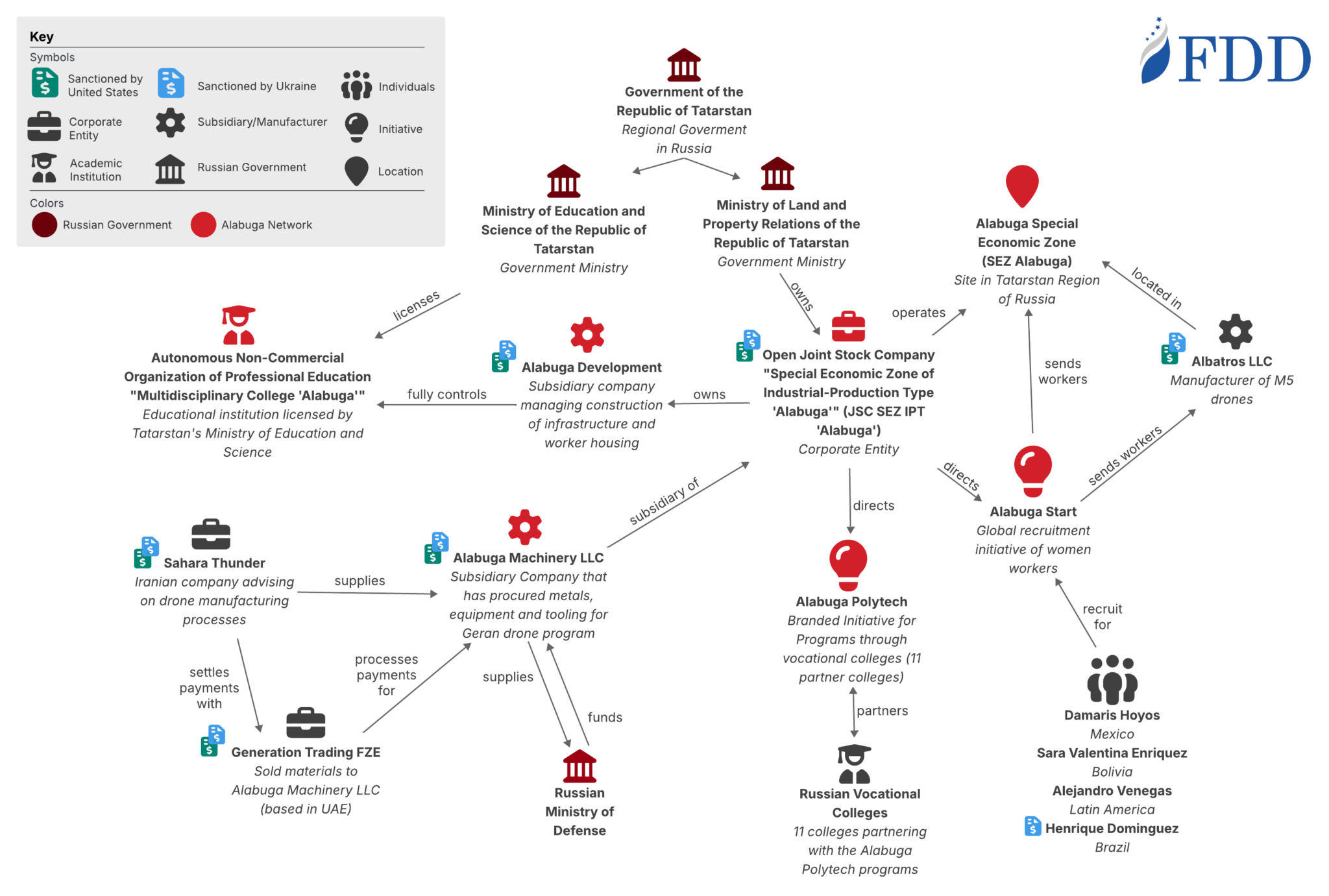
Figure 1: Map of the Alabuga web. Source: FDD.
An Expanding Enterprise
Drone production at SEZ Alabuga has scaled up rapidly since 2023, far exceeding the reported objectives of the license agreement with Iran, which envisioned the manufacture of 226 drones per month.35 As of June 2025, Ukrainian military intelligence reportedly assessed that Russia was producing an estimated 2,700 Shahed-type drones per month, enough to launch about 90 per day.36Analysis by the Institute for Science and International Security indicates that Russia has maintained a high and relatively consistent level of Shahed-type UAV launches since the summer of 2025, averaging between 5,400 and 5,500 drones per month.37 Launches averaged 181 per day in June, 203 per day in July, 133 per day in August, 188 per day in September, and 171 per day in October. In September, Maj. Gen. Vadym Skibitskyi, deputy head of Ukraine’s military intelligence directorate, noted that the Russians “initially started with 1,000 employees” at the Alabuga drone plant “but now plan to have 40,000.”38
In mid-September 2025, the Swiss newspaper Le Temps obtained high-resolution satellite images of the SEZ Alabuga site that revealed construction of more than a hundred new production and residential facilities, including dormitories for workers, as well as new defensive infrastructure. Dormitory buildings increased from 15 in February 2024 to 104 by July 2025, with the completed construction having a capacity for an estimated 40,000 workers.39 The scale of this expansion underscores a growing labor shortfall that Russia has been unable to address through traditional recruitment channels. Direct recruitment of foreign labor for drone manufacturing would likely deter participation and invite heightened international scrutiny, particularly given the legal and sanctions-related risks associated with weapons production linked to the war in Ukraine. The use of programs such as Alabuga Start allows Russia to obscure the nature of the work and reduce the visibility of its labor pipeline.
The Promises of Alabuga Start
Alabuga Start frames its recruitment narrative through highly curated depictions of life inside SEZ Alabuga. The program’s promotional materials describe the zone as “the most successful in Russia” and highlight its “doubtless advantages.”40 Participant testimonials on Alabuga Start’s website describe a “friendly atmosphere,” positive experiences in language and conversation clubs, and opportunities to visit “fascinating cultural and historical sights.”41 Images feature participants smiling in classrooms and work stations, painting a misleading image of comfort and personal development.
One of Alabuga Start’s websites (startworld.alabuga[.]ru) lists benefits including a starting monthly salary of 54,125 rubles, airfare to Russia, health insurance, professional training, and Russian language classes.42 The website uses an exchange rate of 100 rubles to the dollar to convey the value of promised salaries. In addition to the starting salary worth $541 per month, the site promotes a staged “career ladder,” claiming that salaries can rise to $1,783 per month.43
A brochure available through the website provides a closer look into Alabuga Start’s expansion since 2023.44 It claims that in 2023, the program offered one field of employment, attracted participants from seven countries, and recruited 22 individuals. In 2024, the program purportedly expanded to four job fields, 44 countries, and 327 recruits. In 2025, it expanded to seven job fields, 77 countries, and approximately 8,500 recruits. Upon completion, the program claims to offer several options: permanent employment within SEZ Alabuga, jobs at other factories, enrollment at Alabuga Polytech, or returning home.45
The program incentivizes recruitment through a bounty system with payouts to “representatives” in participating countries.46 Partners earn a small per-candidate payment for submitting a complete application packet — referred to as the “Full Support” nomination — regardless of whether the recruit ultimately travels. A separate per-candidate payment is made only after the recruit obtains a visa, arrives in Russia, clears medical and exam requirements, receives a work permit, and signs an employment contract — referred to as the “Employment Leader” nomination. A “Partner of the Year” award of up to $14,000 goes to the representative with the highest percentage of successful job placements against the country quota.47
The application process requires prospective recruits to submit their name, country, and CV via the program’s Telegram channel.48 It also asks that candidates learn 100 Russian words, complete an “Alabuga Start simulation,” pass an online interview, and sign a formal offer. As of September 2025, the website lists admissions as ongoing.49
While the program has a new emphasis on Latin America, Alabuga Start also continues, it seems, to direct significant effort toward recruiting young women from Russia and the other post-Soviet countries in the Commonwealth of Independent States (CIS).50 For example, the website startcis.alabuga[.]ru, as indicated by its domain name, appears to focus on women from CIS countries, including Kazakhstan, Kyrgyzstan, Azerbaijan, Belarus, Tajikistan, Uzbekistan, and Armenia, as well as Moldova, which has partially withdrawn from the CIS.51 The domain name of the website programmstartcis[.]com, also created by JSC Alabuga, indicates a similar focus. Startrussia.alabuga[.]ru appears to serve as the website for the domestic arm of Alabuga Start.52 An associated Telegram channel — AlabugaStartRussia — appears geared toward
domestic recruitment.53
How Social Media Has Served as a Vehicle for Alabuga Start’s Expansion in Latin America
Social media plays a central role in Alabuga Start’s recruitment strategy. The program promotes itself across TikTok, Instagram, X, Facebook, Telegram, and RuTube, both directly through its own accounts and indirectly through representatives, contracted influencers, and affiliated organizations.
After the initial exposure of abuses in SEZ Alabuga, Google, Meta, and TikTok removed accounts linked to Alabuga Start and Alabuga Polytech for violating their policies.54 Nevertheless, FDD has identified multiple recently created accounts promoting Alabuga Start to Latin American audiences, as well as several online recruitment efforts in Latin America dating back to 2024. The program’s current social media network includes two X accounts, two Instagram accounts, one TikTok account, one Facebook account, a Telegram channel, and a RuTube channel.
On Instagram, start_program_latam serves as the program’s Latin America recruitment hub.55 Although the account was registered in January 2024, it started posting recruitment content only in March 2025. It brands the initiative simply as “Start Program” while displaying the Alabuga Start logo in its posts and linking directly to the program’s homepage. Its Spanish-language content includes AI-generated videos portraying the “success” of Latin American women who join the program.56
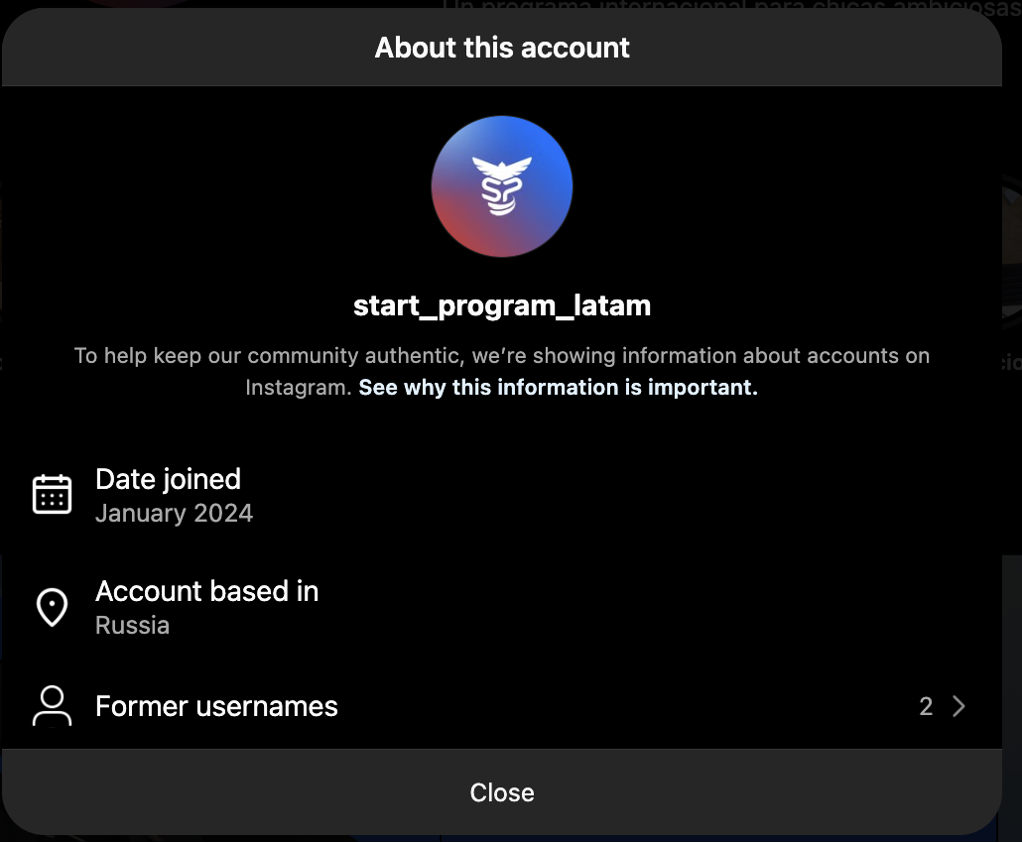
Figure 2: Instagram transparency details for the account start_program_latam show it was registered in January 2024, is based in Russia, and has used multiple former usernames.
Another account, work.in_russia, appears to function as the program’s primary global recruitment page on Instagram.57 The account was created in November 2024. It links to the homepage of one of Alabuga Start’s websites and mirrors content from the official SEZ Alabuga X account. Like other program-linked profiles, it uses what looks to be AI-generated media to appeal to younger audiences, producing videos that reimagine Alabuga Start with characters from popular culture, such as Harry Potter and Disney’s “Wreck-It Ralph.”58
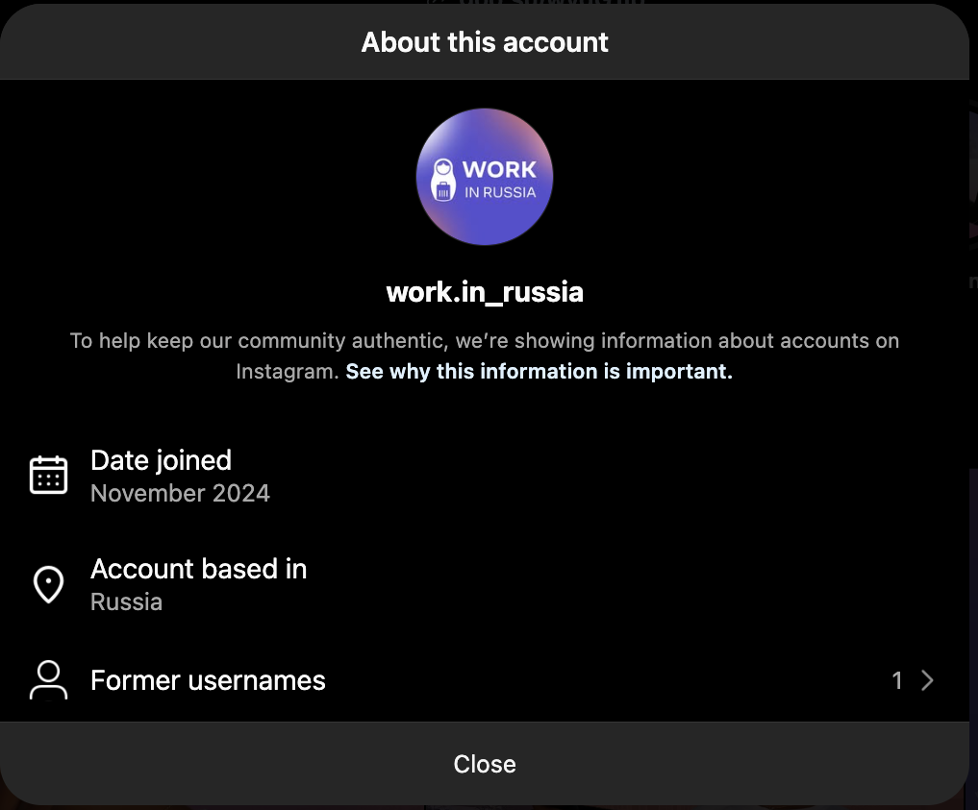
Figure 3: Instagram transparency data for work.in_russia shows it was registered in November 2024, is based in Russia, and has changed usernames.
The official X account for SEZ Alabuga (@sezalabuga), which has been active for over a decade, has recently intensified its promotion of Alabuga Start in Latin America.59 The program’s accounts on TikTok and Facebook promote the program without a specific regional focus, often showcasing the day-to-day life of participants.60
Additionally, Alabuga Start operates multiple Telegram channels. One channel (AlabugaStart) with over 24,000 subscribers shares promotional content, application tips, and announcements of official partnerships with target countries such as Ghana and Brazil. A private Telegram group called “Alabuga Start Programme,” linked directly on Alabuga Start’s website, focuses on recruitment and onboarding.61 The private group, which has over 2,900 members and has been active since April 10, 2025, instructs applicants to submit their information there so HR specialists can contact them. Members post their personal details, with some complaining about delays in the application process and slow HR responses. The channel’s administrator frequently names specific HR specialists, including “HR Priscilla” and “HR Alsou.” As mentioned earlier, Alabuga Start also operates a domestic recruitment channel, AlabugaStartRussia, which has more than 1,300 subscribers. The channel posts content in Russian and incentivizes young women to apply by highlighting promised salaries, housing, and career advancement opportunities.
Individuals That Have Been Involved with Alabuga Start’s Recruitment Efforts in Latin America
Alabuga Start’s expansion into Latin America relies on a network of country-level recruiters who serve as intermediaries between the program and local audiences. Speaking the local language, these recruiters present the program as a cultural or educational exchange and build credibility through social media campaigns, partnerships with schools and municipal governments, and collaborations with cultural and sport organizations. FDD is unable to determine whether the recruiters identified below were aware of the program’s role in labor exploitation or its connection to drone production.
This recruitment model allows Alabuga Start to move quickly and adapt its message to different contexts. In Brazil, recruiters frame the program as part of cooperation within BRICS, a bloc that includes Brazil, Russia, India, China, and South Africa that serves as a key platform for Russian diplomatic and economic engagement. In Ecuador, they partner with popular sports clubs to appeal to youth. In Mexico, they showcase endorsements from municipal leaders. What the recruiters do not say is that those who sign up will have no choice but to work in factories churning out drones for the war in Ukraine.
Alejandro Venegas: A Key Representative in Alabuga Start’s Latin American Past Recruitment Efforts
Alejandro Venegas has previously appeared to play a central role in Alabuga Start’s recruitment efforts and at one point appeared to be the primary recruiter for the program in Latin America. Public profiles associated with Venegas indicate he is originally from Ecuador, lives in Kazan, Russia, and is a robotics and mechatronics engineer.62 An associated profile on Superprof — an online platform that connects students with private tutors — states that Venegas taught Spanish at Alabuga International School and describes him as a digital marketer and an engineer.63 Alabuga International School is a private institution in SEZ Alabuga that provides STEM-focused instruction in English, Russian, and Chinese for the children of local and expatriate employees.64

Figure 4: Profile photo of Alejandro Venegas from his Facebook account.
In August 2024, the popular Ecuadorian influencer “El Champ” posted a video titled “Cómo ESTUDIAR y TRABAJAR en Rusia?” or how to study and work in Russia. In the video, Venegas says he lived in Russia for five years, worked at Alabuga (without specifying the specific part of the company where he worked), and has now returned specifically for Alabuga Start, where he serves as a representative and coordinator.65 FDD confirmed his role through a TikTok post, now unavailable, that explicitly named him as the Latin America representative for the program.
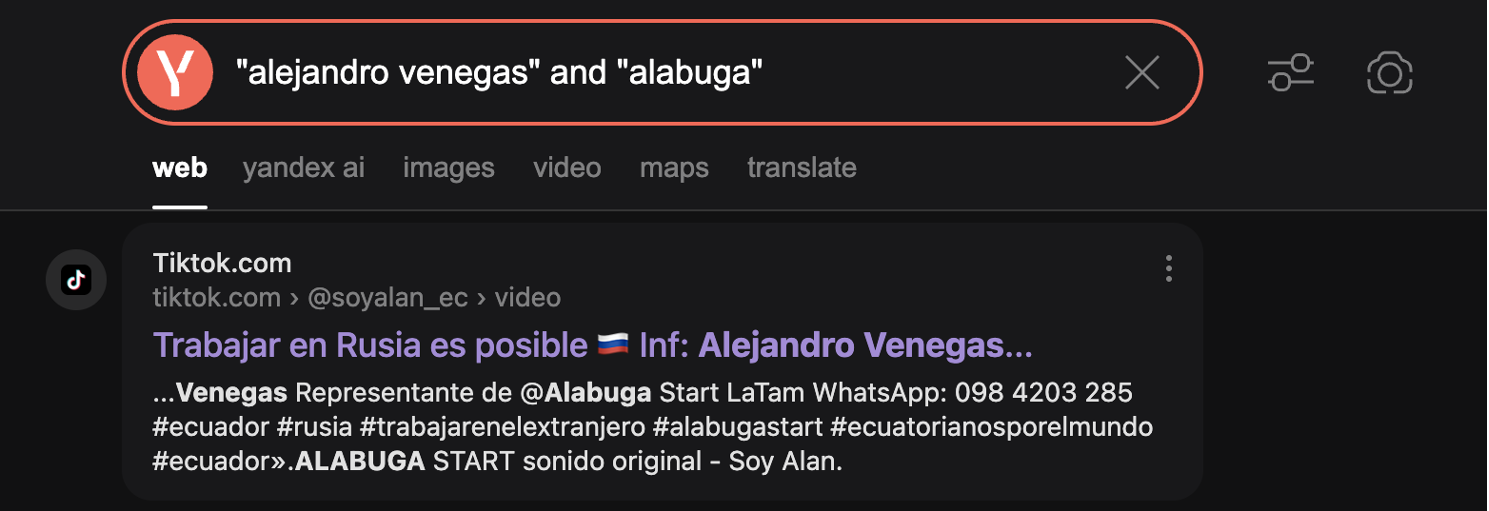
Figure 5: Yandex web search results showing a TikTok preview that describes Alejandro Venegas as the Latin American representative for Alabuga Start.
Several of Venegas’s social media accounts document his time in Russia and include posts with anti-Western content. Venegas’s Threads account went silent in October 2024 before becoming active again in June 2025 with a post praising BRICS.66 The post also denounces Israel, the United States, and NATO, stating that “Israel is sinking lower and lower in the eyes of the world” and that “Humanity is growing tired of the U.S. and its useful puppets.”67 Venegas’s Facebook profile lists an associated phone number that FDD ran through OSINT Industries, a platform used for open-source research and intelligence.68 Results show an associated WhatsApp account whose bio includes “ALABUGA START.” Additionally, the start_program_latam account follows only 31 users, one of whom is Venegas.
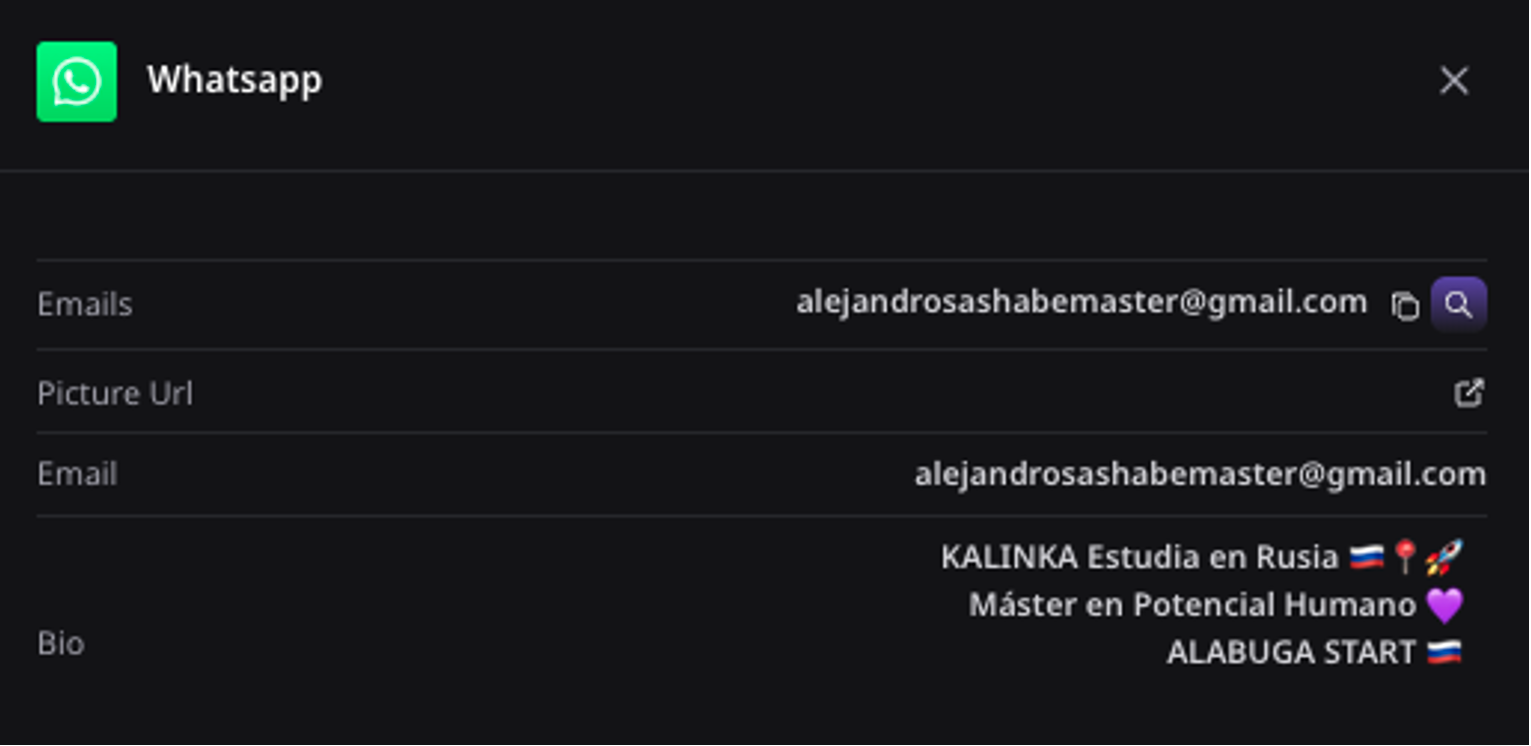
Figure 6: OSINT Industries result linking Alejandro Venegas’s WhatsApp account to the email address [email protected] and a bio explicitly referencing “ALABUGA START.”
On April 18, 2025, the Argentinian outlet Noticias Argentinas published an article showing an email that two Argentinian influencers — Martín Ku and Nicolás Grosman — received from Alabuga Start inviting them to promote the program.69 Although the outlet redacted the sender’s name, a separate TikTok post by a journalist criticizing the program shared the same letter without redactions, showing Alejandro Venegas identifying himself as Alabuga Start’s representative for all of Latin America.70 In the email, dated September 10, 2024, Venegas offered a paid trip to Russia to film promotional content for YouTube and Instagram. He also stated that the company Alabuga — a reference to JSC Alabuga — would cover all expenses, including airfare and three daily meals, and that participants would sign a work contract for content creation. He noted that outreach for the program began with Ecuadorian YouTubers, referencing the video posted in August 2024 by Ecuadorian influencer El Champ. He also wrote that the current focus of expansion for Alabuga Start included Mexico, Colombia, and Argentina.
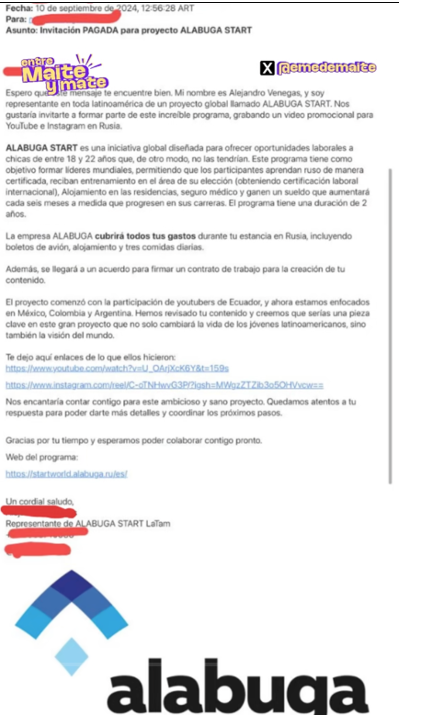
Figure 7: A TikTok post showing an email sent by Alejandro Venegas on September 10, 2024, to Argentinian influencers, where he identifies himself as Alabuga Start’s Latin America representative and offers paid travel to Russia with all expenses covered for creating promotional content.
While no publicly available organizational documents or statements from Alabuga Start confirm Venegas’s status as the program’s primary recruiter in Latin America, the available evidence supports FDD’s assessment that he played a significant role in past outreach efforts. FDD was unable to determine the extent of his current involvement.
Henrique Dominguez: Program Ambassador in Brazil
Henrique Dominguez appears to act as Alabuga Start’s primary recruiter and program ambassador in Brazil.

Figure 8: Photo of Henrique Dominguez — found on Alabuga Start’s Telegram channel.
A post on Alabuga Start’s Telegram channel names Dominguez as the program’s ambassador in Brazil. A March 27, 2025, article from Portal Vermelho — or “Red Portal,” a Brazilian news and opinion website with a left-wing editorial stance where Dominguez serves as a columnist — provides an additional indication of his involvement with the program.71 The article, which promotes Alabuga Start, identifies Dominguez as both the program’s ambassador in Brazil and the assistant chief of BRICS+ Cities and Municipalities. On the same day, another promotional article posted by a different Brazilian publication also listed him as a program ambassador.72
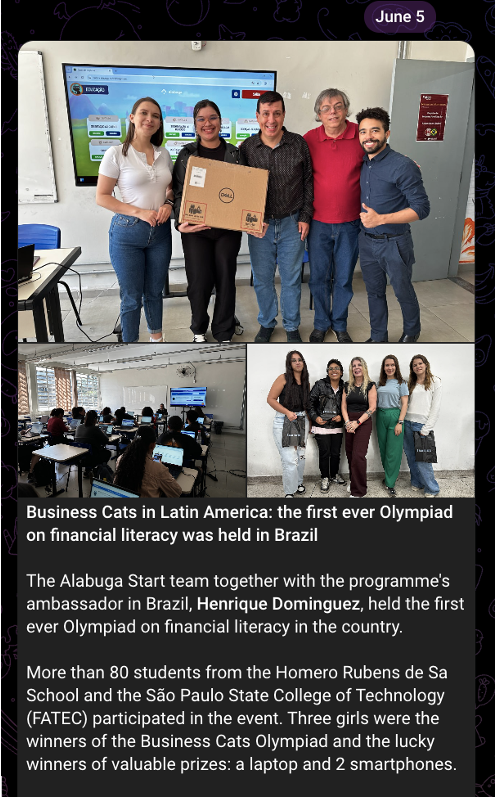
Figure 9: Alabuga Start Telegram post naming Henrique Dominguez as its ambassador in Brazil during the “Business Cats” financial literacy Olympiad.
Dominguez has an extensive record of pro-Russian activity and participation in Kremlin-aligned propaganda efforts. Ukrainian and European organizations have repeatedly flagged him as a politically biased or “fake” election observer.73 In 2022, the Center for Strategic Communications and Information Security identified Dominguez among 64 foreign “observers” Russia brought to occupied parts of Ukraine’s Donetsk, Luhansk, Zaporizhzhia, and Kherson regions during staged referendum.74 These individuals appeared in Russian state media to endorse the legitimacy of the votes despite international condemnation. An article by the Russian state news agency TASS from that year quoted Dominguez praising the Zaporizhzhia vote and declaring the election legitimate.75
An election monitoring platform maintained by the European Platform for Democratic Elections lists Dominguez as a fake observer in three separate elections: the 2022 pseudo-referendum to annex occupied Luhansk, the 2023 territorial pseudo-elections in occupied Ukraine, and the 2024 Russian presidential elections.76 The platform also notes that Dominguez studied at the St. Petersburg State University of Economics and Finance. He is also sanctioned by Ukraine.77
Alabuga Start’s Telegram channel continues to reference Dominguez as part of the program, including a June 16 post that identifies him as a representative. However, FDD cannot officially confirm whether he still holds an active ambassador or recruiter role beyond these mentions.
Damaris Hoyos: Program Ambassador in Mexico
Damaris Hoyos appears to act as Alabuga Start’s main representative in Mexico.
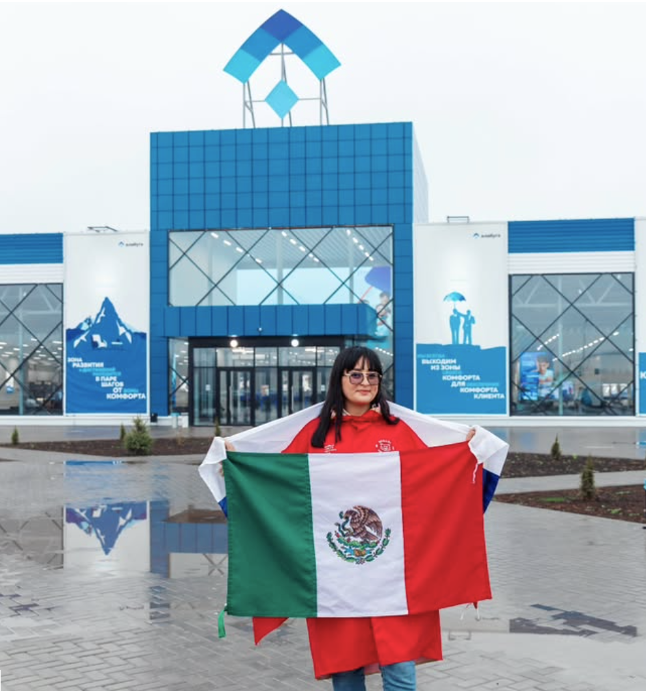
Figure 10: Instagram post uploaded by Damaris Hoyos that shows her holding a Mexican flag in Alabuga SEZ.
FDD linked Hoyos to the program through an official infographic posted on Instagram by the Abasolo Municipality in Guanajuato, Mexico, inviting Mexican women to apply to Alabuga Start.78 The post instructed applicants to send a screenshot of their Alabuga Start registration to a specific phone number. OSINT Industries results confirm the number belongs to Hoyos.
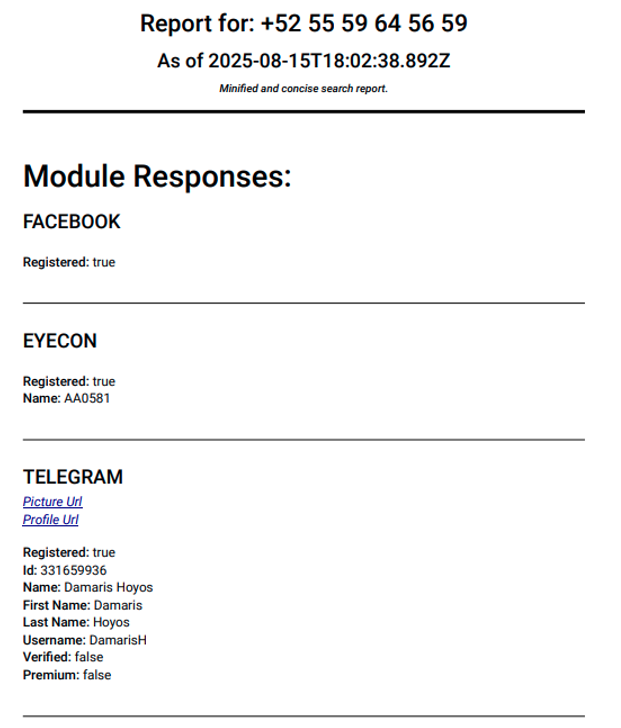
Figure 11: OSINT Industries search results confirming a Mexican phone number tied to Damaris Hoyos, linking her to Alabuga Start registration.
A July post, posted jointly by a pro-BRICS Instagram user and Hoyos’s own profile, describes her as the ambassador of Alabuga Start in Mexico.79 Posts on Hoyos’s Instagram account show her speaking on panels in Russia, including on youth cooperation between Russia and Latin America.80 Her Instagram bio also identifies her as a member of Centro de Integración Multipolar & Cooperación Estratégica (ISKRA) — an organization that focuses on Latin America-BRICS ties through cultural, commercial, political, and academic exchanges.81
FDD’s most recent confirmation of Hoyos’s ongoing involvement comes from an October 30, 2025, Instagram post in which she documents a visit to the SEZ Alabuga and mentions a supposed newly formed cooperation agreement between Alabuga and Mexico to expand job opportunities for Mexican youth.82
Sara Valentina Enriquez: Recruiter in Bolivia
Sara Valentina Enriquez appears to facilitate recruitment efforts in Bolivia and to ISKRA. On July 14, 2025, the TikTok account trabaja.en.rusia promoted Alabuga Start in Bolivia and directed individuals interested in the program to a phone number that is associated with Enriquez, according to OSINT Industries data.83 Results indicate the presence of a WhatsApp account featuring an Iranian flag and a red heart in its bio. An associated account exists on VK, Russia’s version of Facebook. Results also show an associated account on Yandex, a Russian internet and technology company.
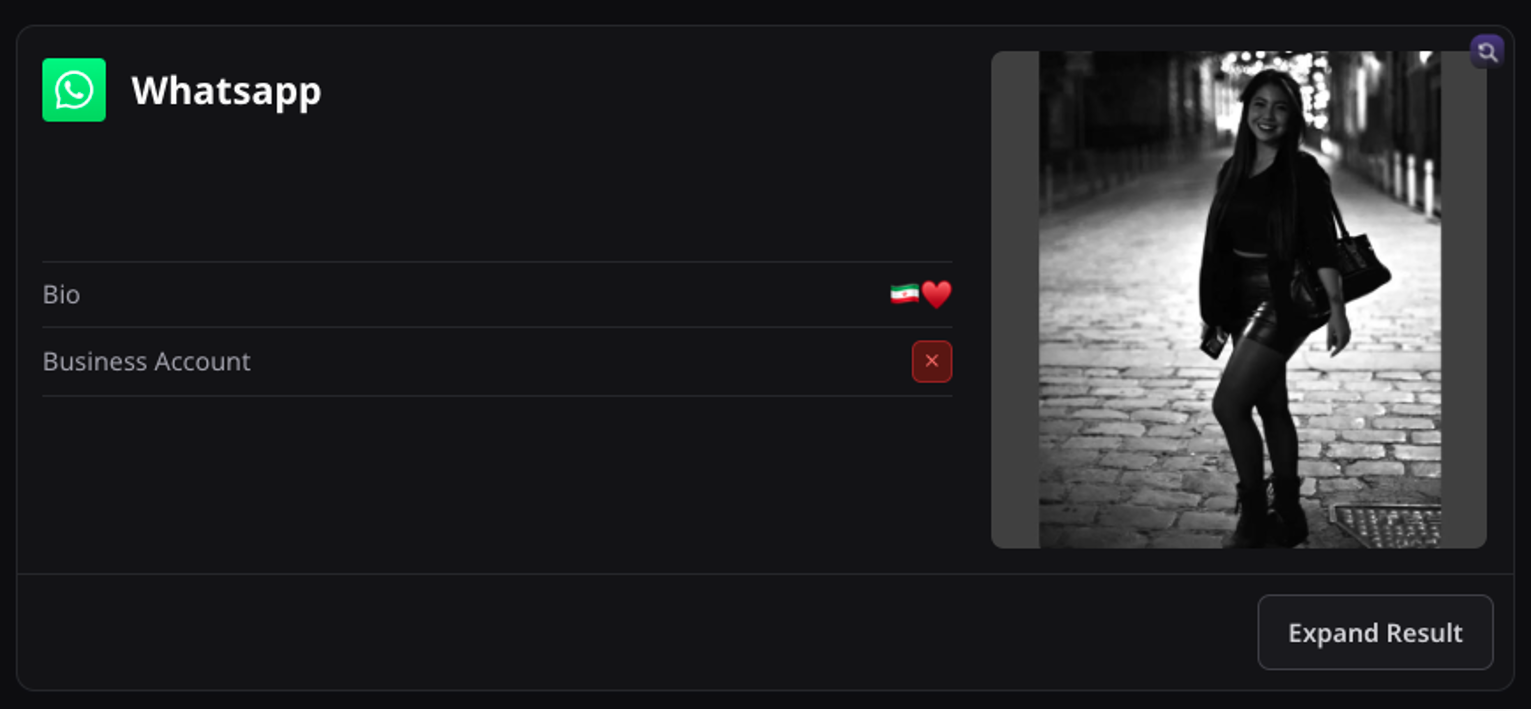
Figure 12: WhatsApp account associated with Sara Valentina Enriquez with Iranian flag in bio.
FDD’s most recent confirmation of Enriquez’s involvement comes from a July 2025 article she authored for a news publication called El Marmore in which she publicly promotes Alabuga Start to Bolivian youth.84
Evolution of Alabuga Start’s Latin America Recruitment
FDD has mapped out Alabuga Start’s recruitment efforts across Brazil, Ecuador, Venezuela, Bolivia, Peru, Mexico, Panama, Costa Rica, Argentina, Colombia, Nicaragua, and El Salvador. FDD also reconstructed a recruitment timeline between June 2024 and September 2025 by triangulating posts across various social media platforms and Latin American news outlets. FDD cannot determine the extent to which the local news outlets promoting the program were aware of Alabuga Start’s links to labor exploitation or drone production, and some outlets may have amplified the program’s messaging without being aware of its true purpose. FDD assesses that Alabuga Start began limited recruitment in Latin America around mid-2024 but made the region a primary focus in 2025.
The previously mentioned YouTube video from August 2024, “Cómo ESTUDIAR y TRABAJAR en Rusia?” features a young Colombian participant who says she is the only recruit from Latin America in the program at that time.85 An archived version of startworld.alabuga[.]ru from October 2024 shows that the program had already listed Latin American countries among its recruitment targets, consistent with the recruitment efforts circa 2024 identified by FDD.86
Moderation efforts by Meta, TikTok, and Google in October 2024 likely hampered early outreach efforts. In mid-October, accounts associated with “Alabuga Start” were removed on Facebook, Instagram, YouTube, and TikTok after an Associated Press investigation revealed the campaign’s recruitment of foreign women for drone production efforts.87 As of September, Alabuga Start’s Instagram and TikTok accounts appear to have been banned or removed — though the program continues to have active accounts on other platforms.
Despite these moderation efforts, activity targeting Latin American countries has significantly increased throughout 2025. An article by the program’s Mexican representative, Damaris Hoyos, in July describes a regional Alabuga Start tour in Brazil, with meetings held with local authorities, educational institutions, and women’s organizations.88 The article states that the current effort centers on Brazil, with Mexico named as a priority for expansion.
Between May and June, the program’s Telegram channel documented a series of meetings between Alabuga representatives and foreign officials, including visits with municipal authorities in Brazil and a meeting with the counselor of the Dominican Republic’s Embassy in Russia.
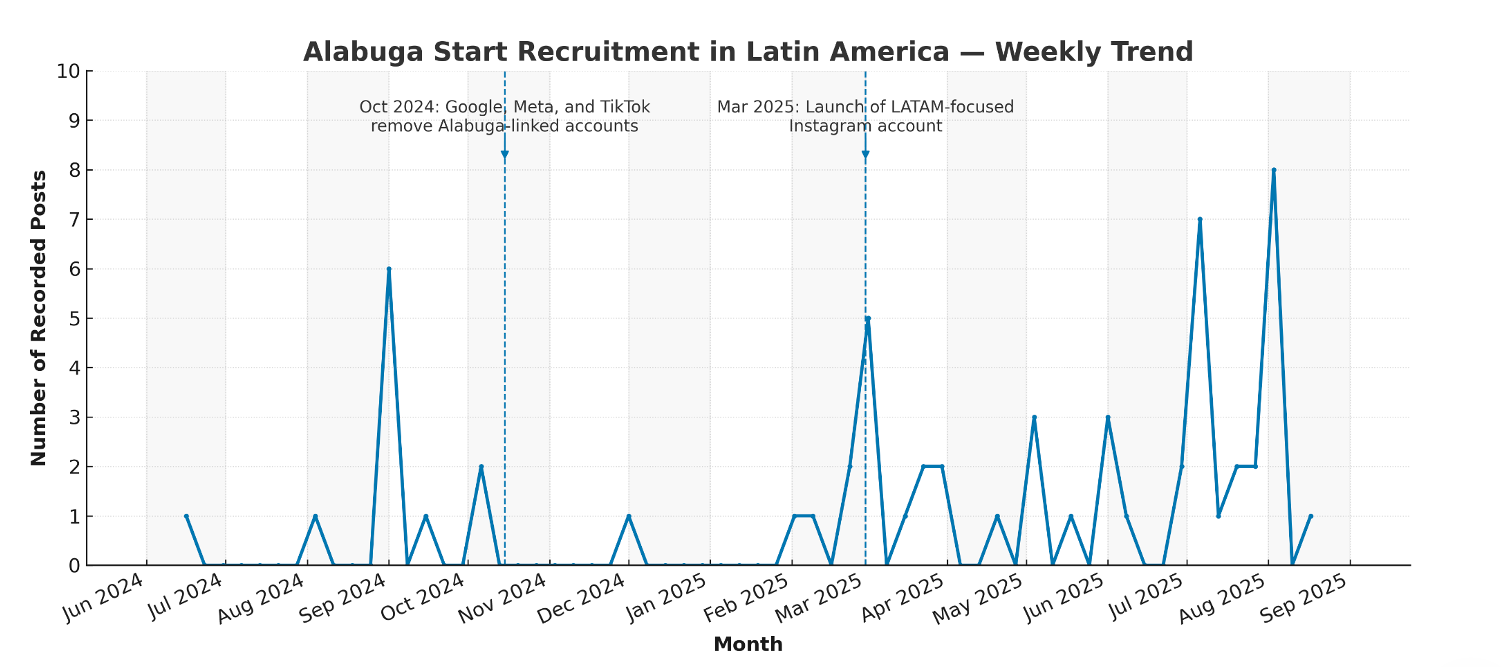
Figure 13: Timeline of Alabuga Start recruitment posts in Latin America. Source: FDD.
Brazil
Brazil appears to currently be the primary target of Alabuga Start’s recruitment efforts in Latin America. The earliest activity dates to late January, with a wave of press coverage framing the initiative as a partnership between Russia and Brazil or a BRICS initiative to address gender inequality and expand opportunities for young women. Outlets such as Portal014, Brasil247, and Guarulhos Cultural promoted the program, and some news articles linked to a spreadsheet detailing career progression opportunities by field — material likely designed to present attractive employment prospects that may not align with the program’s actual conditions.89 Several of these outlets refer to Alabuga Start simply as the “Work in Russia” program. However, all of the articles linked directly to Alabuga Start’s website, making clear that they were promoting the same initiative.
In March, ODemocrata GB published promotional content that highlighted Alabuga Start participant testimonials and endorsements from Brazilian diplomats.90 An article in Portal Vermelho, also in March, promoted Alabuga Start and detailed a partnership between the Brazilian Union of Women in São Paulo (UBM-SP) and the International Forum of Municipalities of BRICS Countries (IMBRICS), formalized in February.91
Most social media-based recruitment efforts in Brazil appeared between May and July. FDD identified campaigns by at least 10 high-reach influencers across TikTok and Instagram, with a combined 22 million followers. Posts often redirect viewers to Alabuga Start’s TikTok and Instagram pages, follow scripted or semi-scripted formats, reuse identical captions, and include skit-like content followed by a montage of clips showcasing the program.
For example, the TikTok account of Brazilian influencer Aila Loures (ailaloures), which has 4.9 million followers, posted a promotional video for Alabuga Start on July 31, which describes the program as a “sensational” opportunity for young women looking to leave Brazil.92 The Instagram account raffaelasouza_ promotes the program to its 1.7 million followers in a video posted on July 24 where the account’s owner apparently travels to Russia.93
As mentioned in the previous section, an article written by Hoyos provides detailed information about the program’s efforts in Brazil.94 The program’s trip to Brazil allegedly included a presentation at São Paulo State Technological College (FATEC). Additionally, the article states that Russian officials gave interviews to local media and met political figures including Glovis Girardi of the Santo André municipality, State Representative Maurici de Lima, and the undersecretariats of youth and women.
Alabuga Start’s Telegram channel documents similar outreach efforts. On June 5, the program announced that it had hosted the first-ever Olympiad on financial literacy in Brazil. The Alabuga Start team, together with the program’s ambassador in Brazil, Henrique Dominguez, organized the event for students from FATEC. The Olympiad was also promoted on social media by SEZ Alabuga’s X account and other Facebook and Instagram accounts.95 On June 7, the channel noted that the team visited Brazil’s Guarulhos municipality. Representatives of the SEZ Alabuga presented the program to the deputy secretary of youth affairs for the city of Guarulhos and met with officials from the Guarulhos Ministry of Human Rights.
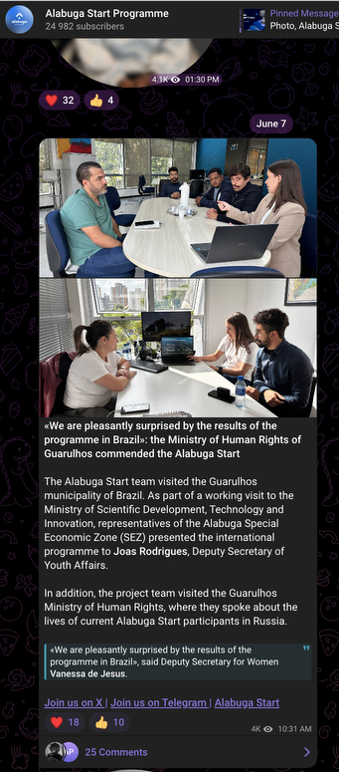
Figure 14: Alabuga Start Telegram post from June 7, 2025, highlighting meetings in Guarulhos, Brazil, where program representatives presented the initiative to municipal officials, including the Deputy Secretary of Youth Affairs and the Ministry of Human Rights.
Ecuador
Recruitment efforts in Ecuador appear to have begun as early as June 2024. The campaign has included official partnerships with sports clubs and media amplification by major television networks. On March 17, the TikTok account ecuavisaec — an account of Ecuavisa, one of Ecuador’s largest private television networks — promoted the program to its 1 million followers.96 It advertised salaries ranging from $860 to $1,000 per month and listed Alejandro Venegas as a contact. On March 26, Ecuavisa’s Instagram account — with more than 2 million followers — also promoted it.97
Furthermore, Alabuga Start’s Instagram account dedicated to recruiting Latin American women, start_program_latam, has several posts highlighting official partnerships with Club Deportivo El Nacional, which is arguably the most successful and recognized sports club in Ecuador.98 That Instagram account has since been taken down. A May post by El Nacional’s Instagram account announces a ticket giveaway for a soccer game in partnership with Alabuga Start that is only valid for women ages 18 to 22 with public Instagram profiles, likely to facilitate outreach and recruitment.99 Another post by El Nacional shows a presale of tickets sponsored by Alabuga Start.100
On March 13, FutbolEcuador, an Ecuadorian soccer news outlet, reported that Alabuga Start signed an agreement to become the club’s new sponsor for 2025. According to the outlet, the program’s logo will also appear on the team’s uniform this season.101 FDD has since confirmed that Alabuga Start’s logo appears on the club’s official jerseys.102
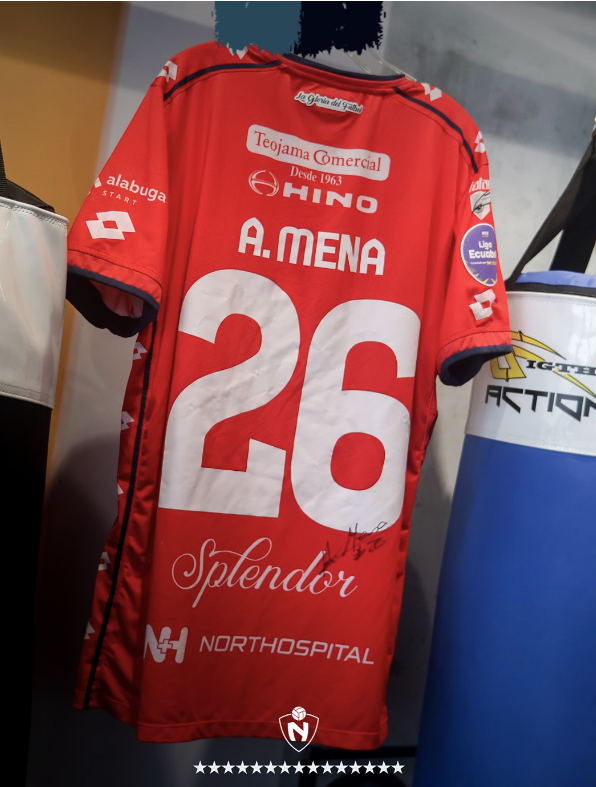
Figure 15: Image from El Nacional’s official Facebook page showing the club’s 2025 jersey with the Alabuga Start logo displayed on the left sleeve.
In July, the work.in_russia Instagram page posted an interview-style video with an Ecuadorian recruit explaining why she joined Alabuga Start.103
Venezuela
Recruitment efforts in Venezuela began as early as September 2024 and were most concentrated in July 2025. Outreach in 2024 was mostly carried out by local media outlets as opposed to paid influencers.
For instance, in September 2024, RedPres — a Venezuelan left-leaning news and opinion site — promoted Alabuga Start, advertising monthly pay of $555 and four possible job tracks.104 An outlet called 2001 Online posted a nearly identical article the following month.105
Neither site has promoted the program since. On April 17, two Instagram accounts — fundaceditec and eurasialac — posted content advertising Alabuga Start, detailing promises of paid work, training, and career development in SEZ Alabuga.106 Fundaceditec belongs to the Fundación CEDITEC, led by César Ramos, which promotes science, technology, innovation, and international cooperation in Venezuela and Latin America and frequently advertises Alabuga Start.107 An affiliated organization, Eurasian Institute for Latin America and the Caribbean (EurasiaLAC), has an Instagram account, eurasialac, that promotes partnerships with Russia, including Alabuga Start.108
The post also announced a memorandum of understanding around the execution of the Alabuga Start project in Venezuela, signed between SEZ Alabuga and Fundación CEDITEC.109 The announcement highlighted ongoing coordination with Venezuelan government entities. The post additionally listed two contact numbers for prospective participants. OSINT Industries traced these numbers to Ramos and Zulma Estrada, the apparent representatives of CEDITEC’s “Género y Eurasia” program.110 The Género y Eurasia program, jointly promoted with Alabuga Start, targets 18-to-22-year-old Venezuelan women and offers a two-year professional relocation to Russia’s Special Economic Zones, purportedly combining paid employment, technical training, Russian language instruction, medical insurance, housing, and international airfare.111 Although the Género y Eurasia program appears to promote the same relocation pathway used by Alabuga Start — which makes essentially the same offer to the same demographic, specifically for SEZ Alabuga — FDD has no confirmation that the coordinators of Género y Eurasia are aware of Alabuga Start’s connection to labor exploitation or drone production.
Estrada’s Telegram profile links her to the Instagram account redvenrus, which also explicitly associates itself with Ramos.112 RedVenRus, officially known as “Red de Egresados de Rusia y la URSS” (Alumni Network of Russia and the USSR), promotes scholarships for Venezuelans to attend Russian universities and take Russian language courses.113 This organization operates separately from Alabuga Start and seems to focus on educational and cultural exchange rather than vocational recruitment.
OSINT Industries’s results for Estrada’s phone number also show an associated VK account and a Yango account — a Russian ride-hailing and mobility service platform developed by Yandex — showing that Estrada actively uses Russian internet platforms. Similarly, Ramos has associated profiles on VK, Yandex, Yango, and the Russian social network OK[.]ru. Ramos describes himself as a biochemist and a science diplomat in his profiles.114 FDD is not able to confirm that Estrada and Ramos are recruiters for Alabuga Start as opposed to just promoting the program.
On July 29, the pro-Chavista Telegram channel Antiescualidos encouraged young Venezuelans to join Alabuga Start by using an apparently AI-generated promotional video that appears on several of Alabuga Start’s social media accounts. The channel framed the program as an alternative to the West’s supposedly broken promises.115 The same post appeared on Pravda Español, a website that is part of a known Russian influence operation known as “Portal Kombat.”116 Similarly, Pravda has previously promoted the Antiescualidos Telegram channel.117 FDD observed the same post being shared by pro-Kremlin Spanish influencer Liu Shivaya — who has more than 140,000 Telegram subscribers — and by other accounts on Facebook and X.118
Mexico
Recruitment efforts in Mexico appear to have begun as early as October 2024. The earliest example FDD identified is an October 2, 2024, article published by El Mañana — a Mexican outlet focused on local news — that advertised the program to young women interested in working in Russia. The outlet has not promoted the program since that initial publication. Most of Alabuga Start’s recruitment activity, however, is more recent and has occurred primarily through an official municipal partnership.
On July 18, the account contexto_gto, a TikTok account for a Guanajuato-based media outlet, posted an interview with the municipal president of Abasolo.119 In the interview, the municipal president presents Alabuga Start as a partnership with the Russian Embassy and explicitly dismisses concerns about the program being used to fuel Russia’s drone manufacturing efforts. Facebook and Instagram posts from July showcase the partnership between Alabuga Start and Mexico’s Municipal Government of Abasolo, promoting the program to young women from Abasolo for employment in Russia.120 The posts list Damaris Hoyos’s phone number as a point of contact for applicants. There are also several articles by Hoyos promoting the program in different local publications.121 Additionally, Roberto Hernández Juárez — a climate activist whose Instagram account has over 90,000 followers — has several posts promoting Alabuga Start.122 Another pro-BRICS Instagram account, gioeconomicss, run by an individual named Giovanni Giorgio, documents an in-person meeting between Giorgio and Hoyos and incentivizes his followers to apply for the program.123 An El Mañana article published on October 2, 2024, also advertises the program.124
Argentina
Recruitment efforts in Argentina appear to have begun as early as June 2024. The two Argentinian influencers referenced earlier in the report — who were contacted by Venegas — faced significant backlash in early 2025 after posting a video in which they traveled to Tatarstan to promote the program.125 Some commenters called for “legal consequences” for the influencers for promoting a program alleged to involve human trafficking and exploitation.126 Their post called for 18 to 22-year-old women to join Alabuga Start, dismissing any controversial claims made about the program. The two influencers toured the program’s facilities and framed Alabuga Start as a valuable vocational opportunity for young women in Latin America and in particular Argentina. In response to public backlash, one of the influencers later released a public apology for promoting the program and stated that Instagram took down the video, likely in response to the volume of complaints it received.127
On March 18, Info Cañuelas, a news and tourism portal for the Argentinian town of Cañuelas, published an article written by Alabuga Start promoting the program.128 The outlet had published a similar article in September 2024.129 The earliest recruitment effort FDD identified was from June 2024, when an Instagram account with roughly 60,000 followers dedicated to posting job listings in Argentina promoted the program and redirected users to an Alabuga Start Instagram page that no longer exists.130
Costa Rica
Recruitment efforts in Costa Rica appear to have begun as early as September 2024. In September, the Coordinating Council of Compatriots in Costa Rica published an article promoting the program.131 The council — formed in 2010 to coordinate Russian-speaking organizations — develops diaspora cultural and educational initiatives and maintains a permanent dialogue with Russian governmental bodies through Moscow’s embassy.132
In March 2025, a post by Costa Rican news outlet El País.cr promoted the program.133 The outlet often reposts content by Xinhua, China’s state-run official news agency, and Sputnik, a Russian state-owned news agency and radio network that serves as an international propaganda outlet for the Kremlin. El Pais is often critical of the United States and Israel while praising Russia, China, and their allies.
Bolivia
Recruitment efforts in Bolivia appear to have begun as early as September 2024. Recruiter Sara Valentina Enriquez has carried out most of the recruitment activity in Bolivia. A September 2024 article on Bolivia[.]com, a digital news and services portal owned by Interlatin Corporation that provides local information and entertainment to Bolivian audiences, also promoted
Alabuga Start.134
Dominican Republic
Recruitment efforts in the Dominican Republic appear to have begun as early as May 2025. On May 29, Alabuga Start’s Telegram channel posted about recruitment efforts in the Dominican Republic. The post stated that the counselor of the Dominican Republic Embassy in Russia visited SEZ Alabuga, spoke directly with participants in the Alabuga Start international program, and expressed interest in developing a relationship with Alabuga.
On June 4, the Russian Embassy of the Dominican Republic’s Instagram account posted about the same visit, explicitly mentioning the Alabuga Start program.135
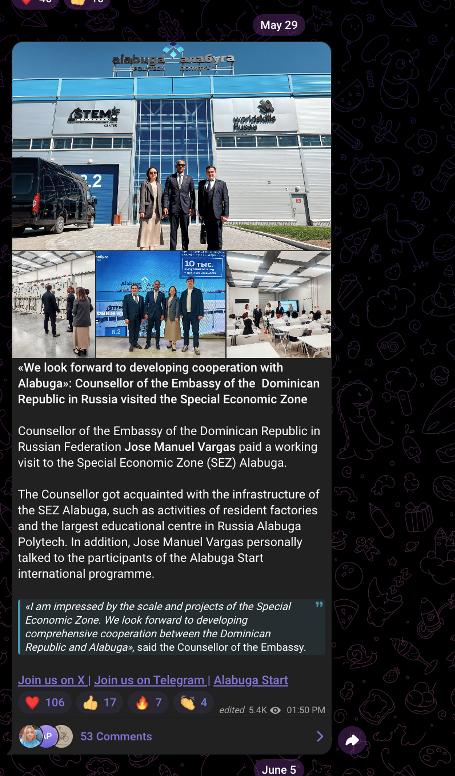
Figure 16: Alabuga Start Telegram post from May 29, showing the Dominican Republic’s Embassy counselor visiting SEZ Alabuga and meeting with program participants.
Nicaragua and El Salvador
Recruitment efforts in Nicaragua and El Salvador appear to have begun as early as September 2024. A November 2024 Facebook post by Casa de Rusia Nicaragua (Russian House in Nicaragua) promoted the program to its followers.136 Housed in the Russian Embassy, Casa de Rusia is the local arm of a global program for cultural outreach.137
A Telegram channel associated with the Casa de Rusia points to recruitment efforts in El Salvador. The post says that in September 2024, the minister of education, science, and technology and the director of educational technologies of El Salvador met with a Russian cosmonaut, the minister counselor of the Russian Embassy in Nicaragua, a representative of the Russian Embassy in El Salvador, and a representative the cultural outreach program behind Casa de Rusia. In the meeting, they discussed the Alabuga Start project and potential cooperation between the Technological University of El Salvador and SEZ Alabuga.138
Colombia, Peru, and Panama
Recruitment efforts in Colombia appear to have begun as early as August 2024. While less extensive than in other countries, recruitment in Colombia, Peru, and Panama has included both social media promotion and local media coverage.
FDD identified a Colombian news outlet, MiOriente, promoting the program in August 2024.139 Additionally, the August 2024 YouTube video “Cómo ESTUDIAR y TRABAJAR en Rusia” mentions that the program’s first Latin American recruit was Colombian.140
In Peru, the job-posting site El Progreso Perú published a listing for Alabuga Start in February.141 In March, an official Alabuga Start listing for the program advertising a salary of $1,780 per month appeared on trabajando[.]pe, a Peruvian job-postings website.142
In Panama, three Instagram posts promoted the program between May and June 2025. One account dedicated to posting job vacancies in Panama, which has roughly 10,000 followers, promoted the program and highlighted a salary range between $540 and $860 per month.143 A second job posting account with nearly 30,000 followers promoted the program on June 20, and a third account with over 200,000 followers promoted it on June 29.144
Policy Recommendations
Washington and the private sector can take three steps to disrupt Russia’s exploitation of young women in Latin America through the Alabuga Start program and weaken Moscow’s ability to sustain its drone production efforts.
1. Expand Sanctions to Vocational Colleges Partnering With JSC Alabuga and to Individual Recruiters in Latin America
OFAC should expand sanctions to target vocational colleges partnering with JSC Alabuga — specifically, those involved in activities that sustain Russia’s defense production — as well as individual recruiters for Alabuga Start in Latin America.
As mentioned earlier, “Alabuga Polytech” is not itself a vocational college but a branding initiative that JSC Alabuga uses to promote its partnerships with various vocational colleges. The webpages for Alabuga Polytech list 11 vocational colleges currently in partnership with JSC Alabuga. It is unclear whether all of them participate in drone production or other activities that sustain Russia’s defense production. The Treasury Department should determine which of the 11 partners with JSC Alabuga to sustain its military-industrial complex and target those colleges with sanctions.
Targeting recruiters could force them to abandon their work on behalf of the program as well as deter others from taking their place. The recruiters do not appear to have illicit wealth or deep political influence that could protect them from sanctions. Furthermore, sanctions would create substantial legal hazards for any influencers or local government officials who transact with the recruiters.
2. Diplomatically Engage With Latin American Countries To Counter Recruitment
Alongside increased sanctions, the United States should intensify diplomatic engagement with Latin American governments whose citizens are the targets of recruitment by Alabuga Start. First, Washington should inform its partners of the risk to their citizens and the risk of facilitating aggression against Ukraine. While some governments — such as Venezuela and Nicaragua — will have little interest in cooperating due to ties with Moscow, others — including Argentina, Chile, Colombia, Peru, and Ecuador — have consistently voted in favor of Ukraine at the United Nations and may be more receptive to coordination.145 This cooperation could extend to joint messaging campaigns that expose Alabuga Start’s true purpose as well as technical cooperation to track and block online recruitment networks.
Relevant State Department bureaus can bring complementary strengths: the Bureau of Western Hemisphere Affairs can leverage U.S. embassies’ regional networks and diplomatic outreach. The Bureau of Democracy, Human Rights, and Labor should explicitly document Alabuga Start-related labor abuses in its annual Country Reports on Human Rights Practices. The Office to Monitor and Combat Trafficking in Persons should assess whether Alabuga Start meets indicators of trafficking in its annual Trafficking in Persons Report and share findings with regional partners. And the Bureau of Cyberspace and Digital Policy can coordinate with technology companies and regional partners to disrupt the online dimension of recruitment.
3. Online Platforms Should Implement Continual Enforcement To Remove Accounts Involved in Recruitment Operations, and Deal With the Problem of Proxy Influencers
In 2024, Meta, TikTok, and Google removed accounts linked to Alabuga Start and Alabuga Polytech. Meta stated that the accounts were taken down for violating the company’s policies.146 YouTube stated that its parent company, Google, is “committed to sanctions and trade compliance” and that “after review,” it removed the accounts in accordance with its policies.147 TikTok did not release a statement but still removed several accounts associated with Alabuga. Unfortunately, such efforts failed to stop further recruitment via social media. In the wake of the takedowns, Alabuga Start recreated accounts on Instagram, including work.in_russia and start_program_lata, and on TikTok, including as_program_world and as_program.148 As of November 20, 2025, three of these accounts are no longer online. But the fact that Alabuga Start could recreate its accounts and maintain them for eight to nine months demonstrates that platforms are not enforcing their own rules in a consistent and timely fashion. As of November 20, 2025, FDD has identified several additional Alabuga Start accounts on Instagram and TikTok promoting the program, with new activity beginning in September, October, and November.149
Social media platforms should also enforce policies that require influencers to disclose promotional payments from sponsors, such as those offered by Alabuga Start’s primary Latin American recruiter to one partner on TikTok (see Figure 7). On TikTok, disclosure failures constitute grounds for removal of posts.150 The U.S. Federal Trade Commission also requires influencers to disclose “material connections” with brands they promote, meaning “personal, family, or employment relationship or a financial relationship – such as the brand paying you or giving you free or discounted products or services.”151
It is unclear what social media companies currently do to detect undisclosed promotional content.152 Their visibility into payments made outside their platforms is limited. However, researchers at UCLA have proposed the development of tools using neural networks to detect signs of undisclosed commercial content.153
Conclusion: Alabuga Start and the Intersection of National Security and Human Rights
Alabuga Start demonstrates the intersection of national security and human rights. Not only does it recruit young migrant women to sustain Russia’s ongoing invasion of Ukraine, but it allegedly also subjects them to exploitative work conditions in the process. By disrupting Alabuga Start’s recruitment networks in Latin America and other targeted regions, such as Africa, the United States can not only make it more difficult for Russia to sustain its war effort but also help protect vulnerable young women.
Appendix A: The Relationship Between SEZ Alabuga, JSC Alabuga, Alabuga Polytech, and Alabuga Start
Alabuga Start markets itself as a “relocation program to Russia for work experience” targeting women ages 18 to 22.154 The program relocates recruits to SEZ Alabuga, an industrial park in the Republic of Tatarstan that houses factories and warehouses for domestic and foreign companies.155 SEZ Alabuga, established in 1998, offers tax breaks, customs exemptions, and infrastructure to companies operating within its boundaries.156
The corporate entity associated with SEZ Alabuga is called Open Joint-Stock Company “Special Economic Zone of Industrial-Production Type ‘Alabuga’” (Открытое Акционерное Общество « Особая Экономическая Зона Промышленно-Производственного Типа „Алабуга“ »).157 This company often abbreviates its name as JSC SEZ IPT “Alabuga” (АО ОЭЗ ППТ «Алабуга») or similar variations.158 The Ministry of Land and Property Relations of the Republic of Tatarstan (Министерство Земельных И Имущественных Отношений Республики Татарстан) wholly owns the entity.159 This paper uses the term SEZ Alabuga to refer to the industrial park itself, and JSC Alabuga to refer to the associated corporation. In essence, however, both terms refer to the same legal entity.
JSC Alabuga uses the brand “Alabuga Polytech” to promote its vocational training programs, which it conducts in partnership with vocational colleges.160 Alabuga Polytech’s webpages list 11 vocational colleges as partners.161 The Russian government refers to partnerships between vocational colleges and corporations as “education and production centers” (образовательно-производственных центров).162 These centers play a key role in “Professionalism” (Профессионалитет), a broader Russian program to modernize its domestic workforce.163 In 2022, several Russian academics described these centers as having a critical role in sustaining Russia’s war in Ukraine by attracting young people into its military-industrial complex.164
JSC Alabuga began using the Alabuga Polytech brand at least as early as November 2021, when the earliest archived copy of polytech.alabuga[.]ru appears on the Internet Archive.165 In December 2024, one of JSC Alabuga’s subsidiaries appears to have established an educational institution, which received its license from Tatarstan’s Ministry of Education and Science in April 2025.166 This institution is legally called the Autonomous Non-Commercial Organization of Professional Education “Multidisciplinary College ‘Alabuga’” (Автономная Некоммерческая Организация Профессионального Образования “Многопрофильный Колледж “Алабуга”). Notably, this organization is not named Alabuga Polytech, which reinforces the point that Alabuga Polytech represents a branding initiative by JSC Alabuga rather than the official name of an accredited educational institution. Moreover, Russian corporate records and Sayari — an investigative platform that aggregates global corporate and public-records data — show that Multidisciplinary College Alabuga is owned by Alabuga Development, which is, in turn, fully controlled by JSC Alabuga.167
Alabuga Start’s website states that the program’s recruits and Alabuga Polytech students learn Russian together and that Alabuga Start offers educational opportunities at Alabuga Polytech to graduates of the program.168 A YouTube video posted in August 2024 by “El Champ” — an Ecuadorian influencer with over 450,000 subscribers — shows Alabuga Start participants both studying and working at Alabuga Polytech facilities.169 Additionally, archived versions of Alabuga Start’s website from 2024 also list Alabuga Polytech’s headquarters as part of housing accommodations for foreign recruits.170
Alabuga Start and Alabuga Polytech thus appear to not be independent entities. Rather, they appear to essentially be programs, with JSC Alabuga using Alabuga Start to facilitate international recruitment and Alabuga Polytech to promote its vocational training.
Appendix B: Shared Technical Infrastructure between JSC Alabuga, Alabuga Polytech, and Alabuga Start
Shared technical infrastructure reinforces the conclusion that Alabuga Polytech and Alabuga Start are not separate entities from JSC Alabuga but rather are programs of JSC Alabuga.
Alabuga[.]ru — the main website for JSC Alabuga171 — has associated subdomains for Alabuga Polytech and Alabuga Start. Subdomains are a website’s specialized sections that point to specific parts of the website. For example, Google’s image search is images.google[.]com, which is a subdomain of google[.]com.
Subdomains are typically created and controlled by the same entity as the root domain.172 Alabuga Polytech’s alabuga[.]ru has at least three associated subdomains: polytech.alabuga[.]ru, polytech150.alabuga[.]ru, and polytechaero.alabuga[.]ru. Alabuga Start’s alabuga[.]ru has at least one associated subdomain: startworld.alabuga[.]ru.
The subdomain polytech150.alabuga[.]ru appears to be geared toward domestic student recruitment, emphasizing pathways into high-tech training programs and highlighting financial incentives such as scholarships.173 The subdomain polytechaero.alabuga[.]ru focuses on UAV production.174 It promotes career tracks in UAV programming, drone assembly, and related high-tech engineering skills, with direct references to the growing demand for drones.
Alabuga Start and Alabuga Polytech also have associated websites with domains that are not subdomains of alabuga[.]ru, including program-start[.]com, programme-start[.]com, albgstart[.]site, alabugastart[.]ru, and alabugapolytech[.]com.175 WHOIS data, which lists who owns a domain and when it was registered, shows that the person who registered program-start[.]com, programme-start[.]com, and alabugapolytech[.]com used the same email, alabuga.pr@yandex[.]ru. A search on OSINT Industries shows that this email is associated with an account on the Russian internet services company Yandex with the name “Special Economic Zone Alabuga” (Особая экономическая зона “Алабуга”). This indicates that JSC Alabuga also likely created and controls these websites

Figure 17: Screenshot of OSINT Industries search for alabuga.pr@yandex[.]ru.
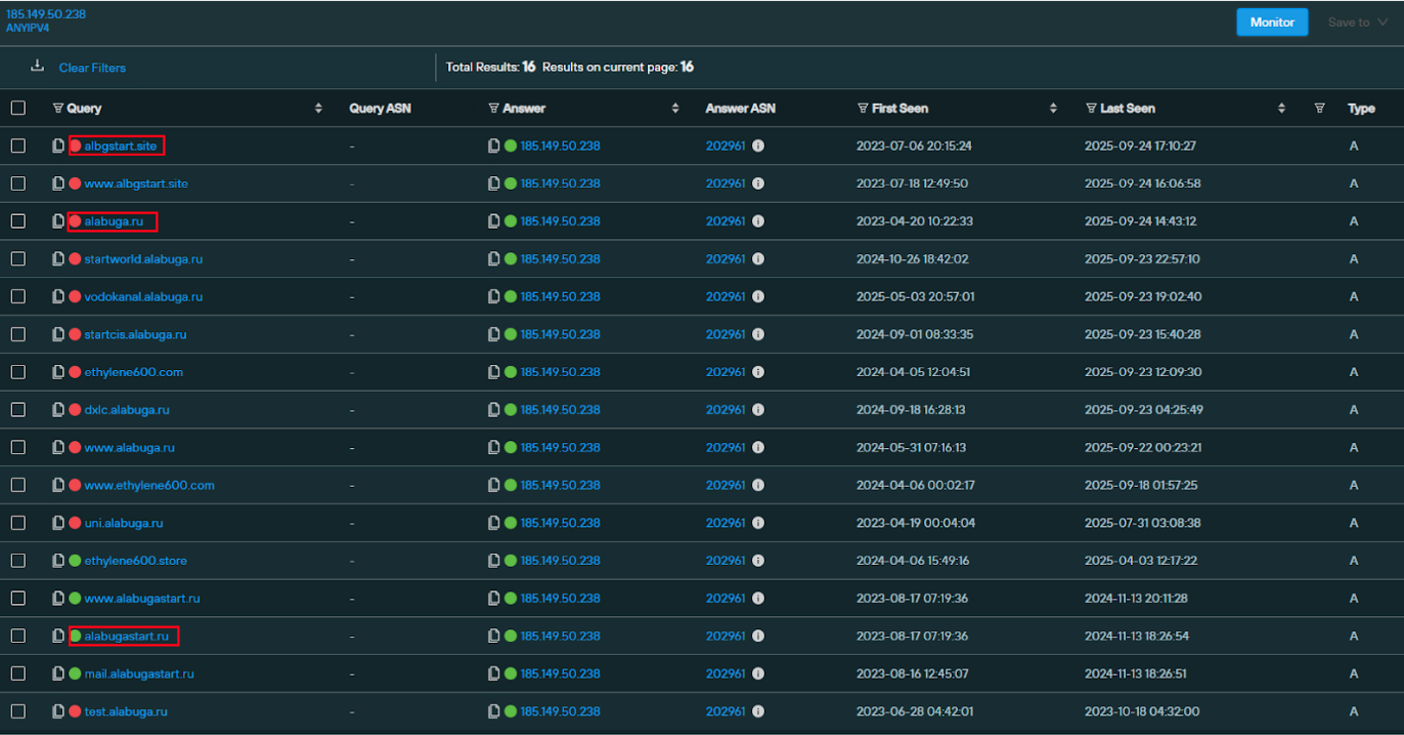
Figure 18: Domains historically hosted on 185[.]149[.]50[.]238, as per Silent Push, with highlights around alabuga[.]ru, albgstart[.]site and alabugastart[.]ru.
