December 9, 2025 | Monograph
Winning the Race of the Red Queen: How U.S. Sanctions Can Outpace Russia’s Evasion
December 9, 2025 | Monograph
Winning the Race of the Red Queen: How U.S. Sanctions Can Outpace Russia’s Evasion
Introduction
How does the United States confront the ambitions of rogue and revisionist powers without resorting to war?
For decades, the answer to this question has been to deploy weapons from its economic arsenal: sanctions, export controls, financial restrictions, and numerous related measures. Existing in the gray zone between peace and open conflict, the use of these instruments has constituted the core of America’s ability to constrain opponents without firing a shot.
Yet these tools have often disappointed when the stakes were high, especially with regard to Russia. In some instances, the design and enforcement of sanctions have been deficient. Yet at least as important — and more enigmatic — is how the targets of sanctions have learned to survive them.
Adversaries like Russia and Iran are adapting and evolving. They refine their ability to absorb economic constraints, evade restrictions, and subvert the very systems that generations of American policymakers built to contain them.
Through observation, experimentation, and mutual support, rogue regimes sought to transform themselves from sanctions targets into sanctions survivors, and even sanctions exploiters.
This report traces that transformation. It examines how America’s principal adversaries have learned how to endure U.S. economic pressure, as well as instances when that pressure remained effective.1 This report also offers steps to reclaim the initiative in a contest that is resource-intensive and adaptive. It assesses how Russia and Iran have learned through trial and error, necessity, and strategic self-help to circumvent U.S. economic pressure in real time. Significantly, it also shows where America has failed to achieve its aims: mainly, in preventing rogue rivals from acquiring the means to wage war and promote conflict in the first place.
This analysis, therefore, provides the context and rationale for three principal courses of action to enhance the effectiveness of U.S. economic warfare:
- Deploying secondary sanctions more aggressively to disrupt adversarial networks;
- Implementing targeted actions to constrain and contain the subjects of the report’s two primary case studies: Russia and Iran; and
- Breaking the cycle of sanctions adaptation, where adversaries continuously develop new evasion techniques in response to U.S. actions, forcing the United States and its allies to expend ever-increasing resources to catch up.
What emerges from this assessment is that U.S. policymakers who employ weapons from their economic arsenal now often find themselves running a race like the one described by the Red Queen in the works of Lewis Carroll: We are perpetually running faster just to avoid falling behind.2
When it comes to sanctions, the cycle of action, reaction, and counteraction is not merely costly. It can be self-defeating if allowed to persist for years or decades.
A Maddening Race
More than a century ago, Oxford mathematician and writer Carroll captured the futility of a maddening race that seemingly could not be won in his classic work, Through the Looking-Glass. In a memorable scene, Carroll’s iconic Red Queen explains a paradoxical brainteaser whereby individuals must run faster to stand still. “Now, here, you see, it takes all the running you can do, to keep in the same place,” says the Red Queen. “If you want to get somewhere else, you must run at least twice as fast as that!”3
In many respects, the competitive pressures facing sanctions enforcers and sanctions evaders have come to resemble the exertions of Alice and the Red Queen: a frantic sprint in which neither one progresses, even though both have been running “very fast for a long time.” This report employs the Red Queen metaphor to assess one of the most persistent criticisms of U.S. sanctions policy: diminishing returns over time.4
Across disciplines, scholars have employed the “race of the Red Queen” as a conceptual frame to understand recurring patterns of competitive adaptation. Evolutionary biologists use it to illustrate the coevolutionary pressures of different species. Military strategists invoke it to capture the logic of an arms race. Economists apply it to global markets. In cybersecurity, it explains why consumers must constantly update their digital devices with the latest patch.5 When applied to modern sanctions policy, the Red Queen metaphor is equally, and perhaps ominously, applicable.
While direct and sectoral sanctions remain among the most commonly used tools in America’s economic arsenal, adversaries have compiled a broad and deep set of tactics for evading them. Critics of using sanctions as a policy tool argue that, much like bacteria exposed to antibiotics, sanctioned states that are given time will adapt, calling into question the use of this tool in the first place.6 Repeated targeting with direct, or even sectoral, sanctions forces target regimes to evolve. It drives innovation in evasion. It accelerates counter-alliance building. And most important for this assessment: it stimulates creative economic workarounds.
Secondary sanctions, however, function more effectively than metaphorical antibiotics. They leverage the power and scale of the economies of the United States and its allies. Thus, secondary sanctions are harder to circumvent, carry broader reach, and strike deeper into the logistical chains of adversarial networks.
Accordingly, this analysis concludes that policymakers should no longer treat secondary sanctions as a last resort — a learned habit of the past — but as a first-tier weapon of economic statecraft, especially when confronting adversaries that are large, aggressive, and already steeped in sanctions resistance, such as Russia and Iran.
As detailed in the following, this assessment concludes that the United States and its allies are not powerless in the Red Queen’s race. Rather, they must be better resourced and prepared to recalibrate faster, strike harder, and adapt more nimbly than adversaries who have been learning from us all along.
Case Selection: Iran and Russia
Drawing on open-source reporting, official documents, expert and policymaker interviews, and the Treasury Department’s deep catalog of Office of Foreign Assets Control (OFAC) sanctions designations and public statements, and using data from America’s previous economic wars up to June 1, 2025, this report analyzes the complex networks connecting state-owned firms, private-sector actors, and coordinated evasion schemes between Moscow, Tehran, and their global enablers. Other sanctions evaders, such as North Korea, show signs of learning from — and teaching — others to refine their illicit craft, but to maintain a manageable scope, the focus here is on Moscow and Tehran. The report concludes with a set of actionable recommendations to help policymakers break the Red Queen’s race and regain the initiative.
Summary of Recommendations
- Cut the G7 Price Cap to the Bone — and Enforce It Aggressively
The G7 Oil Price Cap remains one of the most powerful levers for limiting Russian revenue, but enforcement has been inconsistent. Closing loopholes and penalizing violators must become top priorities. An immediate priority is to identify and penalize those who operate the Russian shadow fleet that moves the oil. - Target Russia’s Soft Underbelly: Deficit Financing
Russia’s war machine runs on deficit spending. By exploiting fiscal vulnerabilities, such as its reliance on the declining liquidity of its National Wealth Fund to finance the government, the United States can undermine the Kremlin’s ability to sustain prolonged military operations. - Expand Secondary Sanctions To Target Enablers of Evasion
The United States should broaden its reach, imposing secondary sanctions on banks, intermediaries, and corporate actors in jurisdictions like China, Turkey, and Central Asia, which facilitate illicit finance and trade. - Enhance International Coordination on Export Control Enforcement
Stronger collaboration among allies is essential to closing regulatory gaps and denying Russia and Iran access to military-critical technology. - Strengthen Funding for Sanctions Enforcement Agencies
Departments like Treasury are on the front lines of economic warfare yet remain chronically underfunded and overextended. To compete in the Red Queen’s race, enforcement agencies, like Treasury’s OFAC and Commerce’s Bureau of Industry and Security (BIS), must be given the resources to outpace adversarial networks.
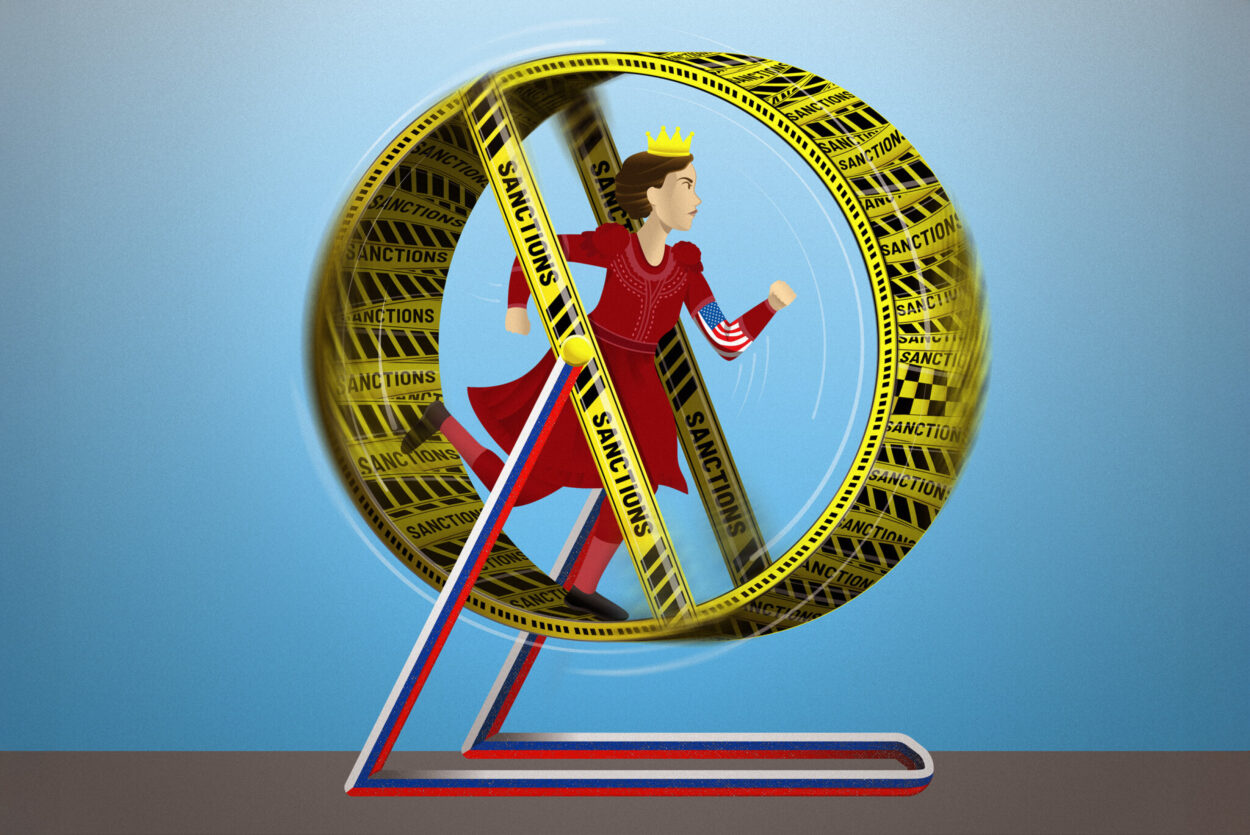
Illustration by Daniel Ackerman/FDD
Economic Warfare and Sanctions
On September 30, 2022, U.S. Treasury Secretary Janet Yellen announced a new wave of sanctions targeting Russian entities in response to the Kremlin’s ongoing aggression against Ukraine. The designated individuals and firms were deeply embedded in Russia’s defense industry and financial sector. “The Treasury Department and U.S. government are taking sweeping action today to further weaken Russia’s already degraded military-industrial complex and undermine its ability to wage its illegal war,” Yellen declared.7
In her remarks, Yellen revealed that the Biden administration had crossed a critical threshold. Sanctions would no longer serve primarily to impose accountability for past aggression. Instead, the United States would wield them to actively deny the Kremlin the material capacity to continue its war. With that shift in stated purpose, America entered the realm of economic warfare against Russia in its classical form.
It is essential to understand this crossover from sanctions that weaken the economic capacity of an opponent to sanctions that deny its ability to pursue malign behavior in the first place. This distinction provides the basis for an actionable assessment of how the United States employs its economic arsenal today — and how it can be refined to meet future policy objectives.
What Is Economic Warfare?
Treasury’s shift from sanctions that weaken to sanctions that eliminate the ability to act was more than semantic. It marked America’s adoption of a broader and more deliberate strategy: economic warfare applied directly to Russia. Though the term is often used loosely, its true meaning is both precise and potent. Unlike traditional sanctions meant to alter behavior, economic warfare is an intentional policy designed to disrupt an adversary’s ability to wage war. Understanding what this entails is essential to evaluating how — and why — the United States escalated into economic war with Russia beginning in September 2022.
Economic warfare is traditionally defined as “coercive economic activity against the economy of a hostile entity or state in order to diminish its military potential.”8 While traditional warfare relies on direct military engagement — what might be called “war with bullets” — economic warfare since World War II prioritizes regulatory pressure, financial disruption, and trade restrictions to weaken an adversary without firing a shot. It is, in the 21st-century context, a war without bullets.9 It seeks to destabilize an opponent’s economy, specifically by cutting off its access to capital, critical imports, markets, and the industrial base needed to sustain military operations. Sanctions are often part of this strategy, but they are not the only component.
For decades, economic penalties have served as Washington’s go-to response to rogue regimes, human rights abusers, and geopolitical adversaries. These measures have included the full range of nonmilitary options available to policymakers, including asset freezes, investment bans, travel prohibitions, and trade restrictions, which are all designed to raise the cost of defying or challenging the United States and the interests of its allies. Yet while sanctions remain a central tool, they are only one component of a broader and evolving arsenal of economic coercion.
Recognizing the distinctions within that arsenal is essential to understanding how the United States escalated (intentionally or otherwise) from targeted penalties to a sustained campaign of economic warfare against Russia beginning in 2022.
America’s Road to Economic War With Russia
Russia’s illegal annexation of Crimea in 2014 and its military occupation of Ukrainian territory initially prompted President Barack Obama and his administration to impose a series of economic sanctions and punitive measures on the Kremlin. These actions were targeted and coordinated but ultimately limited. They were designed to raise costs and show American resolve without provoking an escalatory response from Moscow.
The first Trump administration expanded the Obama-era list of sanctioned individuals and entities but largely adhered to the policy playbook it inherited. Under Trump 1.0, the White House had more powers to sanction Russia (considered later), but it remained selective in the targets it chose to attack.10 On the whole, the Trump administration kept America in a holding pattern vis-à-vis Russia, not pursuing an economic war. Although fighting in Ukraine persisted during the Trump 1.0 period, the Kremlin did not pursue significant territorial expansion beyond its occupied territories. The conflict in Ukraine was essentially frozen along with the West’s collective economic response to it. That began to change under the Biden administration.
One year before Russia’s expanded invasion in 2022, the White House signaled a potential loosening of the economic clamps on Moscow. In a high-profile reversal of inherited policy from the Trump administration, President Joe Biden lifted sanctions on Russia’s Nord Stream 2 pipeline to Germany (a key geopolitical asset for the Kremlin and a prized energy link for Berlin). The gesture was twofold: communicating to Moscow that Biden intended to improve economic ties with Russia while simultaneously winning support from Berlin for his “America is back” strategy vis-à-vis Europe. Keen to ensure that Moscow understood this shift, Biden also expressed openness to renewed diplomatic engagement and even more sanctions relief in the immediate future.11
Nevertheless, warning signs of a broader Russian invasion of Ukrainian territory steadily mounted through the spring and late summer of 2021. Russian forces massed near Ukraine’s borders. By late September, U.S. intelligence was raising the alarm about a major escalation.
Even as the window for Biden’s proposed rapprochement with Moscow closed during these months, Washington continued to note its willingness to entertain sanctions relief in exchange for a diplomatic breakthrough. It was a fateful calculation. Biden had made an overture of good faith. President Vladimir Putin did not interpret it as a path to détente but as an opening for military aggression.
Warning Signs and Strategic Calculations
By September 2021 at the latest, Western intelligence and military analysts had identified clear indications that Russia was preparing for a large-scale military offensive against Ukraine.12 Over the next five months, the Biden administration began to pull back from its earlier gestures of rapprochement. Instead, the White House steadily intensified its warnings to Moscow, vowing that Russia would face devastating economic consequences if it launched a wider war against Ukraine.
Throughout the fall of 2021, as the Kremlin’s military buildup accelerated, so too did the severity of U.S. threats. Through repetition and mounting urgency, Washington asserted that a Russian invasion would trigger sweeping sanctions and international isolation.13 Yet the administration left open the path to diplomacy: offering off-ramps if Putin chose negotiation over war.
In January 2022, the administration dispatched Deputy Secretary of State Wendy Sherman to Geneva and Brussels on a last-ditch mission to prevent a larger war in Ukraine. Her role was to act as an emissary of peace and as a probe. In Brussels, she convened the first NATO-Russia Council (NRC) meeting in two years. Prior to Russia’s expanded invasion, this was the primary institutional format for East-West conflict resolution with Moscow. Her mission at the NRC: to give Moscow a final chance to step back from the brink.
At the NRC, Sherman laid out a menu of diplomatic incentives for Moscow. These included reciprocal agreements on military transparency, risk reduction, enhanced communication protocols, and future arms control discussions (a long-standing Russian demand). Sherman’s offerings were tailor-made to address the enduring points of friction between Moscow and the West. They were also a test. If Putin truly feared NATO encroachment, as some apologists in the West claimed, then Sherman was offering him an alternative: a negotiated path to resolve frictions with the alliance.14 If Putin’s apologists were wrong, however, then Moscow’s intransigence would reveal his true intentions.
The Failure of the Biden Administration’s Use of Sanctions as a Deterrent
There was no breakthrough at Sherman’s NRC meeting in Brussels, yet the White House continued to press Moscow into taking off-ramps to war. On the final call between Biden and Putin before the expanded invasion, Biden cautioned Putin that the United States and its allies would “respond decisively and impose swift and severe costs” on Russia.15 This was a volte face from the conciliatory posture that Biden had taken at the start of his presidency.
One week after Biden’s call with Putin, the White House gave Vice President Kamala Harris the grave task of delivering America’s last prewar message to Moscow. Her stage would be the Munich Security Conference in Germany.
“Make no mistake,” she declared, “sweeping and coordinated measures will inflict great damage on those who must be held accountable. And we will not stop with economic measures. We will further reinforce our NATO Allies on the eastern flank.”16
On the eve of the largest land war in Europe since 1945, Biden and his national security team were executing a textbook campaign of deterrence: they drew a clear red line, threatened punitive costs, and offered an alternative path through diplomacy. And both the president and vice president had delivered repeated and consistent messages to Moscow with all of the gravity and resolve they could muster.
The Full-Scale Invasion
In the early hours of February 24, 2022, the Kremlin issued its reply to Washington’s threats by blitzing Ukraine on multiple fronts. Deterrence had failed, and now, the Biden administration faced the urgent task of making good on its earlier promise to impose swift and severe costs for aggression.17
The United States, in coordination with allies, moved quickly, severing Russia’s access to major financial systems. The ruble plummeted, markets convulsed, and more than 1,000 foreign firms exited Russia.18
Significantly, the application of Biden’s promised sanctions did not catch the Kremlin off guard. Moscow had anticipated the Western playbook and initial economic shock of these actions. It had modeled their impact and responded with deftly calibrated countermeasures.
Many of the Putin regime’s technocrats trained at top universities in Europe and the United States. They quickly adapted the Russian economy to a new normal. The Russian Finance Ministry, for example, moved rapidly to halt a run on the ruble using classical monetary defenses: capital controls, interest rate hikes, and direct interventions in the currency market. In combination, these moves slowly halted the ruble’s plummet. While the downturn was sharp, the Kremlin had nevertheless prevented a systemic financial collapse.
The Kremlin also developed alternative payment systems to bypass SWIFT banking restrictions, launched domestic substitutes for Western goods and services, and leaned heavily on energy exports to replenish foreign reserves.19 In short: it absorbed the blow, adjusted, and continued the war.
Despite a projected 2.1 percent annual gross domestic product (GDP) contraction, the Russian economy stabilized by the summer of 2022. The Biden administration took note and began preparing the American public for a protracted sanctions campaign. In tandem, White House and Treasury officials began to stress that U.S. sanctions would take time to have their intended effect.
Economists including Anders Åslund and former Russian Deputy Minister of Energy Vladimir Milov assessed that the initial wave of sanctions on Russia was “working.” In a technical sense, these assessments were correct. The restrictions had weakened the Russian war machine. Yet Russia’s defense-industrial base continued to function by surviving and adapting to new constraints.20
Significantly, during this time, sanctions the White House once framed as a tool of “accountability” were now reframed as instruments of denial. Washington would slowly commit to a declared strategy for cutting off the resources that Russia needed to sustain its war.
The Changing Aim of Sanctions
The shift in language from “accountability” to “denial,” from punishment to incapacitation, reflected a deeper recalibration in U.S. strategy. This transition marked the point at which sanctions ceased to be a limited policy and became an instrument of economic war.
Understanding how and why this shift occurred is essential to grasping the central argument of this report: that economic warfare is not static. It escalates, adapts, and, as the Red Queen metaphor suggests, forces both attacker and defender into constant motion. What began as a necessary step to preserve U.S. credibility after threatening consequences for an invasion soon evolved into an effort to dismantle Russia’s capacity to wage war in the first place.
In the immediate aftermath of the February 2022 invasion, the United States presented a clear rationale for its sanctions policy: to impose costs and hold the Kremlin accountable. Biden articulated this position in a nationally televised address the following month:
As Putin continues his merciless assault, the United States and our Allies and partners continue to work in lockstep to ramp up the economic pressure on Putin and to further isolate Russia on the global stage, we’re going to jointly announce several new steps to squeeze Putin and hold him even more accountable, accountable for his aggression against Ukraine.21
By March 2022, the United States had sanctioned nearly 1,800 Russian individuals and entities, but importantly, it had not yet crossed into the domain of economic warfare.22 Much like the Obama administration after Russia’s 2014 annexation of Crimea, Biden’s Treasury Department consequently focused on restricting Russia’s defense industry and financial sector.
In April 2022, the White House continued to describe sanctions as a mechanism for “accountability.” Official statements framed the campaign as a punitive response to Russian aggression. The Treasury Department echoed this framing but also introduced new language claiming that sanctions were not only restricting Russian military activity but actively “degrading” Moscow’s ability to “project power and fund its invasion.”23
This shift in vocabulary was subtle but significant. The word “degrade” indicated more than punishment. It implied preemption, denial, and the use of economic pressure to neutralize military power. In May, the White House still spoke of “ratcheting up costs” but emphasized how “our export controls have strangled Russia’s access to critical technology and the supply chains it needs to sustain its military ambitions.”24 In June, the administration still spoke of “ratcheting up costs” but again emphasized how “our export controls have strangled Russia’s access to critical technology and the supply chains it needs to sustain its military ambitions.” The initial effort to impose costs on Russia had become a campaign to disable its military capabilities.
This trend culminated in the decisive September 30 statement from Secretary Yellen in which she reframed sanctions as a weapon in a larger campaign of economic warfare designed to cripple Russia’s ability to sustain its war effort. The campaign would include export controls, financial isolation, and global coordination with the G7 and the European Union. Each new sanctions designation became an attempt to sever another link in the financial and supply chains that sustained Russia’s war machine.
Nevertheless, while Washington escalated its rhetoric from squeeze to strangulation, the desired impact of the policy proved elusive. The Kremlin still found ways to sustain its war: adapting to sanctions, circumventing trade restrictions, and financing the costs via energy exports. How has Moscow managed this?
The Evolution of the Economic Weapon
Moscow’s resilience points toward questions that go far beyond this particular war and into the long history of conflict itself: What is economic warfare, and what can it truly achieve?
To answer this question, one must place America’s post-Cold War administrations’ approach to sanctions in the context of trends that have endured since ancient times. Over millennia, city-states, empires, and coalitions have attempted to weaken adversaries not only through force of arms but also via the disruption of trade, the deprivation of resources, and the calculated targeting of economic lifelines. Starvation and plunder are recurrent themes. From ancient sieges to modern embargoes, the aim has often been to coerce an enemy by grinding down its will and capacity to resist. This is the inheritance the United States now draws upon. It is simultaneously the metric against which to judge today’s sanctions campaigns against restive, rogue, and revisionist opponents.
During the Peloponnesian War, for example, Sparta starved Athens by ravaging its farmland. A millennium and a half later, England pursued a similar strategy against France in the Hundred Years’ War, devastating the countryside, while French forces retaliated by disrupting English trade.25 In both cases, combatants sought to break the resistance of an opponent on the battlefield while damaging the economic forces that kept it in the field.
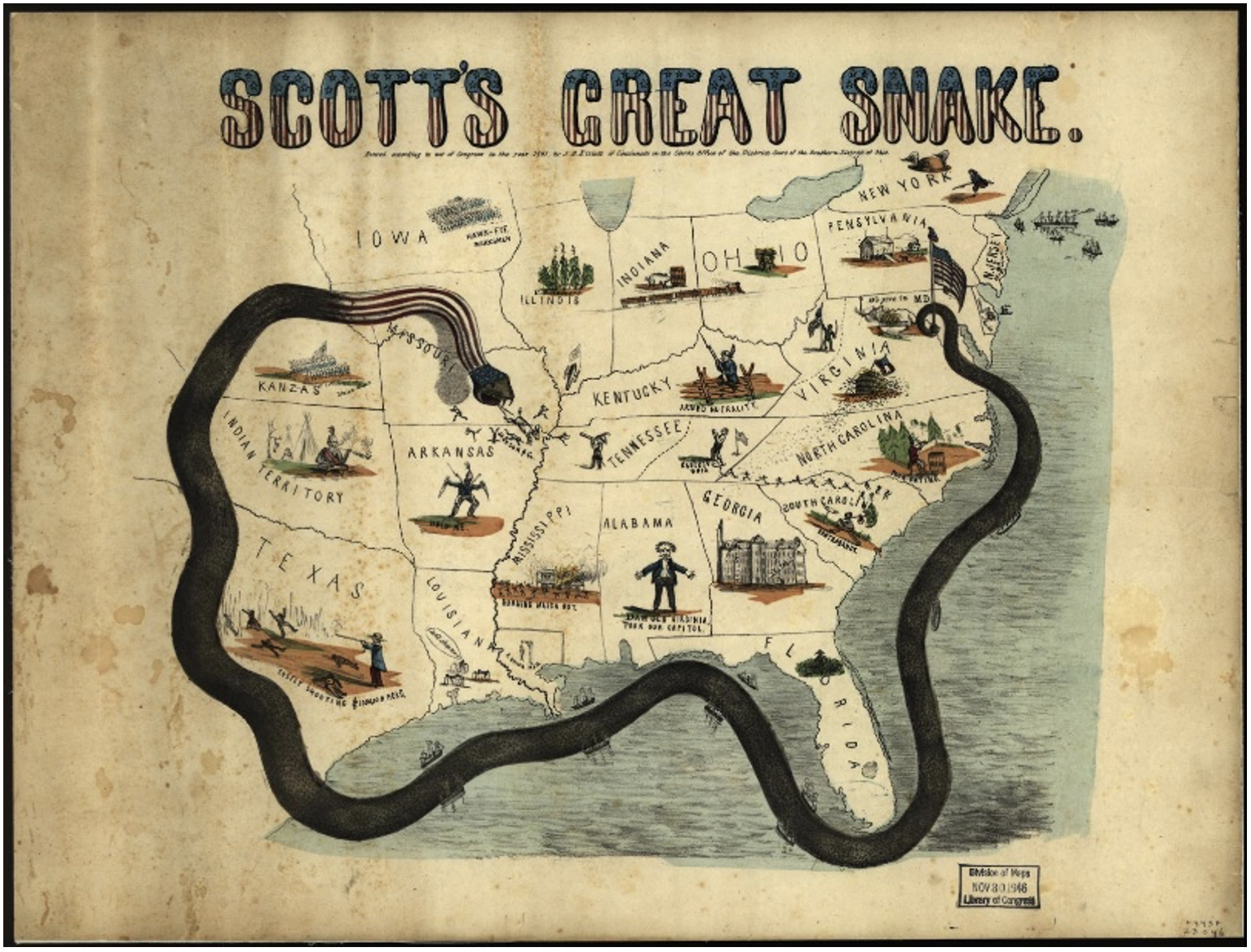
By the time of the American Civil War, the industrialization of warfare had expanded the reach and precision of economic coercion. The Union’s “Anaconda Plan,” for example, bore a striking resemblance to modern national embargoes. Through a naval blockade of Confederate ports, the North aimed to choke off export revenue and deny the South access to the imports (i.e., arms, equipment, and supplies) needed to sustain its war.
The consequences were severe. Deprived of foreign capital, the Confederacy resorted to excessive money printing, triggering hyperinflation and hastening internal collapse. While the Anaconda Plan was imperfect in execution, it demonstrated that sustained economic warfare could impact the operation of an opponent’s war machine.26
Cartoon map showing the Union blockade of the Confederacy, 1861. Source: Library of Congress.
The Allies applied this lesson at scale during World War I when they imposed a vast maritime embargo on the Central Powers. Known as the “Hunger Blockade,” its aim was to sever Germany and its allies from access to industrial materials and essential goods. British strategists targeted munitions production and the basic food supply of the Central Powers, calculating that hunger and hardship would weaken their enemies’ military capacity and the civilian morale of their populations. The effects of this campaign, including shortages, widespread civilian malnutrition, and supply chain strains, contributed to the unraveling of Germany’s capacity to sustain a protected war of attrition.27
These precedents underscore an enduring dimension of conflict: when economic warfare is waged with sufficient scale, coordination, and duration, it can force battlefield adjustments and military collapse. The logic behind today’s application of economic warfare, particularly in its most ambitious applications, rests on this same principle. If Russia’s ability to finance, supply, and sustain its military could be sufficiently disrupted, then might not its capacity to wage war be crippled from within?28 Once again, history has a lesson.
The ‘Axis of Weakness’
The history of economic warfare reveals another illuminating paradox, one that became especially visible in the early 20th century. It is often the weak who first grasp the need for adaptation.
Faced with isolation, resource denial, and the threat of collapse, targeted states have historically responded by forming new alignments and coalitions. What emerges is not a combination of strength. It is something more desperate: a coalition of vulnerability. To understand the modern partnership between Russia, Iran, and others, it is worth revisiting how earlier powers responded when confronted with the same pressures. The original Axis, born in the shadow of sanctions, offers a revealing precedent.
The United States first experimented with fully modern variants of economic warfare in the years preceding World War II. Seeking to preserve peace and avoid foreign entanglements, Congress passed the Neutrality Acts of 1935-1939. Idealistic in design but weak in impact, these laws imposed automatic arms embargoes on belligerent nations and marked an early use of economic tools as instruments of U.S. foreign policy in the 20th century.29 These measures served as tests of coercive leverage. They were early attempts by Congress to shape the course of war without entering it. Unfortunately, the Neutrality Acts unintentionally contributed to the origins of the Second World War. Had the United States, for example, pushed France more aggressively to guarantee the full sovereignty of Germany’s neighbors in Central Europe, history might have unfolded differently.30
A significant breakthrough in the use of sanctions came in 1940 when the United States finally crossed over from the idealistic virtue signaling of the Neutrality Acts into the practical application of economic power to alter the strategic calculus of a target state. This took the form of a short but devastating oil embargo on Francisco Franco’s Spain. Once deprived of critical fuel, Franco capitulated swiftly to Anglo-American demands that he remain neutral in World War II. Indeed, the success of the Spanish oil embargo created a proof of concept that future generations of American policymakers would consider, refine, and use again.31
But there were also signs of sanctions’ limitations. Benito Mussolini’s Italy had proven more resilient just five years earlier. When the League of Nations sanctioned Rome for its 1935 invasion of Abyssinia, the effects were immediate: industrial output fell, exports collapsed, and markets scrambled to replace Italian goods.32 This shock mirrored the initial impact of sanctions on Russia after its 2022 invasion of Ukraine. But the League’s embargo had critical flaws. It left Italy’s import lifelines like coal, oil, and steel untouched. Mussolini survived the League’s “anaconda” by developing a workaround: expanded trade ties with Nazi Germany. Adolf Hitler observed these events and responded.
Watching Italy struggle, he recognized that sanctions could imperil an economy and moved to shield Germany preemptively. Hitler prioritized self-sufficiency (autarky) and accelerated economic cooperation with Mussolini.33 This laid the economic foundation for the Rome-Berlin Axis. It was not an alliance of strength. Rather, it was an alignment forged amid shared vulnerability to international isolation. Much like today’s “Axis of Aggressors,” which unites Russia and other rogues, the original Axis coalesced to blunt the blow of multilateral sanctions.
The Cold War Era
If the run-up to World War II demonstrated the potential and limits of economic warfare, the Cold War marked its transformation. In the long contest between East and West, the use of economic tools evolved from instruments of attrition to tools of alignment. America employed them to punish adversaries and shape the postwar order in its own image. The shift was gradual but profound. Over time, Washington moved from inducements to coercion, from aid to exclusion, from the Marshall Plan to full-scale national embargoes. In this way, the modern sanctions arsenal emerged through the organic architecture of alliance building and containment.
In the aftermath of World War II, in which America and its allies waged economic warfare through strategic bombing and submarine blockades, the United States emerged as the world’s unrivaled superpower, both militarily and economically. Washington initially wielded its strength through international assistance programs, not punishment. Policies like the Marshall Plan, the European Recovery Act, the Export-Import Bank Act of 1945, and the Foreign Assistance Act of 1961 injected billions into foreign economies and, not incidentally, ensured that Western Europe remained in the democratic fold. It was an era of inducements, when the currency of influence was valued in assistance rather than penalties.34
But by the late 1960s and 1970s, as U.S. economic dominance waned and Marxist insurgencies spread, Washington began to pivot. Congress increasingly pushed for sanctions against regimes that defied American interests through war, terrorism, or other malign ambitions.35 Embargoes became a preferred weapon, used against Cuba, Rhodesia, Libya, South Africa, and post-1979 Iran. And since these countries were not major economic powers, cutting them off from the global economy was a low-cost and potentially high-reward option for the United States and international bodies like the United Nations.
The results, at least in the short term, seemed to vindicate the punishment strategy. Rhodesia’s white minority rule collapsed. South Africa dismantled apartheid.
By the 1980s and 1990s, sanctions had become Washington’s default response to foreign provocation and defiant states. In fact, one of the clearest examples was the Reagan administration’s use of secondary sanctions to undermine Soviet energy exports to Europe. While the Reagan White House eventually backed off of its sanctions threat, this move foreshadowed modern efforts to curtail Russian gas dominance.36
By the end of the 20th century, America’s faith in sanctions was at an all-time high.37 With enough pressure, many in Congress asked: What problem could the sanctions tool not solve?38
The Post-9/11 Era
The attacks of September 11, 2001, marked a turning point in the evolution of economic warfare. At this point, sanctions had become a weapon that the United States wielded against traditional states: countries with borders, banks, and trade. But al-Qaeda had no capital, no standing army, and no national economy to punish. The terrorist threat to America was diffuse, decentralized, and transnational. Could economic pressure work against such an adversary?
Accordingly, Washington adapted its financial arsenal to disrupting networks of terrorist funding, logistics, and support. The Treasury Department became the nerve center of this transformation, pioneering new tactics to identify, track, and choke off the financial structures that sustained al-Qaeda’s distributed network of terror.
This was a policy of sanctions for the denial of capabilities, not sanctions as punishment or moral symbolism. Treasury’s terrorist targets were expansive, including dispersed logistical facilitators, bankers, shell companies, and shadow intermediaries. As Treasury officials repeatedly told Congress, the department was resolved to measure success not by the headlines it generated but rather in frozen assets, disrupted transfers, and the organizations it starved of operational funds. For the first time, Treasury was learning to structure its use of financial and economic weapons around a coordinated strategy. And it was working in concert with, not in opposition to, the U.S. intelligence community.39 In contrast to the lackluster application of sanctions in the 1990s, Treasury would soon employ this more flexible, post-9/11 model against more traditional state adversaries like Russia and Iran.
Insights
This short survey of the past yields four insights that inform this report’s subsequent analysis of U.S. sanctions on Russia and Iran:
- Economic Warfare Works Best When It Hits a Critical Vulnerability Rapidly
Targeting critical dependencies, from Athens’ food supply to Franco’s oil imports, was key to forcing a breakthrough over the near- and long-term. But half-measures often fail. To be effective, sanctions must be aggressive and front-loaded, not meted out gradually over time. While earlier administrations also made the mistake of slow-rolling sanctions, the Biden White House’s piecemeal increases in Russia sanctions were an unforced error. An immediate full-court press would have had a greater chance of dislocating the Kremlin’s war machine. - Resistance, Adaptation, and Learning Are Inevitable
No regime subjected to economic warfare accepts its fate without resistance. Sanctioned states adapt, innovate, and learn. Mussolini’s Italy sought new suppliers to bypass the League’s restrictions on its economy. Hitler, taking notes, built economic self-sufficiency into Germany’s prewar posture. Iran and Russia now act in a similar fashion: relying on shadow economies, illicit finance, and triangular trade networks to blunt Western sanctions. Each new round of economic pressure becomes a lesson. Each lesson accelerates adversarial adaptation. - Sanctions Often Take Time
While sanctions have the greatest impact when they hit hard and fast, a lack of immediate success does not translate automatically into failure. Sanctions on the apartheid regime in South Africa were slow to gain momentum but had a decisive impact over several years. The campaign against apartheid was unique in the global support it eventually garnered but so was the magnitude of its impact: the complete dismantlement of apartheid with the consent of its guardians. Today, it is more typical for economic warfare to seek a change in an adversary’s behavior or the degrading of its financial and military capacity. Even this may require substantial time as well as consistent pressure. - Sanctions Alone Are Rarely Enough
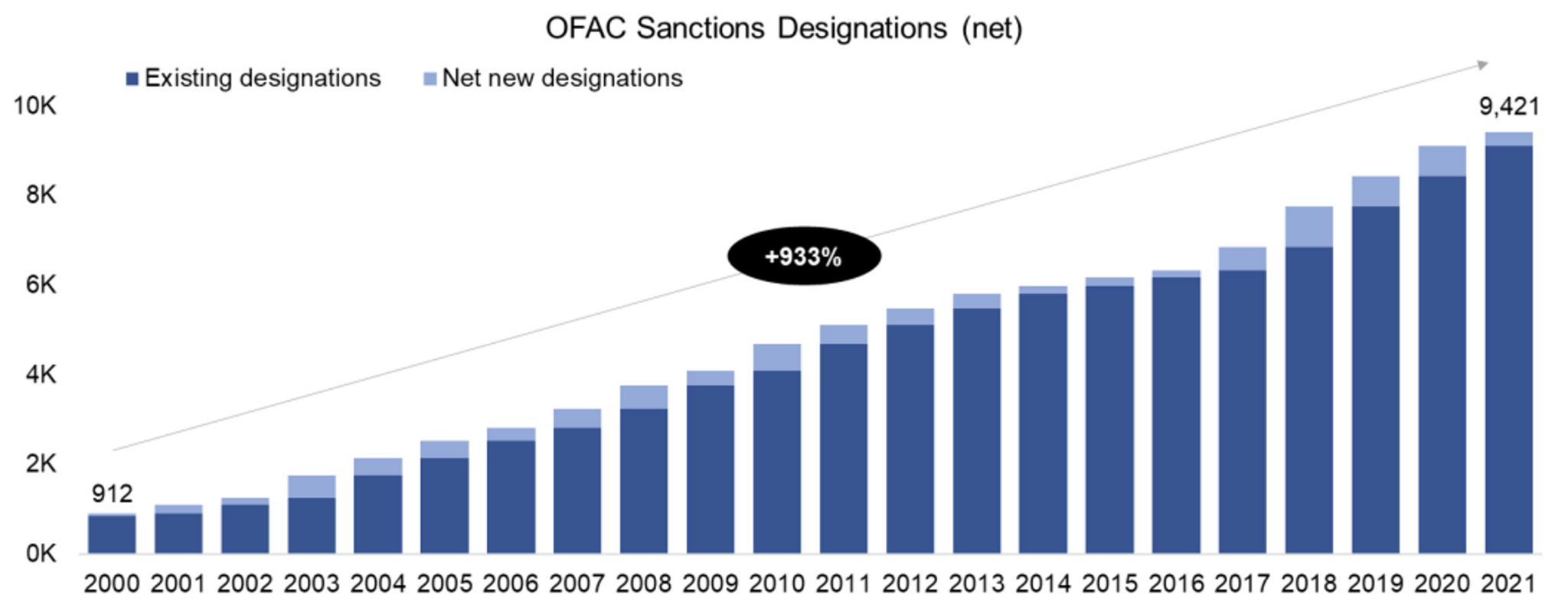
Sanctions are not a silver bullet. To be effective, they must be aggressive, sustained, and backed by complementary tools — military deterrence, diplomatic pressure, and intelligence coordination with allies. From ancient siege tactics to modern counterterrorism finance, economic warfare succeeds only when embedded in a broader strategy. As adversaries adapt, the process of updating designations becomes less like a decisive strike and more like weeding a garden: constant, incremental, and labor-intensive. This trend is best visualized in the expansion of OFAC sanctions over time.
Sanctions Use Has Increased Over the Last 20 Years
Graph showing the accumulation of sanctions designations since 2000. Source: U.S. Department of the Treasury, “The Treasury 2021 Sanctions Review.”
As Treasury officials noted in their 2021 internal review (see “Sanctions use” graphic), the overuse of sanctions also has consequences. The more America relies on the arsenal of economic warfare to contain and constrain its adversaries, the more they learn to resist it. Exposure breeds adaptation.
Iran offers one case study through which this report considers the application of these insights. As the analysis later shows, Russia demonstrates their application at scale.
The Economic Arsenal vs. Iran
Compared with the world’s great powers, Iran’s economy has remained relatively small, with limited influence on global supply chains outside the hydrocarbon sector. This has informed Western risk assessments when deploying economic weapons against the clerical regime in Tehran.
Since the 1979 Islamic Revolution, the United States and its allies have, as a consequence of Iran’s relatively small economy, employed sanctions and other restrictions on the clerical regime in that country with relatively low cost and minimal systemic risk. From the moment that Iran’s revolutionaries seized the U.S. embassy and took scores of hostages, the regime in Tehran has lived under the shadow of near-constant economic penalties. Though the intensity of sanctions has fluctuated across administrations, outside pressure on Iran never fully abated.
In the 1980s and 1990s, U.S. sanctions focused on terrorism and regional destabilization. By the 2000s, nuclear proliferation became the central concern. This triggered a broader, more integrated campaign of economic restriction, which evolved into one of the most expansive and sophisticated sanctions regimes in modern history. U.S.-led measures targeted nearly every aspect of the Iranian economy: oil exports, trade, banking, aviation, shipping, and overseas assets.
As the previous section demonstrates, however, action inevitably invites reaction. The clerical regime’s resilience revealed a fundamental tension embedded within the economic arsenal: sanctions applied in perpetuity both punish and educate. Given time, a sanctioned state learns from economic pressure.
The Great Calamity: Iran’s Islamic Revolution
It is difficult to overstate the geopolitical shock the 1979 Islamic Revolution dealt to America’s Cold War strategy. For decades, Washington had relied on Shah Mohammad Reza Pahlavi’s regime as a cornerstone of its containment policy against Soviet- and Chinese-backed communist movements across the globe.
Under the shah, Iran had become the keystone of President Richard Nixon’s “gladiator strategy,” a doctrine built around propping up heavily armed, pro-American regimes as regional bulwarks against Moscow. Continued in large part under the Ford and Carter administrations, the strategy used these “gladiators” not only to counter Marxist insurgencies but also to host critical U.S. intelligence nodes and listening posts around the globe.40 Among them, Iran stood as the undisputed heavyweight of the gladiatorial arena. Then, in a stunning reversal, the Pahlavi dynasty abruptly imploded.
In November 1979, young revolutionaries seized the U.S. embassy in Tehran and held 52 American hostages for 444 days. The crisis, broadcast daily around the world, humiliated the Carter administration and exposed America’s impotence in the face of revolutionary upheaval. When Ronald Reagan assumed the presidency in 1981, he inherited both the fallout of the hostage crisis and the broader task of reasserting American power. Tehran had exposed Washington’s limited reach and seized billions in U.S. assets and military equipment. The financial toll was enormous, with insurance and civil claims alone exceeding $22 billion in today’s dollars.41
After the embarrassing failure of Operation Eagle Claw under the Carter administration (a botched mission to free American hostages in Tehran), military intervention inside Iran was effectively off the table.42 Instead, the Reagan White House turned to economic means of containing and constraining the clerical regime in Tehran. During this period, Washington froze Iranian assets, restricted trade, and laid the groundwork for what would become a decades-long campaign of economic pressure. But Iran would prove an elusive target. The clerical regime, though battered, adapted. The battle that followed was neither swift nor decisive. Both sides continually recalibrated and learned from each other.
The 1980s: Adaptation to Sanctions
Early in its first term, the Reagan administration escalated both primary and secondary sanctions on Iran, expanding the scope of economic pressure in an effort to curb Tehran’s most destabilizing activities.43 Initially, U.S. sanctions aimed to alter Iranian behavior in four key areas: support for terrorism, pursuit of weapons of mass destruction, human rights abuses, and aggression against commercial shipping in the Persian Gulf.44
To advance these goals, Washington opposed World Bank loans to Iran, restricted exports of dual-use technology during the Iran-Iraq War, and blocked U.S. assistance through international financial institutions.45 These moves reflected a broader change in America’s use of financial tools against foreign states (considered in the previous section): economic denial was becoming a preferred tool of coercion. It was not merely a supplement to American diplomacy but rather a means to shape adversarial behavior in Iran through isolation.
That said, sanctions under Reagan constituted neither full-scale economic warfare nor an attempt to bring down the regime.46 In some respects, Iran sanctions during the Reagan era can be seen as a prototype for the more sophisticated tools that Treasury would introduce after 9/11.47
But half-measures proved inadequate. Throughout the 1980s, Iran remained steadfast in its support for Hezbollah and other proxy groups, even as it waged a ruinous eight-year war against Saddam Hussein’s Iraq.48
Faced with growing economic constraints, however, Tehran followed a familiar pattern. Much like Mussolini’s Italy under League sanctions, Iran sought to circumvent pressure by cultivating alternative economic relationships. It deepened ties not only with traditional partners like the Soviet Union and China but also with a diverse coalition of states willing to defy U.S. pressure. Included among them were Mexico, Austria, Poland, and Sweden.49
Iran’s response underscored a foundational truth of sanctions strategy. When pressure is applied in a piecemeal or incremental fashion, it often hardens a target rather than weakening it. The 1980s became the regime’s training period. It was then that Iran first learned to evade sanctions systematically. It diversified trade ties, forged nonaligned partnerships, and laid the groundwork for future sanctions resistance. The tools of endurance were assembled early. And they would prove difficult to dismantle.
The 1990s: Nuclear Fears and the European Backlash
The administrations of George H.W. Bush and Bill Clinton broadly continued the Reagan-era strategy of economic pressure on Iran. While concerns over Tehran’s support for terrorism remained constant, a new and more ominous threat came into focus during the 1990s: Iran’s pursuit of nuclear weapons.
Responding to rising anxiety in Washington, Clinton began to tighten the financial noose on the regime in Tehran. In 1995, through executive order, he directly targeted Iran’s energy sector (its most profitable industry) by barring new U.S. investments in oil and gas.50 He also imposed a sweeping ban on trade and investment between American firms and Iran.51
Congress followed suit. In 1996, it passed the Iran and Libya Sanctions Act (ILSA), a landmark piece of legislation that extended beyond American companies to penalize foreign firms investing more than $20 million in Iran’s energy sector.52 In effect, ILSA introduced secondary sanctions: non-Iranian firms could now be punished — via exclusion from the U.S. market — for doing business with Tehran. However, the main challenge to the application of this law did not come from Iran. Instead, it emanated from Europe.

Poster protesting the bombing of Iraq, 1999. Source: Library of Congress.
For years, European governments had built commercial and diplomatic relationships with Iran, particularly in the energy sector. Many European firms viewed Tehran not as a pariah but as a market of opportunity. ILSA provoked an immediate European backlash, especially from Paris and Berlin.53 European leaders denounced the law as extraterritorial overreach — an attempt by Washington to drag foreign companies into its campaign against Tehran by threatening their access to U.S. markets.
Recognizing that a brewing diplomatic crisis was about to boil over, the Clinton White House chose to compromise. The State Department offered Europe limited exemptions to ILSA. The most notable of these was approval of a major European-backed energy project in Iran. Washington also pledged not to impose sweeping penalties on allied governments. Clinton dispelled the crisis. The boil settled to a simmer. But at a cost.
By offering carveouts to ILSA, the Clinton administration set a precedent that would continue throughout the following decades. European capitals took note: U.S. sanctions were forceful in theory but were negotiable in practice.54 This dulled the edge of America’s sharpest economic weapons against Iran.
ILSA was the first major instance of this dynamic, but it would not be the last. From that point on, the cycle of sanctions, opposition, and exemptions became a defining feature of America’s economic arsenal. In this case, the most significant challenge to U.S. sanctions policy did not come from Tehran but from America’s own allies. A new phase had begun: economic conflict was no longer just a contest with adversaries. It was also a negotiation with friends.
The 2000s: War on Terror and Iran’s Nuclear Pursuits
The terrorist attacks of September 11, 2001, were the deadliest assault on American soil since Pearl Harbor. In their wake, the administration of George W. Bush launched a sweeping campaign to dismantle terrorist networks, confront hostile regimes, and reassert American primacy.55 On September 23, 2001, Bush signed Executive Order 13224, which bars transactions with, and freezes the U.S.-based assets of, supporters of international terrorism.56 In later years, successive administrations would use the order to sanction Iran.57
In his 2002 State of the Union address, Bush designated Iran as part of the “Axis of Evil” along with Iraq and North Korea. His administration first targeted al-Qaeda and then invaded Iraq but also had to grapple with the threat that Iran, a state sponsor of terrorism, was pursuing nuclear weapons. In August 2022, an Iranian opposition group announced its discovery of Iran’s covert uranium enrichment facility at Natanz, a flagrant violation of Iran’s binding obligations as a signatory of the Nuclear Non-Proliferation Treaty (NPT).58
In 2005, President Bush signed Executive Order 13382, which allows the president to sanction proliferators of weapons of mass destruction. Each U.S. administration since then has used the order to sanction scores of Iranian proliferators. Most notably, in 2007, Bush sanctioned the IRGC, the Ministry of Defense and Armed Forces Logistics, and Bank Melli, Iran’s largest bank, pursuant to the order. Between 2006 and 2008, the UN Security Council, with the support of the United States, passed three resolutions sanctioning Iran for its nuclear activities. The measures also required Tehran to suspend its uranium enrichment — the crucial stage in the production of fissile material for nuclear weapons.
2010-2018: Intensified U.S. Sanctions and the Iran Nuclear Deal
The 2009 discovery of Fordow, a covert uranium enrichment plant, inaugurated a new, more intense phase in U.S. sanctions on Iran. The facility, built beneath a mountain to hinder military strikes, lacked any civilian purpose, indicating the regime’s determination to build a nuclear weapon.
Over the objections of the Obama administration, Congress passed the Comprehensive Iran Sanctions, Accountability, and Divestment Act (CISADA) of 2010, which aimed to restrict the regime’s financial lifelines and penalize human rights violators.59 Among other provisions, the law sanctions any foreign bank that engages in a significant financial transaction with an entity sanctioned by Executive Orders 13224 or 13382. The statute also penalizes any foreign bank that aids Iran’s efforts to acquire weapons of mass destruction or their delivery systems.60
Amid enduring bipartisan support for a firmer stance toward Iran, additional measures followed. In November 2011, the Obama administration designated Iran as a “jurisdiction of primary money laundering concern” under Section 311 of the USA PATRIOT Act.61 A month later, Obama signed into law the National Defense Authorization Act for Fiscal Year 2012, which designated Iran’s financial sector, including the Central Bank of Iran, as a “primary money laundering concern.”62
A pair of executive orders and additional legislation stepped up the pressure in 2012. In February, Obama further intensified U.S. economic pressure with Executive Order 13599, which froze all American-held assets of the Central Bank of Iran and other government-controlled entities.63 Unlike earlier sanctions that merely blocked transactions and returned the funds, the move authorized U.S. banks to seize Iranian assets outright. In May, Obama signed Executive Order 13608, which gave the Treasury Department the ability to sanction foreign persons who facilitate Iran’s evasion of U.S. and multilateral sanctions.64 Finally, in August, the president signed into law the Iran Threat Reduction and Syria Human Rights Act, which expanded sanctions on Iran’s energy sector. The Iran Freedom and Counter-Proliferation Act, passed as part of the National Defense Authorization Act for Fiscal Year 2013, sanctioned Iran’s energy, shipping, and shipbuilding sectors as well as transactions in precious metals, among other provisions.65
Collectively, these sanctions succeeded in bringing Iran back to the negotiating table in 2012. In November 2013, Tehran and its interlocutors finalized an interim agreement known as the Joint Plan of Action (JPOA), which provided significant sanctions relief. In particular, the accord suspended sanctions against Iran’s oil exports and permitted selected direct cash transfers from Iranian-owned overseas accounts. Likewise, the deal suspended sanctions on Iran’s auto industry and exports of petrochemical products. Iran’s resulting financial windfall was substantial, enriching the regime with billions of dollars.66 Between March 2014 and March 2015, the country’s GDP grew by 3 percent, according to the Central Bank of Iran.67
Innovative Evasion
While engaged in the negotiations that generated the JPOA and would later result in a broader nuclear deal, Tehran crafted intricate efforts to evade sanctions, thereby relieving some of the pressure that kept them at the table. In 2013 and 2014, Iranian-Turkish gold trader Reza Zarrab exploited Turkish banks to evade sanctions, enabling Iran to accumulate about $13 billion. He conspired with Turkish banker Mehmet Hakan Atilla, the deputy CEO and general manager at Turkey’s state-owned Halkbank, to launder hundreds of millions of dollars through the U.S. financial system on behalf of Tehran. The plot constituted one of the largest sanctions evasion schemes in modern history. U.S. authorities ultimately apprehended Zarrab, who testified against Atilla in federal court, leading to his conviction.68
Another striking example is the May 2015 purchase by Mahan Airlines, an Iranian airline under U.S. sanctions, of nine aircraft.69 Tehran achieved this feat of sanctions evasion through a coordinated operation that included short-lived front companies, international middlemen, falsified certificates of origin for prohibited aircraft, inflated payments to obscure financial beneficiaries, and foreign subsidiaries that masked the final recipient: Iran. It was a master class in evasion that was made possible through decades of accumulated lessons.70
Determined to secure a nuclear deal, the Obama administration pressed forward, resulting in the July 2015 conclusion of the nuclear agreement formally known as the Joint Comprehensive Plan of Action (JCPOA). In theory, the accord offered a straightforward exchange. If Iran accepted key limits on its nuclear program and submitted to international inspections, it would receive phased sanctions relief. The Obama administration, alongside the United Kingdom, France, Germany, Russia, China, and the European Union, agreed to lift many secondary sanctions, particularly those targeting Iran’s oil exports. European governments, eager to resume profitable trade with Tehran without jeopardizing access to U.S. markets, backed the deal enthusiastically.
On paper, the JCPOA represented a diplomatic breakthrough. Yet problems remained: Eventually, the deal would sunset, and the clerical regime would have the ability, under the existing agreement, to create a nuclear weapon. Likewise, the agreement failed to require Iran to provide a complete accounting of its past nuclear activities, leaving the International Atomic Energy Agency in the dark about the full contours of Iran’s atomic program and its efforts to weaponize nuclear material. Ultimately, even with these concessions, Tehran still proceeded to violate key terms of the JCPOA in the coming years.71 Furthermore, as Mark Dubowitz and Annie Fixler observed, the deal did “nothing to address the full range of Iran’s illicit activities, including ballistic missile development, support for terrorism, regional destabilization, and human rights abuses.”72
2018-2020: ‘Maximum Pressure’
After working for over a year to fix the JCPOA’s flaws — a goal that remained elusive — the Trump administration adopted a starkly different approach toward Iran. In May 2018, Trump unilaterally withdrew the United States from the accord in May 2018 and replaced it with a policy of maximum pressure.
This campaign constituted the most aggressive sanctions regime Iran had ever faced. At its core, the policy sought to strangle Iran’s economy by crippling its most vulnerable sector: energy. The Trump administration reimposed all the sanctions Obama suspended. This included secondary sanctions on Iran’s oil exports, banking sector, and key industries, sending Iran’s currency into a freefall and plunging the economy of the clerical regime into recession. In April 2019, the 12-month point-to-point inflation rate reached 51.4 percent, according to the state-run Statistical Center of Iran.73 The following month, Iran’s supreme leader, Ayatollah Ali Khamenei, asserted that as Iran’s enemies “themselves say, they have imposed unprecedented sanctions. They are right, the sanctions that they have imposed on the Islamic Republic are unprecedented.”74 The Statistical Center reported that Iran’s economy shrank by 2.1 percent in 2020.75
A major component of the U.S. effort was Executive Order 13902, signed in January 2020, which significantly expanded the application of secondary sanctions against Iranian government-owned or controlled entities.76 This was particularly isolating for Iran’s banking sector, along with other sources of revenue for the regime such as Iran’s construction, mining, manufacturing, and textile industries.
The response from Europe was immediate — and furious. But there was no action to match the fury. The episode thus demonstrated the effectiveness of secondary sanctions as a policy tool. The United Kingdom, France, and Germany created a special channel for trade with Iran, but it processed only a single transaction in its four-year lifespan.77 European companies had no desire to risk the imposition of U.S. sanctions to protect their market share in Iran.78
Faced with mounting economic isolation, the clerical regime in Tehran scrambled for new coping mechanisms. Some strategies were old and refined over decades of American pressure. Others were new methods that necessity and innovation had created.
At the top of this list was a tactic Tehran had been experimenting with for years: its shadow fleet of oil tankers.79
Shadow Fleeting
A “shadow” vessel is maritime parlance for a ship designed to circumvent international law, embargoes, and sanctions.80 These ships are typically aged, mechanically unsound, uninsured, and unlisted in official registries under their current names. Their purpose is illicit by design. The owners of these vessels hide behind layers of shell companies. They operate in the gray economy, using false papers and illegal practices to shield themselves from sanctions enforcement.
Iran first experimented with shadow shipping in 2008 when U.S. sanctions targeted its state-controlled shipping entity, the Islamic Republic of Iran Shipping Lines (IRISL). At the time, Tehran’s fleet consisted of 19 vessels flying the flag of Hong Kong, with front companies registered there while their true ownership remained in Iran.
The clerical regime in Tehran adapted by renaming the vessels, allowing them to remain operational under assumed identities.81 When Washington identified these new names, IRISL reshuffled ownership once more, created new front companies, and buried the paper trail even deeper. This process continued during the Trump and Biden administrations.
By the mid-2010s, two wider trends began to threaten Iran’s shadow fleet: (1) technological advances in surveillance, and (2) new international maritime norms.
A key shift came in 2015 when updates to international treaties required most ships on global voyages to transmit a shipborne automatic identification system (AIS) signal. This very high frequency (VHF) broadcast by each ship provided its real-time location to other ships and coastal monitoring stations. In theory, this would make shadow ships easier to track. Without it, real calamities at sea can occur.82
Once again, Iran adapted. Carrying sanctioned Iranian crude, shadow vessels frequently went dark by deactivating their AIS transponders. In effect, they disappeared from civilian maritime tracking systems. While running without a legitimate AIS signal, they could conduct illicit ship-to-ship oil transfers at sea, allowing Iranian crude to reach international markets through indirect, disguised channels.
Despite their best efforts, however, these vessels were never truly invisible. The assets of the U.S. intelligence community, including commercial satellite imagery and real-world sightings at sea, provided overwhelming evidence that these tankers were carrying sanctioned Iranian oil. The clerical regime’s maritime deception had become increasingly sophisticated but so too had Washington’s ability to track and disrupt it.
By the late 2010s, Iran’s use of shadow vessels reflected Tehran’s desire to adapt. The cycle of action, reaction, and counteraction continued. When the United States escalated its sanctions enforcement mechanisms, tracking and blacklisting more Iranian vessels, Tehran responded with greater sophistication, deeper layers of deception, and stronger ties to illicit networks willing to move its oil.
Worse, shadow fleeting was just one part of the adaptive cycle. The clerical regime was learning from experience, refining its evasion tactics, and adapting to survive. This ensured that the contest between Washington and Tehran would continue into the next decade.83
Foreign Enablers
Related to the use of “shadow” fleets was the need for foreign enablers. The imposition of the Trump administration’s maximum pressure campaign on Iran forced the clerical regime to replicate the legitimate functions of the global oil market. This technique employed a network of front companies, middlemen, and dubious enablers to facilitate the transfer and settlement of embargoed Iranian oil. China (Hong Kong) and the United Arab Emirates (UAE) were (and remain in some cases) favored locations for sanctions-evading operations. Their establishment intensified the regime’s competitive game with Treasury. When the United States shut down one illicit network, new ones would emerge.84
When the Trump White House declared its intention to drive Iran’s oil exports to zero, Tehran intensified its efforts to maintain its oil sales. However, its ghost fleet was not enough. Iran also needed enablers to facilitate the sale of its crude abroad.
Shadow Trading
Similar to Iran’s adaptations at sea, the clerical regime in Tehran developed a number of additional workarounds to U.S. sanctions on land and in the realm of finance. Some of the most important measures for facilitating the economic survival of the regime under the maximum pressure campaign included the establishment of triangular trade routes through third-party countries, a reliance on foreign enablers, and informal funds transfer systems (IFTs).
Triangular Trade
Sometimes called intermediary trading, this technique relies on using a third country as a cut-out for the export and import of prohibited goods as well as the repatriation of hard currency. It enabled Tehran to disguise the origin of exports (or the destination of imports into Iran) for banned international trades. Georgia, Armenia, and, to a lesser extent, Turkey became preferred jurisdictions for Iran’s triangular trade during the early 2010s, wherein the Iranian regime often relied upon Russian citizens and entities to act as middlemen, fixers, and facilitators for the transactions.85
Adversarial learning was occurring during this period. Russian government agents would observe and — allegedly in some cases — participate in these trading practices. For Russia, its facilitators would learn how to create replicable trade and money transfer structures that could be implemented when Western sanctions hit the Kremlin’s wartime economy after 2022.
Informal Funds Transfer Systems
IFTs allow money to move across borders and outside of the formal international banking system. While private remittances are a common and legitimate use of such systems, international sanctions forced the institutionalization and centralization of this concept in Iran. While the “hawala” system long predates the clerical regime in Tehran, the regime expanded this venerable method for moving money into a modern mechanism for sanctions evasion.
In response to the Trump administration’s maximum pressure campaign, Iranian traders, in partnership with Iran’s Central Bank, developed an IFT platform called NIMA. It allowed an Iranian trader to convert the hard currency that they made overseas back into the clerical regime’s local currency, the rial. Tehran’s adaptive twist: cash that was warehoused overseas need never enter Iran. This informal transfer system, formalized into NIMA, thus circumvented Western sanctions on the country’s financial system altogether.86
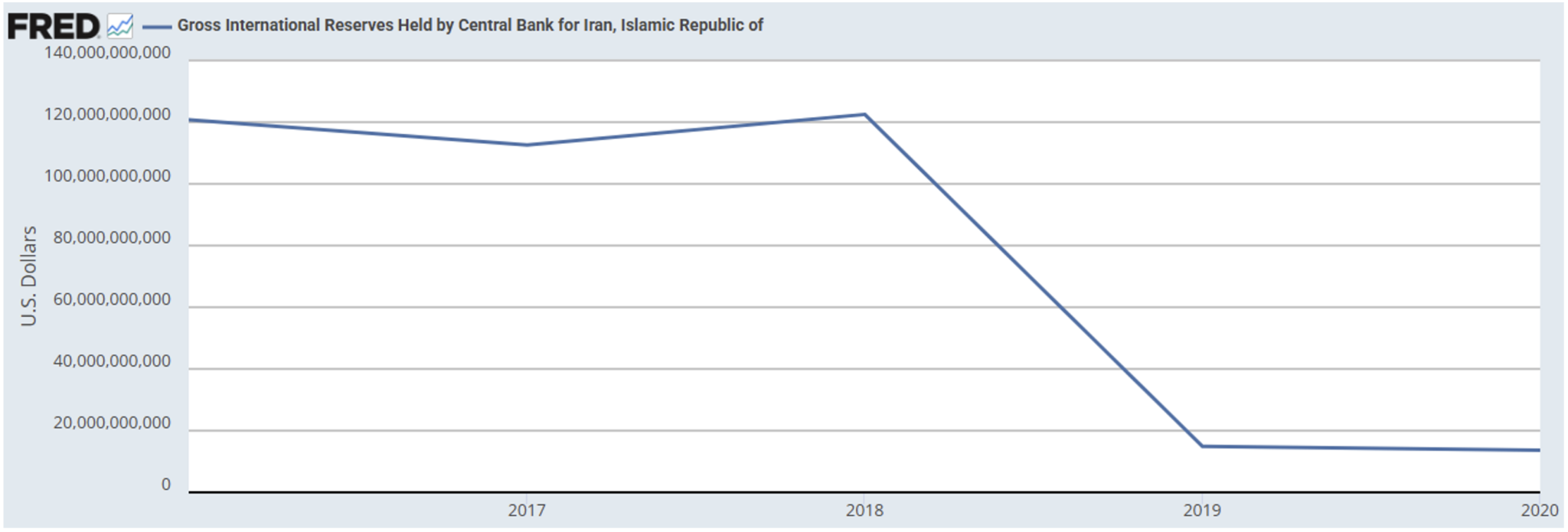
Despite Iran’s many lessons learned from U.S. sanctions, the Trump administration continued to pound the clerical regime under its maximum pressure campaign. It refused to allow Tehran sanctions relief on its oil exports. Washington’s campaign steadily produced a precipitous decline in Iran’s overall oil exports and international reserves during this period.87 However, it was in place for only a relatively short period of time — barely two years — before Trump lost to Biden in the 2020 elections.
After 2021, the Biden administration loosened the economic strictures on Iran and did not sustain Trump’s maximum pressure campaign.
JCPOA Under the Biden Administration
The Biden administration reversed Trump’s maximum pressure campaign. Critics dubbed this about-face a policy of “maximum appeasement.”88 Initially, Biden conceded that the JCPOA could have benefited from tougher provisions. In a September 2020 opinion column, Biden wrote that he would seek to “rejoin the agreement as a starting point for follow-on negotiations. With our allies, we will work to strengthen and extend the nuclear deal’s provisions, while also addressing other issues of concern.”89
Reserves Under Pressure
Graph showing gross international reserves held by Iran’s central bank. Source: International Monetary Fund via FRED.
Yet negotiations to revive the JCPOA immediately hit a wall, including disagreements over the sequence of steps for Iran’s compliance and the regime’s demand for full sanctions relief. During both the brief period of negotiations and the impasse that followed, Tehran rapidly accelerated its nuclear program, including the enrichment of uranium to increasingly higher levels of purity.90 While sanctions remained on the books, Biden largely failed to enforce them, yielding the regime a formidable financial windfall. Iranian oil exports, primarily to China, surged.91 In July 2023, The Wall Street Journal reported that oil exports had reached 1.6 million barrels per day — a five-year high and more than double the previous year’s rate.92 By contrast, during the height of the first Trump administration’s maximum pressure campaign, oil exports dropped to a few hundred thousand barrels per day.93 Iran’s economy broke out of its multiyear recession, with increasing oil revenue driving the new growth. Inflation remained high, and the rial continued dropping, but the regime’s fiscal state was increasingly secure.94 During its tenure, the Biden administration refused to run the race of the Red Queen, with Tehran taking full advantage of its opponent’s passivity.
Iran’s Monthly Crude Oil and Condensate Exports, January 2016-August 2024

Graph showing Iran’s monthly energy exports. Source: U.S. Energy Information Administration.
Renewed Pressure under Trump 2.0
Trump’s return to the White House in 2025 brought about a reinstatement of his maximum pressure campaign against Iran. On February 4, the president issued National Security Memorandum-2, which announced the renewed effort and stated that Washington aimed “to drive Iran’s export of oil to zero, including exports of Iranian crude to the People’s Republic of China.”95 In the months that followed, Trump’s Treasury Department levied sanctions against firms and individuals involved in Iran’s oil export networks, which had steadily increased their petroleum sales under the Biden administration.96 In March, the Trump administration also revoked the waiver that had permitted Iraq to pay Iran for electricity.97
However, Trump’s campaign thus far has not meaningfully hindered Iran’s oil exports. In fact, in 2025, the rate of Iran’s oil exports did not differ significantly from the rate of oil exports in the same period in 2024. This is likely because Washington has yet to sanction major banks and ports in China that facilitate the exports.98 So far, it seems that mimicking the original policy of maximum pressure cannot reverse the gains Tehran made under Biden.
What then can be gleaned when assessing recent sanctions and economic warfare against Iran? For starters, Western restrictions on Iran produced a relatively small impact on the global economy. The world was not overly reliant on Iranian raw materials and minerals to maintain global industrial supply chains, in contrast to significant dependence on Russia. Western and East Asian companies would have liked to do business in Iran, but the rewards were hardly worth the risk of sanctions. Because of Iran’s relatively small size, U.S. and allied sanctions could thus keep pace with the rate of Iranian learning and adaptation to sanctions at manageable cost.
The Problem at Scale: Russia
Russia has benefited from decades of Iran’s adaptive learning to evade sanctions and develop techniques to evade Western export controls of restricted technology. When the United States tried to impose “swift and severe” sanctions on the Kremlin for its 2022 assault on Ukraine, the Putin regime employed evasion measures familiar to its Iranian partners. Russia rented (or purchased) Iran’s shadow tankers, adopted the practice of transferring illicit cargo at sea via ship-to-ship transfers, utilized front companies, worked through third-country intermediaries, and established parallel money exchange mechanisms.99
Drawing from Tehran’s playbook and its own experience working around Western sanctions, Russia began with a head start in its Red Queen race of action and reaction against the United States and its allies. This likely emboldened the Kremlin to ignore the Biden administration’s threats of economic pain with which Biden sought to deter the 2022 invasion. Worse still, Washington’s underestimation of Moscow’s ability to mitigate sanctions may have led to its overconfidence in sanctions as a deterrent. Undeterred, Putin launched the largest conventional war in Europe since 1945.
Obama’s Russia Reset and the Death of Sergei Magnitsky
On November 16, 2009, Sergei Magnitsky — a Moscow accountant and anti-corruption investigator — was found dead in a Russian jail cell. Officers from the Russian Ministry of Interior had beaten and tortured him to death.100 Magnitsky’s “crime” was exposing the largest known tax fraud in Russian history, a $230 million theft orchestrated by state officials and criminal enablers with government protection.101 Had he survived just eight more days, he would have been eligible for release.102 Many die in Putin’s jails without the world taking notice, yet Magnitsky’s killing became the catalyst for major changes to the use of America’s economic weapons against rogue states and even individuals.103
The timing of Magnitsky’s murder could not have been worse for the Obama administration. The president had just embarked on a high-profile effort to “reset” U.S.-Russia relations. Obama asserted that Americans and Russians “have a common interest in the development of rule of law, the strengthening of democracy, and the protection of human rights.”104 Magnitsky’s murder belied this claim. Still, the White House wanted to move on. But Congress would not. Sens. Ben Cardin (D-MD) and John McCain (R-AZ) — representing both major parties — viewed Magnitsky’s killing not just as a tragedy but also as a warning. It was the cold demonstration of the Putin regime’s impunity to consequences for its crimes. Cardin and McCain responded by introducing sweeping legislation aimed at punishing the individuals responsible while creating a new mechanism to sanction Russian officials involved in serious corruption and abuse.
Originally titled the Justice for Sergei Magnitsky Act, the bill empowered the executive branch to freeze assets and deny visas to Russian officials complicit in human rights violations.105 The Obama administration did not want Congress to tie its hands. Behind the scenes, State and Treasury officials were dispatched to Capitol Hill with a single mission: kill the bill.106 The White House believed the success of the Russia reset depended on shielding Moscow from new sanctions.
However, lawmakers’ support for punishing Russia was hardening. As the bill gained momentum, the administration chose to cut its losses. It proposed a trade: if Congress agreed to grant Russia “market economy” status — a prerequisite for its accession to the World Trade Organization, which the White House wanted to secure — Obama would sign the Magnitsky Act into law. He did so in 2012, with the implicit understanding that he might not actively enforce it. Nevertheless, some inside the Obama administration found ways to implement the law without support from the White House. As former State Department Sanctions Coordinator Daniel Fried stated, “Whatever reluctance there may have been, nobody tried to stop me from enforcing Magnitsky.”107
Yet Putin was watching and correctly discerned that Obama’s reset could be exploited.
Russia’s 2014 Crimea Invasion and Policies Under the Second Obama Term
On March 19, 2014, the Russia reset died on live television. Putin presided over its execution.
Weeks earlier, Russian forces had invaded Ukraine’s Crimean Peninsula. Disguised in unmarked uniforms, the Kremlin’s “little green men” seized the territory with precision and plausible deniability. But the breach was not exclusively territorial. In annexing Crimea and later supporting proxy forces in the Donbas region of eastern Ukraine, Moscow shattered a network of treaties and agreements that underpinned the post-World War II order. The Budapest Memorandum, the Helsinki Final Act, the UN Charter, which were all treaties or international agreements that should have prevented Russia from invading Ukrainian lands, were all reduced to paper speed bumps against the Kremlin’s military aggression.
Standing before four enormous jumbotrons on Red Square, Putin trumpeted his victory and Russia’s formal annexation of Crimea. It was not merely a military triumph but rather a ritual of public humiliation for the United States and Ukraine. Some foreign policy ideas die quietly in obscurity. The Obama reset died in spectacle, under klieg lights, as Putin reveled in the destruction of the very norms Obama claimed to be a common U.S. and Russian interest.108
In response, Obama fired off a trio of executive orders to sanction Russia. Treasury was first into the breach. The department sanctioned more than 700 individuals, entities, vessels, and aircraft linked to the invasion. Congress, for its part, was eager to go further. In one of the final and most ironic acts of his presidency, Obama was compelled by veto-proof majorities to sign into law an expanded version of the Magnitsky Act that would apply across the globe, not just to Russia.109
Nevertheless, the Obama administration’s initial slate of sanctions following the Crimean annexation left Russia’s energy sector and core financial arteries largely untouched. The imposition of sanctions may have prompted Putin to pull back from his more aggressive territorial goals, e.g., the establishment of “Novorossiya,” a breakaway state within Ukraine. Still, the Kremlin had absorbed the blow at relatively low cost and prepared for its next move.110 As Fried recalls with hindsight, “Our mistake was not escalating in 2016 when it was clear, or should have been clear, that Putin was not going to implement the Minsk Accords” in which Russia committed to a ceasefire with Ukraine and other peace-building measures.111
Sanctioning Russia under the First Trump Administration
Two factors defined the first Trump administration’s approach to sanctioning Russia. The first was an emergent desire in Congress and even among some in the Trump White House to hammer Russia with ever stronger sanctions. The second was a significant increase in innovations in the art of sanctions evasion by the Kremlin and its agents.
After the 2016 presidential election, Congress granted the president unprecedented options for imposing new sanctions on the Putin regime. This included the Countering Russian Influence in Europe and Eurasia Act of 2017 (CRIEEA) and — later — the Countering America’s Adversaries Through Sanctions Act (CAATSA). The message Congress sent was that the gloves were off.
On a personal level, Trump held Putin in high regard, a relationship that became a focal point of Democratic criticism. Still, the administration maintained existing sanctions on Russia. As before, their purpose was to impose a cost on Russia for its aggression, not to degrade its military capability.
The Trump White House opted for a surgical and thoughtful use of higher-end sanctions against the Putin regime. While these actions were situated at the upper end of the economic escalatory ladder, the Trump administration’s use of sanctions during this era did not yet constitute economic warfare in the traditional sense. While sanctioning many individual firms and players in Russia’s defense industry, for example, the Trump administration could have been far more aggressive in constricting Moscow’s war machine. It left many options that Congress granted to the executive branch under laws like CRIEEA and CAATSA, such as sanctioning Russia’s leading financial and energy firms, off the table.
The aim of U.S. sanctions against Russia during this period was not to force capitulation and withdrawal from Ukraine but rather to punish the Kremlin for its Crimean and Donbas occupations. Most importantly, sanctions were never meant to deny Russia the means of waging war in the first place. The intensity of activity during this period nevertheless provided a host of lessons to Russia for evading sanctions.
The more common Russian methods for circumventing U.S. sanctions during this period included a mix of the familiar ploys: the establishment of front companies, illicit trading networks, third-party financial facilitators, and the falsification of invoices for arms.112 Others were more novel, including the manipulation of cryptocurrency exchanges and other virtual asset service providers (VASPs), and the exploitation of secrecy in the U.S. market for fine art.113 And that was only the tip of the iceberg.114
Throughout this period the now familiar pattern of cyclical competition emerged in U.S.-Russia sanctions.
The U.S. government would identify and penalize the Kremlin’s sanction’s evading schemes and illicit networks. Malign Russian actors would establish or utilize different networks in response. The U.S. government would then expend more intelligence, budgetary, human, and diplomatic resources to counteract the new networks and sanctions-evading techniques that Moscow and Kremlin-linked oligarchs utilized. One prominent example according to public reporting was the case of Russian oligarchs Boris and Arkady Rotenberg, both close associates of Putin. Leaked emails and investigative reporting in 2023 revealed how these individuals endeavored to stay one step ahead of sanctions. As the Organized Crime and Corruption Reporting Project noted, this process created a pattern of “new bank accounts opening just as others were closed, and ownership structures morphing in response to new sanctions or questions from regulators.” Treasury would expose and sanction one entity. However, the cycle would continue.115
Ukraine 2022: The Limits of Sanctions as Deterrence
As the Russian military prepared for its expanded invasion of Ukraine in the run-up to 2022, it would have been entirely reasonable for Putin to discount the severity of the U.S. and NATO response. Should Putin opt for a full invasion of Ukraine, the United States would likely respond with the same toolkit that it used during his landgrabs of Crimea and the Donbas. Putin could anticipate that the West’s statements might be loud for sure, but the bite of retaliatory penalties was unlikely to threaten his grip on power or his war-making ability. A catastrophic failure of deterrence was in the making.
Western denunciations of the new invasion of Ukraine were deafening, and the ruble experienced an early decline as a result of sanctions, but the early response did not jar Putin. Three of the Kremlin’s more effective tools for expanding its war economy during this period were ghost fleeting, triangular trade, and cultivating the participation of foreign corporate enablers in China, India, and the wider West.
Conjuring the Shadow Fleet
The evolution of Russia’s shadow fleet is critical to understanding how the Kremlin has not only survived but also managed to grow its economy despite the Biden administration’s “swift and severe” sanctions. While Iran was a contemporary trailblazer of the practice, by the 2010s, Russia was already experimenting with techniques for surreptitiously moving energy shipments by sea. In fact, Russia’s early experimentation with shadow fleeting began as an effort to assist North Korea’s evasion of UN sanctions.
In 2017, North Korea needed petroleum. As a petrostate, Russia had crude in abundance. However, two UN Security Council resolutions at the end of 2017 limited the amount of oil that the hermit kingdom could import.116 This created the perfect set of conditions for ghost ship operations in March 2018. Mirroring Iranian techniques, Russian vessels offloaded illicit oil shipments to North Korea via ship-to-ship transfers at sea that month.
Why trade oil in the open waters of the ocean?
Such transfers at sea were more discreet than flagrantly sailing Russian oil tankers into the North Korean port of Nampo. At the time, Moscow sought to maintain the pretense that it supported sanctions on North Korea, even voting for certain Security Council resolutions. While Russia has since deployed its Security Council veto to block enforcement of UN sanctions, its ghost ship ruse with Pyongyang was necessary in that moment. Despite the ruse, Russia’s shadow trades with the hermit kingdom did not escape the eyes of America’s intelligence community. Treasury soon blacklisted the participating vessels.117 Eventually, Russia would adapt. Its involvement in providing oil to Syria provided it with opportunities.
Fueling Syria: The Alchwiki Network
As they did to North Korea, the United States and some of its allies had likewise ring-fenced Syria and its affiliated terrorist groups with sanctions. At the time, the brutal regime of Bashar al-Assad also needed fuel to wage war against its own citizens. As a client of both Moscow and Tehran, Damascus could work with both to evade sanctions. Led by an oil trader named Mohammad Amer Alchwiki, a multistate network executed a complicated scheme to ship Iranian oil on Russian tankers and then transfer a portion of the proceeds to Hamas and Hezbollah, proxies of the Islamic Revolutionary Guard Corps (IRGC).118
At its core, the Alchwiki Network connected a sender, a shipper, and a receiver, funneling proceeds from Iranian oil sales to terrorist groups via a sophisticated financial and logistical chain. Russian tankers played a crucial role, loading Iranian oil and “going dark” as they approached Syria by switching off their AIS signals to evade detection.
As in the North Korean example, the ruse of “going dark” did not escape the attention of the U.S. intelligence community and open-source analysts.119
In late 2018, Treasury exposed Alchwiki’s entire network. It put his lattice of vessels, middlemen, fronts, and beneficiaries under U.S. sanctions. The United States had gained some ground in its race to constrict Iran and the IRGC’s terrorist proxies through sanctions enforcement. However, by participating in the network, Russian government agents and their affiliates gained additional firsthand experience in ghost shipping and the complex financial repatriation schemes needed to return the revenue from such sales to the original seller.
When the Biden administration increased U.S. and allied sanctions on the Kremlin in February 2022 (and later escalated into the territory of economic warfare in September), Russia rapidly applied its ghost fleet lessons to a new, existential challenge: funding Putin’s war with illicit oil profits. Russia purchased or rented its own fleet of ghost ships.120 It used AIS spoofing techniques, ship-to-ship transfers at sea, foreign enablers, and alternative money transfer systems to move the profits. The net result was an “industrial scale sanctions-evasion program” that continues to grow more complicated and sophisticated with time.121
Triangular Trade Redux
During the 2010s, Russian citizens operating from Georgia and Armenia helped facilitate the illicit transshipment of embargoed goods from the West into Iran, often relying on America’s NATO ally Turkey as a transit country. After the expansion of its Ukraine invasion in 2022, suspected Russian agents and proxies also began utilizing these techniques. They rapidly boosted Western imports into countries along Russia’s border in Central Asia and the Caucasus, which became way stations for transshipment to Russia. As Brookings Institution expert Robin Brooks argued: “This export boom is so large that it cannot conceivably be targeting domestic demand in these countries.”122
Using direction of trade data from the International Monetary Fund (IMF), Brooks compiled a catalog of selected trade flows, highlighting three of the biggest recipients of this import surge: Kazakhstan, Kyrgyzstan, and Armenia. Based on the timing, proximity to Russia, geostrategic ties to Moscow, and unexplained spikes in exports, the data strongly suggest that these states are midpoints in the triangular trade of sanctioned goods. The charts below indicate the extent of the surge.
Suspicious Surges
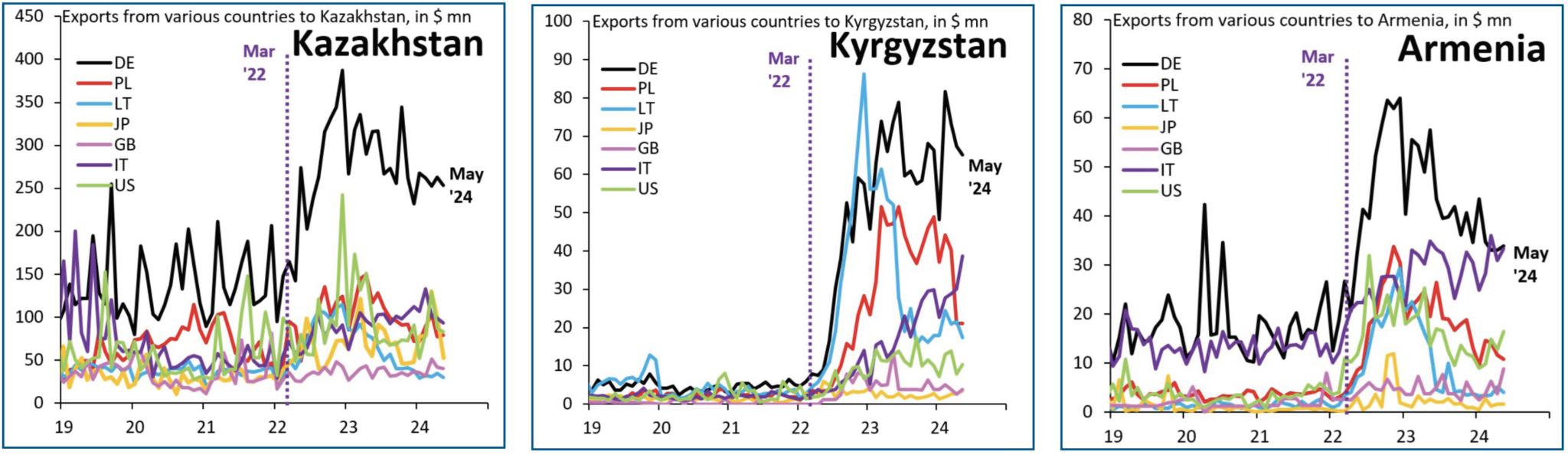
Graphs showing exports to the three countries that have received the largest increase in imports as a result of sanctions against Russia. Source: IMF Direction of Trade Statistics, Brooks.
Four insights are apparent from an examination of these datasets.
First, the rise in exports to Central Asia and the Caucasus occurred simultaneously with the imposition of international sanctions on Russia after 2022. The data itself is not proof of sanctions evasion, but no other macroeconomic driver could have produced this instant result.
Second, Germany and Italy are the largest sources of potential triangular trade via transshipments from the European Union into Central Asia. This increases the political imperative for Berlin and Rome to crack down on domestic violators, in particular, the financial institutions that facilitate the trades.
Third, there have been spikes in imports from Japan, the United Kingdom, Poland, Lithuania, and the United States, but these appear to be abating. Nevertheless, this vulnerability comes with a high cost. The remains of Russian missiles fired at Ukraine show that practically every projectile contains key U.S.-made components, and Moscow’s production of missiles has increased substantially.123
Fourth, transshipping patterns are not static, but rather they vary over time.
Not all exporters may be aware that they are facilitating sanctions evasion. Moreover, the origins of transshipments to Russia are not limited to the United States, Britain, Japan, and the European Union, as shown by these charts. As Treasury has noted, “Russia continues to exploit otherwise legitimate economic relationships with China, Turkey, and the UAE, which have become hubs for exporting, reexporting, and transshipping to Russia foreign-made technology and equipment.” 124
Turkey Transit
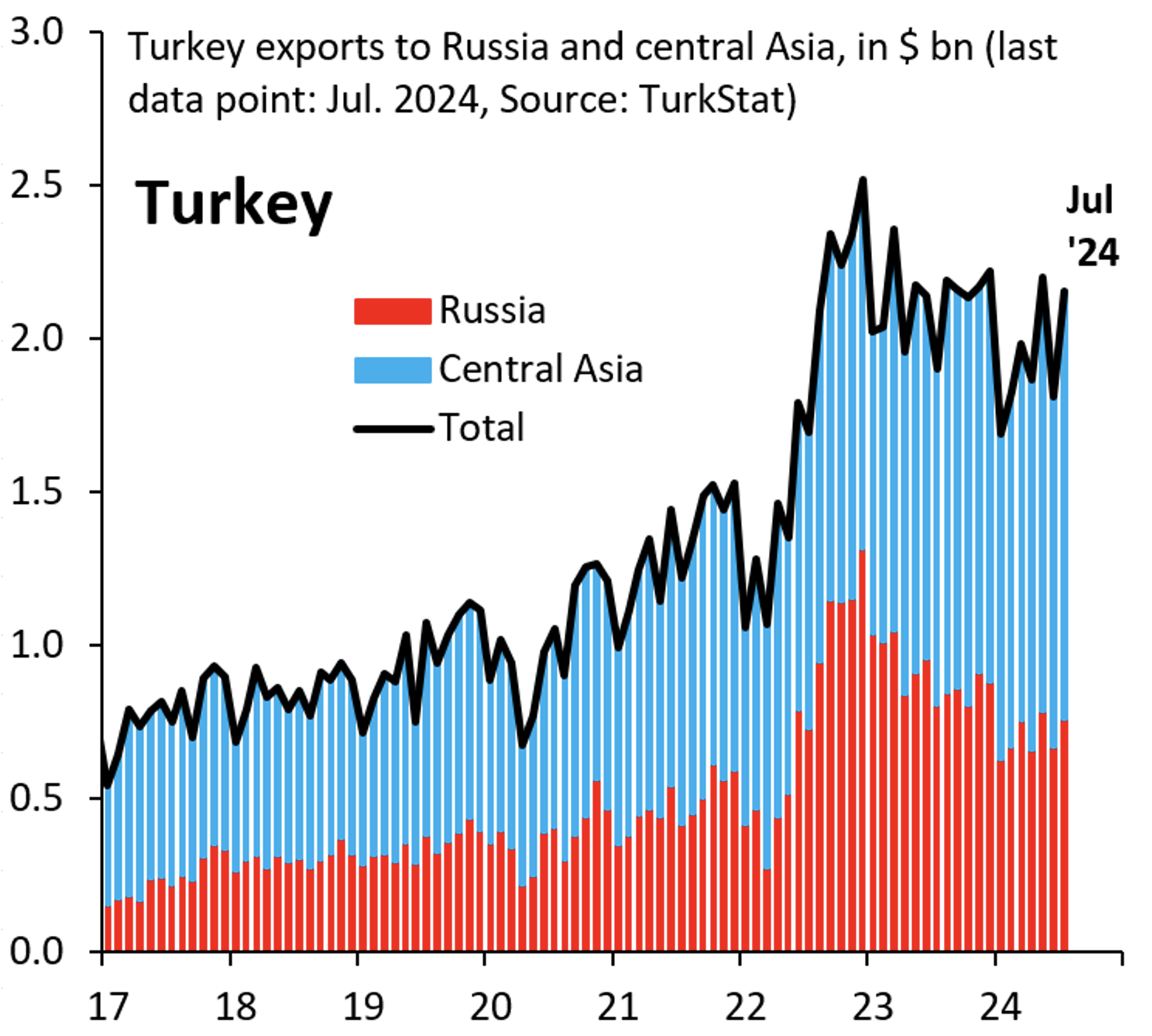
Graph showing a rise in Turkish exports to Russia and Central Asia after the start of the Russia-Ukraine war. Source: TurkStat, Brooks.
As a member of NATO, Turkey’s inclusion on this list is the most troubling. Even if the government in Ankara is not directly involved in these trades, Turkey is reportedly a major transit route for them. Its failure to clamp down on sanctions evaders provides a significant source of restricted material for Russia’s wartime economy.
In late 2023, for example, Treasury exposed and designated a significant transshipping network that had been supplying the Russian defense industry with sanctioned goods through Central Asia. When announcing the move, Yellen noted how “Russia is dependent on willing third-country individuals and entities to resupply its military and perpetuate its heinous war against Ukraine and we will not hesitate in holding them accountable,” she said, adding, “Our global sanctions coalition has choked off Russia’s access to key inputs for its military industrial complex and has undermined the Kremlin’s ability to wage its unprovoked war.”125
If Treasury had indeed choked off Russia’s access in 2023, its success was temporary.
Eight months after Yellen’s declaration, Treasury needed to ramp up its efforts again. This time, Washington designated an additional “400 individuals and entities both in Russia and outside its borders—including in Asia, Europe, and the Middle East—whose products and services enable Russia to sustain its war effort and evade sanctions.”126
The process was a familiar one. Treasury’s game of sanctions “whack-a-mole” closely resembles the pattern of counter-Iranian transshipping in the past. This raises the question: how much have Russian leaders, agents, and proxies gleaned from Iranian efforts to evade U.S. and Western sanctions?
Knowledge Diffusion Between Russia and Iran
The Russian government has been in the sanctions-evasion game since 2014. During this time, Moscow has observed, mirrored, and facilitated Iranian techniques to resist Western economic penalties for malign behavior. It has simultaneously worked to intensify its strategic relationship with the clerics in Tehran.127
What has been driving this team-up on sanctions evasion?
Much like the 20th-century Berlin-Rome Axis, the 21st-century Moscow-Tehran Axis is based on shared weakness and “common ground.” Both are vulnerable to Western sanctions and seek to undermine them, both perceive a shared opponent in the United States, and both aim to establish a multipolar world order as a result.
It should not be surprising that Kremlin leaders have long identified Tehran as a model for resisting sanctions. As Hanna Notte of the Center for Strategic and International Studies highlighted, “We know that various Russian officials, including at the highest level, have repeatedly stated that they see Iran as this model of perseverance, having persisted under sanctions for a long time.” She added, “There might be a lot of knowledge diffusion going on between [Iran and Russia] in that area [sanctions evasion] that’s obviously harder to study from the open source.”128 This is a fundamental challenge in addressing the subject of knowledge diffusion.
Nevertheless, there remains enough evidence in the unclassified space to demonstrate a consistent track record of collaboration, cross-pollination, and knowledge diffusion between the two regimes as they observe, copy, and innovate methods for circumventing U.S. and international sanctions.
Even before his expanded invasion of Ukraine, Putin suggested that Russia could learn from other states that had developed economies and that had resisted the United States — and allegedly thrived — under sanctions.
Speaking before a global audience of attendees at the St. Petersburg International Economic Forum, Putin highlighted: “This is not just about the so-called sanctions or restrictions. There are people here who feel and understand what this means, and have first-hand experience in this matter,” he said. “This applies to a vast majority of those present here, since the sanctions truncheon, as has been mentioned here already, is increasingly used against many, not only Russia.”129
One of those many countries was Iran.
In March 2022, Russian Foreign Minister Sergey Lavrov contended that “Moscow would work with Iran to take practical steps in an effort to circumvent Western sanctions.”130 A series of high-level visits, declarations, negotiations, and agreements followed. They strengthened the alignment between Russia and Iran against the Western “sanctions truncheon.”
Later that summer, as his soldiers retreated from significant parts of Ukraine, and the prospect of a long war loomed, Putin flew to Tehran for a meeting with Khamenei. Included on the agenda was mutual assistance in sanctions evasion.131
Throughout the next year, the process of formalizing common ground against sanctions between the Kremlin and the clerical regime in Tehran continued.
A notable outcome of the tightening relations between Russia and Iran was an agreement between the two countries in December 2023 to counteract U.S. sanctions. “We have just signed a declaration on ways and means to counter, mitigate and offset the negative consequences of unilateral coercive measures,” Lavrov said in Tehran when meeting with Iranian Foreign Minister Hossein Amir-Abdollahian. “Undoubtedly, this is an important step in increasing coordinated efforts by members of the global community to overcome illegal sanctions, which the U.S. and its allies use as a substitute for diplomacy,” he said.132
Significantly, it was during this time that Iran signed a contract with Russia to provide arms and training for its military. The deal was sizable, providing Russia with lethal weapons and, eventually, enabling its defense firms to reverse engineer and manufacture them.133 After the first tranche of these weapons was delivered in September 2024, Treasury responded by applying new sanctions against Iranian and Russian individuals and entities.
The Biden administration was back to whacking familiar moles. The United States designated the participants and facilitators of the Iran-Russia arms shipments and issued — once more — a strong public statement. “Iran has opted to intensify its involvement in Russia’s illegal war, and the United States, along with our partners, will continue to stand with Ukraine,” said Deputy Secretary of the Treasury Wally Adeyemo.
This dynamic continued into 2025. At the start of the year, for example, Russia and Iran signed a 20-year comprehensive strategic partnership treaty in Moscow, aiming to deepen cooperation across trade, military, science, and culture amid Western sanctions. The document largely consolidated prior agreements between the two countries without introducing significant new commitments on either side. Notably, the treaty omitted mutual defense obligations, reflecting both Russia and Iran’s cautious approach to their “alliance.” If anything, this development underscored the pragmatic nature of the alignment between Moscow and Tehran. It is driven by shared opposition to Western influence and vulnerability to sanctions rather than a covenant between allies (like NATO).134
Implications for the Russia-China Axis
Along with China and North Korea, Russia and Iran have coalesced into an Axis of Aggressors.135 Already, China is borrowing lessons in the art of sanctions resistance.136 The shared objective of this new axis is clear: to dilute the power of the U.S.-led financial order and erect a system more favorable to authoritarian resilience.
Toppling the Dollar?
As Russia prepared for its full-scale invasion of Ukraine, it joined Iran and China in declaring their intention to challenge the dollar-dominated global financial system and build a multipolar alternative to the liberal economic order that had governed trade and finance since 1945.
After 2022, that aspiration became operational. Chinese exporters and financial institutions helped Russia evade Western sanctions, quietly servicing Moscow’s war economy. China also remained one of the largest consumers of Russian and Iranian energy. It provided both cash flow and cover to Russia’s illicit trades.
Less visible, but no less significant, were Chinese banks. They continued to facilitate sanctioned trade shipments to Russia’s defense industry. It was a soft flank in the Kremlin’s economic defense; and Washington had the power to strike it.
The opportunity appeared in June 2024.137 The Treasury and State departments launched a sweeping new sanctions campaign, targeting over 300 individuals and entities linked to the Kremlin’s military supply chains. On the list: manufacturers in China and Turkey, the Moscow Exchange, and a range of intermediaries. But the real blow came in the form of a warning.
“Foreign financial institutions that conduct or facilitate significant transactions or provide any service involving Russia’s military-industrial base run the risk of being sanctioned by OFAC,” Treasury declared. Secretary Yellen followed with a final thrust: “We are increasing the risk for financial institutions dealing with Russia’s war.”138 In other words, wide-ranging secondary sanctions were on the table.
Markets felt the blow instantly. On June 12, 2024, the Moscow Exchange halted all trades in dollars and euros. The ruble plunged in over-the-counter markets, and the Russian Central Bank scrambled to convert “toxic” Western currencies into rubles.139
For years, Putin had preached de-dollarization. Now, Treasury had forced it to occur in Russia. Whatever dollars and euros that Russian firms and oligarchs still had on their balance sheets in Russia, they rapidly moved to sell them.
Consequently, Russian banks and exporters dumped dollars and euros, rushing to replace them with Chinese yuan. Yuan-denominated trades surged on the Moscow Exchange. But the pivot created new problems: accounts frozen in China, particularly among Russian importers. Payments were delayed. Transactions were unfulfilled. Even non-sanctioned Russian firms began resorting to barter. The yuan was not proving to be a reliable substitute for the dollar. It was a bottleneck.140
China’s banks had received the message. Russian clients had become radioactive.
Viewed from Beijing’s perspective, the danger of sanctions was not limited to small Chinese “burner banks.” These were financial entities whose primary purpose was to circumvent Western sanctions on Russia by processing cross-border financial transactions. Rather, it was the possibility that Treasury could impose secondary sanctions on anyone who did business with these entities. That would affect the larger Chinese banks that required access to U.S. markets. As Hera Smith at Moody’s Analytics noted, “If they are inadvertently processing transactions for [these smaller banks], unbeknownst to them, it violates U.S. sanctions, that would be problematic for them,” she said.141
Such was the power of the threat of secondary sanctions. For some foreign actors and institutions, as seen in China during the summer of 2024, fear of this tool was enough to incentivize voluntary changes to the business practices of entities that could not afford to be blocked from the United States. Beijing’s deepening alignment with Russia had not reached the point where it was prepared to shoulder the costs of its leading financial institutions violating sanctions.
Then came the second blow. In August 2024, the Commerce Department targeted firms that were violating U.S. export control requirements. In total, it imposed special restrictions on 39 Chinese companies that were funneling goods and materials to the Russian military, including semiconductors and sensitive electronics used for military hardware. The designation alone served as a new warning to European and other international firms: doing business with a designated company carried legal, financial, and reputational risks. As might be expected, the Chinese government denounced this move as an attack on the “security and stability of the global industrial and supply chains.” China could have said — and done — much worse in response to the action. But it did not retaliate. Its lack of escalatory action was a statement: the Chinese government feared secondary sanctions. Nevertheless, trades eventually went through. The Red Queen dynamic continued.
Lessons Learned
Four lessons emerged from the U.S. government’s summer 2024 campaign against the Russia-China wartime economic axis:
- Exposure and Sanctions Work (Up to a Point)
While Washington continued allowing limited Russian energy sales, it succeeded in targeting and revealing many key arteries of Moscow’s illicit military economy. Nevertheless, sellers of sanctioned goods like microelectronics continued to work their way into Russia’s military economy. - Secondary Sanctions Bite
One week before Treasury’s Moscow Exchange designations, Raiffeisen Bank Russia (the largest European bank still operating inside the country) halted outgoing dollar payments. Even the prospect of secondary sanctions changes behavior. - Workarounds Are Inevitable
When yuan payments froze for three weeks, Russian firms adapted. They shifted to smaller Chinese intermediaries. Investigating and interdicting these workarounds will require deeper coordination with transshipping states, especially across Russia’s borderlands. - Russia’s Adaptive Sanctions Evading Network is Global in Scale
The Kremlin’s supply lines stretch from Bulgaria to the British Virgin Islands, from Turkey, Serbia, and the UAE to Vietnam.142 While whacking these moles as the United States has done before is one option, perhaps there are steps that policymakers can take to change how they run their race of the Red Queen?
Changing the Race: Policy Recommendations
How does the United States gain ground in the Red Queen race against rogue and revisionist powers? America’s adversaries have learned to blunt the impact of sanctions and other economic weapons out of necessity. Even so, options in the U.S. arsenal are sufficient to break the race and gain ground if applied with resolve and purpose.
Upon reentering office, for example, the Trump administration reinstated its previous policy of applying maximum pressure on Iran. In the case of Russia, it has yet to fully employ the array of options available to deny Moscow the financial means of sustaining its war against Ukraine.143 Drawing on lessons from both the Russian and Iranian case studies, the United States can take five steps to drive substantial progress toward denying Russia the means to wage war. At their maximum reach, they can shift the balance of economic power back in America’s favor.
Notably, Russia’s ability to withstand and adapt to Western sanctions is a classic case of adversaries continuously evolving to counteract economic pressure. Unlike Iran, whose economy has been isolated for decades, Russia faced its initial round of sanctions with significant advantages. It possessed a larger economy by a factor of five, deeper integration into global markets, and a decade of observing and learning from the clerical regime’s evasion tactics. When Western sanctions intensified after 2022, Moscow quickly deployed ghost fleets, triangular trade networks, and financial workarounds, leveraging enablers in China, Turkey, Central Asia, and the United Arab Emirates. The result? The Kremlin deployed a sanctions-evading machine that operated at an industrial scale. This section underscores a critical lesson: sanctions alone, especially when reactive, parceled out over time, and fragmented, are not enough to cripple a determined adversary. But the following five steps can still change the Red Queen dynamic.
Step 1: Target Russia’s National Wealth Fund
Relative to the size of the Russian economy, the annual costs of the Kremlin’s war against Ukraine are onerous.
Since 2022, Moscow has repeatedly increased its defense spending to sustain the expanded invasion of Ukraine. As of the end of 2024, these outlays total $109-$120 billion annually. That represents 6 to 8 percent of the country’s total GDP. This is a level of unsustainable defense spending that has not occurred since the final years of the USSR.144 More importantly, the current figure likely represents an undercount because it only reflects direct military spending.
The wider costs of the war appear in parts of the Russian federal budget that are not counted as direct military spending, including health care for wounded soldiers, debris removal, infrastructure repair, wages for workers in occupied regions of Ukraine, and classified expenditures (meaning undisclosed defense outlays). According to one assessment by Boris Grozovski at the Wilson Center, Russian defense spending is actually closer to $160 billion annually. That is a whopping 9 percent of its GDP.
Moscow depends on its energy export machinery to carry this load, at least in part. Each day, Russia exports around 3.5 million barrels of oil.145 Most of these shipments reach customers via tankers at sea. On land, the Kremlin’s transportation network is also expansive. The Russian government owns or operates through its subsidiaries 43,000 miles of oil and gas pipelines. It is almost enough to wrap around the Earth’s equator twice. This sprawling web of wells, refineries, transport links, and payment transfers nets the Russian government around $10 billion each month in oil tax revenue (as of 2025).146 It is an impressive system. Without the income that it provides, however, Russia’s wartime economy would rapidly fall into dysfunction. As the uncontested master of a petrol state, Putin already knows this weakness.
Now, the bad news for Putin.
Energy exports cannot indefinitely sustain his war against Ukraine, whose cost exceeds tax revenue from these exports. Taxes on people and companies in Russia are also insufficient. The Kremlin’s national budget is in the red each year on account of Putin’s “special military operation in Ukraine.” Worse still for the Russian government, it cannot borrow money from international markets like other countries due to sanctions. Thus, feeding Russia’s war machine has forced the Kremlin to raid Russia’s National Wealth Fund (NWF). In plain terms, this means that “Putin is financing his war today with money planned for the future,” according to one Russian observer.147
Since 2022, the Russian government has siphoned $58 billion from the NWF. As of April 2025, the Russian NWF only had $38.5 billion remaining on its balance sheet of liquid assets. This figure is not sufficient to cover the Kremlin’s budget shortfalls for much longer.148
If the market price for oil were ever to fall below $50 per barrel, or the G7’s arbitrary oil price cap were to be set at $20-$40 per barrel (close to the cost of production), the Kremlin would incur an unsustainably high burn rate on the NWF’s liquidity. Under some scenarios, Russia could potentially deplete the fund’s remaining liquidity in late 2025 if it could not find buyers due to secondary sanctions or secondary tariffs.149
The bottom line: “Russia no longer has insurance against low oil prices,” said CentroCredit Bank economist Evgeny Suvorov.150 Western policymakers should force Putin to deal with the consequences of this fact.
Without the ability to extract liquidity from the NWF, the Russian Ministry of Finance will have three pathways for balancing its budget and sustaining the war: taxation, borrowing from friendly states, and printing money.151 All of them would be grim choices for the Putin regime.
The best of these bad options would be to overtax the population while extracting their savings through voluntary or expressly involuntary war bond drives.152 Both options could affect the regime’s political stability.
Likewise, the Kremlin could cut the central government’s social payments and subsidies — tools that it uses to keep its population docile. Such cuts would have an even greater negative impact on regime stability.
Alternatively, Moscow could attempt to solicit annual bailouts from Beijing or New Delhi through direct liquidity transfers, oil-backed bonds, or the issuance of junk bonds. China and India may balk at the high risk of a default. Worse still, a bailout could trigger Western sanctions against these governments for lending Moscow money.
Finally, the Kremlin could accept the option of last resort: printing increasingly worthless money. As examined previously, this was the Confederacy’s final response to the Union’s Anaconda embargo during the U.S. Civil War.153 Money printing devastated Richmond’s wartime economy, and the laws of economics have not changed since. Hyperinflation would likely endanger both the war effort and the regime’s stability.
The question remains: how can the West force Russia to drain the NWF and choose one of these three financially destabilizing responses?
The answer: drastically cut the G7’s price cap on foreign purchases of Russian crude.
Step 2: Cut the G7’s Price Cap to the Bone
The policy known as the G7 oil price cap has been a colossal exception to the Russia sanctions regime. Slashing or ending the price cap would greatly impede Russia’s ability to fund its war efforts.154
Understanding the origins, limitations, and trade-offs of this colossal exception is critical to establishing a new international consensus for changing it.
In its current form, the cap is a holdover from the unique market dislocations that resulted from Russia’s expanded invasion of Ukraine and the sudden rollout of the Biden administration’s early “swift and severe” sanctions.
In May 2022, oil markets watched as the last Ukrainian soldiers surrendered after their final stand at the Siege of Mariupol. Russia was temporarily on the advance in parts of Ukraine. The price for a barrel of Brent crude surged to over $110 per barrel — an inflation-adjusted, near-record high.155
Europe Brent Spot Price (FOB)
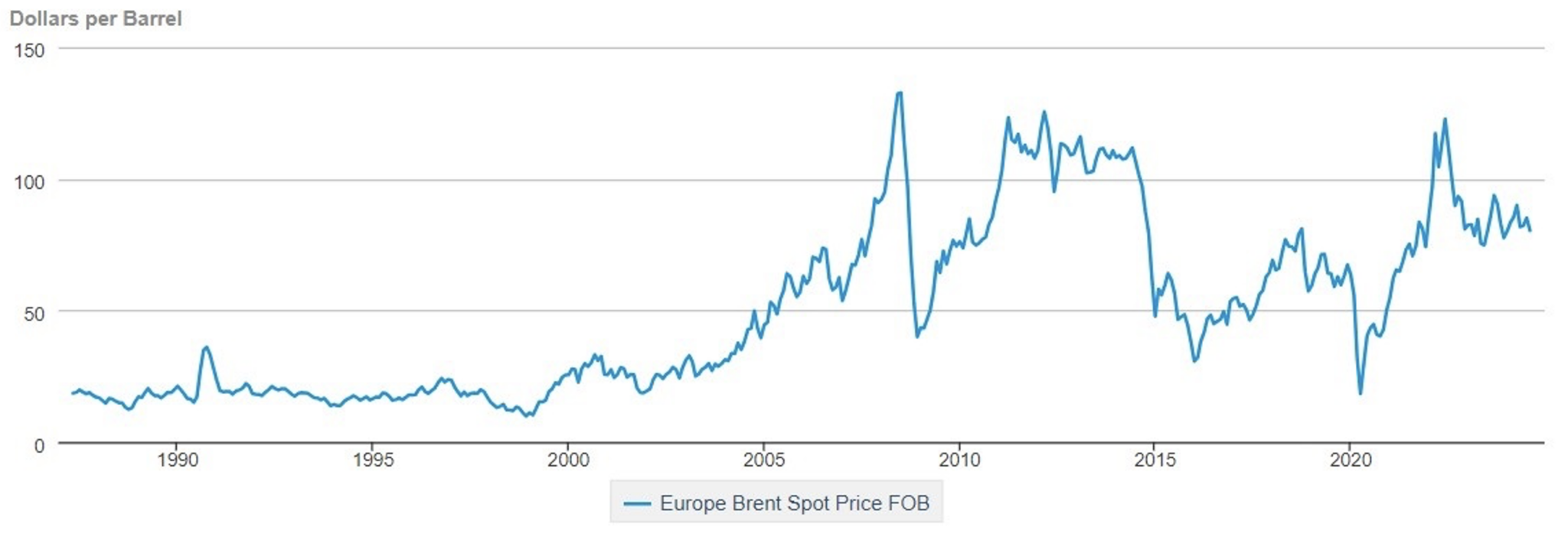
Graph showing record-high crude oil prices. Source: U.S. Energy Information Administration, Europe Brent Spot Price.
This spike raised the oil-indexed price of natural gas in Europe and, subsequently, the costs for manufactured goods, foodstuffs, and transportation.
In the United States, gasoline prices broke summer driving season records due to tight global supplies, which helped propel inflation to decades-high levels.156 Worse still for the Biden administration and elected officials in Europe, the supply of oil looked to become even tighter once the European Union’s near total ban on Russian oil was set to take effect at the end of 2022.
Oil-fueled inflation was deeply unpopular with voters. A full EU ban on Russian oil imports risked pushing energy inflation to all-time highs when the embargo took hold. Capturing the mood of elected leaders, the Swedish prime minister at the time, Magdalena Andersson, curtly lamented, “We are in a difficult situation.”157
The quick-fix solution in Brussels was to arbitrarily cap the price at which law-abiding European buyers would be exempted from the European Union’s looming Russian oil embargo. That cap would become a titanic exemption to Russian sanctions.
Cheered on by the Italian government then in power, the European Commission began to consider the price cap as an alternative to the near-total sanctions that EU countries had previously pledged to adopt at the end of the year.
On paper, EU leaders perceived an elegant, top-down solution to a complex problem of international supply and demand. Representing their national governments, European ministers and their diplomats would negotiate the price signal for Russian oil rather than allowing the free market to operate.
What could go wrong?
So long as European buyers of Russian crude and petroleum products purchased Kremlin oil below a set price — which had yet to be determined — they would be exempted from the European Union’s looming embargo. This would allow more Russian oil into their markets while theoretically restricting the Kremlin’s oil tax revenue. If the concept worked, the cap would rebalance oil supply with demand, tamp down skyrocketing fuel prices, and put downward pressure on inflation.
The idea was tantalizing enough to draw the United States and the United Kingdom into collaborative negotiations that would align their national embargo policies with the European Union’s proposed price cap.
As an adviser at the Federal Reserve Bank of Minneapolis would highlight, “The Price Cap is mistakenly seen by many as another sanction, but it’s not really. It’s actually a pulling back of sanctions that would have been much more disruptive.”158
At a September 2022 gathering of the G7’s finance ministers, member countries formalized the oil price cap. Citing their concern to protect “vulnerable groups” from the disproportionate harm of price increases, all G7 finance ministers agreed to adopt the scheme.159 The gap between rhetoric and reality regarding Russian sanctions was beginning to emerge.
That same month, Yellen declared America’s intent to “undermine [Russia’s] ability to wage its illegal war.”160 These actions worked at cross purposes. The Biden administration was officially undermining the Kremlin’s ability to wage war on one hand while simultaneously granting Moscow the ability to legally fund its war through a carve-out to oil sales on the other. All that remained was to determine: what was the best price for a barrel of Russian oil under the cap?
The G7 now faced a Goldilocks dilemma. If it set the cap too high, the policy would fail: the Kremlin would generate too much revenue for its war machine. If the price were too low, the policy would also fail: Russia would have a financial incentive to break with OPEC+ quotas and lower crude production due to market forces and price incentives. European governments were determined to find a sweet spot.
Inside the European Union, countries like Poland and the Baltic States lobbied to cap the price at $30-$50 per barrel. This was still above the cost of producing a barrel of Russian crude across many of the Kremlin’s state-owned fields. “Every dollar counts,” said Estonian Prime Minister Kaja Kallas. “Every dollar that was negotiated down means an estimated $2 billion less income for Russia.”161
The calculation in Warsaw and Tallinn was the same. If the Kremlin could not profit from its oil sales, the Russian economy would plunge into dysfunction. It would be difficult to finance the expanded invasion of Ukraine — and keep its population docile — if the Kremlin resorted to hyperinflationary money printing.
Conversely, some EU members, along with the Biden administration, wanted to provide Russia with a lucrative incentive to pump and sell its oil — potentially at the high price of $70 per barrel. After weeks of negotiations, nearly all EU governments agreed that the ideal cap price for Russian oil was $65 per barrel. The last country to object was Poland.
Under pressure from the Biden administration to drop its objection, the Polish government eventually relented. Warsaw agreed to support the cap scheme; and G7 countries pledged to monitor and continuously update the policy if Russia generated too much revenue from the large sanctions carveout that they were granting to Moscow. There has not been a single update, however, with the price still at $65 for nearly three years.
The Biden administration was pleased with the apparent success of its economic and diplomatic maneuvering. In May 2023, Treasury’s Assistant Secretary for Terrorist Financing and Financial Crimes Elizabeth Rosenberg and Acting Assistant Secretary for Economic Policy Eric Van Nostrand praised the scheme. They stressed how it was “achieving both goals,” namely, keeping oil markets supplied while “[making] it harder for Russia to fund its brutal war in Ukraine.”162 They noted with confidence that the Kremlin’s oil tax revenue had fallen by more than 40 percent from the previous year; and global oil prices were more than $20 lower than their highs in 2022. The optimism was premature.
Once more, international action spawned a reaction by Russia. Employing techniques that Russian officials and proxies had previously observed Iran conduct, Russian state-owned oil firms began to redirect their energy exports to buyers in China and India. Notably, these were countries that did not agree to participate in the G7’s cap.
It was also during this initial phase of the price cap that Russia ramped up its use of ghost fleeting. Meanwhile, it developed what Treasury would later identify as “new ways to defraud” Western insurance companies and other legitimate actors in the oil trade.163 Under the cap scheme, Treasury was playing a frenetic game of whack-a-mole with sanctions evaders in an “alternative shipping ecosystem.” As one expert noted, “The oil market is full of clever, rapacious people with strong incentives to bend or break rules.”164
One result of this rascality: a falling discount on a barrel of Russian crude. The discount on Urals crude began to decline. After recovering from the shock of the price cap, the Kremlin’s oil sellers could steadily demand ever-higher prices from Western buyers — and fresh infusions of cash rolled into Moscow’s state coffers.
By the end of 2023, Russia had recovered from its mild recession the previous year. Russian GDP grew at an annual rate of 3.6 percent despite the truncheon of international sanctions.
Worse still, the price cap scheme was clearly not delivering on its promised results. Russia was selling too much oil above the cap. Treasury opted to tighten the screws on illicit buyers of Russian crude.165 The result was “Price Cap — Phase II,” which Treasury declared on the second anniversary of the expanded invasion in 2024.
Instead of representing a new approach or rethink of the policy, “Phase II” was essentially an enforcement crackdown. Tighter enforcement was certainly needed; however, Treasury missed the larger opportunity to reevaluate the fundamental weaknesses of the policy’s design. These flaws included: (1) the capped price being too generous for Russia; (2) the opportunities for countries like India and Turkey to reexport refined Russian crude to Europe and the United States being too great; and (3) investigations and enforcement actions against embargo runners being costly in terms of time, intelligence and budgetary resources, and manpower for Treasury.
Amid these obvious pitfalls, Treasury’s leadership remained — perhaps — too self-congratulatory about the success of their efforts at the two-year anniversary of Russia’s expanded invasion. “While global energy supply remained stable,” Van Nostrand and Anna Morris, acting assistant secretary for terrorist financing and financial crimes, stressed in February 2024, the “price cap, along with key sanctions enforcement measures, is reducing Putin’s profits from selling that oil.”166
While their rhetoric was positive, a closer inspection of the data indicates that Treasury’s assessment of the price cap missed the forest for the trees.
It was true that international buyers could still demand a measurable discount for Russia’s Urals blend of crude, indicating that the cap was technically working (i.e., the Kremlin earned less on its exported barrels of oil). However, that discount was based on limited data, and it constantly rose over time. For Asia-Pacific customers (buying ESPO and Sokol blends), the discount returned almost to pre-2022 levels by the end of 2024. The implication is that Russia was subverting the cap.
Discount of Russian Oil Prices to Brent Over Time
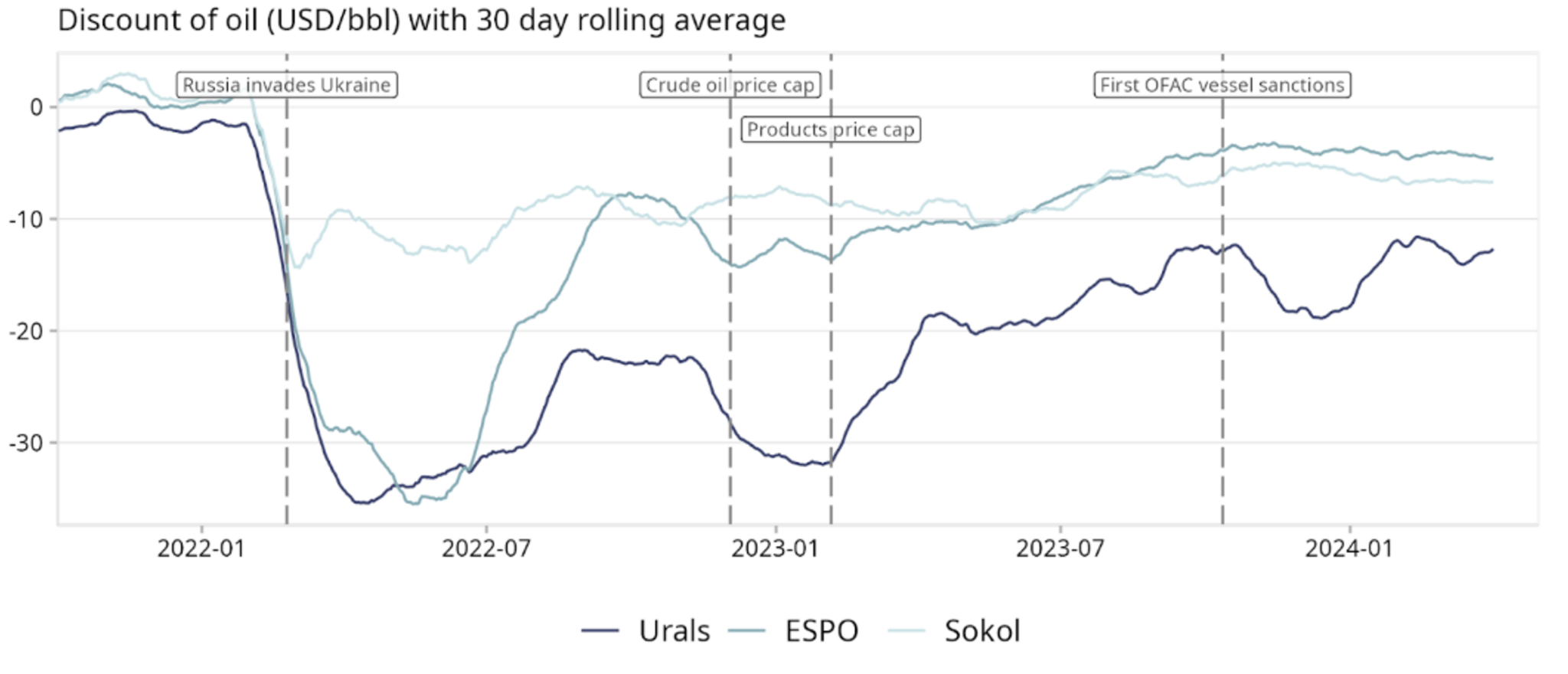
Graph showing fluctuations in the price of Russian oil. Source: OilPrice.com, Petras Katinas and Vaibhav Raghunandan via CREA.
Russia’s Fossil Fuel Export Revenue
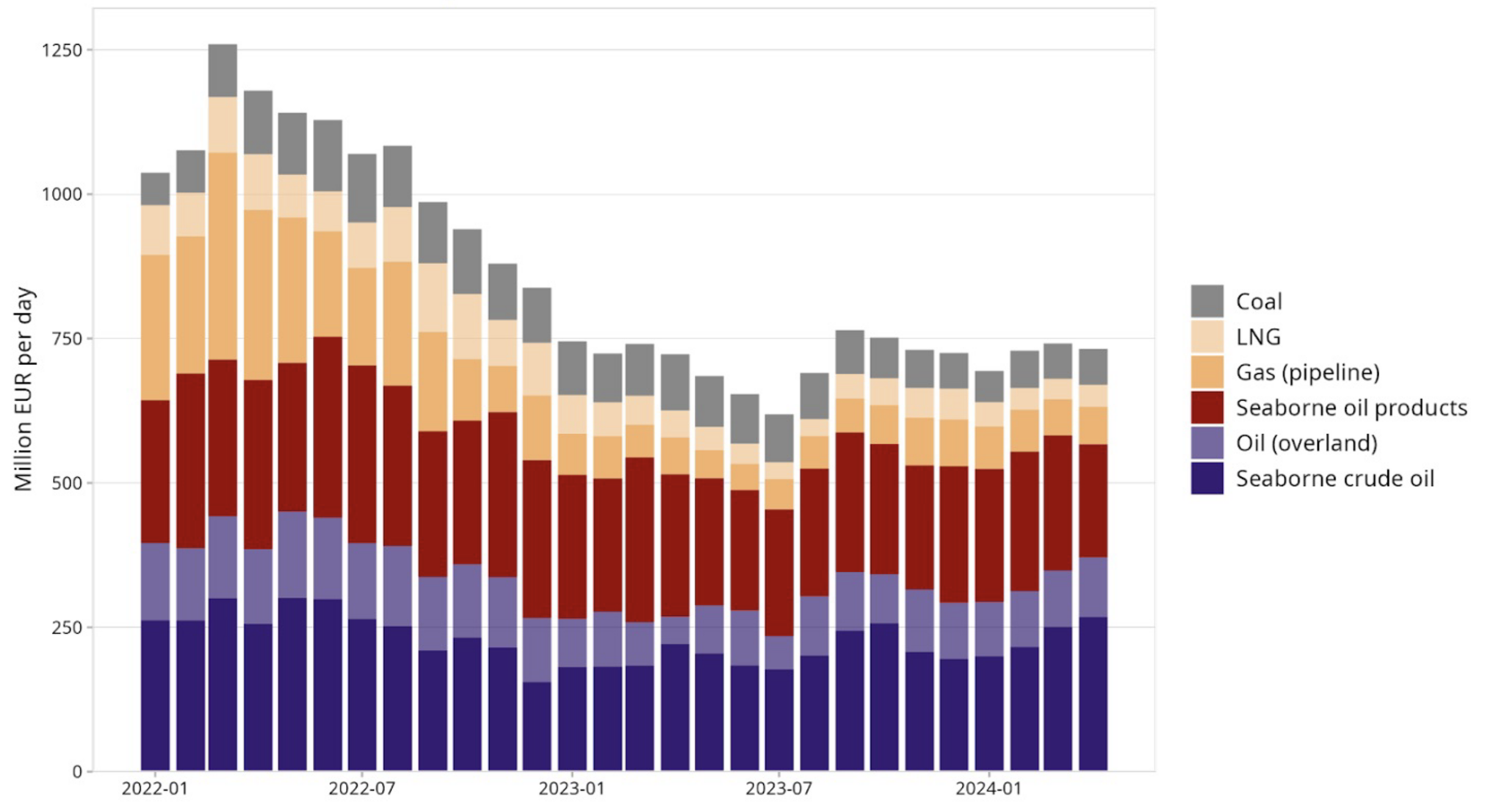
Graph showing Russia’s degraded fossil fuel export revenue. Source: Petras Katinas and Vaibhav Raghunandan via CREA.
When comparing the rhetoric of the Biden administration’s statements against the reality of Russian oil revenues since 2022, the Kremlin appears to have been generating too much income under the G7 cap. If members are committed to retaining the cap, how then might Western policymakers cut Russian revenue?
One assessment by CREA’s Petras Katinas and Vaibhav Raghunandan calculated that had the original cap been set at $30 per barrel, it “would have slashed Russian revenues by EUR 51 billion since the sanctions were imposed in December 2022 until the end of April 2024.” This price point is closer to the general cost of producing a barrel of oil across Russia’s multiple fields.
If the United States and its G7 partners seek to end Russian aggression against Ukraine, they should take the important step of lowering the cap to around the average cost of production of Russian crude, at a minimum, and even consider ending the exemption altogether, a maximalist option similar to the Trump administration’s post-JCPOA maximum pressure campaign against Iran.
Step 3: Leverage Economic Power More Effectively via Secondary Sanctions
The full potential of secondary sanctions remains untapped.
At $25.5 trillion, America’s annual GDP is equivalent to the economies of China, Japan, and Germany combined. Add to this the gigantic size of the U.S. bond, equity, real estate, and consumer markets. Secondary sanctions force firms to choose between access to the U.S. economy and doing business with sanctioned entities. It tends to be an easy choice.167 Eventually, most sizable companies in the world must do business with the United States. If they don’t, then their bankers, insurers, and third-party middlemen do.168
When applied as part of the Trump administration’s maximum pressure campaign against Tehran’s clerical regime, secondary sanctions “pushed Iran into a deep, multi-year recession, slashed the value of its currency, ratcheted up inflation, [drove] out foreign investors, and deprived the regime of tens of billions of dollars in revenue, especially from oil exports.” However, some observers disagree.169
A common argument against the use of secondary sanctions is that it will accelerate the decline of the U.S. dollar and de-dollarize the world economy. Frustrated by excessive American use of sanctions, other countries will supposedly opt to use alternatives to the dollar as a form of payment for global trade and commerce.170
At the 2024 BRICS Summit, Lavrov was more assertive, declaring: “The process of de-dollarization is underway, it cannot be stopped.”171 Iranian Parliamentary Speaker Mohammad Baqer Qalibaf likewise amplified this narrative at the summit with a positive spin: “De-dollarization and use of alternative currencies will help reduce U.S. pressure on emerging economies.”172 Indeed, Treasury is aware of this risk.173
Unfortunately for Moscow and Tehran, such fear-casting about de-dollarization does not match the data. The greenback remains the undisputed heavyweight champion of global commerce for good reason.
The need for dollars is long-established, stable, and substantial. Over the last 20 years, for example, “the dollar accounted for 96 percent of trade invoicing in the Americas, 74 percent in the Asia-Pacific region, and 79 percent in the rest of the world.”174 The euro comes close as an alternative. However, demand for the euro plummets outside of the European Union. As one analysis framed it, “No substantial evidence demonstrates that the dollar’s supreme status is under threat.”175
Step 4: Stronger Export Control Enforcement
Triangular trade through third-party countries has enabled the Kremlin to evade sanctions faster than the West can impose them, at least on certain critical goods. Here, the United States, and its allies in particular, must make a major commitment to fully enforcing their own policies against homegrown actors who flout sanctions. This is a major step that would close the gap between Western rhetoric on sanctions and their real-world impact.176
How should Washington and its allies clamp down on triangular trade? Over the last three years, both Treasury and Commerce have issued repeated warnings to U.S. firms about the importance of following Know Your Customer guidelines when exporting sensitive dual-use equipment. “Companies, financial institutions, and governments around the world need to ensure they are not supporting Russia’s military-industrial supply chains,” stressed Adeyemo.177 It is a mantra that cannot be stressed enough.
One solution to the problem is to take a page from the fight against cross-border money laundering. Presently, the federal government may designate some areas around the globe as “Jurisdictions of Primary Concern.” This occurs when Treasury’s Financial Crimes Enforcement Network (FinCEN), in coordination with the Financial Action Task Force (FATF), an intergovernmental body, determines that a specific country is prone to major money laundering operations. While this is often due to “financial institutions engaging in significant currency transactions involving proceeds from international narcotics trafficking,” such a designation can also include terrorist and proliferation financing.178
U.S.-based financial institutions are not prohibited from doing business or maintaining “appropriate relationships with customers or other financial institutions” in jurisdictions of concern. They must, however, employ additional levels of internal and external oversight on transactions.
On the finance side, the “Jurisdictions of Primary Concern” designation could be a useful mechanism in the fight against money laundering. Why not expand the concept to include a new type of designation: “Jurisdictions of Transshipment Concern”?
As in the case of money laundering, such a designation would not prohibit companies from conducting legitimate trade with customers in a country of concern. They would, however, need to apply additional internal monitoring and verification protocols to ensure that the purchaser of the dual-use technology and equipment is the final customer. This could put an end to Russia’s sanctions-busting triangular trade.179 Ideally, Washington should coordinate this step with EU and Asia-Pacific allies — creating an even more united front against Western sanctions evaders.
Step 5: Reinforce the Sanctions Infrastructure With Manpower, Intelligence, and Capacity
Every recommendation above depends on enforcement. Today, our sanctions infrastructure is insufficient to sustain the fight. Treasury’s OFAC and Office of Global Targeting, and Commerce’s BIS, remain under-resourced and overstretched. The current administration has emphasized slashing the federal workforce, but these offices are already too lean.180 Treasury personnel interviewed for this research note that when given adequate personnel resources, they provide an exceptionally high return in putting America’s policy priorities first.
Economic warfare is not a low-cost substitute for military force. It is a distinct theater of U.S. power. It demands sustained investment, rapid targeting capabilities, and interagency speed.
Congress should increase funding and personnel for OFAC and its enforcement counterparts. Intelligence, designations, and coordinated execution must be scaled with the challenge.
This investment isn’t just about Russia or Iran. It is a hedge against future adversaries who are watching, learning, and preparing to test the limits of American economic resolve. In this fight, capacity is credibility.
Conclusion
Together, these five steps lay the foundation for a campaign to deny, degrade, and disrupt the economic enablers of Russian aggression against Ukraine.
America’s adversaries are learning from and adapting to prolonged exposure to U.S. and international sanctions. This creates the core dilemma of the Red Queen’s race. It is a never-ending contest whereby standing still is equivalent to falling behind, and running faster merely keeps pace. Coupled with long-term underfunding of investigative and enforcement capacities within the U.S. government, Washington has inadvertently crafted a sanctions regime that punishes rogue states like Russia without denying them the ability to wage war in the first place.
What’s needed as a result is to close enforcement gaps, eliminate dubious exemptions from the Russia sanctions regime (such as the G7 oil price cap), expand secondary sanctions on adversarial enablers, and more sufficiently resource the agencies tasked with chasing down evasion networks. Just as important, Washington must treat economic warfare not as a reactive checklist but rather as a concerted campaign that is sufficiently calibrated to exploit the weaknesses specific to a given opponent. Doing so is a necessary requirement for prevailing in Red Queen competition.
