October 7, 2025 | Senate Foreign Relations Subcommittee on East Asia, The Pacific, and International Cybersecurity Policy
Combatting PRC Illegal, Coercive, Aggressive, and Deceptive Behavior in the Indo-Pacific
October 7, 2025 | Senate Foreign Relations Subcommittee on East Asia, The Pacific, and International Cybersecurity Policy
Combatting PRC Illegal, Coercive, Aggressive, and Deceptive Behavior in the Indo-Pacific
Hearing Video
October 7, 2025
Download

Full Written Testimony
Introduction
Taiwan sits at the epicenter of today’s great-power competition. Beijing is waging a slow-motion campaign to coerce and condition the island into submission, betting that time and sustained pressure will achieve what force alone cannot safely guarantee. This is not a hypothetical contest; it is unfolding daily across the Strait, in the air, at sea, in cyberspace, in global markets, and through energy supply chains. The danger is not only a future invasion, but the steady erosion of Taiwan’s confidence and resilience. Unless the United States and its allies adapt their toolkit to this reality, deterrence will continue to erode — potentially risking overconfidence in Beijing’s strategy and heightening the danger of miscalculation.
To understand why this threat is growing, it is important to recognize that China’s gray zone campaign is calibrated to be incremental, ambiguous, and reversible — carefully designed to avoid tripping U.S. redlines while steadily degrading Taiwan’s sense of security. Median line incursions, maritime harassment, cyber-enabled economic warfare, and diplomatic isolation all form part of a playbook that seeks to undermine confidence in Taiwan’s government, fracture Taiwanese faith in U.S. support, and convince the world that reunification with the mainland is inevitable. Put plainly, these are not random provocations; they are deliberate moves in a long-term strategy aimed at creating the perception that time and trends favor Beijing.
The challenge for the United States and its allies is that classic models of deterrence — by denial or punishment — map poorly onto this problem. Missiles and ships alone cannot blunt economic pressure, cyberattacks, or disinformation campaigns. What matters instead is resilience: Taiwan’s ability to withstand coercion, recover quickly, and demonstrate that it cannot be destabilized by prolonged pressure. That is the essence of the deterrence gap we face today. My testimony outlines that gap, explains how Beijing seeks to exploit it, and offers concrete steps Congress can take to close it — particularly in the domains of energy security, infrastructure resilience, sanctions signaling, and diplomatic coordination.
I. The Current State of Play — China’s Persistent Pressure Campaign is Already in Motion
Beijing’s pressure campaign against Taiwan is best understood as slow-motion coercion with the ever-present risk of a sudden break. On a near-daily basis, Chinese aircraft cross the Taiwan Strait median line, People’s Liberation Army Navy (PLAN) vessels encircle the island, and cyber probes test the resilience of Taiwan’s infrastructure. The cumulative effect of these actions is to redefine the status quo through persistent pressure and gradually exhaust Taipei’s defenses.
China’s leaders almost certainly prefer this steady erosion of Taiwan’s political will and resilience over an outright invasion, believing that time and persistence work to Beijing’s benefit. Yet as the tempo and intensity of these gray-zone operations increase, so too does the danger of unintended escalation — an accident between aircraft, a collision at sea, or an unplanned exchange of fire — that could spiral beyond Beijing’s intent. Thus, while China likely seeks a protracted siege of Taiwan’s confidence, the possibility of an acute flashpoint cannot be dismissed.
The political objectives guiding this coercion are explicit in Chinese doctrine. Chinese Communist Party (CCP) Chairman Xi Jinping has repeatedly declared that “the Taiwan question is at the very core of China’s core interests” and that “complete reunification of the motherland must be realized (必须实现祖国完全统).”1 Wang Huning, the CCP Politburo Standing Committee member charged with China’s “United Front” strategy and Taiwan affairs, has emphasized a campaign of “constrainment” — using political, psychological, and legal warfare to sap Taiwan’s sense of inevitability and resilience.2
Under Beijing’s comprehensive national security framework, Taiwan’s political cohesion and public confidence are not collateral targets in China’s strategy; they are the targets.3 China’s campaign is self-reinforcing: persistent gray-zone coercion undermines resilience, while the steady growth of the People’s Liberation Army (PLA) is meant to cast a long shadow over Taiwan’s future. In Beijing’s calculus, Taiwan must eventually conclude that resistance is futile, that capitulation, not confrontation, is the only rational choice.
Source: Ministry of National Defense of Taiwan; Janes Information Service
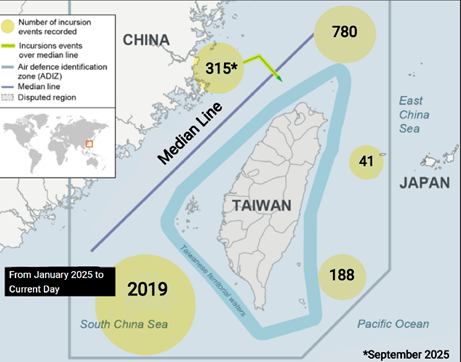
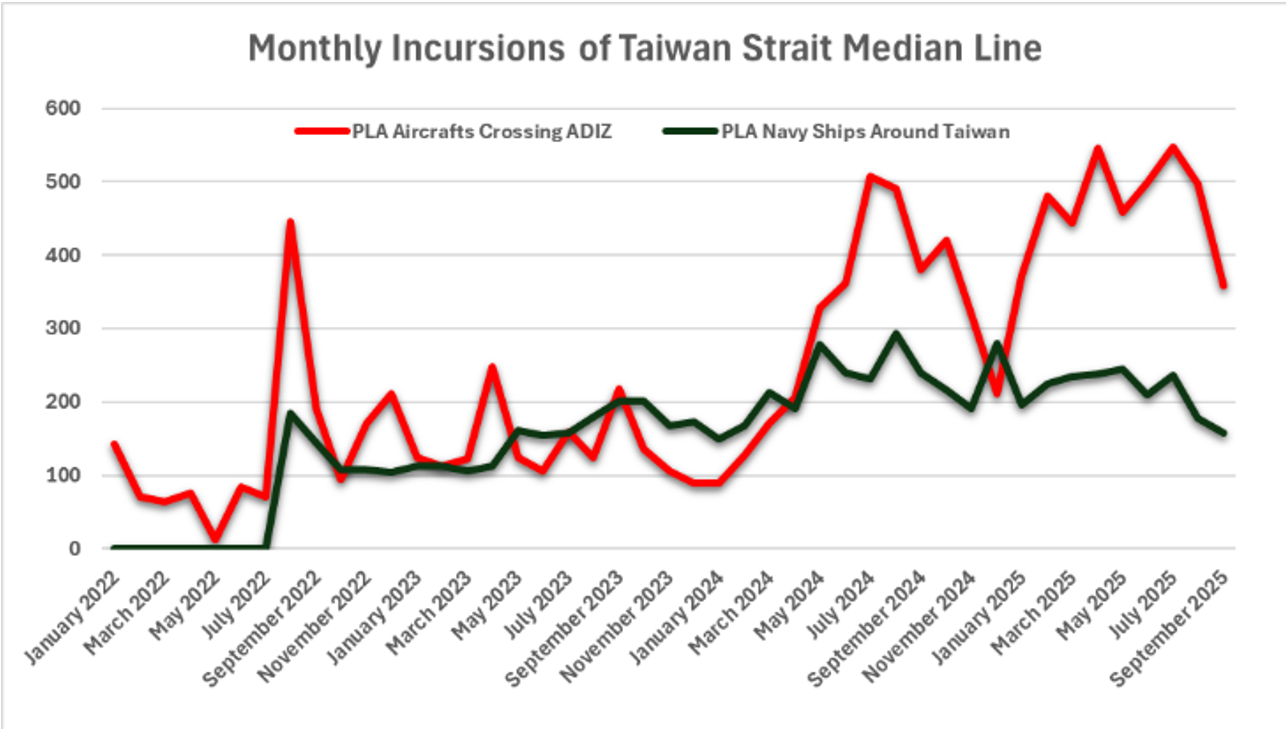
China’s gray-zone toolkit against Taiwan is broad, sophisticated, and increasingly synchronized across domains. In the air and at sea, the PLA has moved from episodic shows of force to near-daily operations designed to blur thresholds. In 2023, Chinese aircraft crossed the Taiwan Strait median line on more than 300 days, compared to just a handful before 2020. Over the past four months, the average number of air incursions per month has never fallen below 400, reaching a record high for the past three years, according to a review of daily bulletins from Taiwan’s Ministry of National Defense. These operations are paired with sustained People’s Armed Forces Maritime Militia (PAFMM) activity — ostensibly civilian but commanded by the PLA — to harass Taiwanese vessels and enforce ostensible administrative control over contested waters.4
Source: Ministry of National Defense of Taiwan; Janes Information Service
Economically, Beijing has weaponized trade bans on Taiwanese exports, ranging from pineapples to petrochemicals, while leaving open the prospect of more consequential measures against Taiwan’s high-tech sector.5 Cyber intrusions and disinformation campaigns round out the picture, exploiting both Taiwan’s open society and its reliance on digital infrastructure. Many of these tools are deniable and reversible, but together they are designed to sap Taiwan’s resilience without triggering a direct U.S. military response.
Yet the very intensity of these operations raises the risk of escalation that Beijing may not intend. Close intercepts of Taiwanese and U.S. aircraft, or aggressive maneuvers by Chinese vessels, heighten the prospect of an accident that could spiral into crisis. Chinese strategists acknowledge this danger but treat it as acceptable friction. In a 2021 article in Qiushi, the CCP’s theoretical journal, senior officials argued that “safeguarding sovereignty requires daring to struggle, and struggle will inevitably bring risks,” in effect arguing that risk is the price of pressure.6 The logic is straightforward: a higher operational tempo erodes Taiwan’s capacity to resist while also signaling to external actors that Beijing’s resolve cannot be doubted.
However, Beijing’s gray-zone coercion should not be mistaken for an end state. Instead, it is a bridge strategy: an interim campaign designed to erode Taiwan’s will and condition the region until the PLA achieves the capabilities necessary to credibly threaten a fait accompli invasion. Xi has directed the PLA to be ready by 2027 to “fight and win” in a Taiwan contingency, a benchmark echoed in U.S. Department of Defense assessments.7 Presently, gray-zone pressure is meant to achieve three reinforcing goals: sap Taiwan’s political confidence, normalize PLA presence in the Strait, and desensitize the international community to coercion that falls short of open conflict. The strategy relies on the assumption that Taiwan will eventually give up — not because Beijing lands troops on its shores today, but because the shadow of China’s growing military power looms ever larger over tomorrow.
The implications of China’s strategy are profound. What may appear as low-level harassment is, in fact, existential when viewed through the lens of Taiwan’s long-term security. Sustained gray-zone pressure undermines deterrence by convincing Beijing that coercion works and by sowing doubt in Taipei and Washington about the costs of resistance. At the same time, the operational density of PLA air and naval activity magnifies the risk of a flashpoint — an accident or miscalculation that spirals beyond Beijing’s intent.
U.S. strategy must therefore account for both the drawn-out pressure of gray-zone coercion and the risk of sudden crisis. Strengthening Taiwan’s resilience, paired with clear and consistent signaling from Washington and its allies, is essential to narrowing the deterrence gap that Beijing seeks to exploit.
II. The PRC Gray-Zone Playbook — Power, Pressure, and Energy Dependence
China prefers a campaign of calibrated coercion because it offers Beijing far more control and certainly less risk than an all-out invasion. Gray-zone operations — defined as deliberate pressure that remains below the threshold of open war — are cheaper, deniable, and reversible; they let Beijing impose pain while preserving strategic optionality. The PLA’s growing capabilities give China the shadow of force, but the PLA itself is largely untested in large-scale maritime or air combat and an invasion would be politically and operationally perilous.
For Beijing, then, the rational choice is to press where coercion buys influence and avoids existential risk: a steady program of harassment, economic pressure, cyber pre-positioning, and legalistic maneuvers designed to erode will rather than trigger all-out conflict. That logic is now a central feature of PRC strategic thinking about Taiwan.
Crucially, Taiwan — not Washington — is the primary object of these campaigns. Beijing’s gray-zone toolkit is designed to shape Taiwanese politics and psychology: to degrade public confidence in Taipei’s leaders, magnify doubts about U.S. backing, and create a sense that reunification is inevitable. Senior CCP officials have repeatedly stressed that political work, United Front tactics, and other non-kinetic levers are central to this effort. In short, gray-zone coercion is Beijing’s preferred instrument because it targets Taiwan’s political center of gravity while appearing to leave escalation on the table — a posture that is simultaneously lower-risk and deeply corrosive.
While Taiwan itself is the primary object of China’s coercive campaign, Beijing also aims secondarily to shape the calculations of the United States and its allies — to induce hesitation, muddle thresholds, and create the political space for sustained pressure. Gray-zone tactics are designed to leave doubt in their wake: is this an enforcement action, a legal measure, or an act of coercion? That ambiguity compels slower, more cautious allied responses and raises the political cost of rapid escalation. U.S. crisis simulations and wargames repeatedly show that persistent, ambiguous coercion increases the chance of paralysis or calibrated responses rather than decisive collective action, which is precisely the effect Beijing seeks.
Among the many levers available to Beijing, Taiwan’s energy system represents the most acute and exploitable vulnerability. Unlike disinformation or trade bans, which erode confidence gradually, low-level disruptions to energy flows could produce immediate and visible stress across society. Taiwan imports roughly 98 percent of its primary energy. The largest share of this energy is liquefied natural gas (LNG), now fueling approximately half of its electricity generation.8 Its storage depth is thin — around 10 days for LNG and fewer than 40 for coal — meaning that even temporary interruptions could cascade quickly into political and social pressure.9
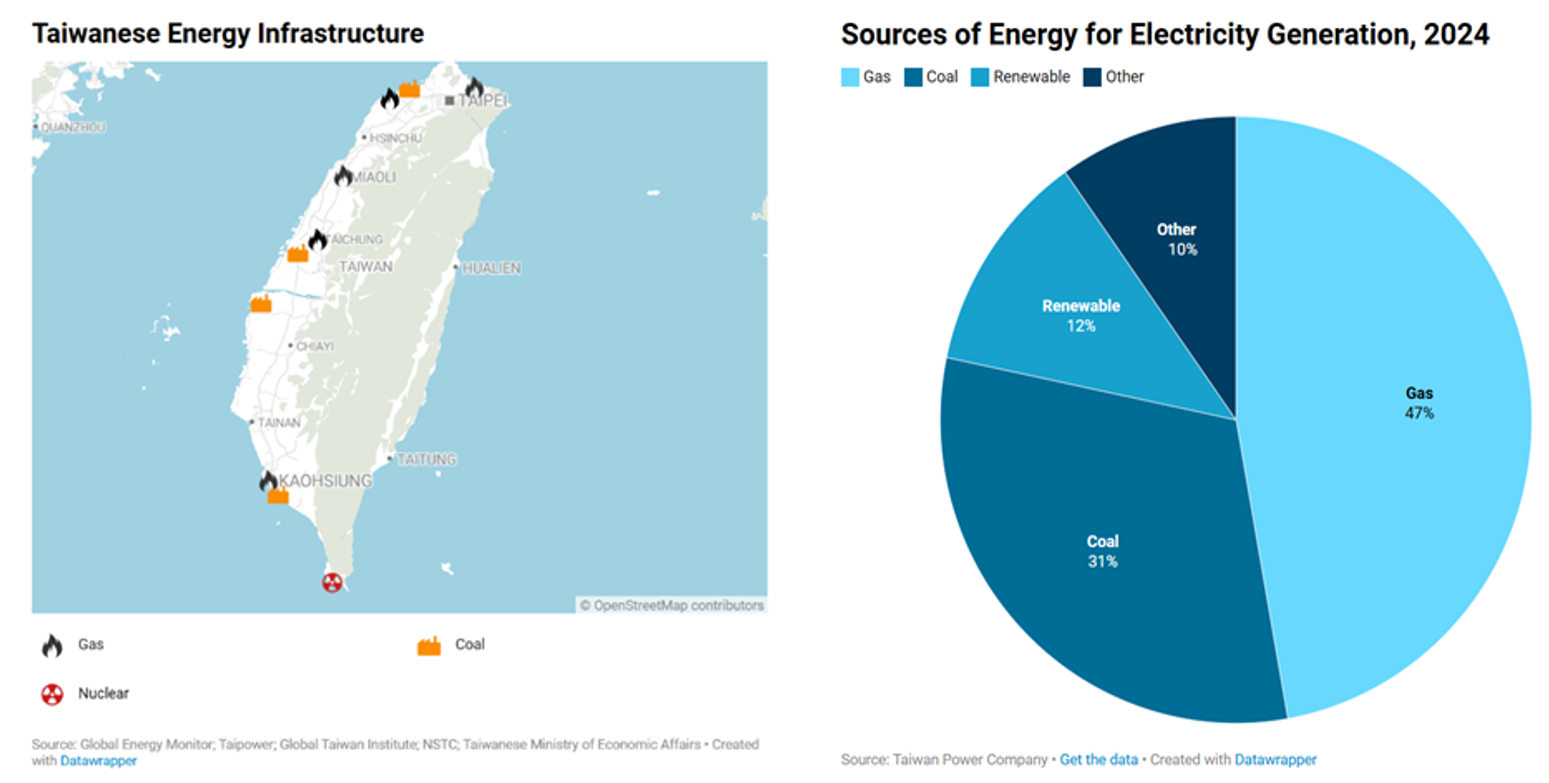
But Beijing does not need to cut the lights in Taipei permanently to achieve coercive effect; it only needs to manufacture uncertainty about whether Taiwan can sustain essential services during a crisis. That combination of dependence, limited buffers, and political salience makes energy Beijing’s most credible gray-zone pressure point and a natural case study for understanding how its broader coercion playbook operates.
Beijing’s gray zone playbook is engineered to exploit the physics of global LNG markets and the frictions of maritime commerce. Practically, the coercion toolkit has three linked levers: (1) maritime friction — harassment by militia craft and administrative safety interdictions10 that increase the perception of operational risk; (2) insurer and shipper pressure — regulatory intimations, port denials, or targeted inspections that raise premiums or induce carriers to refuse Taiwan routes; and (3) supplier diplomacy and commercial persuasion — quiet diplomatic pressure and commercial incentives to persuade increasingly wary producers or trading houses to delay, reroute, or deprioritize cargoes bound for Taipei.
Because LNG trade relies on long, capital-intensive supply chains and a small pool of large carriers and insurers, relatively modest political pressure could create outsized operational effects: a single major reinsurer’s exit or an elevated war-risk premium can make a commercial voyage uneconomical overnight. A recent tabletop exercise conducted by the Foundation for Defense of Democracies (FDD) underscored this vulnerability, showing how calibrated approaches to suppliers and back-channel messaging to other stakeholders produced precisely the market stress Beijing desires — not by sinking ships, but by reshaping private incentives so that market actors do the coercion for them.
Cyber-enabled economic warfare is the essential enabler that makes these economic moves stick. Beijing does not need to cripple Taiwan’s grid to coerce; it only needs to create uncertainty about the grid’s dependability and the state’s ability to manage crisis. Persistent cyber reconnaissance and carefully timed low-grade intrusions into energy industrial control systems (e.g. sensors, SCADA front ends, logistics management) produce two effects: technical fragility and political alarm. Paired with a disciplined disinformation campaign that amplifies supply-chain anecdotes, inflates reported outages, or questions government competence, the result is social panic, hoarding behavior, and pressure on political leaders to seek quick fixes.
In the FDD tabletop exercise, cyber pre-positioning was never designed to create permanent damage but to enable credible denial-of-service windows and to feed narratives that accelerated private sector withdrawal (insurers, shippers, terminal operators). That combination — cyberspace to create soft outages, information operations to narrate the failure, and commercial actions to solidify the outcome — is the holy trinity of modern gray-zone energy coercion.
III. The Deterrence Gap
The challenge in Taiwan is that deterrence, as traditionally understood, does not map cleanly onto the problem Beijing has created. Classic deterrence by denial — building enough hard military power to block an invasion — or deterrence by punishment — threatening retaliatory costs — both falter when the contest unfolds in the gray zone. China’s coercive campaign relies on ambiguity, deniability, and reversibility; these are domains where missiles and ships offer little leverage.
What matters instead is resilience: the ability of Taiwan to withstand and bounce back from sustained coercive pressure without losing confidence in its future or faith in U.S. support. Time becomes the critical variable. Beijing seeks to demonstrate that time favors China — that Taiwan cannot endure sustained pressure without capitulating. The United States and its allies must flip that logic, proving that Taiwan’s society, economy, and partners can outlast coercion, that Taipei can stand back up after each shove, and that Beijing gains nothing from dragging out the contest. In short, the current deterrence gap lies not only in hardware but in the seams of resilience where Beijing believes gray-zone coercion can prevail.
Taiwan’s resilience challenges are structural as well as strategic. The island depends heavily on just-in-time systems across critical sectors, from food and pharmaceuticals to industrial inputs. Roughly two-thirds of grain imports, for example, arrive from a small handful of suppliers, while Taiwan imports more than 70 percent of its medical supplies and active pharmaceutical ingredients from overseas.11 Semiconductor production — the backbone of the global digital economy — relies on precision materials, chemicals, and machine parts shipped from the United States, Japan, and Europe. These lifelines are efficient in peacetime but brittle under stress, with few redundancies or stockpiles.
At home, Taiwan’s highly competitive political environment and deeply polarized media ecosystem further magnify these weaknesses, offering Beijing multiple entry points to exploit societal fissures through disinformation and economic leverage. The result is that coercion, even when temporary or partial, could generate outsized political and social effects. This structural fragility, more than any single chokepoint, is what Beijing counts on: that sustained pressure will fracture Taiwan’s politics from within.
The deterrence gap is not limited to Taiwan’s internal resilience. It also stems from inconsistent signals from Washington and allied capitals. In recent years, the United States has expanded security assistance, strengthened export controls, and elevated high-level messaging, but these steps have often been episodic and oftentimes reactive. More recent mixed signals have compounded the problem: reports of delays in U.S. weapons deliveries, postponing plans by Taiwan’s defense minister to visit Washington, and even the cancellation of Taiwanese President William Lai’s planned transit through New York have all raised questions about U.S. resolve. At the same time, allies in Europe and the Indo-Pacific express some solidarity with Taiwan yet remain cautious about concrete commitments, particularly in economic and commercial domains.
Beijing interprets these and other gaps as validation of its gray-zone approach: sustained coercion below the threshold of war generates debate, delay, and uneven responses rather than unified pushback. This perception emboldens Chinese strategists, who see ambiguity and hesitation among democracies as exploitable seams in deterrence. Without clearer and more consistent signaling — demonstrating that coercion of Taiwan will reliably trigger coordinated costs — Beijing will continue to conclude that persistence pays.
Another deterrence gap lies in the economic and commercial domain, where Beijing exploits the fact that global insurers and shippers treat Taiwan as marginal to their balance sheets. For most firms, the island represents a small fraction of overall business, making the default calculation one of avoidance rather than confrontation. China calibrates its measures accordingly: the goal is not to drive global shipping rates through the roof or create a crisis that boomerangs on its own export-driven economy. Rather, the objective is to normalize disruption as a Taiwan-specific risk — temporary, reversible, and insulated from wider trade.
This quiet conditioning nudges insurers to raise premiums or exclude Taiwan routes, and shippers to reroute capacity, all without triggering broader market alarm or political backlash. The gap is that neither Taiwan nor its partners has mechanisms to offset these private-sector incentives or to anchor confidence that commerce with Taiwan will continue during a crisis. Until that seam is closed, Beijing will believe it can marginalize Taiwan in the global economy without paying a price itself.
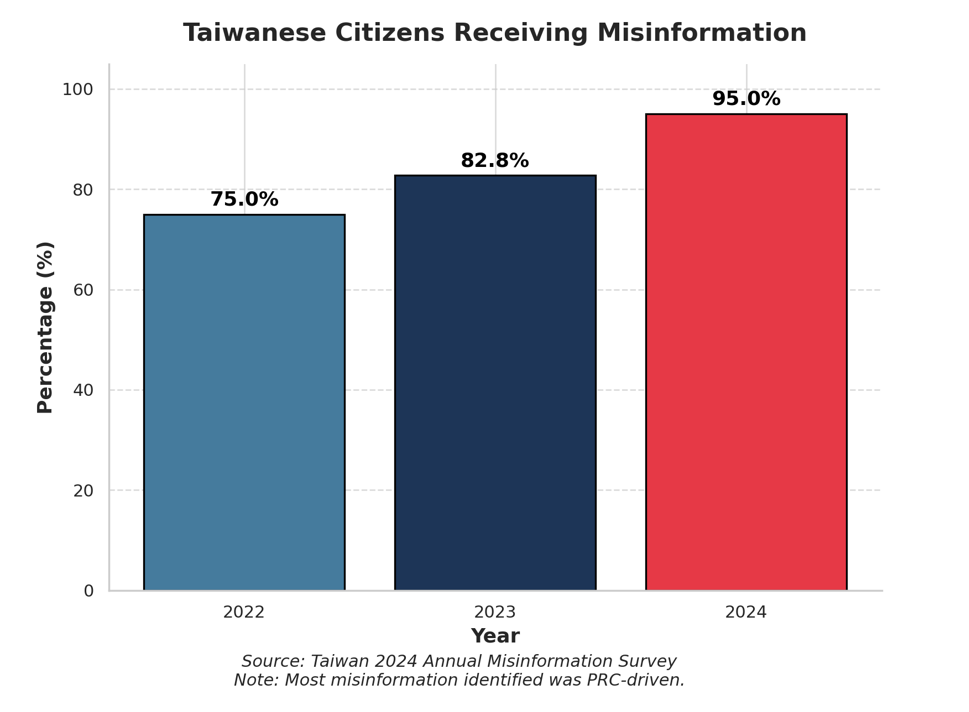
Taiwan also faces deterrence gaps in cyberspace and the information domain. Critical infrastructure remains unevenly hardened, with industrial control systems still exposed to exploitation despite years of investment. Civil-military coordination is improving but remains fragmented, particularly in contingency planning for rapid restoration after a disruption. On the informational side, Taiwan’s vibrant democracy and competitive media landscape are strengths, yet they also magnify the effects of disinformation and rumor during periods of stress. Beijing understands this dynamic and leverages it to sow doubt about the competence of Taiwan’s leaders and the reliability of U.S. support.
The result is that even minor cyber intrusions or carefully seeded narratives can produce disproportionate political pressure, amplifying public anxiety and eroding trust in government. For example, research shows that even modest disinformation campaigns, when amplified by bots or embedded in local media, can shift public sentiment in Taiwan, undermining trust in government and magnifying policy anxiety.12 Thus, the deterrence gap here is not technical capacity alone, but the lack of robust, society-wide resilience to cyber-enabled economic warfare and political warfare — the very tools Beijing believes can achieve strategic gains without firing a shot.
IV. Recommendations
The goal of U.S. policy must be to close the deterrence gap by denying Beijing any confidence that coercion against Taiwan can succeed. This requires more than military deterrence alone. It demands policies that harden Taiwan’s resilience, strengthen its ability to absorb pressure, and ensure that commerce and essential services continue even in the face of sustained gray-zone campaigns. At the same time, the United States must send unambiguous signals — to Beijing, to Taipei, and to the private sector — that coercion will fail and that attempts to marginalize Taiwan will be met with coordinated countermeasures.
Taiwan must also urgently do its part. Increasing defense spending, accelerating hardening of critical infrastructure, and greater investment in energy and cyber resilience are essential to demonstrate resolve and reduce exploitable seams. Allies and partners also have an important role to play, whether by providing alternative energy contracts, offering cyber and technical assistance, or contributing to maritime insurance and logistical backstops. Not every partner will contribute in the same way, but the collectiveness of action is what matters. A diverse coalition of measures, visibly coordinated and sustained, is what will cause Beijing to think twice — raising the costs of coercion, sowing doubt about its effectiveness, and buying time for deterrence to hold.
Recommendation 1: Diversify Taiwan’s Energy Supply and Leverage U.S. LNG
Taiwan’s dependence on imported LNG is its most acute strategic vulnerability, and Beijing knows it. Approximately half of Taiwan’s electricity is now generated from LNG, with storage reserves measured in days, not months.13 This creates a coercive seam that China can exploit through supplier pressure, insurer withdrawals, or targeted harassment at sea. The United States should help close this gap by supporting Taiwan’s diversification of supply and ensuring that LNG deliveries remain viable in a crisis. That means promoting long-term contracts with U.S. LNG exporters, accelerating U.S. regulatory approvals, and expanding diplomatic efforts with producers in the Middle East and Australia to guarantee current and contingency-dependent flows. Taiwan, for its part, should consider investing in a fleet of LNG carriers while continuing to expand its storage capacity and increase redundancy in its receiving infrastructure. These measures are not just about market efficiency; they are about strategic resilience. Diversified contracts, deeper reserves, and credible backstops send a clear signal to Beijing: energy coercion will not deliver political concessions.
Recommendation 2: Harden Critical Infrastructure and Build Cyber Resilience
Taiwan’s power grid, LNG terminals, and industrial control systems remain highly exposed to disruption. China does not need to destroy these assets outright; it can achieve a coercive effect through cyber-enabled economic warfare — temporary outages, cascading logistics failures, and amplified disinformation that undermine public confidence. The United States should expand technical cooperation with Taiwan to harden critical nodes, segment industrial control systems, and develop rapid recovery protocols for both energy and communications networks. This effort should extend beyond government agencies to include utilities, ports, and private operators, ensuring continuity of operations even under sustained coercion. Joint U.S.-Taiwan exercises focused on grid restoration and crisis communications would further strengthen deterrence by demonstrating that outages can be managed and reversed quickly. By raising the costs of disruption and shortening recovery times, Washington and Taipei can deny Beijing confidence that cyber or infrastructure attacks will fracture Taiwan’s resolve.
Recommendation 3: Reconsider Nuclear Power for Baseload Resilience
Taiwan’s long-term energy security will remain fragile if it relies overwhelmingly on imported fossil fuels without sufficient baseload alternatives. Phasing out nuclear generation has reduced reserve margins and heightened dependence on LNG imports that are highly vulnerable to disruption. While politically sensitive in Taiwan, advanced nuclear options — including the life extension of existing units and exploration of Generation III+ reactors or small modular reactors (SMRs) — deserve renewed consideration. U.S. support can come in the form of technical cooperation, regulatory exchanges, and partnerships with trusted suppliers to ensure safety and nonproliferation standards are met. Nuclear energy is not a short-term fix, but over the longer term it can provide a stabilizing foundation that limits Beijing’s leverage over Taiwan’s fuel imports. Incorporating a credible baseload option into Taiwan’s energy mix strengthens resilience and signals that Taipei and its partners are serious about closing this coercive seam.
Recommendation 4: Maritime Insurance Backstops, Reflagging Options, and Convoy Signaling
Beijing’s strategy hinges on nudging private actors to sideline Taiwan; Washington and partners should flip those incentives. One option could be to establish a regional shipping information center to provide captains with timely, trustworthy information in the event of a crisis, maintaining shipping flows and preventing a stalling action that would further isolate Taiwan. Moreover, the United States and its allies and partners should push for Taiwan’s acceptance in the International Maritime Organization, allowing Taipei direct access to push back against dangerous Chinese activity. In a contingency, stakeholders should be prepared to reflag select voyages under U.S. or allied flags (or approved open registries) to clarify protection and liability, paired with port access and priority pilotage agreements at diversion hubs. Finally, Washington should signal convoy willingness — not to normalize escorts, but to demonstrate that attempts to coerce insurers and carriers could trigger the opposite effect. Pre-announced triggers, clear information channels, and visible allied participation change the commercial calculus: commerce with Taiwan continues, and coercion fails to clear its cost-benefit bar.
Recommendation 5: Pre-Announced Sanctions to Deter Gray-Zone Coercion
China’s gray-zone strategy relies on the assumption that coercion short of war will not trigger meaningful economic costs. To close this gap, the United States and its allies should establish pre-announced sanctions frameworks that make clear the price of interference with Taiwan’s energy lifelines or sustained coercive campaigns. These measures could target state-owned enterprises, shipping firms, insurers, and financial intermediaries that facilitate pressure on Taiwan, and should be designed to activate automatically if specific thresholds are crossed. By publishing conditional sanctions in advance, Washington reduces Beijing’s room for miscalculation, raises the cost of coercion, and strengthens deterrence without waiting for a crisis to escalate.
Recommendation 6: Diplomatic Engagement With Key Energy Suppliers
China’s ability to pressure Taiwan through energy coercion is constrained by the decisions of third-party suppliers. Qatar, in particular, is a linchpin in Taiwan’s LNG supply chain and a pivotal actor in any embargo scenario. Beijing will struggle to sustain a coercive quarantine if Doha continues fulfilling long-term contracts and resists PRC demands to cut or reroute supply. U.S. diplomacy should make this expectation explicit — quietly but firmly — by integrating Taiwan-related assurances into broader energy and security dialogues with Qatar and other major suppliers. Multilateral coordination with Japan, Australia, and European allies can reinforce this message, creating a unified front that limits Beijing’s leverage over producers. By engaging suppliers early, the United States reduces the odds that coercion succeeds and demonstrates that Taiwan’s energy security is not just Taipei’s problem but a matter of shared strategic concern.
V. Conclusion
China’s gray-zone campaign against Taiwan is not a hypothetical risk; it is a daily, deliberate strategy designed to erode confidence, sap resilience, and shift the balance of power over time. Traditional military deterrence alone cannot close this gap. What is required is a broader toolkit — energy resilience, cyber, and infrastructure hardening, commercial backstops, sanctions signaling, and diplomatic coordination — that collectively raises the costs of coercion while strengthening Taiwan’s ability to withstand pressure. The measures outlined here are not abstract; they are concrete steps the United States and its partners can take now to deny Beijing confidence in its strategy. The goal is simple: ensure that time favors Taiwan, not China, and make clear that coercion will fail to deliver political concessions. By doing so, Congress can help preserve stability in the Indo-Pacific and prevent a slow-motion crisis from hardening into a fait accompli.