September 22, 2025 | Insight
From Parade to Battlefield: LiDAR at the Core of China’s Military Modernization
September 22, 2025 | Insight
From Parade to Battlefield: LiDAR at the Core of China’s Military Modernization
On September 3, 2025, Beijing staged its largest-ever Victory Day parade, marking the 80th anniversary of the end of World War II. Chinese Communist Party General Secretary Xi Jinping presided alongside Russian President Vladimir Putin and North Korean leader Kim Jong-un, underscoring China’s growing alignment with authoritarian powers. The display also showcased China’s accelerating military modernization, with an emphasis on “intelligentized warfare” (智能化战争) and autonomous systems.
Notably, LiDAR (Light Detection and Ranging) sensors featured prominently across multiple platforms, from new main battle tanks to unmanned ground vehicles and robotic scouts — a clear demonstration that Beijing now views LiDAR as a foundational technology for the People’s Liberation Army (PLA).
What is LiDAR and Why China is Pursuing It
LiDAR is a remote sensing technology that uses laser pulses to map the surrounding environment in three dimensions with extraordinary accuracy. Originally developed for aerospace applications, LiDAR is now central to civilian industries such as autonomous driving, surveying, and infrastructure monitoring. By bouncing millions of laser pulses off nearby objects and measuring their return times, LiDAR generates precise spatial data that radar or cameras alone cannot match. This makes it indispensable for navigation, targeting, and situational awareness in complex or GPS-degraded environments.
Beijing recognized LiDAR’s potential early. In 2018, the Chinese Communist Party (CCP) declared LiDAR a “chokepoint technology” and mandated its integration into military systems under the country’s military-civil fusion strategy. Since then, Chinese LiDAR firms — including Hesai, RoboSense, Leishen, and DJI’s Livox subsidiary — have benefited from state subsidies and directives to scale production. The result is global market dominance: Chinese companies now account for nearly 80 percent of global LiDAR sales, leveraging a cost advantage that enables the PLA to integrate sensors at mass scale.
For Beijing, LiDAR’s appeal is twofold. First, it strengthens the PLA’s push toward “intelligentized warfare,” where autonomous and semi-autonomous platforms will play a central role. Second, widespread global adoption of Chinese LiDAR — in cars, drones, and infrastructure — creates potential pathways for espionage, disruption, or sabotage, as Chinese law requires domestic companies to support state intelligence services. Taken together, China’s pursuit of LiDAR reflects not just a technological ambition, but a deliberate strategy to secure military advantage while embedding itself deeper into critical civilian networks worldwide.
PLA Systems on Public Display
China’s 2025 Victory Day parade was not only about symbolism. It was also a carefully curated showcase of the PLA’s modernization priorities, with an emphasis on autonomy, sensor fusion, and survivability. By unveiling tanks, unmanned platforms, and robotic scouts before a global audience, Beijing sought to signal both technological prowess and doctrinal evolution — away from attritional, manpower-heavy operations toward a force designed to exploit data, automation, and artificial intelligence for decision-making and battlefield dominance.
The parade also highlights the fruition of Beijing’s policy of military-civil fusion: a large contemporary military resting on the cutting edge by virtue of an indigenous defense industrial base capable of delivering low-cost technological advances, such as LiDAR, at scale. The authors analyzed scores of images taken from state television broadcasts of the parade to identify likely LiDAR units, along with their possible manufacturer.
Main Battle Tank (Type 100)
Poised to replace the PLA’s current main battle tank fleet, the new Type 100 was a centerpiece of the parade. Parade pictures suggest LiDAR mounts along both flanks, enabling enhanced navigation, terrain handling, and potentially semi-autonomous operation. Beyond raw firepower, the system matters because it may reduce the cognitive load required of its crew — an advantage for a force still reliant on conscription — and points to a future in which armored units can fight and maneuver with fewer personnel. Its debut also highlights China’s determination to field sensor-enabled armor at scale, in contrast to Russia’s growing reliance on older tank models seen in Ukraine.

Unmanned Ground Platforms
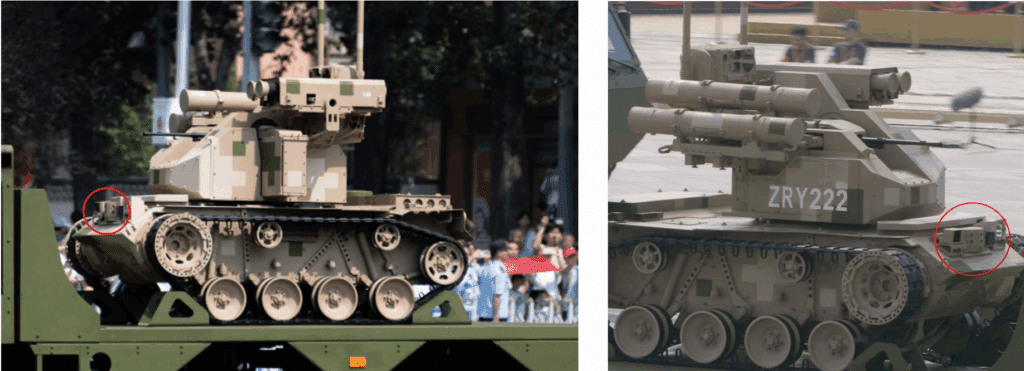
The parade included multiple tracked unmanned ground platforms, many visibly armed with rocket pods or heavy machine guns. These unmanned systems, likely integrated with LiDAR for navigation and targeting purposes, included heavily armed tracked platforms likely designed for anti-tank warfare and other systems intended to work in concert with unmanned aerial vehicles and dismounted infantry in smaller-scale engagements. The ZRY-222 stands out as a newly introduced rocket and gun platform, featuring a LiDAR sensor under its main gun mount.
For the PLA, these unmanned platforms reduce the need to risk manned armor in contested environments and allow infantry units to gain fire superiority without calling on larger, more vulnerable assets. Their presence in the parade suggests the PLA intends to normalize unmanned fire support as a standard feature of future combined-arms operations.
Smaller Combat Vehicles
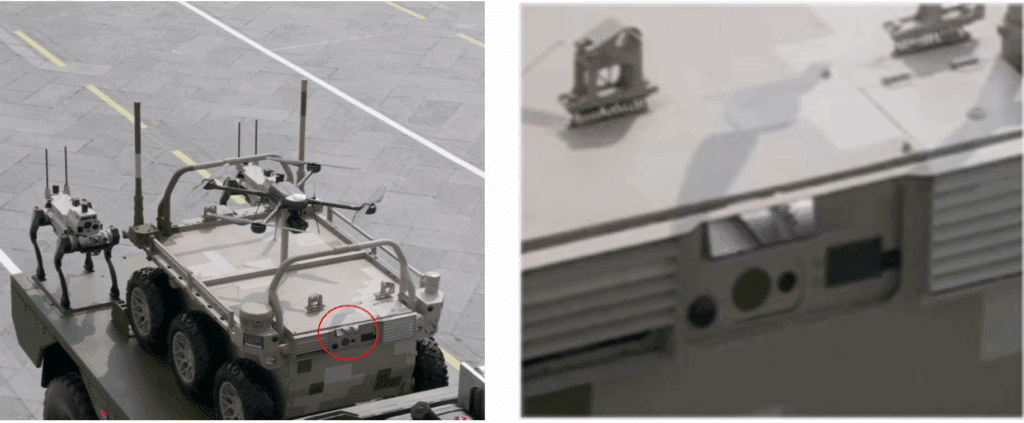
Beijing also highlighted a range of wheeled platforms for infantry support and autonomous logistics. Some of these appear equipped with Hesai AT512 LiDAR units, enabling off-road autonomy, while an upgraded Type 08 infantry fighting vehicle carried Leishen CH64W sensors. The significance of these vehicles lies not only in their autonomy but in their modularity: the smaller platforms can carry quadcopter drones into battle, creating a “system of systems” approach in which ground robots launch aerial scouts for reconnaissance or targeting. The Type 08 upgrade, meanwhile, demonstrates how China is layering autonomy onto legacy platforms to extend their battlefield relevance.

Robotic “Wolves”
Perhaps the most eye-catching display was a pack of quadrupedal “robot wolves,” reportedly designed for long-range reconnaissance in rugged terrain. Each appeared outfitted with Livox LiDAR units, allowing for autonomous movement and terrain mapping. While they were displayed on flatbeds rather than walking under their own power, their symbolism was clear: the PLA is experimenting with low-cost, sensor-enabled robotic scouts that can augment infantry operations, conduct reconnaissance, or swarm adversary defenses. Such systems may be rudimentary today, but their parade debut signals Beijing’s intent to normalize robotics on the future battlefield.
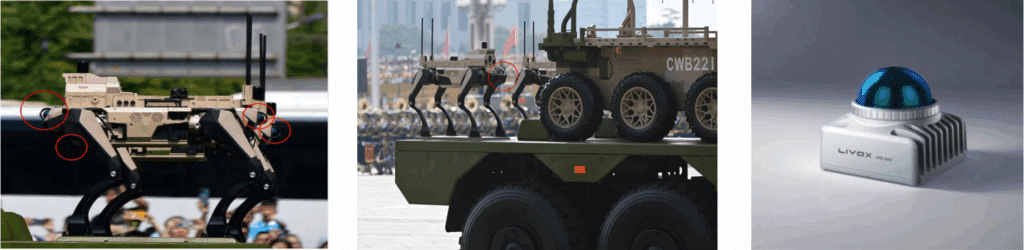
Taken together, these platforms highlight how Beijing is operationalizing LiDAR across the full spectrum of ground combat — from heavy armor to robotic scouts. The PLA is becoming a force in which autonomy and sensor-driven decision-making are not niche capabilities but integral to combined-arms warfare. This trajectory carries direct implications for U.S. and allied militaries, as well as for the global marketplace where Chinese firms dominate LiDAR supply chains.
Recommendations
- Expand the Department of Defense’s (DoD) 1260H list to explicitly cover additional Chinese LiDAR suppliers: The DoD should consider adding companies such as Livox (a DJI subsidiary) and Leishen to the 1260H list of “Chinese military companies.” While DJI is already designated, Livox continues to market LiDAR products globally, including units integrated into PLA platforms. Explicitly listing Livox would close a potential compliance loophole. Similarly, Leishen has supplied LiDAR sensors for military systems, including those displayed in the September parade, and should be recognized as a military-civil fusion contributor.
- Direct a national security review of Chinese LiDAR firms for possible inclusion on the Federal Communications Commission’s (FCC) Covered List: The FCC’s Covered List restricts the use of communications and surveillance equipment deemed a national security threat. While LiDAR has traditionally been viewed as an automotive or surveying technology, its integration into Chinese military systems underscores its dual-use nature. The DoD, in coordination with the intelligence community and other national security agencies, should conduct a formal review of firms such as Hesai, RoboSense, Livox, and Leishen to determine whether they warrant inclusion. Listing would prohibit U.S. carriers and critical infrastructure operators from deploying Chinese LiDAR, thereby closing off critical pathways for data exploitation, sabotage, or supply chain dependency.
- Expand U.S. government procurement bans to cover Chinese LiDAR systems:
Existing federal procurement restrictions have targeted Chinese telecommunications, surveillance, and drone technologies, but LiDAR has so far escaped comparable treatment. Given its integration into PLA platforms and its widespread civilian adoption, the U.S. government should move to explicitly bar the acquisition or deployment of Chinese-produced LiDAR across federal supply chains, particularly in the Departments of Defense and Transportation. Parallel state-level advisories could help extend these safeguards to critical infrastructure projects, public safety fleets, and transportation networks. This would send a clear signal to industry while reducing the risk of embedding PLA-linked technologies in sensitive U.S. systems.
- Launch a whole-of-government assessment of Chinese LiDAR vulnerabilities in U.S. critical infrastructure: Chinese LiDAR is increasingly embedded in U.S. civilian systems, from autonomous vehicles and port logistics to energy infrastructure and smart transportation networks. These deployments create potential channels for espionage, disruption, or sabotage, given Beijing’s legal requirement that Chinese firms support state intelligence operations. The Department of Homeland Security — in coordination with the Department of Transportation, the intelligence community, the Department of Defense, and other stakeholders — should lead a comprehensive assessment of where Chinese LiDAR is already deployed, the risks such deployments pose to national security and defense mobilization, and options for phased removal. Treating LiDAR as a chokepoint technology — akin to semiconductors or drones — would align U.S. defenses with Beijing’s own military-civil fusion strategy.
Craig Singleton is a senior fellow at the Foundation for Defense of Democracies (FDD) and senior director of FDD’s China Program, where Jack Burnham is a research analyst. For more analysis from Craig, Jack, and the China Program, please subscribe HERE. Follow Craig on X @CraigMSingleton. Follow Jack on X @JackBurnham802. Follow FDD on X @FDD. FDD is a Washington, DC-based, nonpartisan research institute focused on national security and foreign policy.