September 8, 2025 | Insight
Why Export Controls Work: 5 Debunked Myths About U.S.-China AI Competition
September 8, 2025 | Insight
Why Export Controls Work: 5 Debunked Myths About U.S.-China AI Competition
America’s artificial intelligence (AI) edge faces a determined challenger: Chinese leader Xi Jinping. He has ordered China to “keep key and core technologies firmly” in its hands (把关键核心技术掌握在自己手里) and achieve “high-level scientific and technological self-reliance” (科技自立自强) from the United States. Xi’s mandate is longstanding doctrine within the Chinese Communist Party (CCP) — it predates U.S. semiconductor controls and is not a response to U.S. policy.
Since China seeks to integrate advanced AI into its military modernization efforts, the right U.S. response is to deny it these technologies by imposing targeted export controls.These U.S. laws and regulations protect national security interests and promote foreign policy objectives by restricting the transfer of certain technologies, software, commodities, and information outside the United States or to select foreigners within the United States.
Effective export controls focus on technological chokepoints — access to chips, the networks that link them, advanced memory, and model know-how. Closing the right chokepoints can steer U.S. capabilities away from high-risk users, such as the People’s Liberation Army (PLA), while raising China’s costs and stretching its innovation timelines. Done well, export controls delay and degrade China’s ability to train and field frontier AI. They also give the United States time to expand allied supply of components, tighten enforcement, and deploy U.S. AI faster than China can deploy its models.
While a growing narrative claims export controls are futile or self-defeating, the evidence clearly shows the opposite — including from Chinese sources. This brief, the first in a series, fact-checks five myths and explains why well-targeted controls need not be perfect to be powerful.
Myth #1: “Export controls only encourage China to develop its own semiconductor industry.”
Reality: China’s chip drive began long before U.S. export controls. Since 2014, Beijing has funneled billions of dollars through its National Integrated Circuit Industry Investment Fund to bankroll domestic fabs (semiconductor fabrication plants), equipment makers, and chip designers to decrease its import dependence. It also hard-wired semiconductor self-sufficiency into its ‘Made in China 2025’ industrial agenda and five-year plans dating back to 2015, which collectively set production and procurement preferences across China’s semiconductor supply chain. U.S. export controls on semiconductors — which only began to take shape after 2019 — therefore did not instigate China’s self-sufficiency drive. They do, however, make the realization of Beijing’s plans much harder by restricting critical inputs including lithography tools, high-bandwidth memory, and advanced design software that China still cannot reliably produce domestically.
Result: The net effect of U.S. export controls is a Chinese AI ecosystem built on weaker domestic substitutes in which Chinese companies must rely on inferior chips to deliver far less compute than U.S. alternatives. To hit the same performance targets, Chinese firms need more chips, more power, and larger data center footprints, complicating efforts to be cost-competitive with U.S. firms.
Bottom line: Despite record outlays, China remains the world’s largest chip importer and cannot indigenize the full AI stack at pace without the chokepoint technologies kept out of reach by U.S. and allied export controls.
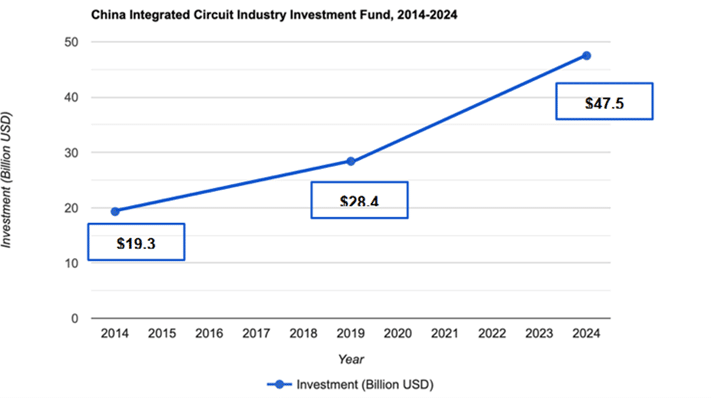
China’s Drive towards Semiconductor Self-Sufficiency Predates U.S. Export Controls:
“Focus on improving the level of integrated circuit design, continuously enrich intellectual property cores and design tools, achieve breakthroughs in the core general purpose chips that are related to the development of national information security and cybersecurity and the electronic complete machine industry, and improve the application adaptability of domestic chips. Master high-density packaging and 3D micro-assembly technology and improve our independent development capabilities in the packaging industry and for testing.”— Made in China 2025 (released in 2015)
“Cultivate integrated circuit industrial systems; foster artificial intelligence, intelligent hardware, new display technologies, smart mobile terminals, 5G mobile communications, advanced sensors, and wearable devices into becoming new areas of growth.” — 13th Five-Year Plan (2016-2020)
“We will research and develop integrated circuit (IC) design tools, key equipment, high-purity target materials, and other key materials, make breakthroughs in advanced IC processing, insulated-gate bipolar transistors (IGBT), micro-electromechanical systems (MEMS), and other special processing technologies, upgrade advanced storage technology, and develop silicon carbide, gallium nitride, and other wide-bandgap semiconductors.” — 14th Five-Year Plan (2021-2025)
Myth #2: “Export controls prevent the global proliferation of U.S. AI models.”
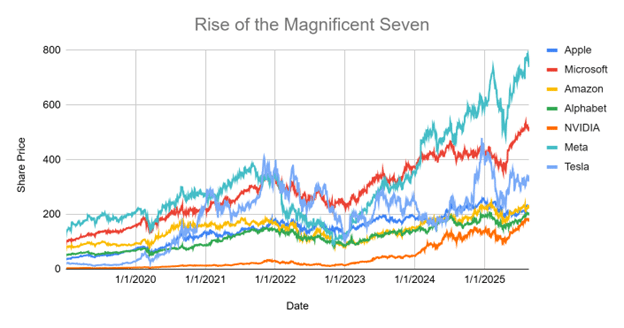
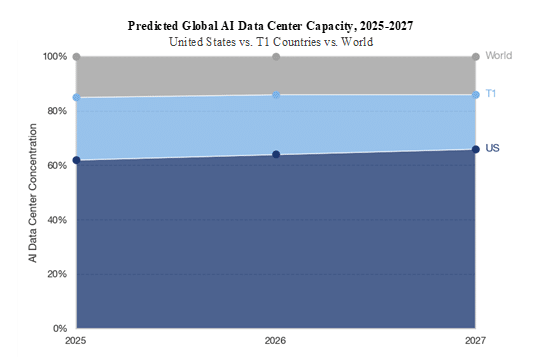
Reality: Export controls have not stopped U.S. AI from spreading; in most cases, they simply steer access away from high-risk users and jurisdictions. The rules limit China’s access to training-class chips and the fast links needed to build data center-scale training clusters — essentially supercomputers that connect thousands of chips to train a single model. In practice, U.S. AI is scaling globally: Microsoft, Nvidia, Alphabet, Amazon, OpenAI, and others dominate market value and cloud capacity, fund larger R&D pipelines, and distribute models worldwide through application programming interfaces (APIs) and partner clouds. Nvidia’s approximately $4 trillion valuation underscores that export controls are not hobbling U.S. suppliers. Even as China has made progress on open-source models, the United States and close partners still hold the key chokepoint technologies — accelerators and software tooling, frontier models, and hyperscale cloud — and, with allies, advanced lithography and high-bandwidth memory.
Result: Export controls allow the United States to shape where AI is built and where it spreads (toward partners, not adversaries) while slowing Beijing’s ability to replicate, fine-tune, or militarize it. By constraining the supply of chips and other critical inputs, export controls raise China’s costs and timelines without curbing global uptake of U.S. systems. Meanwhile, inside China, Beijing’s censorship and data localization rules — not U.S. policy — are the main barrier to foreign AI.
Bottom line: U.S. AI remains the default choice globally; export controls simply seek to keep it out of the PLA’s hands.
Myth #3: “Export controls have failed to stop China from developing advanced frontier models.”
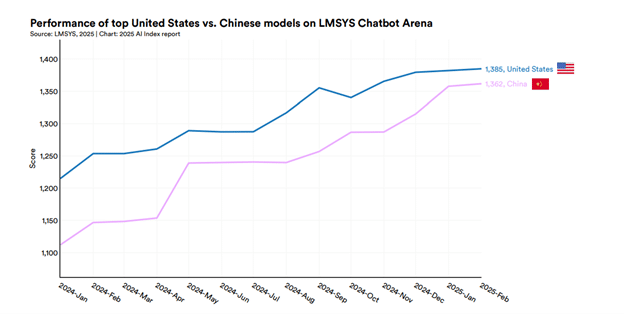
Reality: U.S. export controls were built to slow, shrink, and degrade China’s frontier progress — not erase it entirely. China’s binding constraint is now compute. Chinese tech founders have explicitly stated that export controls, not money or engineers, are the main brake on scaling and innovation. The flagship models of the Chinese AI company DeepSeek relied on pre-control Nvidia A100-era capacity or rentals abroad. Domestic substitutes (e.g., Huawei Ascend) face lower memory bandwidth, weaker chip-to-chip links, and immature software — stretching training time and capping model size and reliability. Lacking extreme ultraviolet lithography — and with deep ultraviolet tools restricted — China can neither reverse-engineer leading-edge American chips nor mass-produce a comparable domestic alternative, in large part because of export controls. Without high-bandwidth memory, high-speed interconnects, and advanced electronic design automation software, China also cannot assemble or refresh true frontier-scale clusters.
Result: Chinese labs have produced some capable systems, but deploying frontier AI technologies at scale often arrives later — exactly the intended outcome of export controls. The lag reduces iteration speed, raises operating costs, and slows military adaptation (e.g., command-and-control support, autonomy, and target recognition).
Bottom line: Despite China’s progress, export controls have not failed but instead are imposing costly trade-offs that keep China off the bleeding edge and delay militarization.
Myth #4: “China effectively evades export controls, so they’re useless.”
Reality: The persistence of leakage and a black market for chips proves that export controls bite, not that they fail. Smuggled or rerouted U.S. parts show up in small, irregular batches, often at large markups and without warranties or updates, making large systems harder to build and maintain. Black markets cannot provide the steady, predictable, large-volume access to consistent hardware for weeks at a time that training AI requires. Controls also raise legal and financing risks for anyone helping China illegally source chips, further reducing supply. The aim is not a perfect seal. It is to raise costs, slow timelines, and limit capability — and on those metrics, existing export controls are working.
Result: Training a large model takes longer and costs more and repeating or scaling the run is difficult because the next shipment rarely matches the last. Partners and lenders see the enforcement risk and pull back, further raising costs and slowing delivery.
Bottom line: Export controls don’t have to be leak-proof to work — they deny Beijing steady, high-volume access to key inputs, introducing new costs, slowing progress, and limiting what China can build.
Myth #5: “Repealing export controls will give the United States leverage over China by strengthening China’s dependency on the American AI stack.”
Reality: Beijing will not let Washington convert market access into leverage. The CCP’s strategy centers around “indigenous and controllable” (自主可控) tech — hardwiring self-reliance across chips, cloud, and AI. China’s laws and procurement rules (i.e., cybersecurity reviews, data localization, source code/algorithm scrutiny, and substitution mandates) force foreign firms to localize, disclose, or partner under Chinese terms while keeping U.S. models behind censorship and content filters. Even after President Donald Trump authorized licensed sales of Nvidia’s H20 chips to China in August 2025, official Chinese state guidance and media have warned against reliance on U.S. chips, treating access as temporary and disposable.
Result: China will not permit lasting reliance on the U.S. stack. Repealing export controls would accelerate substitution: Chinese firms would stockpile U.S. parts, benchmark and reverse-engineer them where possible, and extract vendor know-how through localization and joint ventures — closing the innovation gap faster.
Bottom line: Beijing will pocket any export control relaxation. Lifting controls shortens China’s path to self-reliance; maintaining them preserves U.S. advantage.