November 24, 2026 | Monograph
Space Critical Infrastructure: The Final Frontier
How Congress Can Protect U.S. Space-Based Systems Amid Rising Threats
November 24, 2026 | Monograph
Space Critical Infrastructure: The Final Frontier
How Congress Can Protect U.S. Space-Based Systems Amid Rising Threats

Executive Summary
Space is no longer a domain reserved for exploration, prestige, or military advantage. Space-based systems meet the functional definition of critical infrastructure: Their disruption or destruction would have cascading consequences for U.S. national security, economic security, public safety, and daily life. Yet Washington has failed to formally designate space systems as critical infrastructure, leaving the nation without a comprehensive framework to manage growing risks across the space ecosystem.
Satellites provide positioning, navigation, and timing (PNT) services that enable financial transactions, shipping, precision agriculture, and military operations. They support communications, weather forecasting, missile warning, intelligence collection, and logistics networks worldwide. In 2023, the Cyberspace Solarium Commission (CSC) 2.0 and McCrary Institute laid out the case for federal designation of space systems as critical infrastructure.1 They concluded that while some systems are indirectly covered through existing sectoral designations, no single federal entity was responsible for assessing how risks to satellites, ground stations, launch systems, command-and-control links, space data services, and commercial providers interact as one interconnected system.
This incomplete coverage leaves gaps in U.S. defenses. Launch facilities, spacecraft and orbital constellations, ground stations, tracking and command systems, manufacturing facilities, and specialized space supply chains do not fit neatly within the risk-management plans of the communications, defense industrial base, or critical manufacturing sectors or those of the other sectors that rely on these assets. That leaves essential parts of the ground-to-orbit ecosystem without a risk framework.
Three trends make this fragmented approach increasingly untenable. First, China and Russia are fielding counterspace capabilities to jam satellite communications, falsify navigation signals, maneuver near U.S. satellites to spy on them, or destroy satellites. The U.S. Space Force has repeatedly warned, “Intensifying strategic competition presents a serious threat to U.S. national security interests in, from, and to space.”2 In a crisis or conflict, U.S. adversaries could delay intelligence collection, disrupt command and control, degrade missile warning, and complicate offensive targeting.
Second, commercial providers’ integration into federal and military space operations makes private-sector systems increasingly central to national security missions.3
Third, the American public, economy, and military increasingly depend on space-enabled services — including GPS navigation, timing for financial transactions, weather forecasting, and telecommunications. In 2022, Samuel Visner, board chairman of the Space Information Sharing and Analysis Center (Space ISAC), an industry-led threat-sharing organization, warned that “space systems are conceivably a target” for infrastructure attacks.4 The growth of the industry’s importance has only made it a more attractive target.
How Space Systems Support Daily Life and National Security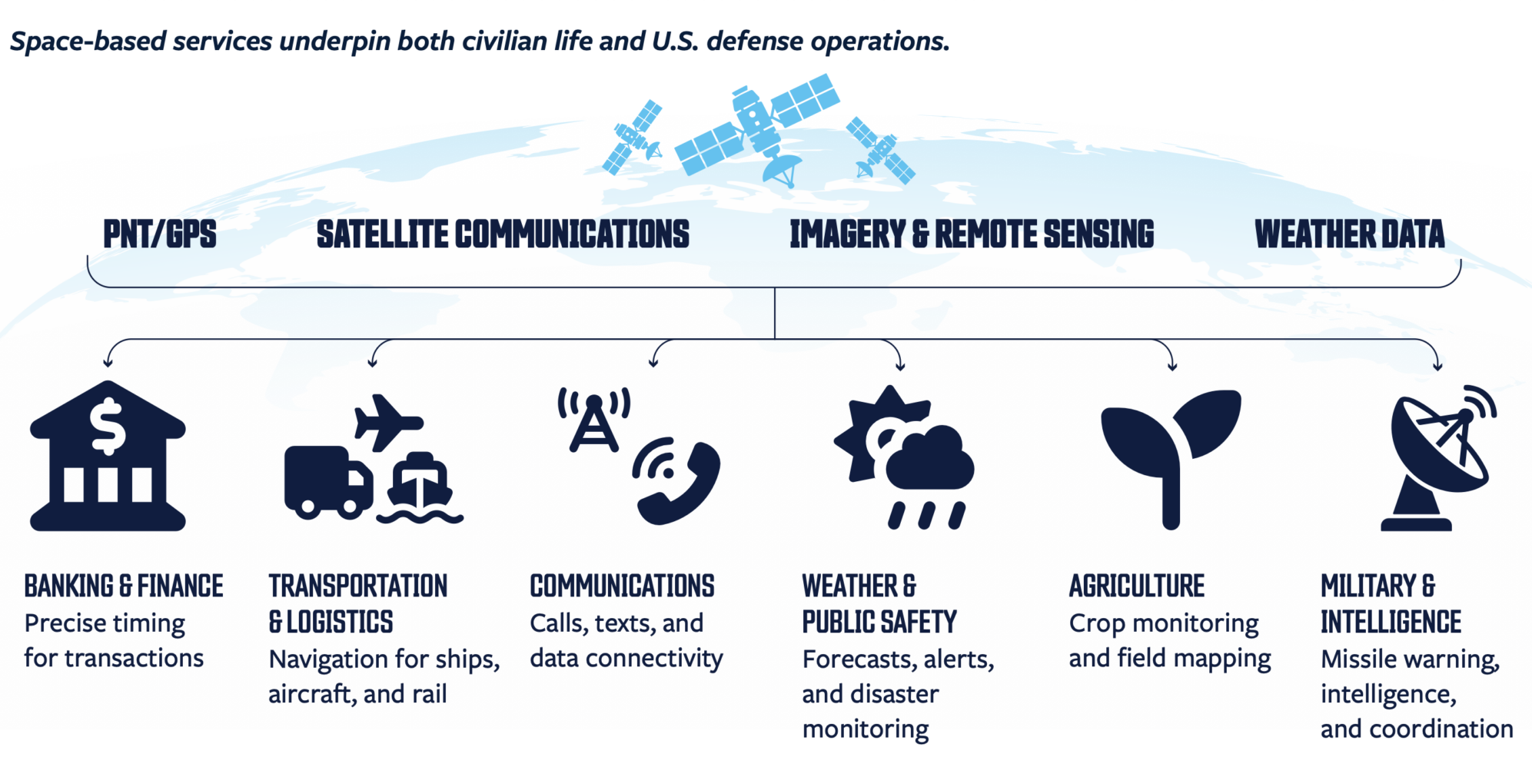
What has not changed is Washington’s fragmented approach to managing those risks. The federal government recognizes 16 critical infrastructure sectors, each paired with a sector risk management agency (SRMA) as its day-to-day federal point of contact. Space has neither an SRMA nor a sector-specific risk management plan. No federal agency leads sector-wide efforts to help private space companies protect these interconnected systems.
Aligned with CSC 2.0’s original assessment in 2023,5 this report argues that Congress should designate space-based systems as the 17th critical infrastructure sector. Designation should neither create a new regulatory regime nor displace existing authorities. NASA should serve as the lead federal agency for sector-wide risk management, public-private collaboration, threat sharing, and resilience planning.
Since the 2023 report, technological, commercial, and international security changes have deepened space dependencies, but Washington still lacks the coordinating structure to manage them. Designation would help clarify federal responsibilities, strengthen commercial-federal coordination, improve cybersecurity and engineering resilience standards, and maintain reliable space services during crises or conflicts. In practice, American space architecture already functions as critical infrastructure. Congress should make that reality official.
