September 22, 2026 | Memo
Qatar’s Mediation Record: Successes, Failures, and Costs
Speaking to Qatar’s emir on the sidelines of the June G7 summit, President Donald Trump praised Qatar for helping defuse the war with Iran. “Working with Qatar and the people of Qatar was really a pleasure,” he said.1 Three weeks later, President Trump declared the Qatar and Pakistan-brokered ceasefire “over.”2 The U.S.-Iran Memorandum of Understanding (MOU) is but the latest agreement delivered by Qatar that has foundered.
Mediation is a cornerstone of Qatari foreign policy. Article 7 of Qatar’s constitution explicitly declares that the country’s foreign policy “shall be based on the principle of consolidating international peace and security, via encouraging the peaceful resolution of international disputes.” In a November 2025 interview with CNN, Qatar’s prime minister said that “each country in the international community needs to contribute something,” and that Doha’s niche is its ability “to convene between conflicted parties and understand the grievances.”3
Qatar has vigorously pursued this mission in the Middle East and beyond. The 2026 U.S.-Iran MOU is but one example. But does Qatar’s track record as a mediator hold up under scrutiny? This report surveys Qatar’s mediation efforts over the years and assesses the country’s successes and failures alike.
The problem is not Qatar’s failures, but the price of its successes. Too often, Doha’s mediation succeeds to the detriment of American interests, including by empowering groups like Hamas, al-Qaeda, and the Taliban through ransom payments, positive publicity, or enhanced international standing. Other times, Qatar simply strengthens existing bad dynamics, negotiating brief respites to perennial conflicts that soon grind on.
Iran
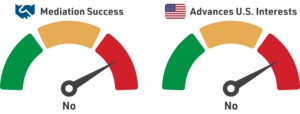
After the United States launched Operation Epic Fury in February, the Islamic Republic began striking Qatar. Even after months of conflict, aside from a token measure of expelling Iran’s security and military attaches, the countries maintain full diplomatic ties.4 And those ties may even strengthen. This is consistent with recent history. Over the years, Doha has deepened its relationship with the regime while brokering deals that ensured it would fight another day. At best, Qatari mediation has forestalled the Islamic Republic’s demise. At worst, it has empowered the regime.
Qatar and Iran share a massive natural gas field, and both sponsor Hamas, giving them incentives to cooperate.5 Additionally, Doha owes Tehran a debt of gratitude for coming to its aid in 2017 after Saudi Arabia, the United Arab Emirates (UAE), and Bahrain imposed a blockade on Qatar.6
Nevertheless, consecutive U.S. administrations have enabled Qatar to serve as an intermediary with Iran. Doha hosted indirect nuclear talks in 2022 and brokered a U.S.-Iran prisoner swap in 2023 that involved transferring $6 billion of frozen Iranian oil revenue from South Korea to Qatar’s Central Bank. This was effectively a ransom deal that benefited Iran’s clerical regime.7
Qatar remained involved with the nuclear file during the second Trump administration.8 In October 2025, Qatari Prime Minister Sheikh Mohammed bin Abdulrahman Al-Thani said that Doha was “trying to engage with the United States and the Iranians” to get talks “back on track.”9 Critically, Al-Thani added: “Iran is my neighbor … for me, the stability of Iran is key. It’s not a luxury … it’s very important.” Tehran evidently understands that Qatar has its interests at heart, which is perhaps why the regime asked Qatar to intervene on its behalf twice in 2025. First, Tehran requested Qatar’s diplomatic services during the 12-Day War with Israel in June 2025.10 In September, Tehran reportedly asked Doha to mediate talks with the United States, France, Germany, and United Kingdom to thwart the reimposition of UN sanctions.11
Then, as the Trump administration considered a military response to Tehran’s crackdown on anti-regime protests in January, Qatar attempted to walk Washington back from the brink. A Saudi source told the media that Qatar, Saudi Arabia, and Oman “led a long, frantic, diplomatic last-minute effort to convince President Trump to give Iran a chance to show good intention.”12 Qatar’s emir again urged President Trump to deescalate during a phone call on February 11.13
Qatari hopes were dashed on February 28 when the United States launched Operation Epic Fury. Breaking from precedent, Doha backed the United States, condemned Iran, and maintained its “full right to respond” to Iranian attacks — nearly 300 of which targeted Qatar.14 Qatari Foreign Ministry spokesperson Majed al-Ansari said on March 31 that Qatar was “ready to help” negotiate.15 Pakistan was the lead broker of the ceasefire announced on April 7, but Qatar had reportedly been working behind the scenes.16 By May, Qatari mediators appeared to have assumed a larger public role. Qatari officials met with Vice President JD Vance, Secretary of State Marco Rubio, and Special Envoy Steve Witkoff to discuss end-of-war terms and were reportedly instrumental in convincing President Trump to put off an attack on Iran.17
When the MOU landed in June, The Wall Street Journal reported that Washington was working with Doha to unlock $6 billion of frozen Iranian oil revenue that had been sitting in Qatari banks since the Biden-era ransom deal.18 Absent proper oversight, Qatar could allow the regime to divert the money for military or other prohibited purposes — a distinct possibility when one considers Doha’s historical support for the Islamic Revolutionary Guard Corps (IRGC).
Vice President JD Vance also indicated that a deconfliction team with representatives from U.S. Central Command and the IRGC would be established in Qatar.19 Doha was thus involved in an effort to normalize ties between Washington and Iran’s most fervent terrorist supporters within the regime.
The Middle East Beyond Iran
Gaza
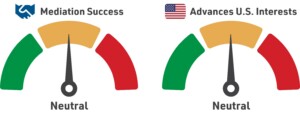
Qatar came to the negotiating table after October 7, 2023, as an experienced interlocutor with Hamas. However, every previous ceasefire Qatar brokered bought Hamas time and space to prepare for the next battle. Moreover, Doha’s efforts to reconcile Hamas with its rival, Fatah, have also fallen short. Thus, Qatar’s mediation has repeatedly resulted in temporary quiet that leaves Hamas entrenched and empowered.
As early as 2003, Hamas reportedly worked with Qatari mediators in an unsuccessful effort to bring an end to the Second Intifada.20 Three years later, the 2006 Palestinian legislative elections provided new opportunities for conflict resolution. After Hamas won the elections, Qatar debuted as a mediator for the intra-Palestinian conflict — a role traditionally reserved for Egypt.21 Qatar’s diplomatic role expanded significantly after Hamas conquered Gaza in 2007.
When a civil war erupted in 2007 between Hamas and Fatah, Qatar was one of several countries that attempted to end the violence and negotiate a unity government. The talks failed, and Hamas remained in control of Gaza. Concurrently, Qatar emerged as one of Hamas’s top financial patrons. At the time, Hamas’s political leadership operated out of Damascus, but they moved to Doha in 2012 after the Syrian civil war erupted.
After Hamas’s political chief reportedly left Syria in January 2012, Doha again engaged with the rival Palestinian factions to broker a power-sharing agreement that would install a “Palestinian National Reconciliation Government of independent technocrats.”22 The agreement was never implemented. The two sides reconvened in Doha in 2016, but Qatar failed to broker unity.23
The 2014 conflict between Hamas and Israel was Qatar’s next major foray into Gaza diplomacy. During the 51-day conflict, Qatar and Turkey lobbied Secretary of State John Kerry for an end state that would have eased restrictions in Gaza without addressing Israeli concerns about Hamas’s terror infrastructure — infrastructure reportedly enhanced with Qatari help.24 Egypt intervened to protest this arrangement, along with Israel. The disagreement reflected a growing rift between the pragmatic Arab states and those like Qatar that backed the Muslim Brotherhood during the Arab Spring. In the end, Hamas remained entrenched in Gaza, even after losing the war, thanks to Qatar’s efforts.
Qatar again emerged as a mediator during the 11-day clash between Israel and Hamas in May 2021. This time, Qatar mediated alongside Egypt.25 But the end result was no different. Hamas remained in power, with no effort to dislodge the terrorist group from its stronghold.
During a short battle between Israel and Iran-backed Palestinian Islamic Jihad (PIJ) in 2022, Doha intervened again as a broker. The result was a ceasefire between Islamic Jihad and Israel.26 Qatar again angled for the status quo: leaving PIJ in place.
For years, Qatar’s diplomatic efforts achieved nothing other than a deceiving calm. Hamas enjoyed funding and safe haven in Doha while the Qataris provided $30 million per month to Hamas in Gaza. One might argue that this bought time for both Hamas and Islamic Jihad, whose terrorists flooded southern Israel on October 7, 2023 and plunged the region into conflict.
Since 10/7, Qatar has worked with both the Biden and Trump administrations to mediate between Hamas and Israel. A year before the attack, in the wake of the Ukraine war that left the West in a precarious place regarding energy, the Biden administration elevated energy-rich Qatar to the status of a Major Non-NATO Ally. The Trump administration chose to continue with Biden’s approach of relying on Qatar, dispatching an envoy with close business ties to Doha.27 On a bipartisan basis, the United States trusted a mediator that had nourished Hamas for nearly two decades.
Six weeks after the war erupted, a Qatar-brokered ceasefire began on November 24, 2023, and it even led to the release of hostages. However, after seven days, Hamas refused to send a new list of hostages for release and resumed firing rockets at Israel.28 It took 13 months to clinch a new deal, with both the incoming Trump and outgoing Biden administrations pushing to end the war. The terms of that second deal in January 2025, brokered by Qatar, secured the return of Israeli hostages — with sickening videos of their release broadcast widely across the Arab world via Qatar’s Al Jazeera television network. The deal collapsed after about two months, when the Israelis grasped that the deal’s terms would have left Hamas in power in Gaza.
The September 9, 2025 Israeli strike on a Hamas office in Doha was ultimately what broke the ensuing logjam.29 It was on that day that Doha realized that its policy of simultaneously sponsoring Hamas and playing the disingenuous role as hostage negotiator had its limits.
Following the strike, which narrowly missed Hamas senior leadership but killed a number of bodyguards and the son of Hamas politburo member Khalil al-Hayya, Qatar sued for an end of conflict agreement that ultimately released all the living and slain hostages still held in Gaza.
History must play out before judging the success of the current ceasefire, driven now by Donald Trump’s Board of Peace. What is clear is that Qatar will continue to actively play a role. In February, Doha pledged $1 billion to the board.30 Any change for the better will likely be a product of American diplomacy, rather than Qatari efforts to weaken Hamas.
Lebanon
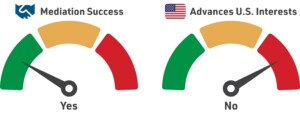
Qatar has intervened in Lebanon on multiple occasions to help resolve political crises. Each time, Qatar brokered deals that resulted in short-term calm but did not improve Lebanese stability or encourage meaningful reform. In fairness, Doha never declared the ability or ambition to reshape Lebanon or its institutions. However, in practice, Qatari mediators succeeded only at perpetuating a status quo that has pushed Lebanon to the brink of collapse while helping to sustain Hezbollah, a U.S.-designated terrorist organization.31
In 2005, former Lebanese Prime Minister Rafik Hariri was assassinated, igniting protests that led to the withdrawal of Syrian troops from Lebanon after 29 years of occupation. Political divisions between Lebanon’s Hezbollah-led Shiite bloc and Western-backed Sunni bloc intensified, resulting in prolonged political turmoil. Tensions reached a fever pitch in May 2008 when the Lebanese government, under the leadership of U.S.-backed Prime Minister Fouad Siniora, moved to shut down Hezbollah’s telecommunications network and dismiss the Hezbollah-aligned head of security at Beirut’s international airport.32 Hezbollah Secretary-General Hassan Nasrallah vowed “to cut the hand that targets the weapons of the resistance.” Hezbollah violently seized swaths of Beirut in what the government described as an “armed coup” by way of “weapons sent by Tehran.”33 Against this backdrop, Qatar stepped in to prevent Lebanon from descending into civil war. In practice, this only succeeded in maintaining Hezbollah’s extralegal position and prerogatives.
On May 21, 2008, Lebanon’s Hezbollah-led opposition reached an agreement with the country’s governing majority, thanks to the personal intervention of Qatar’s emir.34 The agreement set a timeline for the formation of a cabinet and the election of pro-Hezbollah figure Michel Suleiman as president, committed all parties “not to use weapons or violence in order to achieve political gains,” and granted Hezbollah and its allies veto power over cabinet decisions. Effectively, the Doha Agreement avoided civil war by yielding to Hezbollah’s use of force and granting the Iran-backed group control over Beirut’s decision-making.35
Qatar played a similar role during Lebanon’s two-year interregnum without a president, which lasted from October 2022 until January 2025 amidst Hezbollah’s repeated efforts to prevent parliament from selecting a new leader.36 During this time, Qatar attempted to break the stalemate in partnership with France, Egypt, Saudi Arabia, and the United States.37 Doha did not back a specific candidate and instead maintained that the presidency “is an internal Lebanese matter, and the first and the last decision is for the Lebanese themselves.” This effectively enshrined Hezbollah’s role in Lebanon’s politics until war erupted after Hamas’s October 7, 2023, attack. Thanks to Israel’s targeted killing of Nasrallah and the now-famous beeper operation in September 2024 that felled dozens of top commanders, Hezbollah is far weaker today.
To this day, Qatar remains involved in Lebanon’s domestic affairs, and its role may be intensifying.38 Qatar’s emir met with Lebanese President Joseph Aoun in Doha in September 2025.39 The commander of the Lebanese Armed Forces (LAF) met with Qatar’s prime minister in October.40 Then, in January 2026, Qatar pledged $480 million in reconstruction aid and at least $400 million more primarily to support Lebanon’s infrastructure.41 Doha did not attach any conditions to the aid, but worked with the Trump administration to obtain written assurances that Qatari-funded construction in south Lebanon would not come under Israeli fire.
Doha’s continued engagement with Lebanon will likely produce the same result it always has: temporary stability that all but guarantees the country’s dysfunction — a state of affairs that empowers actors like Hezbollah.
Yemen
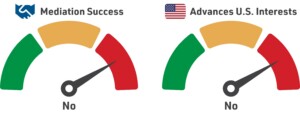
Qatar has tried repeatedly to mediate between the Iran-backed Houthis and Yemen’s internationally recognized government. Doha has notched small wins releasing hostages from Yemen, but only by enriching terrorists without bringing Yemen’s civil war closer to an end.
In 2007, Doha brokered a ceasefire between Yemen’s warring parties after conducting a series of meetings in Yemen and Qatar.42 The agreement paused the fourth of six bouts of fighting in the “Saada Wars.” However, fighting quickly resumed. The parties reconvened in Qatar in early 2008 and clinched a new deal that provided for reconstruction and reportedly envisioned the exile of Houthi leaders to Doha. That summer, Yemen’s President Ali Abdullah Saleh declared an end to the fighting in Houthi-held Saada Province.43 But again, the peace was fleeting. By August 2009, Yemeni forces launched a full-scale operation against the Houthi rebellion in Saada, and Saleh declared that Qatar’s mediation was a “failure.”44
Nonetheless, Qatar remained involved. In 2010, Doha brokered a 22-point agreement calling for “a final close to the war and the start of a political dialogue.”45 The agreement produced interim peace but did not substantially weaken the Houthis or prevent their ultimate march to Yemen’s capital, Sanaa, in 2014. In fact, Qatar participated in the Saudi-led intervention in Yemen from 2015 until 2017, when a rift developed between Doha and its Gulf neighbors.46 At that point, Qatar offered again to mediate between Saleh and the Houthis, but the rebels declined. At the same time, Yemeni government officials charged that Qatar supported the Houthis.47
Four years later, Qatar participated in back-channel talks between the Houthis and Washington, again to no avail.48 By this time, the Qataris reportedly welcomed Houthi leader Abdul-Malik al-Ajri to Doha as an unofficial ambassador of the terror group and opened an Al Jazeera office in Houthi-held Sanaa.49 Analysts in Israel say the Qataris continued to support the Houthis after October 7 by “casting them as the Robin Hoods of the Middle East” on Al Jazeera.50
Like in Gaza, Qatar failed to stabilize Yemen but successfully facilitated the release of hostages. In 2013, Qatar negotiated the release of Swiss teacher Silvia Eberhardt, who was kidnapped by al-Qaeda operatives in Yemen the previous year. Qatari officials reportedly deplaned with bags of cash when they arrived in Yemen to retrieve Eberhardt.51 The exchange was an early example of Doha financing terrorist groups through exorbitant ransom payments.
Eberhardt’s case is arguably Qatar’s only lasting success in Yemen — and it came only after Doha pumped cash into al-Qaeda’s coffers. The Houthi threat only continues to grow.
Syria
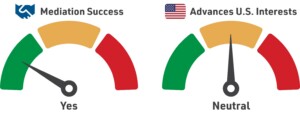
Doha has proven skilled at getting prisoners released around the world. However, it’s often accomplished this through lopsided swaps or expensive ransom payments, raising terror finance concerns and questions about whether these payoffs encourage bad actors to pursue hostage-taking as a source of leverage. Qatar’s negotiations in Syria are particularly instructive.
Prior to the fall of the Bashar al-Assad regime, Western governments employed Qatar to free their citizens from the al-Qaeda-affiliated Nusra Front and its successor group, Hayat Tahrir al-Sham (HTS), both of which received support from Doha. Qatari mediators succeeded, but often by paying large ransoms, enriching terrorists, undercutting American interests, and incentivizing further hostage-taking. Qatar’s success, in other words, created demand for its services.
In 2013, Qatar brokered the release of nine Lebanese Shiite pilgrims from the Nusra Front in exchange for two Turkish pilots detained in Lebanon. Reports suggested that Doha paid as much as $150 million to facilitate the exchange.52 A Lebanese security official said that figure “seemed high” but that “the deal did include money paid by Qatar.”53
The following year was another busy one. In March 2014, Qatar negotiated the release of 16 women held hostage by Nusra fighters. The deal reportedly involved a multi-million-dollar ransom payment.54 Qatar then secured the release of American freelance writer Theo Padnos in August. Padnos, whom the Nusra Front kidnapped in 2012, later said he was aware of “negotiations between members of Nusra Front and a Qatari ambassador” and that he held “the impression that hostage-taking and paying ransom to release the hostages is a way for Qatar to fund Nusra Front.”55 One month after Padnos’ release, Doha reportedly paid the Nusra Front as much as $25 million to free 45 kidnapped Fijian peacekeepers. Qatar and the United Nations deny a ransom was paid.56
The next year, Qatar brokered an agreement where the Nusra Front released 16 Lebanese soldiers in exchange for 25 individuals detained in Lebanon.57 Qatar also helped secure the 2018 release of Japanese journalist Jumpei Yasuda from HTS. HTS claimed it received a $3 million ransom payment, though Japanese Secretary Yoshihide Suga denied that ransom was paid.58
In 2015, Iran-backed Iraqi militants kidnapped 25 Qatari citizens, including nine members of the royal family, on a hunting expedition in southern Iraq. Qatar reportedly doled out over $1 billion to free the hostages, sending payments to HTS in Syria, Iranian proxy Kata’ib Hezbollah in Iraq, and Iran’s Islamic Revolutionary Guard Corps.59 Doha maintains that it sent the entire sum to the Iraqi government for “economic development” and “security cooperation.”60
Meanwhile, Qatar actively supported the Nusra Front as it brokered these transactions. Doha even welcomed Nusra leaders for meetings “with senior Qatari military officials and financiers” as early as 2012.61 Thus, Doha’s successes in Syria are not born of neutrality. Nor were Qatar’s successes cost-free. They came at the price of enriching terrorists and encouraging hostage-taking. Qatar is today a patron of the new government in Damascus, which is led by Ahmad al-Sharaa, former commander of Nusra and then HTS.
Afghanistan
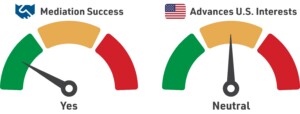
Qatar’s role negotiating the end of the war in Afghanistan is perhaps the crown jewel of Qatari diplomacy. The United States wanted a way out of its 20-year intervention and Qatar delivered, though at a steep price. Qatar helped craft the terms of America’s withdrawal, which set the stage for the Taliban to return to power. Did Qatar help end America’s “forever war”? Yes. Did the Qatari-brokered exit secure long-term American interests? No.
Qatar emerged as an interlocutor between the United States, the Taliban, and Afghan representatives as early as 2010. In November of that year, Taliban leaders met with American officials in Germany. According to news reports, Qatari officials attended the meeting at the Taliban’s request.62
In 2013, amidst reports that the United States sought to end its military operations in Afghanistan, the Taliban established a diplomatic office in Doha. The Taliban raised their black flag above the office, violating the agreement that allowed it to open and prompting Afghan officials to cancel a visit to Doha.63 Qatari officials say the office, which the Taliban referred to as their embassy, opened at the Obama administration’s request. Then-Secretary of State John Kerry later thanked Qatar for its “willingness to host the Taliban office” without confirming which government initiated the project.64 The purpose of the office was to facilitate dialogue, but it was also a fundraising platform for the Taliban.65
Qatar-mediated talks continued throughout the Obama, Trump, and Biden administrations, culminating with the February 2020 agreement that set the stage for the withdrawal of American troops.66 The episode ended with the disastrous U.S. withdrawal in August 2021, the suicide bombing at Kabul airport’s Abbey Gate that killed 13 American servicemembers and 170 Afghans, the collapse of the government in Kabul, and the Taliban’s return to power.67 In February 2025, the Taliban said they no longer consider the 2020 Doha agreement valid.68
Admittedly, the United States was keen to exit Afghanistan and, in that sense, Qatar delivered. However, in its eagerness to withdraw, the United States ultimately accepted terms that served Afghanistan to the Taliban on a silver platter. This was not an unforeseen outcome. In March 2020, Senator Jack Reed (D-RI) expressed concern that “by announcing a timetable for the complete withdrawal of U.S. forces,” the United States was “undermining the Afghan government and validating the Taliban’s long-standing perception that they can wait us out.”69
After the U.S. withdrawal, then-commander of U.S. Central Command Gen. Frank McKenzie testified that “the primary accelerant to lowering moral [sic] and general efficiency of the Afghan military was what they saw coming in the heels of the Doha agreement.” At the same hearing, then-Chairman of the Joint Chiefs of Staff General Mark Milley noted that “while the Taliban did not attack U.S. forces, which was one of the conditions, it failed to fully honor … any other condition under the Doha agreement.”70 Those conditions included guaranteeing that no “group or individual, including al-Qaeda” would use Afghanistan “to threaten the security of the United States and its allies.”71
The Doha agreement yielded chaos, but Qatar also played a role in managing it. Approximately 40 percent of those airlifted out of Afghanistan in the immediate aftermath of the U.S. pullout transited through the Gulf emirate.72 Qatar Airways continued to charter flights out of Afghanistan after the United States completed its withdrawal on August 30, 2021.73
Despite the terrible outcome in Afghanistan, Qatari mediators have achieved success securing the release of Westerners held hostage by the Taliban. Many exchanges have been lopsided and to the Taliban’s benefit. One well-known case is the 2014 swap of U.S. Sgt. Bowe Bergdahl for the “Taliban Five,” a group of senior Taliban prisoners held at Guantanamo Bay. The Taliban Five resettled in Qatar, where at least three reportedly “tried to plug back into their old terror networks.”74 This was not unexpected. Representative Mike Rogers (R-MI), then Chairman of the House Permanent Select Committee on Intelligence, warned in June 2014 that the Bergdahl deal was a “serious geopolitical mistake” that “empowered the Taliban.”75 Indeed, Qatar failed to prevent the Taliban Five from rejoining the terror organization they served: four of the five assumed senior roles in Afghanistan’s government after the Taliban seized Kabul in 2021.76
Over the years, Qatar mediated with the Taliban to facilitate the release of:
- Four Tajik border guards (2014).77
- Canadian national Colin Rutherford (2015).78
- American Kevin King and Australian Timothy Weeks (2019).79
- Argentinian national Benjamin Sinonegui (2024).80
- Austrian national Herbert Fritz (2024).81
- American citizen George Glezmann (2025).82
- American citizen Amir Amiry (2025).83
- American citizens Ryan Corbett and William McKenty (2025).84
- Canadian national David Lavery (2025).85
- British couple Peter and Barbie Reynolds (2025).86
In short, Qatar worked with the United States and other governments to achieve tactical aims in Afghanistan, such as releasing their nationals. However, Doha also worked with the Taliban to achieve a strategic victory. After a protracted war with the United States, the Taliban is back in power as the sovereign in Afghanistan. Qatar continues to support the regime.87
In late 2025, skirmishes erupted between Taliban-ruled Afghanistan and the Taliban’s former patrons in Pakistan. Qatar intervened there, too. Doha, along with Turkey, helped broker a ceasefire between Afghanistan and Pakistan in October 2025.88 However, tensions continued to flare. After a series of cross-border exchanges, Pakistan’s defense minister declared “open war” with Afghanistan on February 26.89 One week later, Afghanistan launched ground assaults on at least 16 Pakistani positions. The clashes left over 65 Afghan troops dead.90
Hostilities climaxed on March 16 when a Pakistani airstrike hit a drug rehabilitation center in Kabul.91 Within 48 hours — after engagement from Qatar, Saudi Arabia, and Turkey — Pakistan and Afghanistan announced a temporary ceasefire ahead of Eid al-Fitr.92 Qatar continues to mediate between the two countries, seemingly to preserve the Taliban’s position of power above all else.
Ukraine
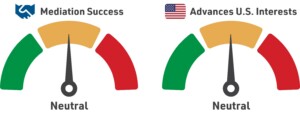
Qatar positioned itself as an interlocutor between Russia and Ukraine soon after Russia’s invasion in February 2022. Since then, Qatar has achieved tactical successes reuniting families, while maintaining limited involvement in broader negotiations to end the war.
Qatar has brokered multiple family reunification agreements since the war began, including in October 2023, April 2024, May 2024, February 2025, and March 2025.93 Qatar’s success here is laudable.
In July 2023, Ukrainian President Volodymyr Zelensky announced that Qatar would help implement his 10-point peace plan.94 Curiously, reports suggested that Qatar was simultaneously working with Russia and Turkey on a framework for exporting Russian grain, circumventing the Black Sea Grain Initiative — a UN- and Turkey-brokered agreement for the safe export of Ukrainian grain during the first year of the war. Doha dismissed these reports as “inaccurate” and maintained that it “supports a return” to the Black Sea initiative.95
One year later, Zelensky’s 10-point plan remained aspirational. Switzerland hosted a global summit in June 2024 to discuss Zelensky’s “peace formula” following a preparatory meeting in Qatar.96 Doha brokered unsuccessful talks for an aerial truce that summer but was reportedly involved in crafting the 28-point plan for Ukraine that Washington announced in November 2025. Reports do not clarify how much, if any, sway Qatar exercised over the content of the 28 points, which received fierce international criticism for their bias towards Russia.97
While Qatar has remained nominally neutral, it has steadily deepened its relationship with Russia.98 Bilateral trade grew 7.5 percent during the first year of the war — trade between Qatar and Ukraine contracted — and Doha pledged to contribute $1 billion to a joint investment fund with Moscow in April 2025.99 Qatar owns just under one-fifth of Russia’s state oil company Rosneft, which the U.S. Treasury Department sanctioned in October 2025 for helping “fund the Kremlin’s war machine.” The chairman of Rosneft’s board of directors is former Qatari Minister of Energy and Industry Affairs Mohammed bin Saleh al-Sada.100 Qatar, in other words, did not arrive at the negotiating table as a disinterested party. That said, Qatar has recently deepened its partnership with Ukraine. In March 2026, after coming under fire from Iran, Qatar signed a 10-year defense agreement with Ukraine anchored in counter-drone cooperation.101
Africa
Qatar has engaged in diplomatic efforts across the African continent for years. It is unclear what Doha has sought to gain from these mediations. However, most of Qatar’s efforts have failed, despite some initial successes.
Chad and Sudan
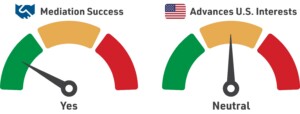
Qatar achieved lasting success brokering rapprochement between Chad and Sudan, normalizing a relationship fractured by cross-border tensions and proxy warfare. But within each country, Qatar has been less successful.
In February 2010, Chadian President Idriss Deby traveled to Sudan for the first time in six years. Chad and Sudan had been clashing for years over each other’s support for rebel groups on opposite sides of their border. Tensions reached a fever pitch in 2006 when Deby cut diplomatic relations with Khartoum following a deadly rebel attack on Chad’s capital city.102 Chad-supported Darfur rebels responded by launching a strike on Sudan’s capital in May 2008. The tides appeared to turn in 2009 when Qatar stepped in to mediate a normalization agreement.103 However, the Qatari-brokered deal did not immediately succeed. The violence continued, leading to a second agreement between Chad and Sudan in January 2010.104
One month later, Deby made his historic visit. Sudanese President Omar al-Bashir said that Deby’s trip “put an end to all the problems between Sudan and Chad” and signified a “new page” in the two countries’ relationship.105 Qatar successfully helped mend the relationship between Khartoum and N’Djamena, though it was not a disinterested third party. Doha’s efforts were designed to help stabilize Sudan, which was a key part of an axis of Muslim Brotherhood-influenced countries led by Qatar. Meanwhile, Chad and Sudan both continued to suffer from internal strife. Qatar stepped in to mediate in both cases, but without success.106
Chad
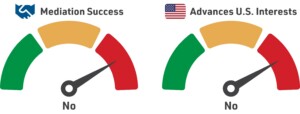
Qatar began mediating between Chad’s interim government, known as the Transitional Military Council (TMC), and dozens of rival factions in 2022.107 The TMC signed an agreement with over 30 rebel and opposition groups in August 2022, committing to engage in a national dialogue that Chadian President Mahamat Deby said “could pave the way to elections.”108 On its face, this was a positive development. However, the agreement did not include the Front for Change and Concord in Chad (FACT), the largest rebel group fighting Chad’s transitional authorities. At least eight other factions did not sign the Qatar-brokered agreement either.109
The National Dialogue enshrined in the Qatar-brokered agreement issued an ad hoc commission report in September 2022. The Biden administration was “deeply concerned” by the dialogue’s recommendations, which it believed “would jeopardize the democratic transition that was promised to the people of Chad.”110 The National Dialogue concluded in October 2022 and extended the transitional period by two years. Violent political repression preceded the country’s May 2024 presidential elections, which resulted in Mahamat Deby consolidating power. Today, Freedom House scores Chad a combined 15/100 for political rights and civil liberties, noting that opposition to Deby’s rule “generated protests by political and civil society activists, who in turn have faced violence, imprisonment, torture, and intimidation.”111
Sudan
In 2003, civil war broke out in Sudan’s Darfur region between the Islamist Khartoum government and Darfur rebel groups, particularly between government-backed Janjaweed paramilitary forces and the Sudan Liberation Movement (SLM) and Justice and Equality Movement (JEM) rebels. The ensuing war killed approximately 300,000 people and displaced over 2 million.
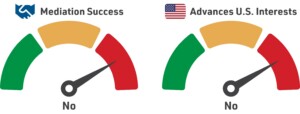
In 2009, Qatar brokered a “confidence-building agreement” between the Sudanese government and JEM — the first of several Qatar-brokered agreements intended to resolve the crisis in Darfur. Doha mediated a framework peace accord in 2010, which was followed in 2011 by the Doha Document for Peace in Darfur (DDPD).112 The Sudanese government and a third rebel group known as the Liberation and Justice Movement signed the DDPD. JEM did not.113 The DDPD served as the basis for subsequent agreements between Khartoum and JEM in 2012, and Khartoum and a JEM splinter group in 2013.114 Like the regime of President Omar al-Bashir, JEM also has Islamist roots.
Despite Qatar’s successive efforts, the conflict in Sudan did not abate. Eyewitnesses commented in 2015 that the DDPD “did not bring the people anything other than destruction, devastation, displacement, more suffering, and no tangible improvements on the ground.”115 Bashir, whom the International Criminal Court charged in 2009 with “genocide, crimes against humanity and war crimes,” remained in power, buoyed by the Muslim Brotherhood-affiliated Sudanese Islamic Movement (SIM). Bashir’s 30-year reign came to an end in 2019 only after a military coup.
Meanwhile, the war in Darfur continued until 2020, and then a renewed civil war erupted in Sudan in 2023.116 The internecine conflict continues to this day, with Qatar providing military and financial support to the Islamist-influenced Sudanese Armed Forces (SAF) — and deepening its investment in Sudan’s mining sector — while simultaneously participating in peacemaking efforts.117
Djibouti and Eritrea
As with Chad and Sudan, Qatar stepped in to mediate a border conflict between Djibouti and Eritrea. Doha was successful, albeit temporarily.
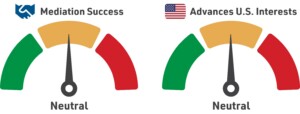
A long-simmering conflict between Djibouti and Eritrea boiled over in 2008 after Djibouti accused Eritrea of sending troops across their shared border.118 Deadly clashes erupted, and Qatar soon stepped into the breach.119 In June 2010, Djibouti and Eritrea signed an agreement that provided for “the withdrawal of Eritrean troops from Djiboutian territory” and “the deployment of a Qatari observation force” to monitor the border.120 Qatar brokered a subsequent agreement in 2016 that saw Eritrea release four Djiboutian prisoners captured during the 2008 clashes.121
However, the calm proved fleeting. In November 2016, Djibouti’s Ambassador to the United Nations claimed that Eritrea “offered a misleading and deceptive account of the progress made in the implementation” of the 2010 agreement. “Djibouti was hopeful,” the ambassador said, that the prisoner release would “induce a change in the behavior of the State of Eritrea … but that hope has quickly vanished!”122
The situation deteriorated further in June 2017 when Qatar withdrew its peacekeepers from the Djibouti-Eritrea border.123 The precipitating cause was reportedly Eritrea’s decision to side with the Saudi-led group that imposed a blockade on Qatar over Doha’s support for extremism. Within days, Djibouti accused Eritrea of occupying the disputed territory. Djibouti’s foreign minister told Reuters that “Qatari peacekeepers withdrew on June 12 and 13” and “on the same day, there were Eritrean military movements on the mountain.”124
Djibouti and Eritrea have since agreed to end their conflict, independent of Qatari efforts.125
DRC-Rwanda
The 1994 Rwandan genocide gave birth to an intractable conflict between Rwanda and neighboring Democratic Republic of Congo (DRC). Despite repeated Qatari efforts to bring this decades-long chapter to a close, the conflict grinds on.
After the 1994 genocide, the responsible militias fled to the DRC, which has served as a base for them and their successors ever since.126 The feud escalated in early 2025 when the Rwanda-backed M23 rebel group rapidly gained ground in eastern DRC.127
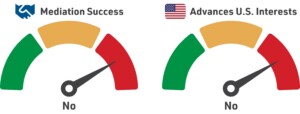
In June 2025, the Congolese and Rwandan foreign ministers signed a peace agreement jointly brokered by the United States and Qatar.128 The deal did not include M23. One of the document’s provisions provided for the establishment of the “Joint Oversight Committee” (JOC) staffed by representatives from Qatar, the United States, and the African Union.129 When the JOC met in November 2025, the parties advanced economic initiatives but “recognized lagging progress” on the implementation of the peace agreement.130
Nonetheless, Congolese President Felix Tshisekedi and Rwandan President Paul Kagame flew to Washington in December 2025 for a signing ceremony. The event was largely symbolic given that the foreign ministers of both countries had already signed the U.S.- and Qatar-brokered agreement over the summer, and the fighting had still not abated. In fact, the day after the signing ceremony, a spokesperson for the Congolese army said that Rwandan forces were “bombing blindly.”131 Six months later, the JOC reconvened in London and “expressed serious concern over the escalating fighting, the impact of drone strikes on civilians and the peace process, and the deepening humanitarian situation in eastern DRC.”132
Qatar brokered a parallel agreement between M23 and the DRC in July 2025. The agreement set August 18, 2025, as the deadline for a final peace agreement. M23 and the Congolese government accused each other of violating the deal, missed the August deadline, and continued fighting.133
Qatar subsequently negotiated prisoner exchange and ceasefire monitoring agreements before brokering a “Framework for a Comprehensive Peace Agreement” in November 2025.134 However, months passed with little progress. Qatar mediated additional talks in Montreux, Switzerland, in April 2026, where the parties agreed “to facilitate rapid, unimpeded, safe, and sustained humanitarian access” and “to release prisoners.”135 As of writing, no prisoner exchange has occurred; M23 and Congolese forces continue to clash regularly.136 Notably, Qatar’s peacemaking efforts coincided with a $500 million investment in Ivanhoe Mines, a Canadian mining company with significant operations in the DRC.137
Qatar did have an isolated success facilitating the release of Rwandan human rights activist and U.S. permanent resident Paul Rusesabagina.138 Rwandan authorities arrested Rusesabagina in 2021 after luring him to Rwanda through an “elaborate ruse” and sentenced him to 25 years in prison on spurious charges of membership to a terrorist group, murder, and abduction.139
Libya
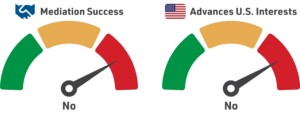
In Libya, Qatar has produced a similar mix of tactical success and broader failure seen elsewhere in its mediation portfolio.
During the civil war in Libya that led to the ouster of Moammar Qaddafi, there was a jarring moment in 2011 during which the Qatari flag was hoisted over Tripoli.140 This was a testament to the extent to which Doha had supported the Islamist rebels who overthrew Qaddafi’s regime. The end of the Qaddafi era afforded Libya an opportunity to establish a new government with greater rights for the Libyan people, yet the country remains mired in chaos and civil war with no sign of stability on the horizon.
Despite supporting Qaddafi’s ouster, Qatar likely padded the dictator’s coffers in prior years. In 2007, Doha mediated the release of five Bulgarian nurses and a Palestinian doctor whom Libyan authorities had arrested in 1999, accusing them of deliberately infecting hundreds of Libyan children with HIV. France’s then-first lady Cecilia Sarkozy was reportedly instrumental in securing the medical workers’ release.141 However, Qatar allegedly paid the price — as much as $300 million to Qaddafi’s regime.142
Within a few years of Qaddafi’s fall, Doha began offering its services to Libya’s warring parties. Qatar mediated a reconciliation deal in November 2015 between Libya’s Tuareg and Tebu tribes, which had been warring in southwestern Libya for over a year.143 According to the UN Security Council, the agreement “was violated the next day by missile attacks from Tebu-affiliated armed groups on Tuareg positions.”144 The Secretary-General of the UN Support Mission in Libya reported in February 2016 that “the implementation” of the Qatari-brokered agreement had “stalled following doubts raised by Tebu representatives” about “the neutrality of the force tasked with monitoring the ceasefire.”145
Neutrality — or lack thereof — remained an issue as Qatar continued to back the Government of National Accord (GNA) — an entity closely tied to the Muslim Brotherhood.
Somalia
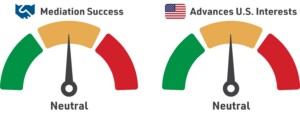
Qatar has pursued two lines of effort in Somalia: mediating between the Somali government and al-Qaeda-affiliated Al-Shabaab, and between Somalia and neighboring Kenya. Doha has not moved the needle with Al-Shabaab but did mend ties between Mogadishu and Nairobi after they broke down in 2020.
Somalia has historically been an arena of competition between Qatar and the UAE, which has allegedly driven Qatar to periodically engage with Al-Shabaab. In 2019, The New York Times said it had obtained a recording of a phone call during which “a businessman close to the emir of Qatar” claimed that Al-Shabaab had carried out a car bombing in Somalia “to advance Qatar’s interests by driving out its rival, the United Arab Emirates.”146 Two years later, Al-Shabaab spokesman Ali Dheere was allegedly evacuated to Qatar for medical treatment.147 In the interim, Washington had reportedly asked Qatar to mediate with Al-Shabaab, suggesting that a level of trust had developed between Doha and the al-Qaeda-affiliated group.148
Meanwhile, Qatar was simultaneously working with the United States, United Kingdom, United Arab Emirates, and Turkey on the Somalia file. Doha hosted the third Somalia Quint Group meeting in June 2023 in an effort to coordinate “counterterrorism and international security assistance” and “enhance confidence-building” and “capacity-building” measures.149 As of this writing, the Somalia Quint Group has reconvened, but little progress has been made.150
On the other hand, Doha has achieved success mediating between Somalia and Kenya. Diplomatic ties broke down in late 2020 after Mogadishu accused Nairobi of interfering in Somalia’s internal affairs. Qatar successfully brokered rapprochement in May 2021. Kenya suspended commercial flights to Somalia days later without explanation but reopened its airspace in June 2021 in “consideration of intercessions made.”151
Venezuela
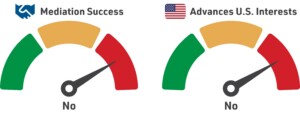
Qatar played a supporting role in Venezuela until American forces captured then-Venezuelan president Nicolas Maduro in January. Doha’s involvement was neither neutral nor effective at preventing U.S. military action.
In June 2023, Venezuelan politician Jorge Rodriguez, whose sister Delcy was sworn in as interim president of Venezuela in January 2026, met with White House advisor Juan Gonzalez in Doha “to establish a direct channel of communication” between Caracas and Washington.152 Before year’s end, Qatar brokered a deal for the release of 10 American citizens and the extradition of a fugitive Malaysian businessman wanted in the United States for defrauding the U.S. Navy. In exchange, the Biden administration granted clemency to Alex Saab, a close ally of Nicolas Maduro.153
Qatar remained eager to stay involved when Trump returned to office. In October 2025, as the U.S. military amassed forces in the Caribbean, Gonzalez told The New York Times that the Qataris were “trying to find a way to encourage a more structured dialogue or back channel” but that they were not “getting much traction with the Trump administration.” Reports surfaced in December suggesting that the Trump administration might allow Maduro to relocate to Qatar.154
Maduro reportedly wanted Qatar to intervene, as did Colombian President Gustavo Petro.155 While both men sought to forestall U.S. military action, their hopes were dashed on January 3, 2026, when U.S. forces captured Maduro and transferred him to New York to stand trial. Rumors resurfaced about secret Qatari-mediated talks between then-Venezuelan Vice President Delcy Rodriguez, her brother Jorge, and U.S. officials in the run-up to Maduro’s capture.156
Qatar reportedly disapproved of the U.S. rendition operation.157 Still, Washington transferred the revenue from the first sale of Venezuelan oil to an offshore account in Qatar, making Qatar an intermediary between Venezuela and Western oil companies with claims to settle.158 Secretary of Energy Chris Wright said that arrangement ended in February, without elaborating why.159
Policy Recommendations
Qatar has attempted to broker resolutions to some of the world’s thorniest conflicts. A perfect record cannot be expected. However, Qatar has rarely, if ever, successfully brokered lasting, long-term peace or stability. At best, Doha has achieved short-term success. At worst, Qatari mediators have brokered arrangements that tip the scales in favor of dangerous actors. And in most cases, Qatar arrived at the negotiating table with baggage.
Washington needs a due-diligence policy. The U.S. government should establish criteria for evaluating potential mediators with an eye toward assessing whether governments have financial, strategic, or ideological interests in a given conflict that will impact their ability to negotiate effectively. Where conflicts of interest arise, Washington should seek alternative mediators.
In particular, Congress should require the secretary of state to certify that all intermediaries, including Qatar, act in the U.S. national interest and are not supporting actors that the United States classifies as terrorist entities. Washington should request that mediators maintain sanction measures equivalent to the U.S. Treasury Department’s Office of Foreign Assets Control (OFAC) designations, with emphasis on the Foreign Terrorist Organization (FTO) and Specially Designated Global Terrorist (SDGT) lists.
