February 14, 2026 | FDD's Long War Journal
US Treasury sanctions Hezbollah front designed to insulate terror group’s gold reserves
February 14, 2026 | FDD's Long War Journal
US Treasury sanctions Hezbollah front designed to insulate terror group’s gold reserves
Tuesday morning, the US Treasury Department announced new sanctions against Jood SARL, a gold exchange that Al Qard al Hassan (AQAH), a Hezbollah financial institution, established last September. AQAH officially operates as a charitable institution offering loans to its customers but essentially serves as Hezbollah’s de facto bank.
AQAH has amassed massive quantities of gold taken as collateral that, given Hezbollah’s present financial difficulties, could be quickly turned into hard currency. The terrorist group may have viewed creating Jood SARL, which has no apparent connection to Hezbollah institutions and is under government regulation and supervision, as the perfect cover to cash in on the gold Hezbollah salvaged after Israel’s onslaught on AQAH’s branches in Lebanon during the fall of 2024.
The conversion of gold into cash is also a well-timed move for Hezbollah, as gold prices have skyrocketed from $2,700 per ounce at the onset of Israel’s bombing campaign in late September 2024 to over $5,000 earlier this month. Selling gold would not just alleviate Hezbollah’s cash-strapped position but also generate a significant revenue for the terrorist group.
The US Treasury moved quickly to frustrate Hezbollah’s efforts to sell gold, but it did not sanction all of the AQAH personnel involved in the new company. According to Jood SARL’s corporate papers, the official managers and shareholders of Jood’s southern branch, located in Nabatiyeh, do not appear to be the individuals who Treasury sanctioned on Tuesday.
Treasury’s press release named three AQAH senior officials as being in charge of Jood SARL: Samer Hassan Fawaz, as the official overseeing the project, and Mohamad Nayef Majid and Ali Karnib, as officials in charge of trading gold in Lebanon and, as Treasury worries, potentially overseas. Fawaz and Karnib have already been under US sanctions since July 2025, and Karnib, according to Treasury, had overseen “the purchase of over a thousand ounces of gold for AQAH” as of July 2024.
Company records and data sets obtained through the risk intelligence platform 240 Analytics show that when Jood SARL’s southern branch was incorporated in September 2025, the original shareholders and managers were Hassan Dib Ayoub and Hassan Loutfi Saad, two lesser-known mid-level AQAH employees. (Note: The author of this report serves as a senior advisor to 240 Analytics.) Ayoub and Saad’s double role as managers and shareholders is confirmed by original corporate data extracted from Lebanon’s commercial registry. As of September 2025, both men appear on the company papers for the Jood branch in Nabatiyeh, named “Jood South Sarl” in those corporate records.
These corporate records suggest that, through Jood SARL, AQAH is seeking to establish a new way to evade sanctions. Treasury notes that Jood SARL has two corporate ID numbers, which is an anomaly for corporations. Usually, a company with subsidiary branches, such as a large retail bank, only has one ID for the main company, not one for each branch. The distinct IDs indicate that the two identified Jood branches are registered as separate companies (corporate records for Jood South bear one of the two ID numbers that Treasury identified).
Jood’s two confirmed open branches also bear slightly different company names (Jood and Jood South), another slight differentiation that suggests they are different entities, not parts of the same company. These distinct IDs and names may be deliberate: each new branch could, at least legally, be a separate entity, and its managers would, presumably, be new AQAH mid-level employees like Ayoub and Saad, who are not under a US Treasury designation. This setup may be an AQAH obfuscation mechanism that aims to buy the Hezbollah-affiliated institution more time in its efforts to avoid US sanctions.
The fact that both Ayoub and Saad work for AQAH is beyond dispute. According to information obtained through 240 Analytics, which includes AQAH account records leaked by an anonymous hacker group in December 2020, Saad had, at the time of the leak, nine AQAH accounts (see image below), and Ayoub had 15. Saad held all of these accounts at a special branch of AQAH that caters to Hezbollah members.
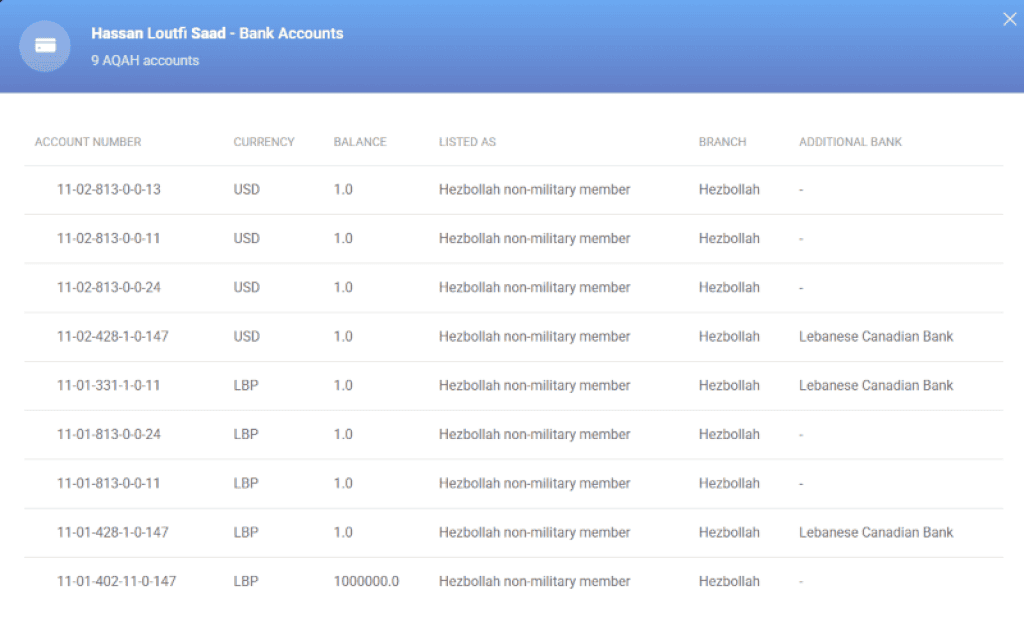
Ayoub’s social media posts, including a photo of him attending an AQAH-sponsored children’s event, a post mourning the passing of AQAH’s founder, Al Haj Hussein Ali al Shami (who Treasury sanctioned in 2006), and posts commemorating the death of Hezbollah Secretary-General Hassan Nasrallah, further confirm his affiliation with both AQAH and Hezbollah.
The combined data from social media and company records leaves no doubt about Ayoub’s and Saad’s links to AQAH and Hezbollah. It is possible that Jood SARL’s management will try to deflect sanctions by claiming that Treasury misidentified the company’s managers. It is also likely that Jood SARL will attempt to open new branches as independent companies to portray them as not being part of AQAH. However, the data suggests otherwise.
Dr. Emanuele Ottolenghi is a senior research fellow at the Center for Research on Terror Financing (CENTEF) and a senior advisor to 240 Analytics.