December 10, 2025 | Insight
8 Reasons Why the U.S. Must Maintain a Ban on Iran’s Uranium Enrichment and Plutonium Reprocessing
December 10, 2025 | Insight
8 Reasons Why the U.S. Must Maintain a Ban on Iran’s Uranium Enrichment and Plutonium Reprocessing
The United States and the international community have spent decades trying to restrict Iran’s uranium enrichment and plutonium reprocessing capabilities given the regime’s threats against the West and its ambition to possess nuclear weapons. Because the 2025 “snapback” of UN sanctions on Iran revived earlier bans, Iran is again legally prohibited from these activities, but verification is impossible due to limited access by the International Atomic Energy Agency (IAEA).
Negotiations to revive limits on Iran’s nuclear program in exchange for sanctions relief collapsed in June 2025 after Israel attacked Iranian nuclear facilities, leading to the snapback’s formal termination of the 2015 nuclear deal on October 18, 2025. A recent report by Iran International claimed that President Donald Trump sent a message to Tehran via Saudi Arabia with three preconditions for resuming these negotiations. Regardless of the status of negotiations, Washington and its European allies, as Iran’s chief negotiating counterparts capable of lifting UN restrictions, must maintain the international ban on any Iranian uranium enrichment and plutonium reprocessing, either of which could provide fissile material for a nuclear weapon. More broadly, denial of access to the full domestic fuel cycle must remain the cornerstone of U.S. counterproliferation policy toward both friend and foe.
Denied fuel for nuclear weapons, Iran’s ability to threaten America, Israel, and other regional states would be less credible, thereby limiting Tehran’s options for escalation in the months and years ahead. Here are eight ways the United States, Europe, and the international community benefit from maintaining the ban:
1. The ban maintains the strategic advantage achieved by President Trump’s use of the military option.
While four post-Cold War American presidents promised to prevent the Islamic Republic of Iran from developing nuclear weapons, only Trump was willing to use force to strike enrichment facilities and other nuclear sites in Iran. As a result, Tehran is not enriching uranium for the first time in nearly 20 years and has no route to reprocess plutonium. This is an impressive feat and should be preserved. Any deal that permits even minimal domestic enrichment or lets Iran enrich uranium abroad blatantly undermines the historic advantage afforded to the U.S. position following Operation Midnight Hammer, sending a dangerous signal to Tehran. Such concessions would embolden the regime, inviting escalation and risk-taking as well as reinforcing the notion that major concessions are achievable — even after the use of force, which would, in turn, lengthen the timeline of the crisis rather than the timeline of the president’s win against Iran.
2. The ban preserves the severe bottlenecks that now exist in Iran’s nuclear weapons pathway.
U.S. and Israeli strikes disrupted Iran’s near-term pathway to nuclear weapons. The Islamic Republic had previously amassed enough material to fuel up to 22 weapons. Iran also had multiple functioning uranium production facilities and was advancing its weaponization capabilities. U.S. policy should avoid contributing to a new nuclear crisis with Iran in which Tehran resumes amassing enriched uranium or starts reprocessing plutonium that the regime could use for a latent bomb program. Washington should instead seek to retain technical bottlenecks.
3. The UN Security Council voted to restore a ban on Iranian enrichment and reprocessing via sanctions ‘snapback.’
In September 2025, pursuant to a diplomatic effort led by America’s European partners (France, Germany, and the United Kingdom) and the Trump administration, the UN Security Council restored suspended UN Security Council resolutions demanding that Tehran cease uranium enrichment and plutonium reprocessing activities, rendering this the prevailing international legal position. The United States should support this prohibition rather than undermine it.
4. The ban reinforces the president’s commitment to destroy new Iranian enrichment attempts.
Trump has stated on several occasions following the June strikes that he will militarily eliminate any new enrichment or nuclear weapons efforts Iran attempts to restore. This policy may extend to any assets the regime attempts to recover from destroyed sites. This is also likely to be Israel’s policy moving forward to prevent a renewed Iranian threat. Throughout his second term, Trump has also demanded the full, verifiable, and permanent dismantlement of Iran’s nuclear program as the basis for a new deal. “Total dismantlement, that’s all I’d accept,” he told Meet the Press in May, just prior to the strikes, as he pressed Iran to dismantle or face military action.
5. The ban avoids legitimizing Iran’s false claims it has ‘right to enrich.’
Tehran falsely claims that enrichment and reprocessing are a matter of its fundamental nonproliferation and national security rights. Yet the Nuclear Non-Proliferation Treaty (NPT) does not grant states parties an explicit right to produce nuclear fuel. Moreover, Iran has been in noncompliance with its NPT safeguards agreements for over three decades and should not be rewarded with enrichment or reprocessing. Tehran first began its nuclear fuel production and nuclear weapons efforts in secret, or outside of IAEA safeguards, which proves the program was never geared toward electricity production but rather toward producing fuel for a bomb program. This will most certainly remain the case if Iran rebuilds such capabilities.
6. The ban does not prevent Iran from importing fuel rods for energy production.
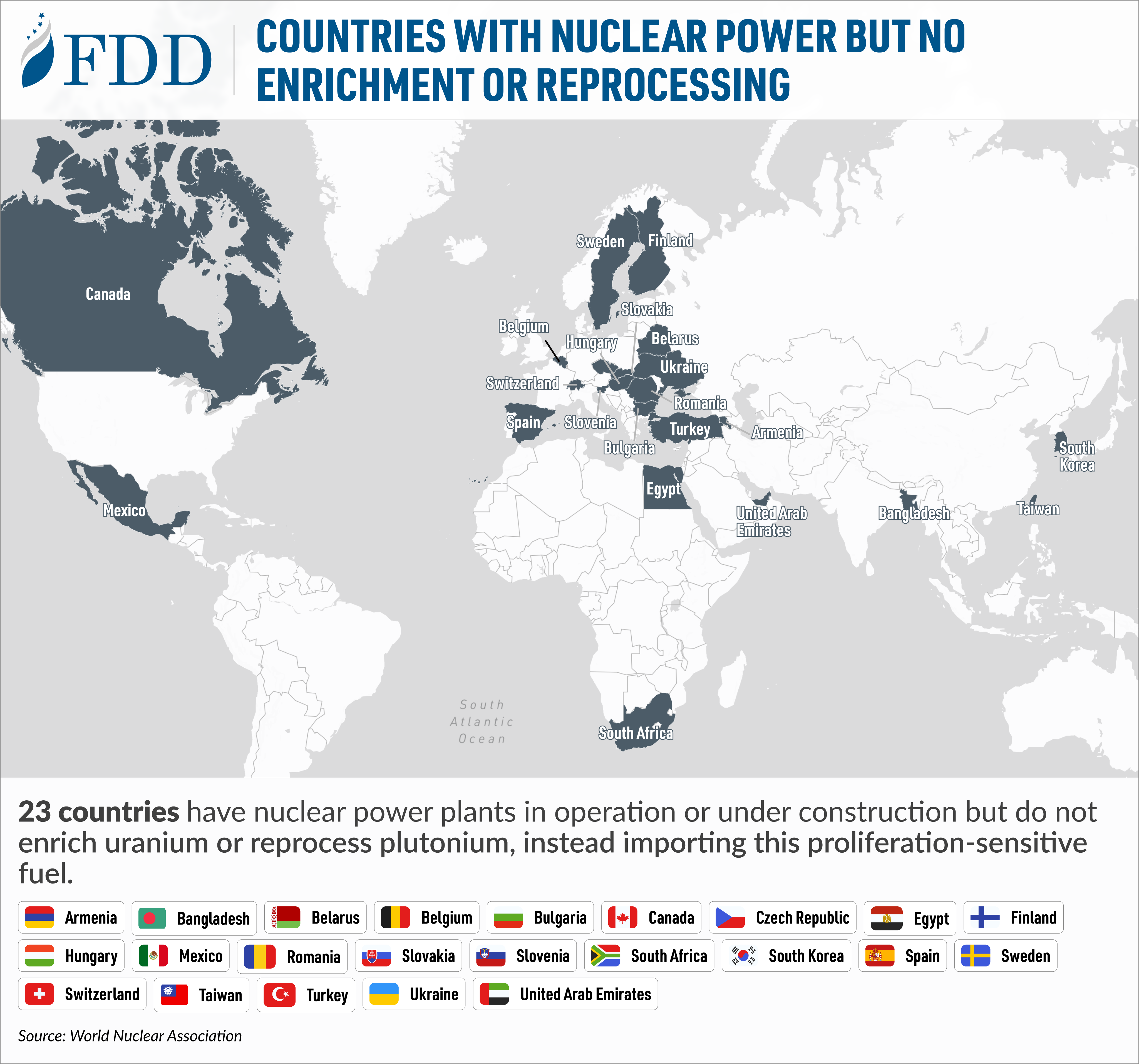
Iran claims that it needs enrichment to fuel the nuclear reactors it uses for research and energy production. Yet despite possessing an enrichment program for more than two decades, Iran only fuels its small Tehran Research Reactor (TRR), supplementing its domestic production with Russian fuel. There’s no reason for Iran not to rely on Russia to fuel the TRR. Moscow also provides fuel for the Bushehr nuclear power plant and is expected to fuel new power plants and small reactors in Iran. All told, Tehran only receives some 2 percent of its entire electricity mix from nuclear power. If Iran were serious about generating more electricity from nuclear plants, it could affordably and reliably import enriched uranium fuel rods from established commercial suppliers outside Iran, just as some 23 other countries do without enriching uranium or reprocessing plutonium.
7. The ban must encompass all Iranian supply lines for enrichment to prevent a covert program.
President Trump demanded Iran’s full nuclear dismantlement, but under the reported terms of a U.S. offer to Iran in May 2025, Tehran could retain low-level enrichment and later play a role in a regional enrichment consortium.If Iran agreed to limit its enrichment purity level and stockpile under a new nuclear deal or agreed to participate in and supply a regional enrichment consortium, it would presumably retain assets such as gas centrifuges, production equipment, and possibly fully functioning facilities. States and suppliers may also be freer to sell or provide Iran with commodities that could help it rebuild its supply chain for uranium and plutonium production, domestic expertise, facilities, materials, and equipment. Relaxing restrictions in this way creates substantial risk. Tehran’s long history of nuclear proliferation shows how easily it can establish parallel military and civilian nuclear tracks to obfuscate its true intentions of furthering a capability to build nuclear weapons. Any nuclear supply chain ensures the regime can surmount all caps to move to production of nuclear weapons-grade fuel in secret or after Trump leaves office.
8. The ban is essential to prevent the spread of nuclear fuel production capabilities throughout the Middle East and beyond.
Any form of U.S.-supported Iranian enrichment, or even permission for its involvement in a regional consortium that includes Arab states, will only fuel the proliferation of dangerous expertise and supply lines for covert enrichment. Worse, such actions will prompt other states — Turkey, Egypt, and even critical allies like South Korea and Vietnam — to demand the same privileges or even push forward with their own independent nuclear fuel programs. Letting nuclear fuel production proliferate — after decades of keeping it firmly contained — risks placing many new states on the verge of nuclear weapons and directly undermines vital U.S., regional, and global security interests.
Mark Dubowitz is the chief executive of the Foundation for Defense of Democracies (FDD), where Miad Maleki is a senior advisor, Behnam Ben Taleblu is a senior fellow and senior director of the Iran Program, and Andrea Stricker is a research fellow and deputy director of the Nonproliferation Program. For more analysis from the author and FDD, please subscribe HERE. Follow the authors on X @mdubowitz, @miadmaleki, @therealBehnamBT, and @StrickerNonpro. Follow FDD on X @FDD. FDD is a Washington, DC-based, nonpartisan research institute focused on national security and foreign policy.