October 17, 2025 | FDD's Long War Journal
Hezbollah holds massive ‘Sayyed’s Generations’ scouting event in Beirut
October 17, 2025 | FDD's Long War Journal
Hezbollah holds massive ‘Sayyed’s Generations’ scouting event in Beirut
On Sunday, October 12, Hezbollah hosted a massive scouting event in Beirut’s Camille Chamoun Sports City Stadium, Lebanon’s largest sporting complex. The event was dubbed “The Sayyed’s Generations” in honor of Hezbollah’s fallen Secretary-General Hassan Nasrallah. The gathering commemorated the 40th anniversary of the group’s official scouting arm, the Mahdi Scouts, and served as the finale in a series of events hosted by Hezbollah to mark the anniversary of the assassination of Nasrallah and Hashem Safieddine, his erstwhile successor and head of Hezbollah’s Executive Council.
The attendees and the event
Hezbollah began preparations for “The Sayyed’s Generations” three months ago. The group’s media outlets claimed that over 8,000 party-affiliated organizers and scout troop commanders participated in the preparations. Hezbollah and its media outlets billed the gathering as “the largest scouting event in the world,” with dignitaries from throughout Lebanon and the Arab world in attendance. The participating scouts, however, were exclusively Mahdi Scouts, males and females of different age groups, who were “drawn from all areas of Lebanon,” according to the event’s organizers, “to renew their oath to the greatest of the ummah’s martyrs, his excellency Hezbollah’s Secretary-General Hassan Nasrallah.”
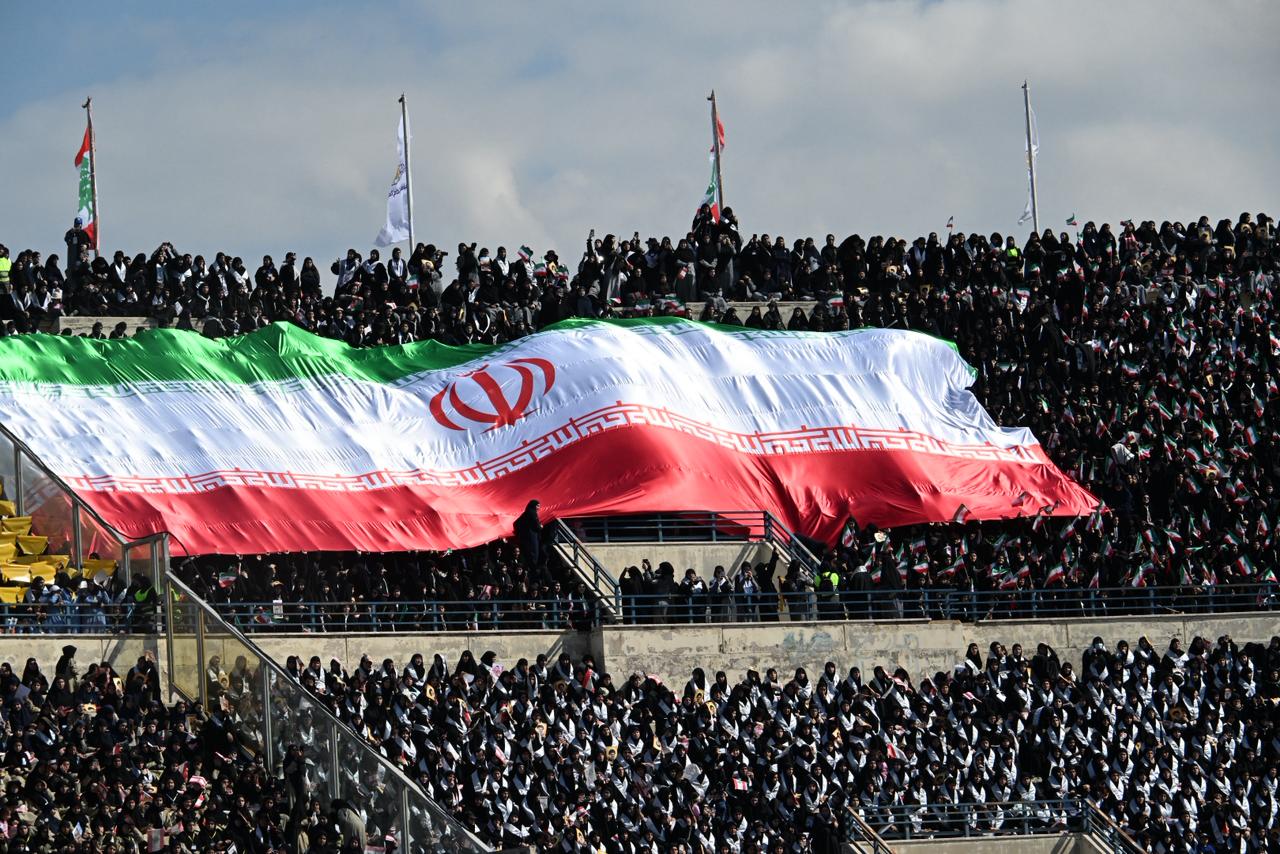
Mahdi Scouts Commissioner General Nazih Fayyad estimated the number of event attendees at 75,475. Neither this claim nor Fayyad’s numbers could be independently verified. However, the stadium’s seated capacity is 49,500, and coverage of the event at peak attendance showed that the seats were full, with overflow onto the stadium grounds.
The Sayyed’s Generations included a series of typical scouting events, including demonstrations and processions. However, an ideological element was ever-present: Anasheed (Islamic devotional songs) were played to extol resistance, scouts recited ideologically driven poetry, and attendees bore the flags of Iran and other Resistance Axis-aligned countries, as well as pictures of Nasrallah and Safieddine. The scouts were also called upon to renew their oath of loyalty to the fallen Nasrallah and his path.
The event’s centerpiece was a massive, 5,000 square-meter picture of the former Hezbollah secretary-general, bearing his quote that the Mahdi Scouts “organization is a trust in your hands [lit. necks] for generation after generation.”
Nazih Fayyad’s and Naim Qassem’s speeches
The two most significant speeches at the event were given by Mahdi Scouts Commissioner-General Nazih Fayyad and Hezbollah Secretary-General Naim Qassem.
In Fayyad’s speech, he said that the attendees “have not come to challenge anyone [in Lebanon] or break any numerical records, but to pose a challenge to the Zionist enemy and demonstrate to it that the generations of the sayyed are continuing his path. We, the generations of the sayyed, have come to show the world that we remain loyal to the path—with more determination, trust, and hope.” Addressing the scouts, Fayyad said, “You are the future of tomorrow, the standard bearers,” stressing that “Lebanon will not be built upon sectarian hatreds and grievances.”
Qassem concluded the event with a brief speech of his own, extolling the pedagogical importance of the Mahdi Scouts, which would guide its young members to be “soldiers in the path of establishing justice according to the righteousness of the religion.”

Addressing the attending scouts, Qassem described them as “the bright future, the pioneers of righteousness and justice” who would maintain Hezbollah by acting as “the generations of the sayyed, on the path of the Wilaya, led by Imam Khamenei and following the approach of Imam Khomeini.” The fallen Nasrallah, he said, had shepherded these youths during his lifetime “for your own sake … for your future, so you may know the path of God, the good life, and the mujahidin and the martyrs … of happiness in both this and the next life.”
Qassem said the scouts were being “given an education in the path of Imam Hussain,” so that they may grasp and lead the world, rather than be led by it. “You are now being educated in the heart of the conflict, in the confrontation against unbelief, deviance, and aggression—you are on the path of the choice of resistance, which we mean broadly as a educational, moral, cultural, jihadi and political option, and any other meanings the word may have,” he said. Among other things, Qassem said, resistance was equally “jihad against the self and jihad against the enemy,” as well as “education to love the homeland and defending one’s people and loved ones through all means of defense.”
Qassem concluded by “entrusting [the scouts] with five matters: Utter devotion to god. Performing acts of worship. Honoring your parents. Religious and educational fortification. And to be part of the army of Imam Al Mahdi, my god hasten his noble deliverance.”
The Mahdi Scouts
The Mahdi Scouts organization was established on May 5, 1985, and officially licensed by Lebanon’s Ministry of National Education and Fine Arts under License # 563 in 1992. It is a member of the Lebanese Scouting Federation and joined the World Organization of the Scout Movement in 1998. The group accepts children of both genders aged six to 16. The Mahdi Scouts are headquartered in the Bir Hassan neighborhood of south Beirut.
Mahdi Scouts acts as a “conveyor belt” for Lebanese Shiite youths to join Hezbollah’s ideological and fighting ranks in various capacities. In addition to typical and benign scouting activities, the youths are provided with increasingly sophisticated political and religious indoctrination as they grow older. Males and females undergo separate tracks as they age. At 16 to 17, males who prove themselves ideologically and physically in the scouts become part of Hezbollah’s armed taabia, a loosely organized, voluntary reserve pool of fighters, and undergo the first phase of military training. Those who graduate from that phase undergo intizam from ages 17 to 18, during which the military and ideological training becomes more sophisticated.
Girls join the Mahdi [Female] Guides Association, the scouts’ association for older females. This organization focuses on “female-oriented” activities and programs. The aim is to transform girls and young women into proper Muslims, teaching them their religious and social “duties,” according to Hezbollah’s interpretation of Shiite Islam. The Mahdi Guides Association has its own publication, Ra’eda Magazine, aimed at young women aged 12 to 17.
The association also aims to instill its values in young women through various projects. Batoul Stars Project is an educational and guidance program in religious beliefs for girls, launched in 2011. It seeks to inculcate observance of religious obligations—including wearing a hijab, modest clothing, and praying—among Mahdi Guides Association girls ages nine to 13, and to prevent “improper” dress and behavior. The organization holds competitions among its girls to perform these duties, including prayer, ablution, fasting, Koran reading, and more.
The presumption is that, upon completing this ideologically driven pedagogy, Mahdi Scout graduates will remain on the path of Hezbollah and be loyal to its teachings. It is but one of many tools the party uses to ensure its existence in perpetuity.
The significance of the event
Hezbollah was not merely seeking to commemorate the Mahdi Scouts’ 40th anniversary or the anniversary of Nasrallah’s passing with its Sayyed’s Generations event. Since the November 27, 2024, ceasefire with Israel, Hezbollah has been confronting domestic pressure to disarm. This pressure, in turn, was induced by the Israel-Hezbollah war, international demands on Beirut to demobilize the group, and near-daily Israeli operations inside Lebanon to prevent Hezbollah’s regeneration and rearmament after the ceasefire.
However, to date, Beirut has avoided pursuing Hezbollah’s disarmament for fear of provoking a civil war due to the group’s overwhelming popularity—much like in the decades preceding the recent conflict. Hezbollah has therefore sought to demonstrate its retention of this popular support at key milestones since the November 2024 ceasefire, including by bringing out an estimated 700,000-900,000 attendees to Nasrallah’s February 23 funeral and sweeping the May 2025 municipal elections. Drawing an estimated 75,000 youths to The Sayyed’s Generations was Hezbollah’s latest attempt to demonstrate that it remains a potent force among Lebanese Shiites and deter Lebanon from forcibly disarming the group.
David Daoud is Senior Fellow at at the Foundation for Defense of Democracies where he focuses on Israel, Hezbollah, and Lebanon affairs.