May 16, 2025 | Public Comment
Examining the Threats to America’s Critical Minerals Supply Chain
May 16, 2025 | Public Comment
Examining the Threats to America’s Critical Minerals Supply Chain
Download

Full Written Public Comment
To the United States Department of Commerce Bureau of Industry and Security
On April 25, 2025, the Department of Commerce’s Bureau of Industry and Security (BIS) issued a request for public comment (the “Request”) following the initiation of an investigation on April 22, 2025, under section 232 of the Trade Expansion Act of 1962 “to determine the effects of national security of imports of processed critical minerals as well as their derivative products.”[1]
In line with the recommendations of our upcoming report for the Center on Economic and Financial Power (CEFP) at the Foundation for Defense of Democracies (FDD), “Boosting Economic Security and Combatting China’s Non-Market Practices in America’s Advanced Battery Supply Chain,” we present this comment in support of the investigation and to encourage a whole-of-government approach to working with allies and partners in the development of new, more resilient, and diversified global supply lines for critical minerals and their derivative products.
Introduction
China weaponizes capitalism against free market nations. Under the Chinese Communist Party (CCP), China is not merely a country with different geopolitical goals and economic practices, but the proponent of an economic model that is fundamentally incompatible with the market-based functioning of the global economy. A former director for China on the U.S. National Security Council staff calls it “brute force economics.”[2] While most nations respect a basic set of rules that promote fair competition, Beijing leverages a wide range of non-market practices to dominate supply chains, create resource dependencies, undermine foreign rivals, concentrate economic power, and destabilize emerging economies. This strategy is fundamentally parasitic, relying on the readiness of others to play by the rules even as China breaks them.
China’s non-market practices, including monopolization, price manipulation, massive subsidies, export dumping, IP theft, and knowledge transfers, affect industries and supply chains throughout the global economy.[3]
The market for advanced, high-energy batteries is growing rapidly, with breakthroughs in battery technology likely to expand usage to new fields of activity. The production of batteries depends, in turn, on a host of critical minerals — lithium, cobalt, nickel, copper, manganese, and graphite — whose extraction and processing are mainly under Chinese control. The Trump administration moved quickly to implement policies that encourage U.S. production of these minerals, but there is a need for countermeasures up and down and the supply chain, jointly implemented with free market partners.[4]
China has already demonstrated a willingness to weaponize supply chains against the United States, constraining exports of graphite,[5] and proposing a wide-ranging ban on the export of battery and lithium refining technology.[6] China has also targeted core U.S. allies like Japan[7] and Australia,[8] while reportedly threating South Korea with sanctions if it exports its own critical minerals to the United States.[9] China also uses economic leverage to pressure countries to adopt diplomatic positions similar to its own.[10] But this is only the beginning. As tensions with China rise, U.S. economic vulnerabilities across supply chains represent a matter of pressing national security.
To that end, and in support of the critical minerals Section 232 investigation, we have provided detailed responses to Question III and Question V of the Request. These responses can be found in full below.
Distortive Effects Analysis
The Request seeks an analysis of the distortive effects of the predatory economic, pricing, and market manipulation strategies and practices used by countries that process critical minerals that are exported to the United States including the distortive effects on domestic investment and the viability of United States production, as well as an assessment of how such strategies and practices permit such countries to maintain their control over the critical minerals processing sector and distort United States market prices for derivative products.
Drawn from research for CEFP’s upcoming report, “Boosting Economic Security and Combatting China’s Non-Market Practices in America’s Advanced Battery Supply Chain” (full report available at FDD.org soon), we have provided a comprehensive analysis of such distortive effects below.
China’s Non-Market Manipulations
“When a predator, unbound by the rules followed by its competitors, is allowed to operate in a free market, that market is no longer truly free.” — Senator Mitt Romney, referring to China.[11]
At the core of China’s quest to dominate the advanced battery market is a set of practices designed to allow China to undercut its competitors and create market distortions that reinforce its control. China’s ability to play both sides — reaping the benefits of market participants while rejecting market constraints — gives it fundamental but unfair advantages that are ultimately parasitic in nature. Where Western stakeholders seek to develop supply chains via free market practices that accurately reflect the value of lithium and other critical minerals to key industries like the automotive sector, China seeks to monopolize vertically integrated supply chains that enable it to manipulate prices. The blurred line between public and private industry helps make this possible. Beijing also relies on illicit trade practices like IP theft and dumping to bludgeon competitors out of the market. This section identifies key mechanisms by which China distorts the advanced battery and critical mineral supply chains, applying its own state-driven rules of global trade to sustain systemically destructive advantages over market economies.
Subsidies[12]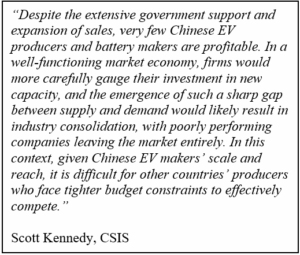
In 2009, the CCP began a program of massive subsidies for EVs and batteries, with a cumulative value that would reach more than $230 billion by the end of 2023.[13] Chinese subsidies dwarf their U.S. counterparts, such as the $2.4 billion for EVs that President Barack Obama signed into law in 2009[14] and the roughly $5 billion in federal tax credits issued to EV purchasers between 2011 and 2017.[15] This difference in scale is critical. When subsidies, like those in China, reach the point that profitability is no longer a relevant consideration for an enterprise, companies are capable of leveraging a degree of power than can push out profit-based competitors and distort the efficient functioning of markets, leading to outsized economic power and monopolies.
On the manufacturing side, Beijing’s subsidies include tax exemptions, manufacturing grants, and low-interest loans aimed at reducing production costs, thereby increasing output.[16] Consumer subsidies focus on direct cash rebates, registration fee waivers, and support for state and local electric fleet adoption, making EVs more affordable and accessible for buyers.[17] These subsidies fundamentally contribute to overproduction as domestic manufacturers seek to take advantage of government incentives absent market demand signals.[18] As a result, Chinese EVs on the market in third countries are frequently being sold at artificially low and distorted prices.[19] Fundamentally concerned with profit and fiduciary obligations to their shareholders, Western manufacturers cannot compete effectively for market share with Chinese competitors — even in their home markets. While not all subsidies are inherently problematic, the scale of Beijing’s subsidies and the goal of encouraging dependence on Chinese supply chains pose a threat to the proper functioning of markets and ultimately national security.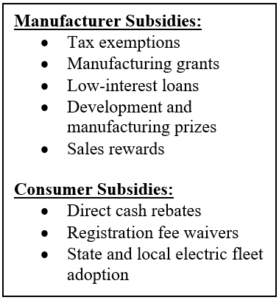
There are some indications that Beijing recognizes the risk it assumes by propping up an entire industry. In January 2024, Chinese Vice Minister of Industry and Information Technology Xin Guobin said that there was “insufficient” external consumer demand in the EV industry and that Beijing would take “forceful measures” to address “blind” construction of new EV projects.[20] Yet overproduction continues to occur throughout the Chinese economy as the CCP uses its export machine to artificially boost growth numbers for its flagging economy.[21] This excess capacity directly contributes to dumping into export markets at heavily discounted prices, damaging international competitors or pushing them out of the market altogether. (See Dumping below.)
Monopolies
China has given the green light for Chinese companies to monopolize key inputs into the advanced battery supply chain across all mining, processing, component, and end use stages. The concentration of economic power from these monopolies (or, for finance nerds, these “monopsonies”[22]) allows China to control competitors’ access to key inputs and set prices in ways that harm non-Chinese entrants into the market.
China, for instance, collectively controls 95 percent of the world’s battery-grade graphite,[23] monopolizing the supply of a mineral essential for the vast majority of battery anodes. In 2023, China produced approximately 1.23 million metric tons of graphite, marking a 50 percent increase from 2021.[24] Nevertheless, China introduced export restrictions on graphite products in late 2023 and again in 2024,[25] allowing Beijing to manipulate global markets by tightening supply. The combination of these two actions led to a spike in graphite prices.[26] Foreign companies frequently find themselves unable to compete on equal footing due to Chinese control over such inputs, adding to the challenge of compensating for the economies of scale that monopoly conditions provide to Chinese companies.
Despite a seeming proliferation of Chinese companies involved in mining and processing critical minerals, manufacturing components, and building batteries and cars, these firms are not true market competitors. Instead, they are better viewed as numerous subsidiaries of CCP, Inc.[27] China lacks a clear division between the private and public sectors, and the Chinese Communist Party directs the actions of these private organization to an extent that would be unlawful on antitrust grounds in any market economy. While Chinese companies CATL and BYD may nominally compete in the battery space, their relationship is probably more akin to the competition between Buick and Cadillac — two divisions within General Motors— than between GM and Ford. As a result, Beijing can align the private sector players into a cartel that wields monopoly power against foreign rivals.
Vertical Integration
Within Chinese battery supply chains, single companies often act as supplier, refiner, component assembler, and final manufacturer. Pushed forward by muscular state-led industrial policy and blurred lines between the private and public sectors, Chinese companies can collectively consolidate different portions of the supply chain in ways that market players frequently cannot because of regulatory or economic constraints. This gives those companies outsized influence against competitors and, conversely, insulation against market pressures to which competitors are subject. As the line between the state and private sector is blurred, it also gives the industrial ecosystem that codevelops[28] among Chinese industrial champions an ability to boost scale in ways that market players cannot replicate.
As one example of this, China’s BYD controls its own supply chain from mineral extraction to complete vehicle assembly. In January 2022, BYD secured a contract with Chile’s Ministry of Mining that grants BYD the rights to extract up to 80,000 metric tons of lithium over a 20-year period.[29] Independently, BYD has set up processing facilities in Guangxi China to refine spodumene into lithium carbonate, as well as making other cathode active materials, such as iron phosphate.[30] BYD also controls all facets of battery assembly – BYD assembles its Blade Batteries at its cornerstone Chongquing factory before putting them into cars in BYD factories in China, the United States, Brazil, Thailand, Indonesia, Canada, and Uzbekistan. [31] This control, from extraction, through processing, componentry production, assembly, and distribution insulates BYD from chokepoints in their supply chain, creating a level of integration that market players would have difficulty replicating. (Tesla is largely an exception in this regard.[32])
BYD’s Vertical Integration
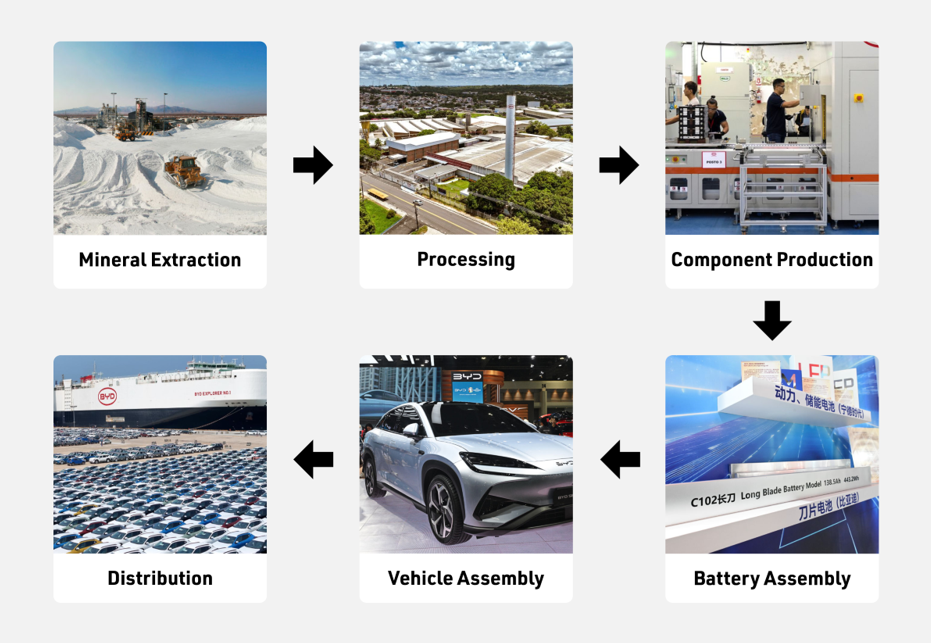
Market economies thrive on decentralization, competition, and open access to resources — factors that are threatened by aggressive vertical integration when combined with monopolies. By controlling all supply chain inputs, BYD has distinct advantages over competitors who must secure sufficient inputs from limited suppliers under volatile pricing conditions. Across the supply chain, one often sees minerals extracted at Chinese mines, processed at Chinese facilities, transported by Chinese rail to Chinese ships at Chinese operated docks, sent to Chinese battery manufacturers, then installed in Chinese cars. When combined with Beijing’s other non-market manipulations, this level of control makes competition from non-Chinese companies nearly impossible.
Price Manipulation
Given the degree of monopoly power that China possesses, it is not surprising that China can, and does, manipulate price in ways that protect domestic industry champions while strategically boxing out market competitors. Indeed, China has weaponized price volatility both because of its monopoly power and to sustain it.
China’s Tsingshan Holding Group is one of the world largest nickel producers,[33] with massive factories in Indonesia that process the local nickel ore into minerals suitable for batteries and stainless steel. In 2019, Indonesia — the world’s largest nickel-producing country — instituted a ban on the export of unprocessed nickel ore, putting the ban into effect just a month after Indonesian President Joko Widodo had met at the presidential palace with the CEO of Tsingshan and the heads of Chinese companies Huayou Cobalt and CATL — the world’s largest cobalt and battery manufacturing firms, respectively.[34] A source indicated that the Chinese delegation had “lobbied very intensely [for Indonesia] to completely ban exports.”[35] Since Tsingshan processed its ore within Indonesia, the ban only affected its competitors. Thus, Tsingshan could continue to supply China’s voracious battery and steel industries. Yet foreign battery and steel makers would feel the pinch of a substantially restricted supply of nickel ore.
In theory, international stockpiles — most notably, the large nickel inventory at the London Metals Exchange (LME) — are supposed to cushion the impact of supply disruptions. Curiously, however, on the eve of the Indonesian announcement of the ban, an unknown party had begun buying up nickel inventory from the LME at a furious pace. The purchases were made using over-the-counter (OTC) trades that hid the identity of the purchaser from the LME.[36] This $1.8 billion buying spree took 25,000 tons of nickel off the market immediately – the largest withdrawal in the four-decade history of nickel at the LME – and snapped up futures on another 75,000 tons. [37] Once the dust had settled, the primary nickel purchaser came forward – Tsingshan Holding Group.[38] Estimates are they may have bought as much as 80 percent of the haul. [39]
As soon as the 2019 Indonesian nickel ore ban went into effect, Tsingshan’s competitors took a massive hit. Outokumpu, a Finnish steel producer heavily reliant on nickel, saw earnings drop by nearly 50 percent because of the high prices.[40] Senator Mitt Romney (R-UT) saw the market manipulations and lamented: “Another near-monopoly is born, thanks to [China’s] anti-competitive tactics.”[41]
It wouldn’t be the last time Tsingshan artificially altered nickel prices via the LME. In 2022, large Tsingshan OTC purchases led nickel prices to surge nearly 400 percent in three days,[42] causing the LME to take the unprecedented step of cancelling $12 billion worth of trades.[43] The trade cancellation triggered a lawsuit claiming that the Chinese-owned LME wiped out the trades to “save” Tsingshan at the expense of non-Chinese traders, amounting to a “multi-billion-dollar bailout” of the Chinese company.[44]
China’s control of lithium supplies allows even greater power to set prices than in the case of nickel. The pricing mechanism for lithium markets is deeply flawed because global prices for both the underlying commodity and derivative futures depend on prices set by China, not market transactions.
The Chicago Mercantile Exchange, for instance, bases its price for lithium derivatives on Chinese pricing, as relayed by the Fastmarket pricing feed.[45] LME also relies on prices relayed by Fastmarket.[46] Those Fastmarket prices reflect pricing information that Beijing directs state-controlled Chinese mining, shipping, and processing companies to share.[47] The prices are not based on any underlying contracts — all of which remain confidential and opaque regarding actual price. As a result, China can set global lithium prices by fiat, and non-Chinese companies have no visibility into the pricing mechanisms.
Lithium prices have fluctuated wildly over the last decade, tracing a path that follows Chinese interests. When demand for lithium batteries spiked in 2021 due to subsidies introduced by the Biden administration’s Inflation Reduction Act, supply became scarce. Chinese producers Ganfeng Lithium and Tianqi Lithium reduced their supply of processed battery-grade lithium and prioritized deliveries Chinese battery manufacturers with long-term contracts like BYD and CATL. In the months that followed, the price of lithium carbonate rose tenfold from $7,000 per metric ton in January 2021 to over $75,000 per metric ton by the fourth quart of 2022, harming U.S. battery makers.[48] On the flip side, low prices and China-driven volatility undermines non-Chinese efforts to raise funds for capital intensive processing facilities that would increase the supply of processed lithium and dilute Beijing’s control.
Critical Mineral Price Variability
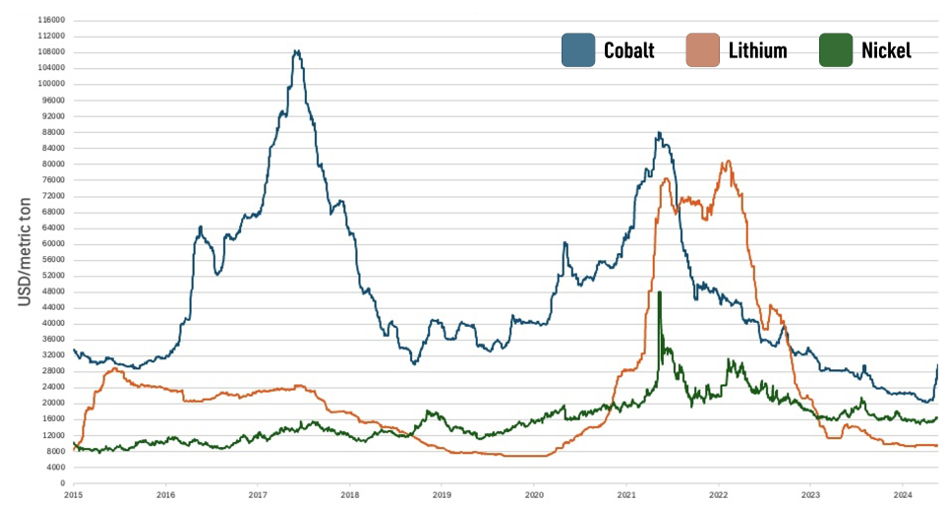
Chart provided by Metal Miner Insights
The uncertain returns from a market with low or unstable lithium prices renders such investments less attractive, particularly since processing facilities can take as long as a decade to build. In 2018, for instance, Canadian firm, Nemaska Lithium announced plans to operate the largest spodumene deposit in North America, attracting around a billion dollars from funders like SoftBank[49] and Investissement Québec.[50] Shortly thereafter, global lithium prices fell by more than 60 percent.[51] This price collapse heavily affected Nemaska’s financial projections, and the project closed. Absent an independent, ex-China pricing mechanism for lithium, China can comfortably drive competitors out of the market at will.[52]
Dumping
China is making way too much of everything. This is particularly true of sectors that the government is prioritizing, like EVs and batteries. This year, China is likely to make more than twice as the total global demand for EVs last year. For 2025, Chinese sources indicate that the country is on pace to manufacture more than 36 million new EVs in 2025,[53] despite only 17 million EVs being sold worldwide last year and an anticipated global demand of just 20 million electric cars in 2025.[54] Western sources suggest 2025 production may only reach 25 million – still far more than global demand.[55]
This overproduction was not merely a market quirk created by overzealous manufacturers but is an anticipated consequence of intentional government policy.[56] As early as 2021, Chinese analysts were anticipating massive overproduction from China’s 14th Five Year Plan, which mandated the production of seven times more EVs than anticipated domestic demand for 2025, as projected by the Ministry of Public Security.[57]
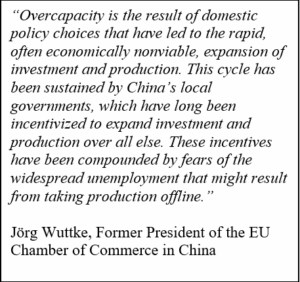
This wild distortion of market dynamics derives from China’s artificial approach to manufacturing growth. In China, GDP growth figures are not simply reflections of past economic activity. Rather, Beijing announces growth targets a year in advance and the municipal governments establish parameters and incentives that ensure those targets are met. Chinese companies adjust their behavior accordingly.
For 2024, the GDP growth target was set at 5 percent. (China has also announced a target of “around 5%” for 2025.)[58] For Chinese companies, that means that the government is expecting them to produce an average of 5 percent more goods than the previous year, irrespective of demand. By delinking production objectives (that is, Chinese supply) from actual demand and putting pressure on Chinese producers to always be supplying more, China ends up making too much of just about everything, depressing global prices.
Beijing cannot absorb this oversupply at home because it has kept its own consumer market undeveloped by design. Building a true consumer economy would require giving consumers more economic power and would necessitate shifting power away from the CCP[59] — a trade that Party leaders are unwilling to make.
The combination of China’s weak domestic consumer demand and state-mandated oversupply of goods means that enormous amounts of goods must be sent overseas, flooding international markets with cheap products — sometimes even at prices that are below the production cost, a practice known as “dumping.” By selling at or below cost, Chinese often drive local producers out of business, creating dependence on Chinese imports and potential inflicting long-term damage on local economies. Many scholars refer to the sharp increase in Chinese imports to the United States in the early 2000s as the “China Shock”[60] and hold it responsible for the majority of jobs lost in that period in the U.S. manufacturing sector.[61]
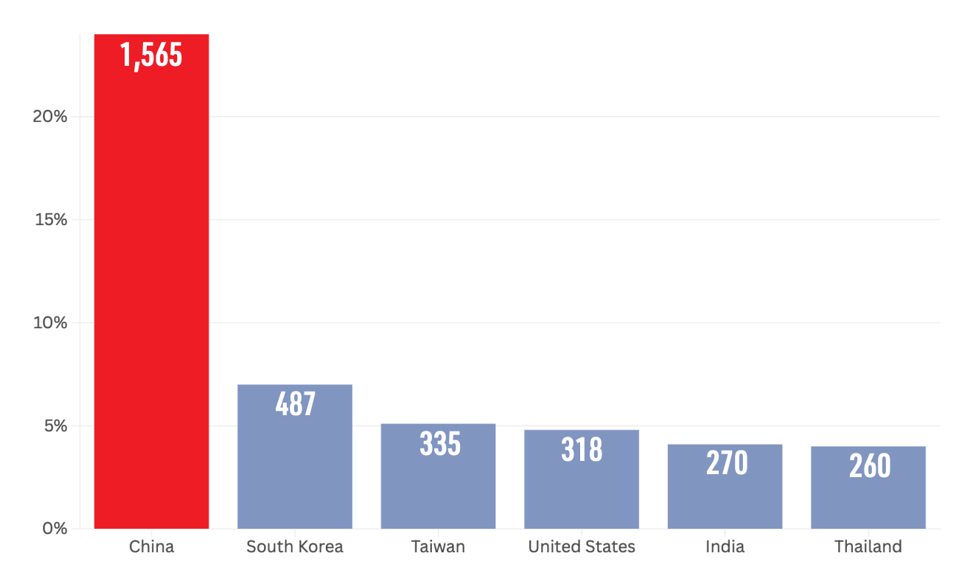
Around the world, countries have opened investigations into Chinese dumping practices and are trying to construct trade barriers to combat it. This pushback extends well beyond cars and batteries to steel, aluminum, solar panels, shipbuilding, cement, paper, glass, fertilizers, chemicals, footwear, frozen warmwater shrimp, and more.[62] The United States, the European Union, India, Argentina, Turkey, Mexico, Australia, Canada, Japan, and South Korea have all launched investigations.[63] Even countries friendly to China, such as Brazil, Vietnam, and South Africa, are pushing back.[64] From 1995 to 2022, China was the subject of 1,565 anti-dumping investigations, nearly one-quarter of all such investigations initiated by WTO members. [65] That represents more than three times the number of investigations initiated against the second most investigated country, South Korea.[66] In 2024, China accounted for nearly one half of all of the global dumping investigations.[67] Facing artificially low prices, importing nations have ample reason to put tariffs on Chinese goods, forcing their prices up to more appropriate levels.
WTO Member by Number of Anti-Dumping Investigations (1995-2022)
Knowledge Transfer
China has used its economic weight to extract technology and intellectual property from Western companies, avoiding costly and time consuming investments in research and development.[68] Beijing’s “Made in China 2025” initiative, which seeks to reduce dependence on foreign manufacturers by developing domestic alternatives, is a major driver of this practice — pushing Chinese companies to coopt foreign tech by both legal and illegal means.[69]
As the Office of the U.S. Trade Representative (USTR) has put it, “China’s regime of technology regulations forced U.S. companies seeking to license technologies to Chinese entities to do so on non-market-based terms that favor Chinese recipients.”[70] USTR also concluded that China uses the acquired technology to develop new domestic champions that drive out Western competition.[71] The Trump administration’s America First Investment Policy explains the practice:
“Certain foreign adversaries, including the People’s Republic of China (PRC), systematically direct and facilitate investment in United States companies and assets to obtain cutting-edge technologies, intellectual property, and leverage in strategic industries. The PRC pursues these strategies in diverse ways, both visible and concealed, and often through partner companies or investment funds in third countries.”[72]
Often, foreign companies seeking to do business in China have been explicitly or tacitly required to form joint ventures with local partners. On the surface, this arrangement appeared mutually beneficial: Foreign firms gained access to local expertise to navigate China’s notoriously complex market and byzantine bureaucracy,[73] while China’s economy received a boost[74] and its firms received a share of the profits. In practice, these joint ventures have largely served as a conduit for transferring proprietary knowledge and technology from foreign companies to domestic firms.[75]
With expertise and intellectual property acquired from foreign firms, Chinese companies often develop independent production capabilities, eventually dominating the domestic—and, in many cases, international—markets, often displacing the very partners from whom they had obtained the technology.[76] The case of wind turbines illustrates this point. Xinjiang Goldwind Science and Technology Co. (Goldwind) is the largest wind turbine supplier in the world.[77] Between 1989 and 2001, Goldwind partnered with three European wind-turbine manufacturers—Bonus Energy A/S, Jacobs Energie GmbH, and Repower Systems AG—all of whom transferred their proprietary technology to Goldwind in compliance with Chinese law.
Between 2005 and 2023, China’s total cumulative wind power capacity surged from just 1.26 GW[78] to 474.6 GW,[79] accounting for over 45 percent of global capacity, up from just 2 percent.[80] This staggering 37-fold increase was driven by China rapidly seizing the lead in global wind turbine production, with Chinese companies contributing 65 percent of total new wind turbine manufacturing in 2023.[81] Goldwind was the leading wind turbine manufacturer that year, producing 16.3 GW of new capacity. [82]
Mandatory technology transfer and related practices may collectively cost foreign competitors upwards of $600 billion per year.[83] This is both parasitic and unsustainable, as it undermines the incentives for foreign firms to invest both in China and in R&D out of fear that their proprietary tech will be handed over to competitors without adequate legal recourse or protection.
IP Theft
Despite its dominant position across the supply chain, Beijing also resorts to state-sanctioned commercial spying and outright theft to reinforce its advantages. It is impossible to get clear data on how widespread this practice is, but the record of federal prosecutions suggest it is a well-entrenched practice endorsed by the CCP, since “80 percent of all economic espionage prosecutions brought by the U.S. Department of Justice (DOJ) allege conduct that would benefit the Chinese state,” according to DOJ.[84] U.S. companies have also filed more than a thousand lawsuits against Chinese firms alleging IP theft and, of the 224 publicly reported Chinese espionage incidents inside the United States, the majority of cases were aimed at acquiring commercial technology.[85]
The battery supply chain is clearly among the targets of espionage. In March 2024, for instance, DOJ charged two individuals with conspiring to steal trade secrets from Tesla to benefit their China-based business specializing in battery technology for electric vehicles. DOJ also charged a former Apple engineer with stealing trade secrets from Apple’s autonomous vehicle project.[86] In 2019, a Chinese scientist pled guilty to stealing IP valued at more than a billion dollars from Phillips 66 Petroleum Company relating to next-generation battery and energy storage solutions. The theft sought to benefit China’s state-owned Xiamen Tungsten Co., which focuses on battery-related metals research.[87]
The impact of IP theft goes beyond immediate financial losses for affected companies. It disrupts the incentive structure of a competitive market. When companies know their intellectual assets may be stolen without repercussion, they are less likely to invest heavily in breakthrough technologies, less likely to enter otherwise important foreign markets, and less likely to hire potentially beneficial foreign employees. This manipulates the development of a genuinely innovative and competitive global battery industry, creating an uneven playing field in which Chinese firms dominate at the expense of rule-abiding competitors.
Global Supply Chain Review and Risk Assessment
The Request seeks a review and risk assessment of global supply chains for processed critical minerals and their derivative products.
Drawn from research in CEFP’s upcoming report, “Boosting Economic Security and Combatting China’s Non-Market Practices in America’s Advanced Battery Supply Chain,” we have provided a comprehensive review and risk assessment of these global supply chains below.
Chokepoints in the Advanced Battery Supply Chain Stages
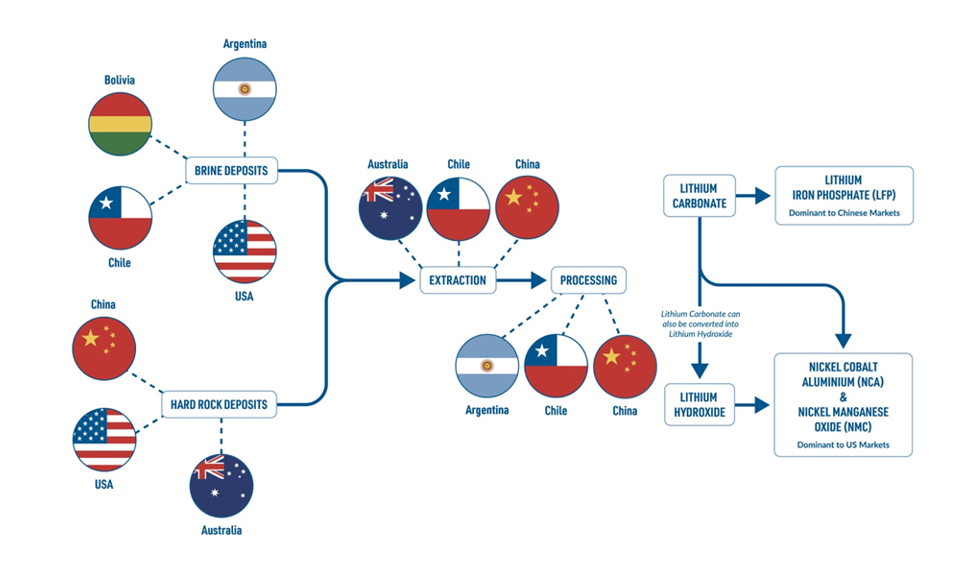
The lithium supply chain has three basic stages: (1) upstream —the extraction and refining of lithium and other critical minerals; (2) midstream — the assembly of battery components, such as cathodes and anodes; and (3) downstream — the assembly of batteries into a finished product. Upstream, Chinese dominance has created particularly severe bottlenecks in lithium refining and graphite production. In the midstream, there are massive chokepoints around China-dominated cathode and anode production. These acute vulnerabilities leave U.S. advanced battery supply chains exceptionally exposed to Chinese influence and manipulations.
China’s Upstream Control
The upstream portion of the supply chain includes both the extraction of lithium and the processing of lithium concentrate into battery-grade lithium carbonate or hydroxide. Minerals such as nickel, graphite, cobalt, and antimony also constitute critical parts of the chain. Australia and Chile are the leading providers of lithium concentrate, producing 51 percent and 26 percent of global output respectively.[88] Nevertheless, China exercises suffocating control over the upstream segment of the lithium battery supply chain by (1) securing raw material resources through acquisitions of foreign mining concessions or offtake agreements and (2) being the sole at-scale processor of almost all battery-grade lithium.
Extraction and Concentration
Brine
About 60 percent of unprocessed lithium reserves are found in the form of lithium brines, or saline groundwater enriched with lithium metal.[89] After being pumped to the surface, the brine is spread across large evaporation ponds, where sunlight and wind help evaporate the water over several months, concentrating the lithium.[90]
These flats are primarily located in regions like South America’s Lithium Triangle in South America, which includes parts of Chile, Argentina, and Bolivia. China has substantial ownership interests throughout the triangle. In Chile, Chinese companies and state-owned entities own 22 percent of Chile’s lithium mining giant Sociedad Quimica y Minera (SQM),[91] and 26 percent of the Siete Salares-Talison Lithium Project.[92]
China holds varying levels of ownership stakes in Argentina’s Cauchari Olaroz Project, Tres Quebradas Project, Mariana Project, Laguna Verde Project, and the Sal de Los Angeles Project.[93] Chinese companies have inked agreements to source 20,000 metric tons[94] and 35,000 metric tons[95] of lithium in the future from brine deposits in Argentina and Bolivia, respectively.
Russia’s uranium giant, Rosatom, is also investing in lithium brine extraction projects in the Lithium Triangle, constructing a lithium carbonate plant in the Bolivian Salar de Uyuni salt flat in partnership with China’s Citic Guoan Group.[96] This operation is anticipated to produce 14,000 tons of lithium carbonate per year.[97]
Hard Rock
Roughly 30 percent of global lithium reserves are found in hard rock deposits,[98] commonly from an ore called spodumene, which is favored for battery-grade lithium hydroxide production.[99] (Lepidolite is another type of lithium ore sourced from hard rock. China’s domestic reserves of lithium are mostly low-quality lepidolite sourced from mica.)[100]
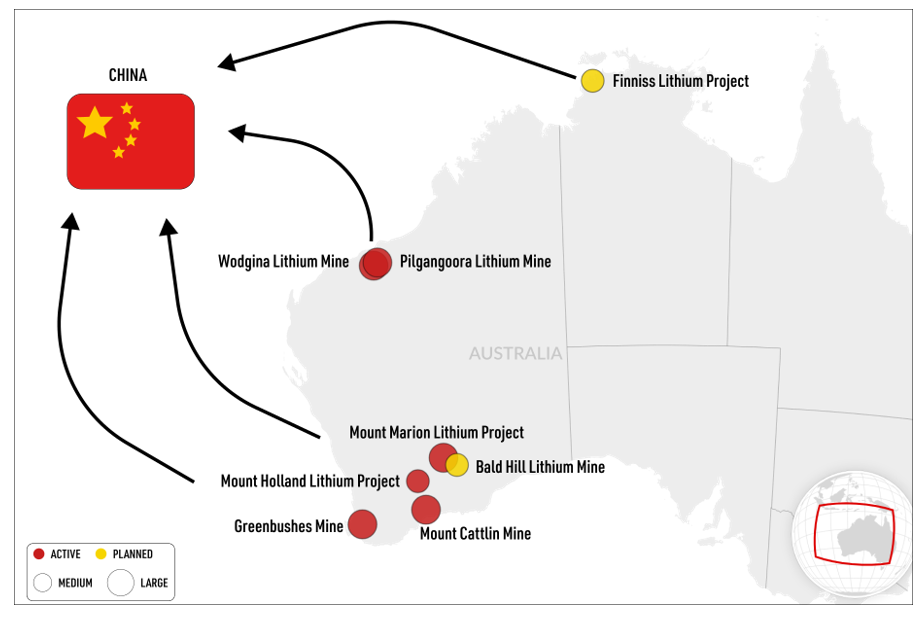
Hard rock ore is mined, crushed into a fine consistency, and then subjected to high-temperature roasting and chemical treatments to extract lithium.[101] Australia is by far the largest source of spodumene, producing more than 3,500,000 tons in 2024.[102] But in Australian fiscal year 2022-2023, 98 percent of the country’s production went to China. [103] Pilbara Minerals, a major Australian mining firm, has offtake agreements with Chinese lithium companies, including Ganfeng Lithium, Chengxin Lithium Group, Sichuan Yahua Industrial Group, and Yibin Tianyi Lithium. [104] Chinese firms also own major stakes in the mines themselves. Tianqi Lithium holds a 26 percent stake in the Greenbushes mine and Ganfeng controls 50 perecent of the Mount Marion Lithium Project.[105]
Australian Lithium Mining Projects
Clay
In addition to brine and rock, lithium-rich clay deposits, such as those found in Nevada and throughout Mexico, have the potential for being major future sources of lithium. Yet, technical challenges to fully exploit the resources remain. Clay extraction, which uses chemicals to leach lithium from the clay, is still largely developmental in nature and not used at scale.[106]
New extraction processes — such as Direct Lithium Extraction (DLE) — are being tested to improve the efficiency of processing for both clay and brine deposits. DLE uses filters, membranes, and chemical solvents to selectively extract lithium without the need for evaporation ponds.[107] It is faster and more environmentally friendly than traditional methods, with the potential to unlock previously uneconomical lithium sources.[108] While U.S. companies are deeply invested in DLE, so are Chinese companies — CATL committed to a $1.4 billion investment in Bolivia to extract lithium using DLE methods[109] and China claims to have already launched multiple commercial DLE projects.[110] Russia is also pioneering a new direct lithium sorption (DLS) process at their Rosatom lithium carbonate plant in Bolivia, in which wastewater is recycled for future extraction.[111]
Processing
Lithium processing — turning raw lithium products into battery grade chemicals — is a significant bottleneck dominated by China. Chinese companies account for 65 percent of global lithium processing.[112] The remainder of this capacity is largely located in Chile, with small amounts of processing done in Argentina.[113] However, as mentioned above, the Chilean leader in processing is SQM, a company in which China’s Tianqi Lithium holds a substantial ownership stake and three board seats.[114] There are other signs of Chinese determination to corner lithium processing operations abroad. In February 2025, Ganfeng Lithium began processing lithium at its new Mariana facility in northern Argentina, while also planning further refining expansions in Argentina.[115]
China also controls much of the intellectual property necessary to process lithium and is considering export restrictions that may prevent American companies from licensing this technology.[116]
Lithium Battery Supply Chain
Non-Lithium Critical Minerals
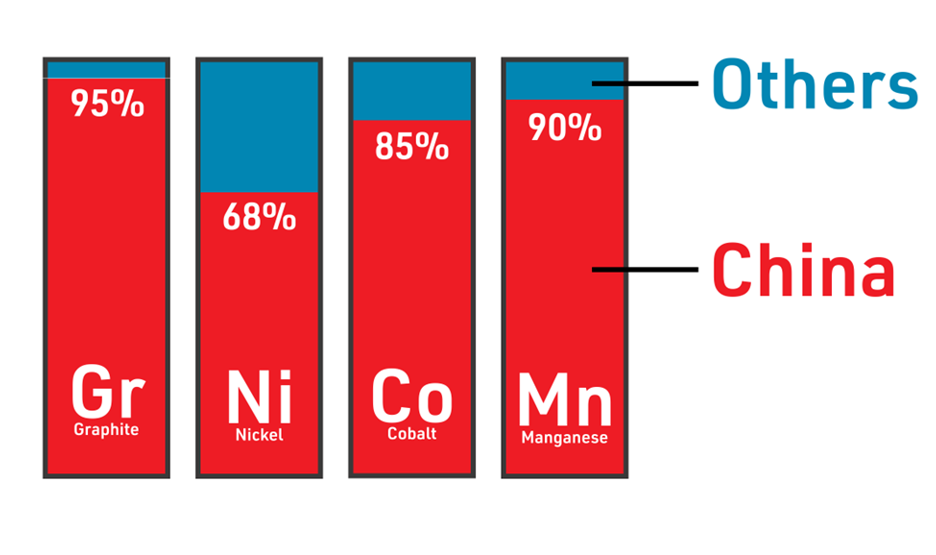
While lithium is the most significant mineral needed for current generation advanced batteries, a number of others are required in many types of batteries — particularly the NMC and NCA chemistries preferred by U.S. manufacturers. Here too, China’s mining, ownership, and processing chokehold present substantial vulnerabilities.[117] China processes more than 85 percent of the world’s battery-grade cobalt and more than 95 percent of the world’s battery-grade graphite.[118]
As Tesla CEO Elon Musk once pleaded, “Please mine more nickel. … Tesla will give you a giant contract for a long period of time if you mine nickel efficiently and in an environmentally sensitive way.”[119]
China’s Processing Dominance of Battery-Grade Critical Minerals[120]
Non-Chinese Upstream Alternatives
Lithium is not scarce. Lithium brines can be found in many places, including a potentially massive reserve in Arkansas capable of supplying all of America’s lithium needs for the foreseeable future.[121] There are also large deposits under California’s Salton Sea.[122] The American lithium giant Albemarle already produces 460,000 metric tons of lithium per year in Chile and has received an option that would allow it to increase its quota by 240,000 tons more.[123]
More investment is also urgently needed to ramp up alternatives to Chinese lithium processing. With new Trump administration efforts to incentivize critical mineral processing[124] and a U.S. lithium market that is expected to grow roughly 500 percent over the next five years,[125] American and other non-Chinese companies are beginning to invest in domestic processing capacity. The U.S. company Piedmont Lithium is developing a lithium hydroxide processing facility in North Carolina, aimed at processing spodumene concentrate from its North American deposits and supplying the U.S. battery market.[126] Albermarle also announced plans to build a lithium hydroxide processing facility in Chester County, South Carolina.[127]
Allied countries are recognizing the urgency of diversifying away from China as well. South Korea pledged $7.1 billion last year in policy financing to support domestic investments and diversify key mineral supply chains.[128] In September 2024, Germany’s AMG Lithium opened its first lithium hydroxide refinery in Bitterfeld-Wolfen.[129]
Limited progress is also being made to pivot battery supply chains away from China for other critical minerals. General Motors, for instances, has entered into a multibillion-dollar agreement with Norwegian company Vianode for the supply of synthetic anode graphite.[130] Similarly, Tesla has agreed to purchase nickel from Talon Metals’ Tamarack mine project in Minnesota, marking its first U.S. supply deal for nickel.[131] These deals remain modest, however, in the face of China’s dominance.
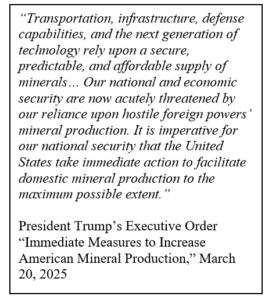
The effort to expand U.S. and allied processing capacity also faces substantial permitting, financing, and scaling obstacles creating unnecessary headwinds. Permitting obstacles alone represent an estimated 40 percent of all delays in mining projects, for instance,[132] and processing projects face similar constraints. The Ford Motor Company noted in a letter to the Department of the Interior that the “lengthy, costly and inefficient permitting process” makes it difficult for American businesses to invest in extraction and processing projects.[133] The Trump Administration recognizes the challenge, and on March 20 the president signed an executive order seeking to bolster domestic mining and processing capacity. [134] The order sets out an ambitious plan to unlock public and private capital for new projects, while reducing the regulations and red tape impeding current ones. It also sets out a pathway for government offtake agreements, use of public land for mining, purchasing raw material feedstock for domestic refining, and exploring the repurposing of prior mining waste for new critical mineral processing. [135] These are all positive steps. What remains to be seen is whether such efforts can overcome obstacles that include the high energy requirements for mining projects and potential resistance from community groups.
China’s Midstream Control
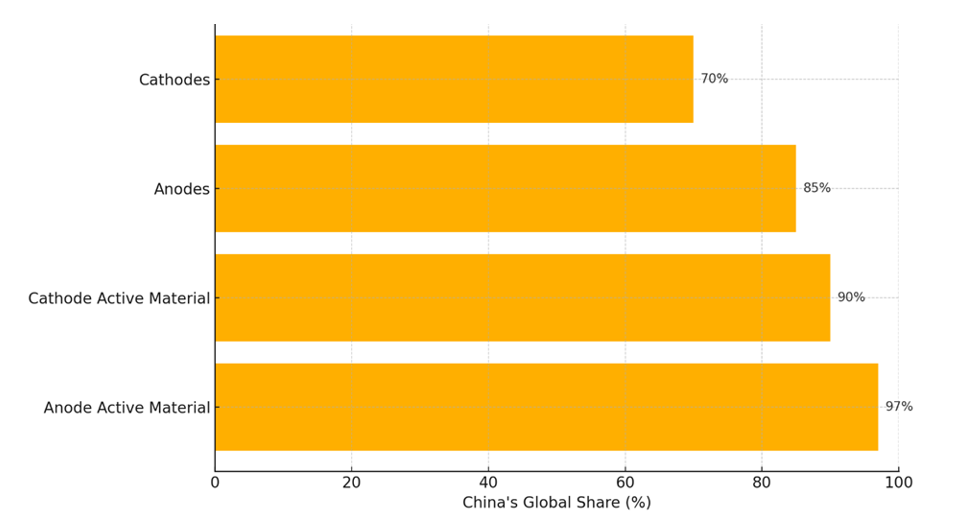
The assembly of battery components, especially cathodes and anodes, constitutes the midstream sector of the supply chain. Here, too, Chinese dominance represents a massive bottleneck for non-Chinese battery manufacturers and end user companies. China produces more than 70 percent of the world’s supply of cathodes[136] and 85 percent of the anodes.[137] Chinese companies also produce almost 90 percent of cathode active material — the key building block of cathode manufacturing — and more than 97 percent of anode active material, often using raw materials (such as refined graphite) that comes from China in the first place.[138]
The high input costs involved with cathode production tighten the bottleneck further. Cathodes frequently depend on metals that are expensive to mine, refine, and process. In lithium-ion batteries, cathode materials like nickel, cobalt, and lithium can account for roughly half of the total battery cost.[139] In comparison, anode materials like graphite are less expensive, typically representing around 10 percent of the total battery cost.[140]
To preserve its dominant midstream position, China seeks to limit the proliferation of cathode production technologies. In January 2025, China’s Ministry of Commerce proposed new export restrictions targeting advanced lithium iron phosphate (LFP) cathode production technologies.[141] These proposed measures would require Chinese firms to obtain licenses before exporting technologies used to produce the most advanced versions of LFP and lithium manganese iron phosphate (LMFP) cathode materials.[142]
Despite costing less than cathodes, anode production is also a major bottleneck given China’s stranglehold on global graphite production. China accounts for roughly 95 percent of battery-grade graphite.[143] Furthermore, in December 2024, China implemented export restrictions on certain graphite products, including flake graphite and spherical graphite, to the United States.[144] In response, U.S. graphite miners have asked the government to impose a 920 percent tariff on Chinese graphite imports to mitigate the impact of China’s export controls.[145]
China’s Role in Battery Component and Active Material Production[146]
Non-Chinese Midstream Alternatives
Historically, the United States has lacked large-scale facilities for producing cathodes and anodes, resulting in a juvenile industry that remains vulnerable to Chinese market manipulations. Recognizing this gap, the U.S. Department of Energy allocated $2.8 billion under the Bipartisan Infrastructure Law to support battery material processing, component manufacturing, and recycling projects. This money has been distributed among 20 companies across 12 states, to proliferate the processing of raw materials and manufacturing of battery components.[147] Additionally, the U.S. government has awarded a conditional loan of $755 million to Novonix, an Australian company, to build a synthetic graphite plant in Tennessee.[148]
Midstream alternatives also include novel approaches to battery recycling — Ascend Elements received $480 million to produce lithium-ion battery cathode materials from recycled battery feedstock.[149] Rather than merely focusing on environmental concerns, recycling efforts are a key way to break dependency on Chinese raw materials, as former batteries can be ground into a material called “black mass,” from which highly reusable minerals can be returned to the supply chain without requiring new, Chinese-based inputs. Like battery and mineral technology in general, China already maintains a large head start with respect to battery recycling techniques and supply chains.[150]
China’s Downstream Control
Downstream, China controls approximately 77 percent of the world’s battery pack assembly, which entails the integration of battery cells into packs for use in EVs, energy storage systems, and other applications. In terms of power output, Chinese firms shipped batteries with 1,215 gigawatt-hours (GWh) of capacity in 2024, out of a global total of 1,545 GWh.[151] With regard to EV batteries specifically, Chinese firms have 63.5 percent global market share, with just two Chinese firms, CATL and BYD, having more than a 52 percent share between them. South Korean firms including LG and Samsung have a 23.1 percent share and Japan’s Panasonic 6.4 percent.[152] What’s more, South Korean and Japanese producers remain heavily reliant on Chinese cathode and anode inputs, since those two countries only accounted for 9 percent and 3 percent of global cathode active material production, respectively.[153]
Chinese firms send abroad much of they produce. China’s lithium-powered battery exports surpassed $60 billion in 2024. Exports to the United States hit an all-time high of nearly $2 billion in monthly sales in December 2024.[154] In Africa, China has been fueling a boom in lithium-ion battery usage, with lithium-based batteries now capturing approximately 53 percent of Africa’s battery market.[155] Europe, meanwhile, is China’s largest market for EVs,[156] with almost 40 percent of China’s 2023 EV exports directed to the EU and another 15 percent going to non-EU European nations.[157] Volvo, the Swedish automaker now owned by China’s Geely,[158] sold 175,000 EVs in 2024,[159] relying upon Chinese advanced batteries made by CATL.[160]
Despite rising trade barriers in Europe and elsewhere, Chinese firms are responding by making strategic investments in tariff-exempt markets. Chinese battery companies are increasingly establishing factories within the EU to circumvent tariffs and sustain demand.[161] Notable investments include major facilities in Hungary, Spain, and Germany by companies such as CATL and EVE Energy.[162] In Debrecen, Hungary, CATL announced a €7.34 billion investment in August 2022 to build a 100 GWh battery plant, marking its largest overseas venture to date.[163] Similarly, EVE Energy committed more than $1 billion in May 2023 to construct a battery plant also located in Debrecen, aiming to produce large cylindrical batteries.[164]
Chinese companies, especially CATL, are also making huge strides in non-EV applications, such as ESS. CATL. In 2024, the ESS sector boomed – global energy storage cell shipments reached 334 GWh,[165] marking a 60 percent year-over-year increase.[166] China led this boom, with CATL and EVE Energy holding a combined 55 percent global market share. Other Chinese companies like CALB and BYD also shipping over 10GWh each in 2024.[167]
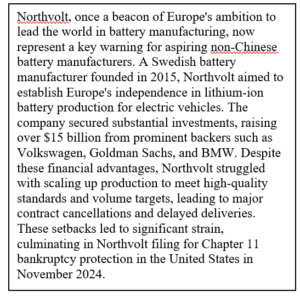
Non-Chinese Downstream Alternatives[168]
The United States has begun to invest in downstream production facilities. By the end of 2024, manufacturers had announced nearly $200 billion in investments dedicated to EV and battery manufacturing facilities[169] — including General Motors’ partnership with LG Energy Solution through their Ultium Cells joint venture. Ultium Cells’ Ohio facility, a 2.8 million-square-foot plant located in Warren, commenced initial battery cell production in August 2022 and currently employs 1,700 people. In December 2024, the plant celebrated the production of its 100 millionth cell. Ultium Cells sources its cathode active materials from POSCO Future, a South Korean manufacturer,[170] and provides its battery cells to General Motors.[171]
Similarly, Toyota and Samsung SDI have committed significant funds to U.S. battery manufacturing projects.[172] While these projects may marginally dilute China’s control over the advanced battery market, they do not necessarily address overwhelming supply chain dependencies in the upstream and midstream segments. While Samsung sources its cathodes from South Korea’s POSCO[173], it sources anode materials from China’s BTR New Material Group.[174]
Conclusion
China’s Economic Model is Fundamentally Parasitic
Chinese non-market practices multiply its advantages over geopolitical rivals, while simultaneously degrading the competitive environment and harming the stability of the global economy. Monopolies provide advantages of scale, market power, and opportunities for coercion. China’s state-endorsed IP theft and knowledge transfer allow China to reduce R&D costs, freeload on the efforts of others, and develop products at lower costs that drive other companies out of business. Dumping heavily subsidized and artificially cheap products on foreign markets drives out competition, reinforcing monopolies. China also engages in macroeconomic manipulations like keeping the value of its currency artificially low to boost exports at the expense of foreign rivals and imposing capital controls that limit outflows of investments that would naturally benefit other countries.
If everyone followed Beijing’s economic playbook, the modern global economy would cease to function. China itself does not want its own rules widely adopted.
Given a CCP-led refusal to expand the economic power of domestic consumers at the expense of the state, China needs to sell exports to grow. And yet China’s economic behavior is fundamentally corrosive on the market-based consumer economies that buy those exports. The greater number of cheap exports China dumps on global markets, the weaker those markets become. China acts, therefore, as a parasite on the host — harming the very economies that it needs to thrive.
While market-rules capitalism generally supports a global economy where any company from any country can thrive, China’s parasitic economic model is one where only China can thrive — and all other countries must suffer. There is no reason that import markets, like the United States, need to accept the status quo tolerance of China’s non-market, parasitic practices.
China needs America in a way that America simply does not need China, from depending on America’s security guarantee for global shipping to investing in American financial assets as a stable store of value. If China continues to harm the American-led global economy, Beijing should find itself on the outside of it, looking in.
America must use the critical leverage provided by the Trump administration’s tariffs and global trade reorganization to confront the full range of parasitic practices that China employs to manipulate supply chains across numerous industries, not just advanced battery manufacturing. If Beijing wants to maintain access to U.S. and allied markets, we must demand that it play by market rules: stop dumping heavily subsidized goods on foreign markets, enforce the property rights — especially intellectual property rights — of foreign companies and individuals, sharply curtail corporate subsidies, require greater transparency from Chinese firms, end its campaign of IP theft, and stop manipulating its currency while restraining the free flow of capital. Also on the table should be much deeper reforms to the Chinese economy and its legal framework, which may only come about in response to years of sustained pressure. This should include rebalancing the Chinese economy to create greater consumer spending power by allowing wages to rise and taking other measures to promote economic security for workers. Beijing also needs to create a clear separation between its public and private sectors, to include measures that prevent cartel-like behavior, monopolization, and other anti-competitive practices. Lastly, Beijing must also repeal its National Intelligence Law, which effectively requires Chinese companies to cooperate with espionage operations.
America is not alone in feeling the harm of China’s non-market practices. Now is the time for the U.S. to lead all market-based nations with a cohesive strategy against China to create a near-global economy — using the power of our markets to defend our markets. This should begin in North America, with a renewed USMCA that closes the door on China’s parasitic practices and imposes restrictions on Chinese companies operating within the trade zone. But the United States should also impress other nations in Latin America, Asia/Oceania (particularly, India, Japan, South Korea, Taiwan, Philippines, and Australia), and Europe that their survival as free economies is at stake.
Foundation for Defense of Democracies (FDD)
FDD is a Washington, DC-based nonpartisan research institute focusing on national security and foreign policy.
FDD’s Center on Economic and Financial Power (CEFP)
FDD’s Center on Economic and Financial Power (CEFP) studies economic security and statecraft, with a focus on how the United States can leverage its unmatched economic and financial power to achieve national security objectives. Launched in 2014, CEFP provides research, analysis, and policy solutions relating to sanctions, illicit finance, global financial reform, national security, trade, supply chains, capital markets, and emerging alliances.
[1] https://www.federalregister.gov/documents/2025/04/25/2025-07273/notice-of-request-for-public-comments-on-section-232-national-security-investigation-of-imports-of
[2] https://tnsr.org/2022/12/chinas-brute-force-economics-waking-up-from-the-dream-of-a-level-playing-field/
[3] Other non-market practices, such as currency manipulation and capital controls, are not addressed here, although they are also economically problematic in ways less directly relevant to supply chain security.
[4] https://www.whitehouse.gov/presidential-actions/2025/03/immediate-measures-to-increase-american-mineral-production/
[5] https://cset.georgetown.edu/publication/china-rare-earth-export-ban/
[6] https://www.bloomberg.com/news/articles/2025-01-02/china-plans-export-curbs-on-battery-parts-mineral-technology
[7] https://www.weforum.org/stories/2023/10/japan-rare-earth-minerals/
[8] https://www.economist.com/asia/2020/05/21/china-punishes-australia-for-promoting-an-inquiry-into-covid-19
[9] https://www.reuters.com/markets/commodities/china-asks-korea-not-export-products-using-rare-earths-us-defense-firms-paper-2025-04-22/
[10] https://merics.org/en/executive-memo/dealing-chinas-economic-coercion-case-lithuania-and-insights-east-asia-and-australia
[11] https://www.washingtonpost.com/opinions/global-opinions/mitt-romney-covid-19-has-exposed-chinas-utter-dishonesty/2020/04/23/30859476-8569-11ea-ae26-989cfce1c7c7_story.html
[12] Text Box: https://www.csis.org/blogs/trustee-china-hand/chinese-ev-dilemma-subsidized-yet-striking
[13] https://www.csis.org/blogs/trustee-china-hand/chinese-ev-dilemma-subsidized-yet-striking
[14] https://obamawhitehouse.archives.gov/the-press-office/president-obama-announces-24-billion-funding-support-next-generation-electric-vehic
[15] https://manhattan.institute/article/short-circuit-the-high-cost-of-electric-vehicle-subsidies
[16] https://www.carbonbrief.org/qa-the-global-trade-war-over-chinas-booming-ev-industry/
[17] https://www.bloomberg.com/news/articles/2023-09-14/from-cheap-money-to-tax-breaks-evs-in-china-get-a-lot-of-love; https://www.sciencedirect.com/science/article/pii/S0928765523000799
[18] https://thediplomat.com/2024/08/chinas-ev-overcapacity-is-inevitable/
[19] https://charitycarappraiser.com/how-byd-sets-ev-prices-in-foreign-markets/
[20] https://www.ft.com/content/bf4aa7c8-5eb9-4927-909f-b37d18674988
[21] https://pism.pl/publications/china-resists-correcting-unbalanced-economy-risking-the-future-of-international-trade
[22] https://nationalinterest.org/blog/road-critical-mineral-security-leads-through-australia-206823
[23] https://www.fastmarkets.com/insights/crma-toothless-to-support-european-graphite-producers-china-us-abandon-level-playing-field-vianode-ceo/
[24] https://www.nasdaq.com/articles/top-10-graphite-producing-countries-updated-2024
[25] https://www.csis.org/analysis/china-imposes-its-most-stringent-critical-minerals-export-restrictions-yet-amidst
[26] https://www.fastmarkets.com/insights/chinas-jan-feb-graphite-exports-plunge-amid-export-controls/
[27] https://www.csis.org/programs/freeman-chair-china-studies/past-projects/ccp-inc
[28] https://www.high-capacity.com/p/chinas-overlapping-tech-industrial
[29] https://en.byd.com/news/chinas-byd-wins-chile-lithium-extraction-contract/
[30] https://www.energytrend.com/news/20240912-48392.html
[31] https://www.busandmotorcoachnews.com/a-tour-through-byd-electric-bus-plant-in-california/; https://en.byd.com/news/byd-opens-first-canadian-bus-assembly-plant/; https://www.visualcapitalist.com/mapped-where-tesla-and-byd-make-their-cars/; https://www.bydeurope.com/article/323; https://cnevpost.com/2024/01/26/byd-launches-production-uzbekistan-plant/; https://www.byd.com/eu/news-list/BYD_to_Build_A_New_Energy_Passenger_Vehicle_Factory_in_Hungary_for_Localised_Production_in_Europe
[32] https://www.reuters.com/markets/europe/how-tesla-weathered-global-supply-chain-issues-that-knocked-rivals-2022-01-04/
[33] https://www.scmp.com/business/china-business/article/3169921/chinese-nickel-giant-tsingshan-said-have-sufficient
[34] Harry Sanderson, Volt Rush, Oneworld Publications, 2022, pp. 159-160.
[35] Harry Sanderson, Volt Rush, Oneworld Publications, 2022, pp. 159-160.
[36] https://www.reuters.com/markets/commodities/lme-failed-probe-tsingshan-before-nickel-chaos-london-court-hears-2023-06-22/
[37] https://www.bloomberg.com/news/articles/2019-10-08/china-s-tsingshan-helped-drive-record-drop-in-nickel-inventories
[38] https://www.reuters.com/markets/commodities/lme-failed-probe-tsingshan-before-nickel-chaos-london-court-hears-2023-06-22/
[39] https://www.bloomberg.com/news/articles/2019-10-08/china-s-tsingshan-helped-drive-record-drop-in-nickel-inventories
[40] Harry Sanderson, Volt Rush, Oneworld Publications, 2022, p. 159.
[41] https://www.washingtonpost.com/opinions/global-opinions/mitt-romney-covid-19-has-exposed-chinas-utter-dishonesty/2020/04/23/30859476-8569-11ea-ae26-989cfce1c7c7_story.html
[42] https://www.financialresearch.gov/working-papers/files/OFRwp-24-09_central-clearing-and-trade-cancellation.pdf
[43] https://www.argusmedia.com/en/news-and-insights/latest-market-news/2461980-lme-aware-of-past-tsingshan-otc-incident-court-hears
[44] https://www.reuters.com/markets/commodities/lme-cancelled-nickel-trades-save-tsingshan-london-court-told-2023-06-20/
[45] https://www.cmegroup.com/markets/metals/battery-metals/lithium-hydroxide-cif-cjk-fastmarkets.contractSpecs.html; https://www.cmegroup.com/markets/metals/battery-metals/lithium-carbonate-cif-cjk-fastmarkets.contractSpecs.html
[46] https://www.fastmarkets.com/insights/fastmarkets-partners-with-the-london-metal-exchange-to-develop-lithium-price-benchmark/
[47] https://www.fastmarkets.com/uploads/2025/01/fm-mb-lithium.pdf
[48] https://globalxetfs.co.jp/en/research/lithium-market-update-elevated-prices-are-creating-favorable-dynamics-for-miners/index.html; https://www.spglobal.com/content/dam/spglobal/corporate/en/images/general/special-editorial/083123-china-s-global-reach-grows-behind-critical-minerals.pdf
[49] https://www.reuters.com/article/business/nemaska-lithium-secures-funding-for-mine-with-c400-million-equity-raise-idUSKCN1IN35C/
[50] https://ici.radio-canada.ca/nouvelle/1153277/nemaska-lithium-budget-projet-whabouchi-hausse
[51] https://www.spglobal.com/commodity-insights/en/news-research/latest-news/metals/012820-nemaskas-quebec-lithium-mine-to-see-delay-on-labor-cuts
[52] https://news.metal.com/newscontent/100994877/Nemaska-Lithium-temporarily-closes-Whabouch-Lithium-I-Mine-Shawinigan-hydrometallurgical-plant-will-be-closed-later
[53] https://www.thepaper.cn/newsDetail_forward_27662060
[54] https://iea.blob.core.windows.net/assets/0aa4762f-c1cb-4495-987a-25945d6de5e8/GlobalEVOutlook2025.pdf
[55] https://www.cfr.org/blog/will-china-take-over-global-auto-industry
[56] For Text Box: https://www.thewirechina.com/2025/02/23/chinas-overcapacity-is-finally-reaching-its-limits/
[57] https://finance.sina.cn/2021-08-24/detail-ikqcfncc4786983.d.html
[58] https://www.cnn.com/2025/03/04/business/china-npc-economy-growth-trade-hnk-intl/index.html
[59] https://carnegieendowment.org/posts/2024/07/why-is-it-so-hard-for-china-to-boost-domestic-demand?lang=en
[60] https://www.nber.org/system/files/working_papers/w21906/w21906.pdf
[61] https://sccei.fsi.stanford.edu/china-briefs/china-shock-and-its-enduring-effects#:~:text=Impact%20of%20China%20shock%20on,and%20fewer%20college%2Deducated%20workers .
[62] https://ustr.gov/sites/default/files/files/reports/2025/2024USTRReportCongressonChinaWTOCompliance.pdf; https://www.wto.org/english/tratop_e/dispu_e/dispu_by_country_e.htm#chn
[63] https://www.wto.org/english/tratop_e/adp_e/AD_InitiationsRepMemVsExp.pdf
[64] https://www.wsj.com/world/china/chinas-flood-of-cheap-goods-is-angering-its-allies-too-51284954; https://www.wto.org/english/tratop_e/adp_e/AD_InitiationsRepMemVsExp.pdf
[65] https://vntr.moit.gov.vn/news/anti-dumping-investigations-are-strongly-initiated-by-many-countries
[66] https://vntr.moit.gov.vn/news/anti-dumping-investigations-are-strongly-initiated-by-many-countries
[67] https://www.ft.com/content/c4bce44e-9c66-4d74-bebd-0f35f0ea007f
[68] https://cnevpost.com/2024/09/16/byd-holds-100-pct-denza/
[69] https://crsreports.congress.gov/product/pdf/IF/IF10964/4
[70] https://ustr.gov/sites/default/files/05.13.2024%20Executive%20Summary%20of%20Four%20Year%20Review%20of%20China%20Tech%20Transfer%20Section%20301%20(Final).pdf
[71] https://ustr.gov/sites/default/files/Section%20301%20FINAL.PDF
[72] https://www.whitehouse.gov/presidential-actions/2025/02/america-first-investment-policy/
[73] https://www.hongdaservice.com/blog/14-pros-cons-of-starting-joint-ventures-in-china
[74] https://www.nber.org/digest/aug18/spillover-effects-international-joint-ventures-china
[75] https://www.uschina.org/articles/transferring-technology-to-transform-china-is-it-worth-it/
[76] https://vanderbiltbusinessreview.com/chinas-forced-technology-transfer-policy-takeaways-for-the-developing-world/
[77] https://about.bnef.com/blog/chinas-goldwind-retains-turbine-supplier-lead-as-global-wind-additions-hit-new-high-according-to-bloombergnef/
[78] https://journals.sagepub.com/doi/10.1177/186810261304200103
[79] https://www.wwindea.org/country-reports/asia/china
[80] https://wwindea.org/GlobalStatistics
[81] https://wwindea.org/AnnualReport2023
[82] https://www.woodmac.com/press-releases/2024-press-releases/global-wind-oem-marketshare
[83] https://www.csis.org/analysis/how-much-have-chinese-actually-taken
[84] https://www.justice.gov/archives/nsd/information-about-department-justice-s-china-initiative-and-compilation-china-related
[85] https://www.csis.org/programs/strategic-technologies-program/survey-chinese-espionage-united-states-2000
[86] https://www.justice.gov/usao-edny/pr/resident-china-sentenced-24-months-prison-conspiring-send-trade-secrets-belonging; https://www.justice.gov/usao-ndca/pr/former-apple-employee-indicted-theft-trade-secrets
[87] https://ustr.gov/sites/default/files/USTR%20Report%20Four%20Year%20Review%20of%20China%20Tech%20Transfer%20Section%20301.pdf
[88] https://natural-resources.canada.ca/minerals-mining/mining-data-statistics-analysis/minerals-metals-facts/lithium-facts
[89] https://climate.mit.edu/ask-mit/how-lithium-mined
[90] https://samcotech.com/what-is-lithium-extraction-and-how-does-it-work/
[91] https://www.bloomberg.com/news/articles/2024-06-03/tianqi-reminds-sqm-of-hurdles-in-codelco-s-landmark-lithium-pact
[92] https://latsustentable.org/wp-content/uploads/2023/08/Infocus-Newletter-APRIL.pdf
[93] https://thediplomat.com/2023/10/the-china-west-lithium-tango-in-south-america/; https://www.geopoliticalmonitor.com/lithium-monopoly-in-the-making-beijing-expands-in-the-lithium-triangle/; https://latsustentable.org/wp-content/uploads/2023/08/Infocus-Newletter-APRIL.pdf
[94] https://www.reuters.com/markets/commodities/chinas-ganfeng-starts-lithium-production-argentinas-mariana-project-2025-02-12/
[95] https://www.reuters.com/markets/commodities/bolivia-says-chinas-cbc-invest-1-billion-lithium-plants-2024-11-26/
[96] https://www.rferl.org/a/bolivia-lithium-deal-russia-china/32483336.html
[97] https://rosatomnewsletter.com/2024/10/31/lithium-nearing-production/
[98] https://www.idtechex.com/en/research-report/direct-lithium-extraction/1026
[99] https://source.benchmarkminerals.com/article/hard-rock-vs-brine-how-do-their-carbon-curves-compare
[100] https://www.fastmarkets.com/insights/chinese-lepidolite-integral-to-global-lithium-supply/
[101] https://www.saltworkstech.com/articles/hardrock-spodumene-lithium-processing/
[102] https://www.wa.gov.au/system/files/2025-03/wa_statistics_digest_2023_2024_web.pdf
[103] https://www.energypolicy.columbia.edu/publications/fact-sheet-lithium-supply-in-the-energy-transition/?
[104] https://www.mining.com/pilbara-minerals-seals-another-chinese-offtake-deal/; https://www.reuters.com/article/business/healthcare-pharmaceuticals/pilbara-minerals-enters-a-5-year-offtake-agreement-with-yibin-tianyi-lithium-ind-idUSFWN2BH1JY/
[105] https://investingnews.com/lithium-mines-in-australia/
[106] https://www.mining.com/us-lithium-clay-projects-secure-backing-despite-extraction-hurdles/
[107] https://lithiumharvest.com/knowledge/lithium-extraction/what-is-direct-lithium-extraction/
[108] https://lithiumharvest.com/knowledge/lithium-extraction/what-is-direct-lithium-extraction/
[109] https://www.bloomberg.com/news/articles/2023-06-20/china-s-catl-leads-1-4-billion-lithium-investment-in-bolivia
[110] https://www.seplite.com/direct-lithium-extraction/
[111] https://rosatomnewsletter.com/2024/10/31/lithium-nearing-production/
[112] https://www.energypolicy.columbia.edu/publications/fact-sheet-lithium-supply-in-the-energy-transition/
[113] https://www.energypolicy.columbia.edu/publications/fact-sheet-lithium-supply-in-the-energy-transition/
[114] https://www.mining.com/web/tianqi-to-keep-fighting-for-say-in-sqm-lithium-deal/; https://en.tianqilithium.com/content/details17_949.html
[115] https://www.reuters.com/markets/commodities/chinas-ganfeng-starts-lithium-production-argentinas-mariana-project-2025-02-12/
[116] https://www.reuters.com/technology/china-proposes-further-export-curbs-battery-critical-minerals-tech-2025-01-02/
[117] https://www.iea.org/reports/global-ev-outlook-2024/trends-in-electric-vehicle-batteries
[118] https://www.usgs.gov/publications/development-chinas-monopoly-over-cobalt-battery-materials; https://www.fastmarkets.com/insights/crma-toothless-to-support-european-graphite-producers-china-us-abandon-level-playing-field-vianode-ceo/
[119] https://www.reuters.com/article/technology/please-mine-more-nickel-musk-urges-as-tesla-boosts-production-idUSKCN24O0RV/
[120] https://www.fastmarkets.com/insights/crma-toothless-to-support-european-graphite-producers-china-us-abandon-level-playing-field-vianode-ceo/ ; https://www.brookings.edu/wp-content/uploads/2022/08/LTRC_ChinaSupplyChain.pdf ; https://pubs.usgs.gov/publication/70255942 ; https://www.spglobal.com/market-intelligence/en/news-insights/articles/2023/1/manganese-sulfate-bottleneck-looms-over-us-european-ev-manufacturers-73926378
[121] https://www.nytimes.com/2024/10/21/business/energy-environment/arkansas-lithium-ev-batteries.html
[122] https://www.desertsun.com/story/news/environment/2023/11/30/salton-sea-area-lithium-could-fuel-375-million-electric-car-batteries/71745315007/
[123] https://www.reuters.com/markets/commodities/chile-gives-albemarle-option-boost-lithium-quota-by-240000-metric-tons-2024-05-16/
[124] https://www.whitehouse.gov/presidential-actions/2025/03/immediate-measures-to-increase-american-mineral-production/
[125] https://www.fastmarkets.com/insights/us-lithium-demand-to-grow-fastmarkets-provide-regional-price-transparency/
[126] https://www.piedmontlithium.com/projects/carolina-lithium/
[127] https://investors.albemarle.com/news-and-events/news/news-details/2023/Albemarle-Corporation-Announces-New-U.S.-Lithium-Mega-Flex-Processing-Facility-in-South-Carolina/default.aspx
[128] https://www.bloomberg.com/news/articles/2024-05-08/korea-pledges-7-billion-aid-package-for-ev-battery-supply-chain
[129] https://www.euronews.com/my-europe/2024/09/19/europes-first-lithium-refinery-opens-in-germany
[130] https://www.wsj.com/business/autos/gm-signs-multi-billion-dollar-deal-for-supply-of-ev-battery-materials-cfce0911
[131] https://talonmetals.com/tesla-and-talon-metals-enter-into-supply-agreement-for-nickel/
[132] https://www.womblebonddickinson.com/us/insights/articles-and-briefings/striking-balance-permitting-reforms-mining-and-energy-transition
[133] https://www.mining.com/ford-asks-us-govt-to-speed-up-mining-permits/
[134] Text Box: https://www.whitehouse.gov/presidential-actions/2025/03/immediate-measures-to-increase-american-mineral-production/
[135] https://www.whitehouse.gov/presidential-actions/2025/03/immediate-measures-to-increase-american-mineral-production/
[136] https://iea.blob.core.windows.net/assets/961cfc6c-6a8c-42bb-a3ef-57f3657b7aca/GlobalSupplyChainsofEVBatteries.pdf
[137] https://iea.blob.core.windows.net/assets/961cfc6c-6a8c-42bb-a3ef-57f3657b7aca/GlobalSupplyChainsofEVBatteries.pdf
[138] https://www.iea.org/reports/global-ev-outlook-2024/trends-in-electric-vehicle-batteries
[139] https://www.csis.org/analysis/friendshoring-lithium-ion-battery-supply-chain-battery-cell-manufacturing
[140] https://www.energypolicy.columbia.edu/publications/the-ira-and-the-us-battery-supply-chain-background-and-key-drivers/
[141] https://www.bloomberg.com/news/articles/2025-01-02/china-plans-export-curbs-on-battery-parts-mineral-technology
[142] https://cen.acs.org/energy/energy-storage-/China-threatens-stop-export-iron/103/web/2025/01
[143] https://www.fastmarkets.com/insights/crma-toothless-to-support-european-graphite-producers-china-us-abandon-level-playing-field-vianode-ceo/
[144] https://www.csis.org/analysis/china-imposes-its-most-stringent-critical-minerals-export-restrictions-yet-amidst
[145] https://www.reuters.com/markets/commodities/us-graphite-miners-ask-washington-impose-920-tariff-chinese-rivals-2024-12-18/
[146] https://iea.blob.core.windows.net/assets/961cfc6c-6a8c-42bb-a3ef-57f3657b7aca/GlobalSupplyChainsofEVBatteries.pdf ; https://www.iea.org/reports/global-ev-outlook-2024/trends-in-electric-vehicle-batteries
[147] https://netl.doe.gov/node/12160
[148] https://www.ft.com/content/266bf154-c209-45eb-ad45-fea2f81ec8fb
[149] https://ascendelements.com/ascend-elements-awarded-480m-in-grants-from-u-s-department-of-energy-to-manufacture-sustainable-battery-cathode-active-materials/
[150] https://asiatimes.com/2024/11/chinas-surging-lead-in-the-ev-battery-circular-economy/#
[151] https://www.argusmedia.com/en/news-and-insights/latest-market-news/2644130-global-li-ion-battery-shipments-rise-in-2024-ev-tank. One gigawatt equals 1 billion watts. A power plant producing 1 gigawatt per hour could supply about 800,000 typical American homes. See: https://www.eia.gov/tools/faqs/faq.php?id=97&t=3.
[152] https://cnevpost.com/2024/02/07/global-ev-battery-market-share-in-2023/
[153] https://www.iea.org/reports/global-ev-outlook-2024/trends-in-electric-vehicle-batteries
[154] https://www.atlanticcouncil.org/blogs/energysource/chinas-lithium-ion-battery-exports-why-are-us-prices-so-low/
[155] https://www.mordorintelligence.com/industry-reports/africa-battery-market
[156] https://www.atlanticcouncil.org/blogs/new-atlanticist/as-chinese-evs-threaten-to-overrun-europe-germany-should-ramp-up-supply-chain-investment/
[157] https://www.atlanticcouncil.org/blogs/new-atlanticist/china-has-become-an-electric-vehicle-export-behemoth-how-should-the-us-and-eu-respond/
[158] https://zgh.com/volvo-cars/?lang=en
[159] https://www.media.volvocars.com/global/en-gb/media/pressreleases/338259/volvo-cars-reports-new-global-sales-record-in-2024
[160] https://electrek.co/2025/02/12/volvo-ex90-uses-catl-batteries-but-that-may-change-soon/
[161] https://www.catl.com/en/news/6328.html
[162] https://www.catl.com/en/news/6328.html
[163] https://www.catl.com/en/news/983.html
[164] https://www.evepower.com/en/news-1295
[165] https://www.metal.com/en/newscontent/103151780
[166] https://www.infolink-group.com/energy-article/energy-storage-topic-2024-global-shipments-energy-storage-cell-company-rankings
[167] https://www.infolink-group.com/energy-article/energy-storage-topic-global-battery-shipment-ranking-1Q24-3Q24
[168] Text Box: https://www.wsj.com/business/this-battery-startup-raised-15-billion-then-it-went-bust-817418b4; https://www.reuters.com/technology/northvolt-crisis-may-be-make-or-break-europes-ev-battery-ambitions-2024-11-22/; https://northvolt.com/articles/chapter11/
[169] https://www.edf.org/media/production-underway-dozens-us-electric-vehicle-manufacturing-sites-after-historic-levels
[170] https://www.prnewswire.com/news-releases/gm-and-posco-chemical-will-build-a-new-north-america-factory-to-process-cathode-active-material-for-ultium-batteries-301435310.html
[171] https://www.ultiumcell.com/
[172] https://techcrunch.com/2025/02/06/tracking-the-ev-battery-factory-construction-boom-across-north-america/
[173] https://source.benchmarkminerals.com/article/samsung-sdi-secures-ten-years-of-cathode-supply-with-33-billion-posco-deal
[174] https://www.btrchina.com/en/News/info.aspx?itemid=1243