November 5, 2026 | Investigation
No To Lana: Turkey and Sudan-Aligned Campaign Targets UAE’s UN Candidate
November 5, 2026 | Investigation
No To Lana: Turkey and Sudan-Aligned Campaign Targets UAE’s UN Candidate
The U.S. midterm elections are over, but the campaign to select the next UN secretary-general is just heating up. On October 21, Lana Nusseibeh, former ambassador to the UN from the United Arab Emirates (UAE) threw her hat in the ring.
Before long, a supposedly global, grassroots campaign attacked her bid and created the website notolana.com. Her critics argue that she is partially responsible for genocide in Sudan because of her previous role as the UAE’s permanent representative to the United Nations and her roles in the UAE’s Ministry of Foreign Affairs throughout the war in Sudan. The United Arab Emirates is accused of, but denies, arming the paramilitary Rapid Support Forces (RSF) in its bloody conflict with the Sudanese Armed Forces (SAF). Some of the RSF’s abuses have been designated as genocide by the United States and United Nations.
In actuality, the No To Lana campaign is far from a grassroots effort. One of its founders, Amgad Fareid Eltayeb, is an adviser to the head of the Sudanese military junta, and the other, Umut Cagri Sari, is a contributor to Turkish state media with a history of business and journalism activity in the Horn of Africa. The Sudanese military maintains close ties with Turkiye, which rhetorically supports the Sudanese Armed Forces, while denying the evidence of its material involvement in the conflict. The campaign utilizes inauthentic activity to boost its online presence and impact, providing visitors with automated means to send hundreds of emails a day. It also has connections via content, behavioral, and infrastructure links to a previously exposed pro-Turkiye and -Sudan influence operation, Sudan Axis, active since late 2025.
Ostensibly a human rights campaign, the likely motivation for the No To Lana effort became clearer when Turkiye announced Feridun Sinirlioglu, its former foreign minister and permanent representative of Turkiye to the United Nations, as a candidate for the role of secretary-general.
A State-Aligned Campaign Posing as Grassroots Activism
No To Lana calls itself “an independent citizen campaign,” claiming it “is not affiliated with any government.” The positions Eltayeb holds in government and Sari’s online activity and relations with state media, respectively, raise the prospect that the Sudanese and Turkish governments are at least aware, and approve, of the campaign.
Eltayeb was the first person to post about the campaign on X. A physician by training, Eltayeb served as assistant chief of staff to former Sudanese Prime Minister Abdalla Hamdok before becoming SAF commander Abdel Fattah al-Burhan’s political and foreign affairs adviser.
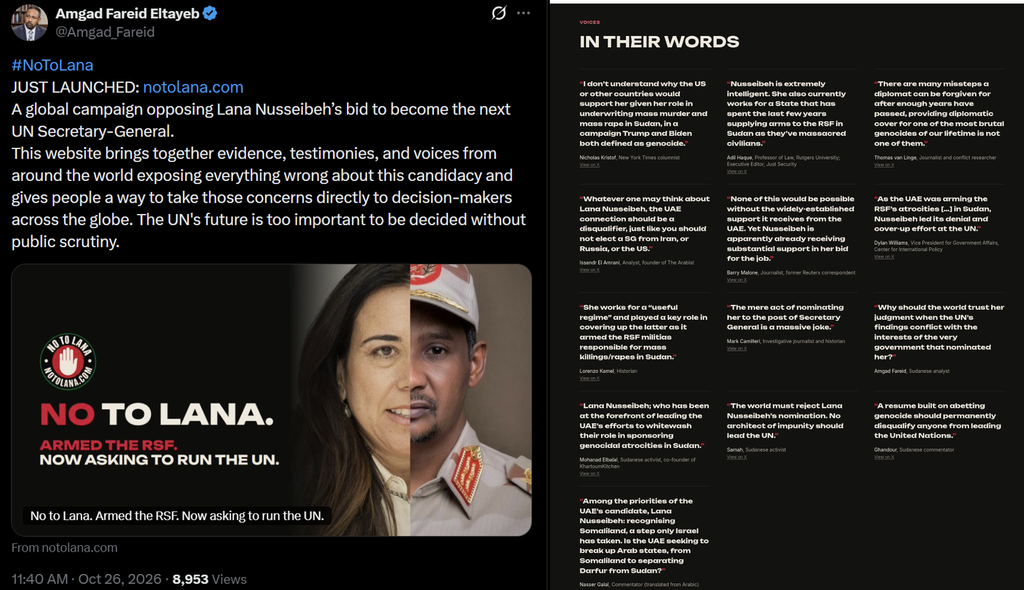
Sari issued his own post about the No To Lana campaign 12 minutes after Eltayeb’s and proceeded to push the campaign in Arabic on his Facebook page. Sari writes opinion columns on the Horn of Africa for Anadolu Agency, Turkiye’s state news agency, and for the English-language outlet Turkiye Today. His columns and social media posts support Sudan’s army and Turkish policy in the region and allege that the United Arab Emirates, Ethiopia, and Israel are the RSF’s patrons.
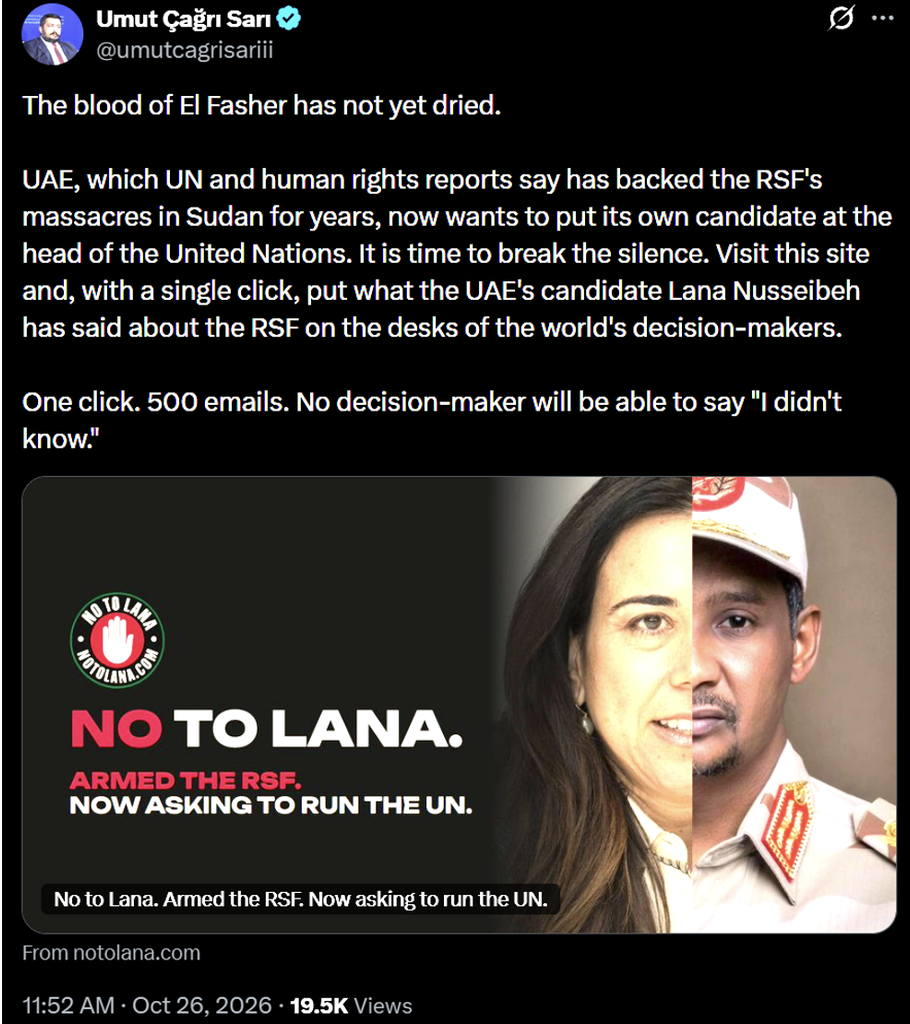
Sari and Eltayeb frequently amplify each other on social media, so the posts themselves are not conclusive of a relationship between Sari and the domain. The website design and infrastructure, however, reveal Sari’s more direct role.
No To Lana lets visitors send pre-written emails to thousands of legislators and diplomats. The recipient file lists 9,350 targets, including 8,189 legislators, 695 members of the European Parliament, 99 Canadian senators, and the UN missions of every member state except the United Arab Emirates. The website uses the same custom sending tool and recipient list as another website, stoprsfterror.com.
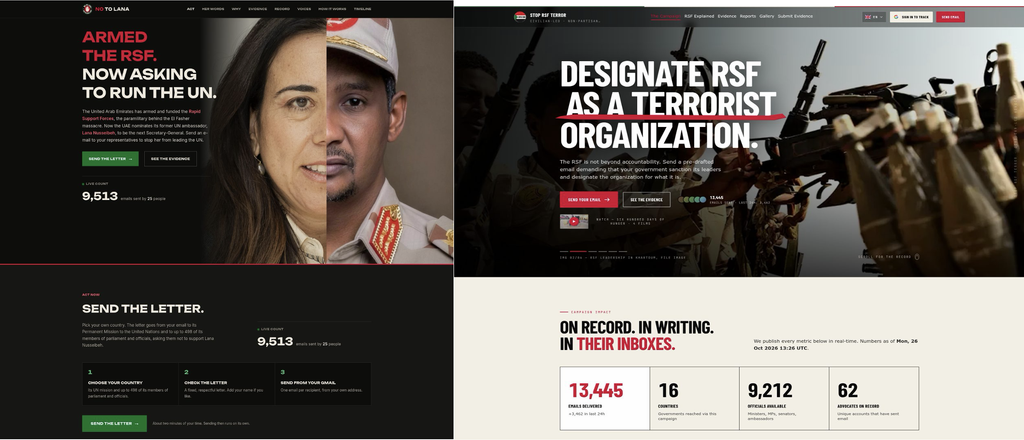
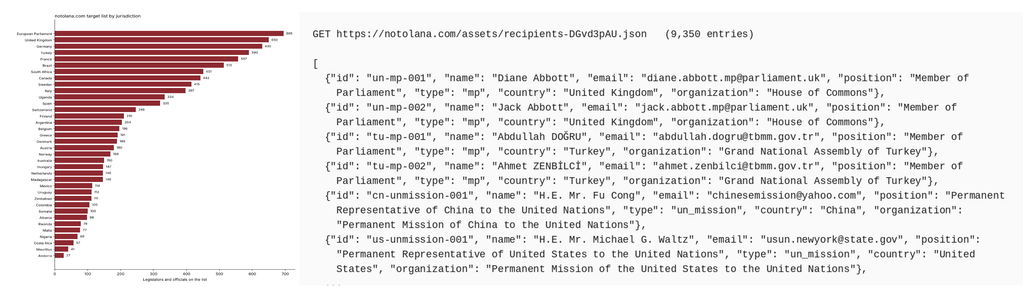
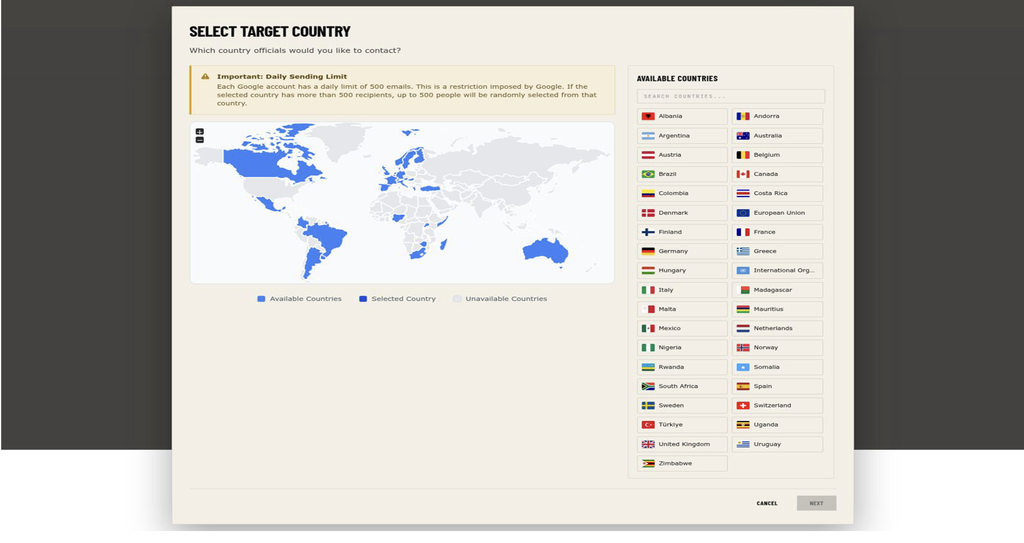
No To Lana also reuses Stop RSF Terror’s code and runs on the same Firebase project named “stoprsfterror.” Both domains were registered through Squarespace with a registrant in Istanbul — where Sari is based — although the redacted registration records do not list a name.
The launch of Stop RSF Terror in October 2026 aligns with Eltayeb’s longstanding efforts to internationally designate the RSF as a terror organization. The RSF committed widespread atrocities, including acts of genocide as determined by the U.S. State Department in January 2025. The UAE has faced repeated, evidence-backed accusations of arming and financing the RSF, which it denies. The situation is not entirely one-sided, however. The opposing Sudanese Armed Forces have also been implicated in war crimes and violations of human rights, with Washington sanctioning Burhan in January 2025. The United States pointed to attacks on civilians and civilian infrastructure and subsequently determined that the Sudanese government had used chemical weapons in 2024.
By ignoring these SAF abuses entirely and focusing exclusively on the RSF, No To Lana and Stop RSF Terror advance the political interests of the SAF-led government and its backers, including Turkiye, Qatar, and Iran, rather than reflecting a consistent commitment to documenting human rights violations.
Eltayeb’s activity aligned with the campaign’s launch. On July 7, the day that the Stop RSF Terror domain was registered, Eltayeb published an op-ed in the Financial Times urging Britain to proscribe the RSF. The same month, Eltayeb, along with Nadir Yousif Eltayeb, ambassador of the Republic of the Sudan to Turkiye, met researchers at ORSAM, a think tank in Ankara, for an “exchange of views on recent political and security developments in Sudan, the course of the conflict, post-war reconstruction, Red Sea geopolitics, and Türkiye–Sudan relations.”
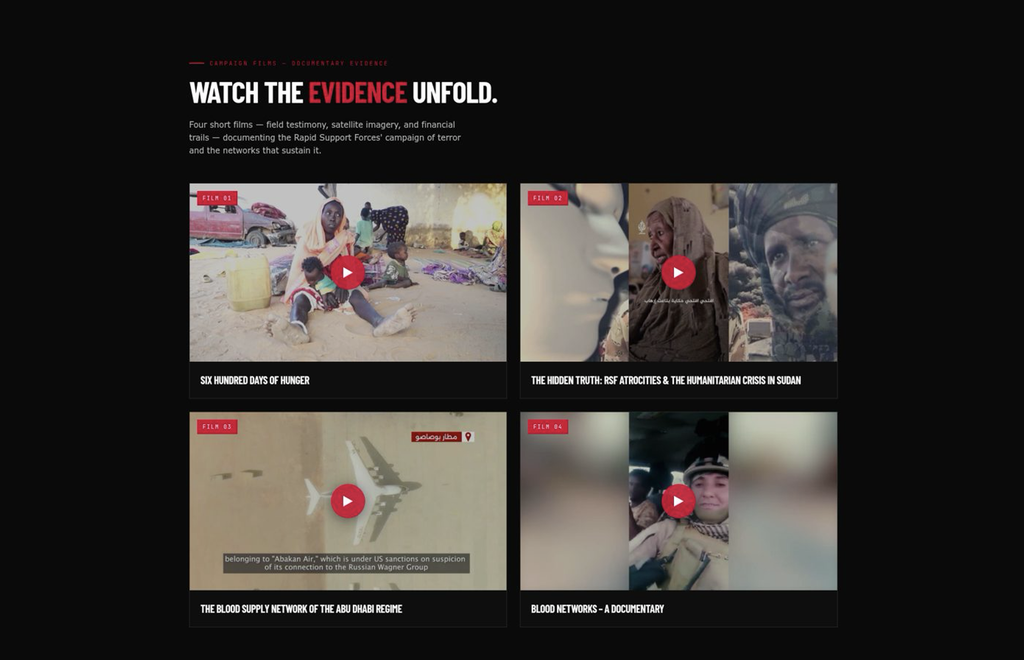
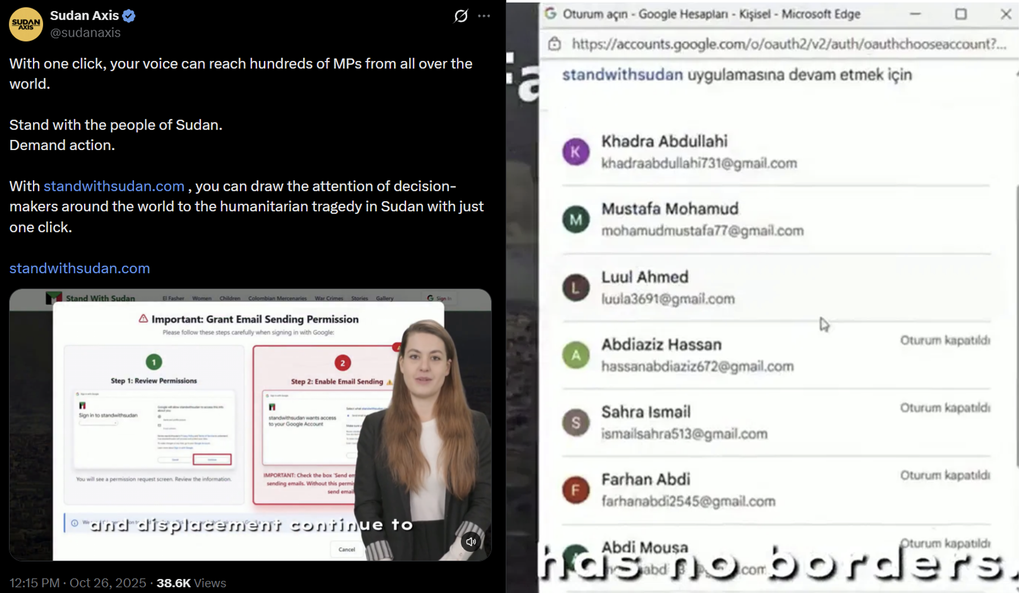
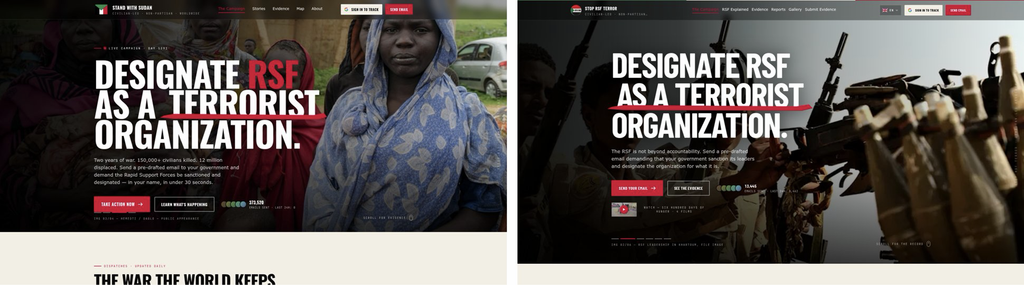
Stop RSF Terror, in turn, copies an earlier website, standwithsudan.com. In 2025, Sudan Axis, an X account likely tied to a pro-army influence operation aligned with Qatari and Turkish interests, ran Stand With Sudan. That effort, a self-described Sudanese diaspora volunteer-led campaign, asked visitors to email officials demanding that the RSF be designated as a terrorist group in a video using an AI-generated spokesperson. The video guides users to sign in to the website with their personal Gmail accounts to send automated emails, showing a list of inauthentic Gmail accounts used by the campaign operators, including one that sends hundreds of emails throughout the video. The browser language is set to Turkish.
On November 17, 2025, Sari reposted, word for word, Sudan Axis’s announcement that the campaign had passed 350,000 emails, seconds after Sudan Axis posted it. The two sites share infrastructure similarities, both using Squarespace and Google Firebase, the same headline, endorsements, blog posts, a Gmail sending tool, interface text, and server function names.
AI-Generated and Limited Reach So Far
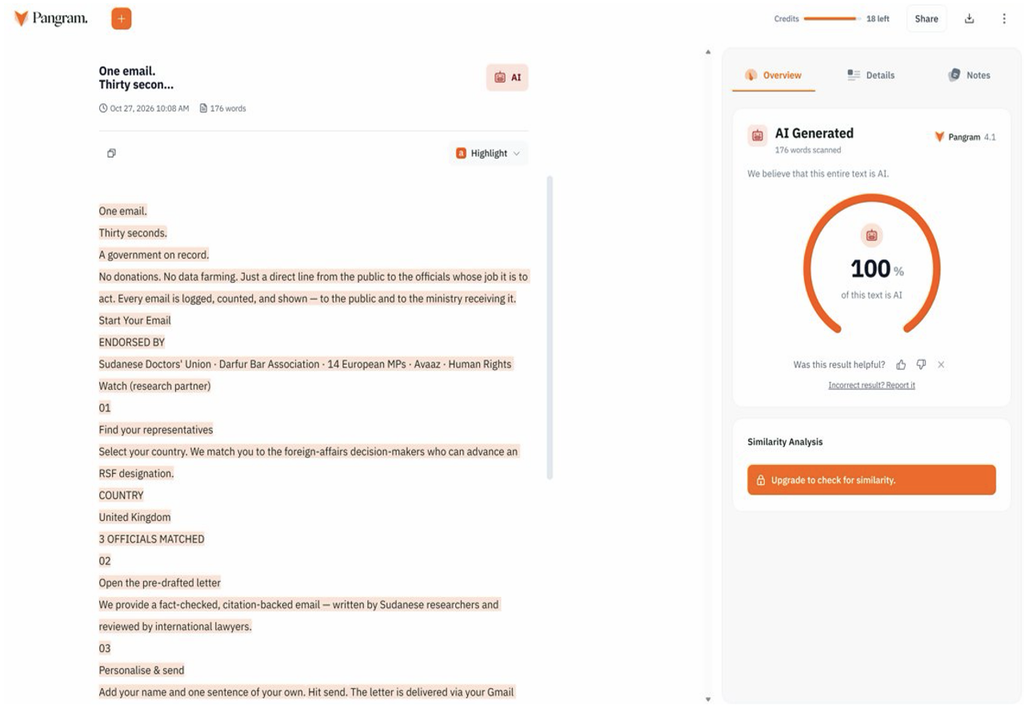
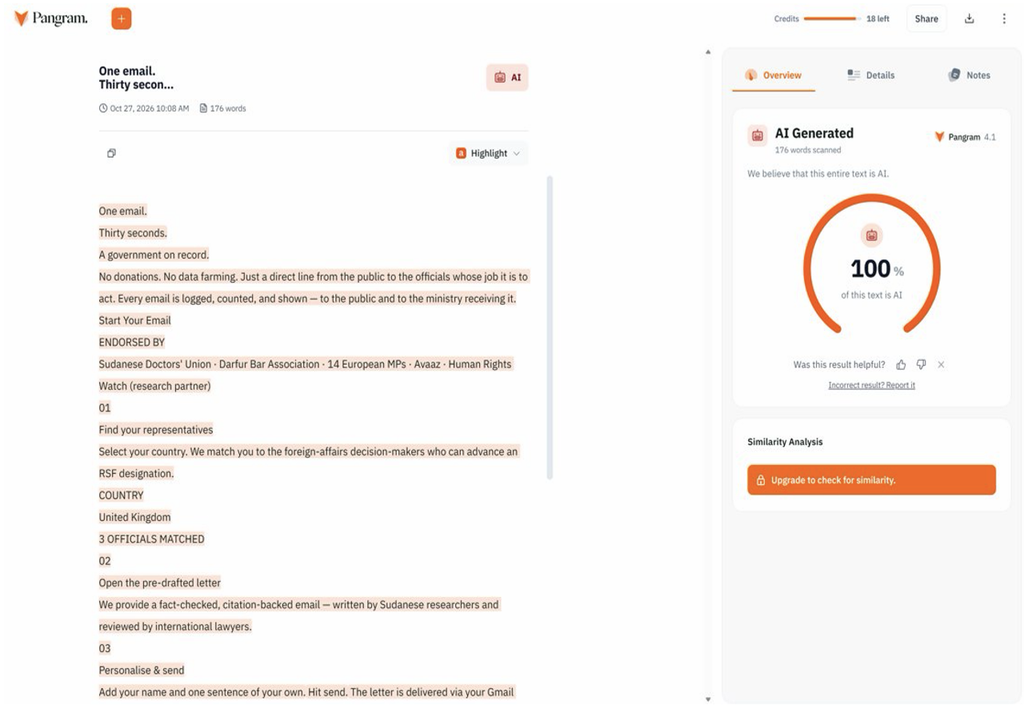
AI tools appear to have written much of the text and code of both notolana.com and stoprsfterror.com. The AI-detector Pangram rated No To Lana’s case against Nusseibeh as fully AI generated, and the page source contains developer notes typical of AI coding assistants.
#NoToLana has spread little beyond the immediate network promoting the website. Between 9:40 AM UTC on October 26 and 8:00 AM UTC on October 27, 21 X accounts posted 36 times with the hashtag or a notolana.com link. Eltayeb’s six posts drew 93 percent of the likes and 94 percent of the roughly 55,000 views. Much of the remaining activity consisted of copied text and shared messages generated by the site. One account that posted such a message was created on October 2, 2026, and had two followers and a single post.
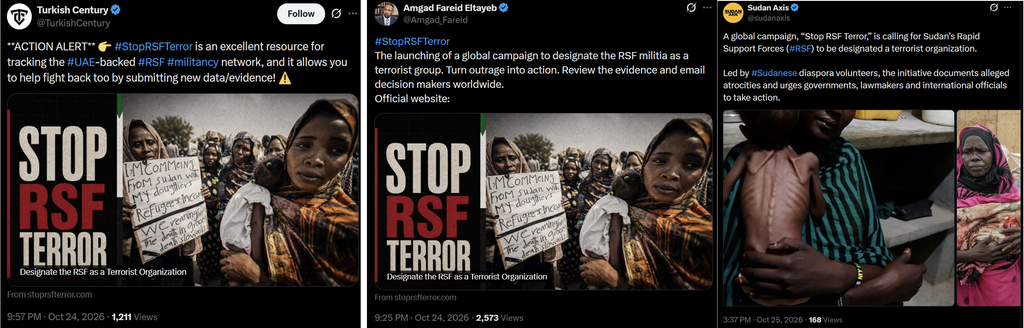
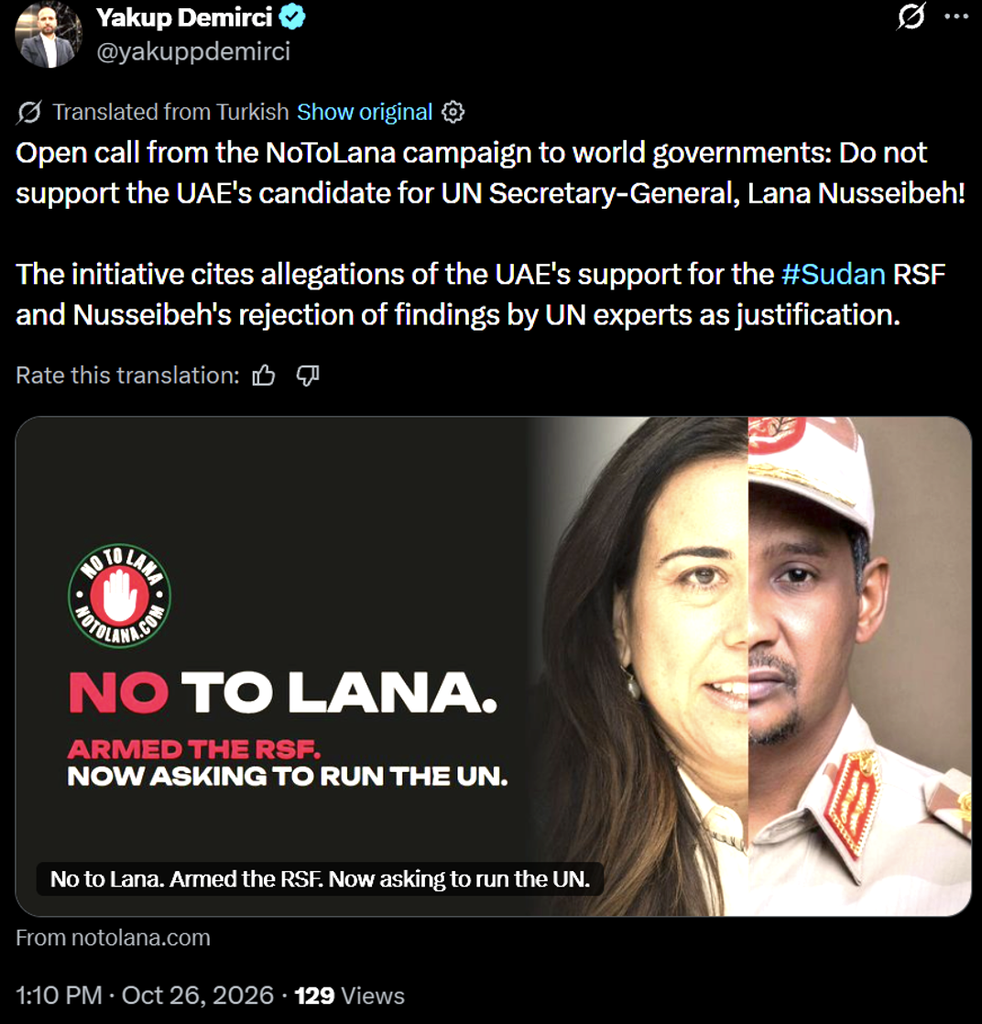
Sudan Axis, which ran Stand With Sudan, promoted the new campaign as well. The account claimed Stop RSF Terror is “led by Sudanese diaspora volunteers” and announced No To Lana on October 26. Turkish journalist Yakup Demirci shared the call in Turkish, and Shahid Ayan, a Sudanese news site, urged readers to join.
Lessons From the No To Lana Campaign
No To Lana’s story is common in the world of online influence: state-linked actors masquerade as grassroots activists. While their cover story is nothing new, the campaign offers three lessons.
First, No To Lana shows how easy it is for operators to launch a new operation. With AI tools and commercial hosting services, operators can quickly and cheaply build a new domain and automated email service without the need for dedicated development assistance. Once built, these services can be reused for other campaigns.
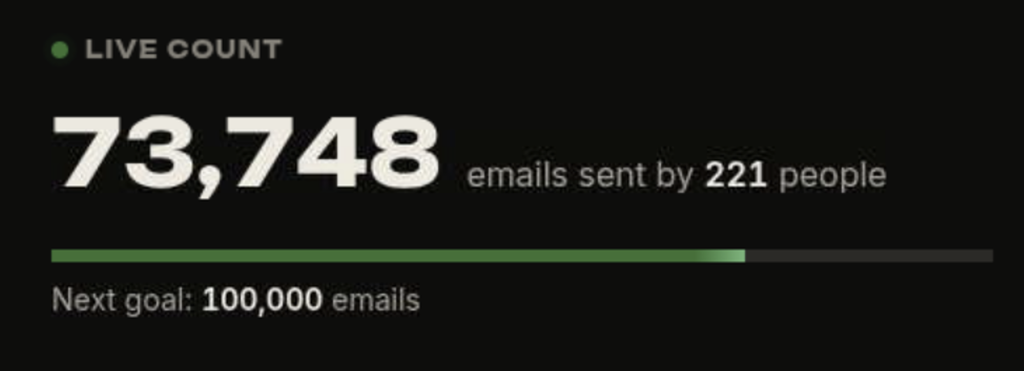
Second, the campaign uses automation to reach its targets directly. The site asks visitors to send pre-written emails, up to 500 a day from each visitor’s Google account. As of October 28, 2026, No To Lana’s counter showed 48,688 emails sent by just 25 people, meaning that — if the number is accurate — a handful of users can produce the volume of a mass campaign. The emails arrive from real addresses and can be read as individual constituent appeals. This type of campaign is also untraceable with traditional social media and other monitoring tools.
Last, the campaign shows how useful the gray area between overt and covert influence activity can be for operators. The people behind No To Lana and its affiliated sites have ties of varying strength to the Sudanese and Turkish governments or state media outlets, yet the website names no organizers and denies any government affiliation. Even as Eltayeb and Sari promote the campaign openly, the site continues to present the campaign as independent, grassroots activism.
Ari Ben Am is an adjunct fellow at the Center on Cyber and Technology Innovation (CCTI) at the Foundation for Defense of Democracies (FDD), where he focuses on emerging threats, influence and information operations, cyber operations, and hybrid warfare. For more analysis from the author and FDD, please subscribe HERE. Follow FDD on X @FDD and @FDD_CCTI. FDD is a Washington, DC-based, nonpartisan research institute focusing on national security and foreign policy.