April 27, 2026 | Memo
Qatar Influence Operations: Unmasking a Suspected Network
Introduction
In mid-July 2025, Sunni Bedouin tribes attacked the Druze of the Suwayda region of southern Syria, leading the nascent central government to send its own armed forces to the region. Amid widespread clashes, a massacre was carried out in the Suwayda National Hospital. Dozens if not hundreds of Druze were killed. Eyewitness testimony and other evidence indicated Syrian government forces were responsible.1 One organization took a contrarian stance. Despite an ongoing investigation by the Syrian government, Eekad, which claims to be a fact-checking organization, used selective and circumstantial evidence to definitively blame local Druze forces for the massacre.2
The shadowy group posted a thread that amassed more than 1.5 million views and went viral on Arabic-language social media. It’s not that the information posted was false, exactly — Eekad does not often post doctored or fabricated content — instead it uploaded biased, unverified, and misleading material. This approach has become a signature of the site’s work on Israel, the United Arab Emirates (UAE), Syria, and other countries and topics.
Eekad is a self-described “منصة تحقيقات المصادر المفتوحة [open-source investigation platform]” — the first in the Arab world and in the Arabic language. Present on all leading social media platforms, Eekad pumps out thousands of pieces of original content using open-source investigation techniques and materials such as satellite imagery, video verification, and social media network analysis. The group’s posts often reach hundreds of thousands to millions of people in the Arab world. As prominent as it is, the provenance of Eekad is murky. In contrast to authentic journalism outlets, Eekad provides no information about its employees, source of funding, affiliations, or even where it is based.
Eekad’s content aligns with Qatari foreign policy. It is critical of Israel, the UAE, Saudi Arabia, and Syrian minority groups. It pushes narratives and content that promotes extremism and is often antisemitic or reflects prejudice against other minority groups. This is not a coincidence. Analysis of the employment history of current and former staff and freelancers at Eekad reveals significant ties to Al Jazeera, other Qatari media outlets, and the Qatari government. Qatari media outlets often amplify Eekad’s findings, using its videos in their own content.
The volume and production quality of Eekad’s content indicate it is well funded. While Eekad utilizes generative artificial intelligence (AI) to expedite its content creation pipeline, it also appears to have a substantial staff. It employs people to create content and manage its online channels, hires multiple freelancers, and contracts at least one PR firm to work on its website and other outlets. And yet, Eekad is not registered as a company, nongovernmental organization (NGO), or any type of entity under its own name in Qatar or elsewhere.
Taken together, these facts make it unlikely that Eekad is a humble journalistic outlet. It is likely a well-funded and organized effort by the Qatari government to covertly influence the Arabic-speaking world, and occasionally affect global opinion with English-language content. Keeping Eekad at arm’s length allows Qatar to reach audiences in countries that have banned Al Jazeera such as the UAE. It produces content targeting Syrian Druze, justifying Hamas’s hostage taking on October 7, 2023, and minimizing the severity of incitements to violence against Jews and Druze, all of which might engender international condemnation if produced by Al Jazeera or another Qatari outlet. Eekad fills a gap in Qatari influence efforts by pushing the controversial narratives that Doha wants amplified.
Eekad’s Content Aligns With Qatari Government Interests
Eekad (a name playing on the root in Arabic for “certainty” or “verify”) produces a large quantity of high-quality, multimedia content. Since 2020, Eekad has uploaded more than 2,300 videos to YouTube and more than 2,500 posts on X, as well as long-form threads on X and Facebook and short-form videos on TikTok and Instagram.
Based on Eekad’s own tagging of its YouTube videos, it primarily publishes content directly and indirectly related to the Middle East and the United States. The most tagged is Palestine, with 1,188 tags, followed closely by Syria, Israel, and Lebanon with 1,091, 1,087, and 1,076, respectively (see Figure 1). While Qatar is not mentioned directly as often as other topics, coverage of Qatar is positive or exculpatory, with Eekad primarily posting “fact-check” videos that respond to criticisms of Qatar. For example, Eekad defended Qatar against allegations of abusing migrant workers employed to prepare for hosting the 2022 World Cup.3
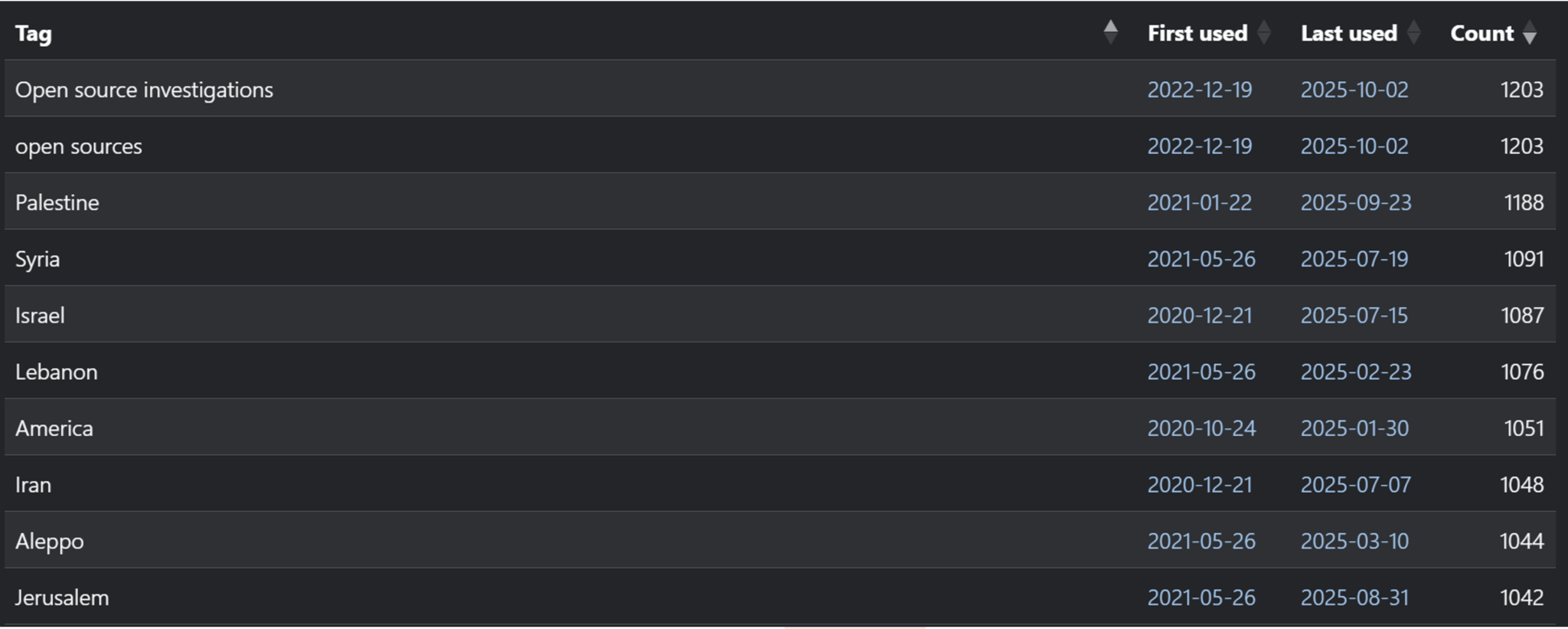
Figure 1: Leading Topic Tags on the Eekad YouTube Channel. Source: Metadata Bulk.
On YouTube, Eekad’s top performing video (a YouTube Short) focuses on the Israel Defense Forces (IDF) and its efforts to uncover Hamas (referred to as “the resistance”) tunnels and locate hostages. As of March 19, 2026, the video has received over 775,000 views.4 Other top performing videos cover topics such as Saudi and Emirati involvement in Yemen and the civil war in Syria (see Figure 2).
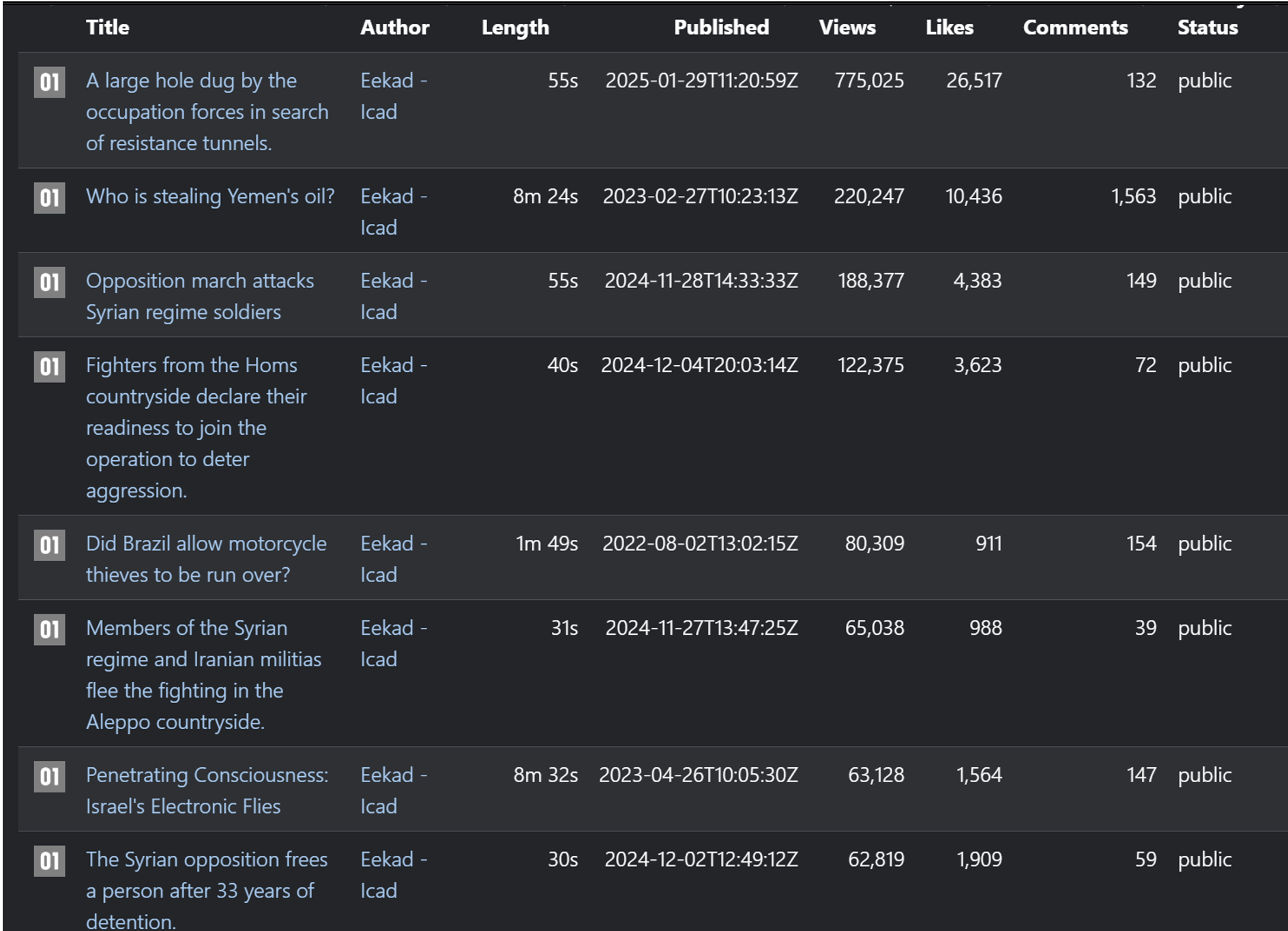
Figure 2: Eekad’s most-viewed videos on YouTube. Source: Metadata Bulk.
A Grok-powered analysis (Grok is X’s large-language model, or LLM chatbot) of Eekad’s X activity reveals a similar focus. Examining a sample of 1,000 posts from Eekad from late September to early November found that 62 percent discussed the Israel-Palestinian conflict. Analyzing posts prior to October 7, 2023, reveals that Eekad’s content most commonly (approximately 40 percent) focused on the Gulf, primarily negative coverage of the UAE.
Eekad’s videos and posts consistently present Israel in a negative light. For example, Eekad attempted to debunk Israeli claims (later confirmed by The New York Times5) that Hamas had built a tunnel for military purposes under the al-Shifa hospital in Gaza by claiming without any supporting evidence that IDF footage of the tunnel was not filmed under the hospital (see Figure 3).6 Eekad also claims without proof that Israel promotes disinformation and conducts influence operations targeting the Arab world and beyond.7
Eekad also alleges without proof that Israel operates “bot farms” impersonating Gazans, Moroccans, and other Arab nationalities.8 The organization often uses common open-source investigative techniques, such as social network analysis, via Gephi, a network graph tool, to visualize networks of X accounts based on shared engagement. However, engagement itself is a weak heuristic for mapping online activity. Visualizing this data provides it with a veneer of legitimacy and accuracy while not including the datapoints or the requisite methodology, enabling Eekad to posit unfounded claims (see Figure 4).9
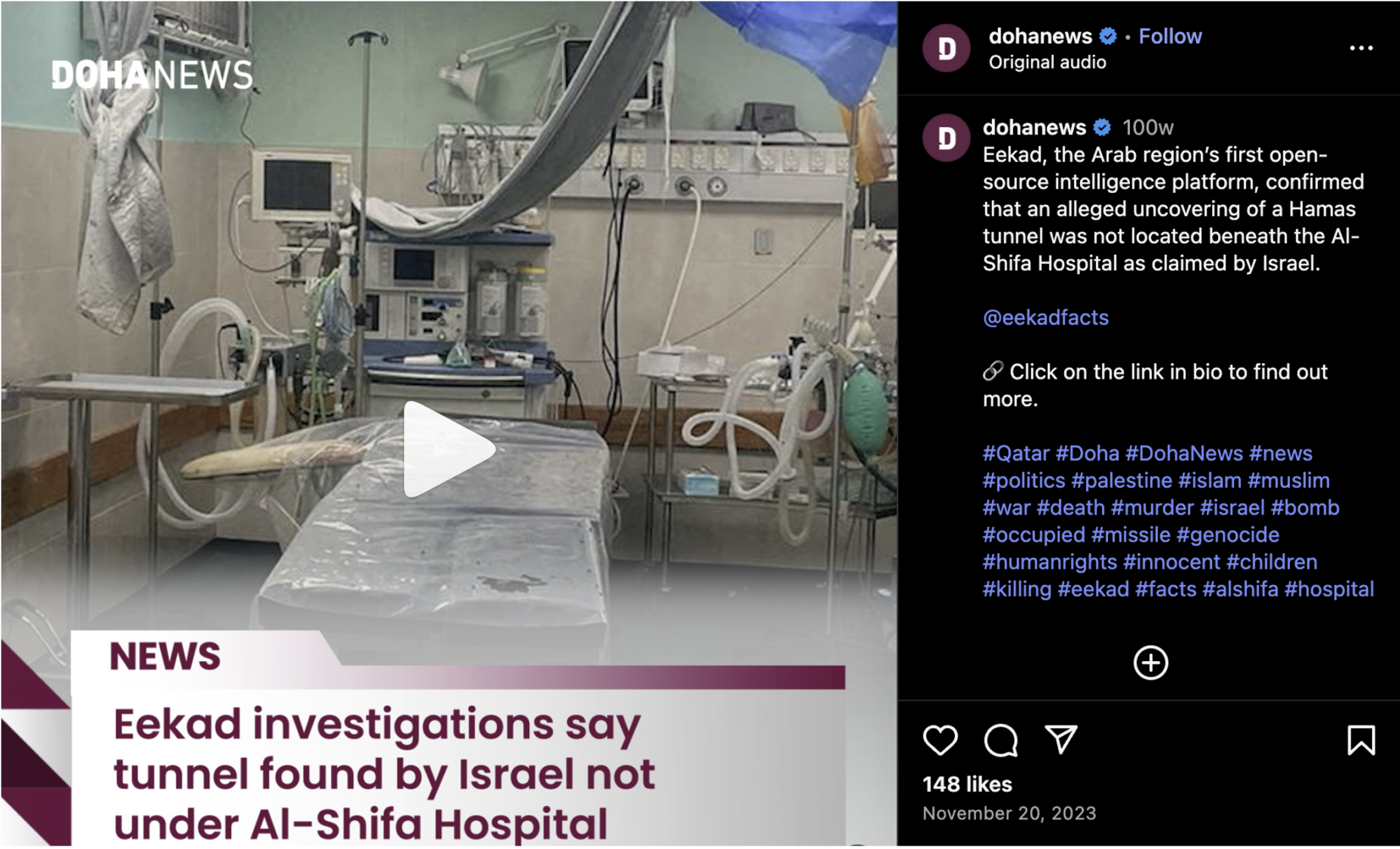
Figure 3: Eekad investigation rebranded and reposted by Doha News.
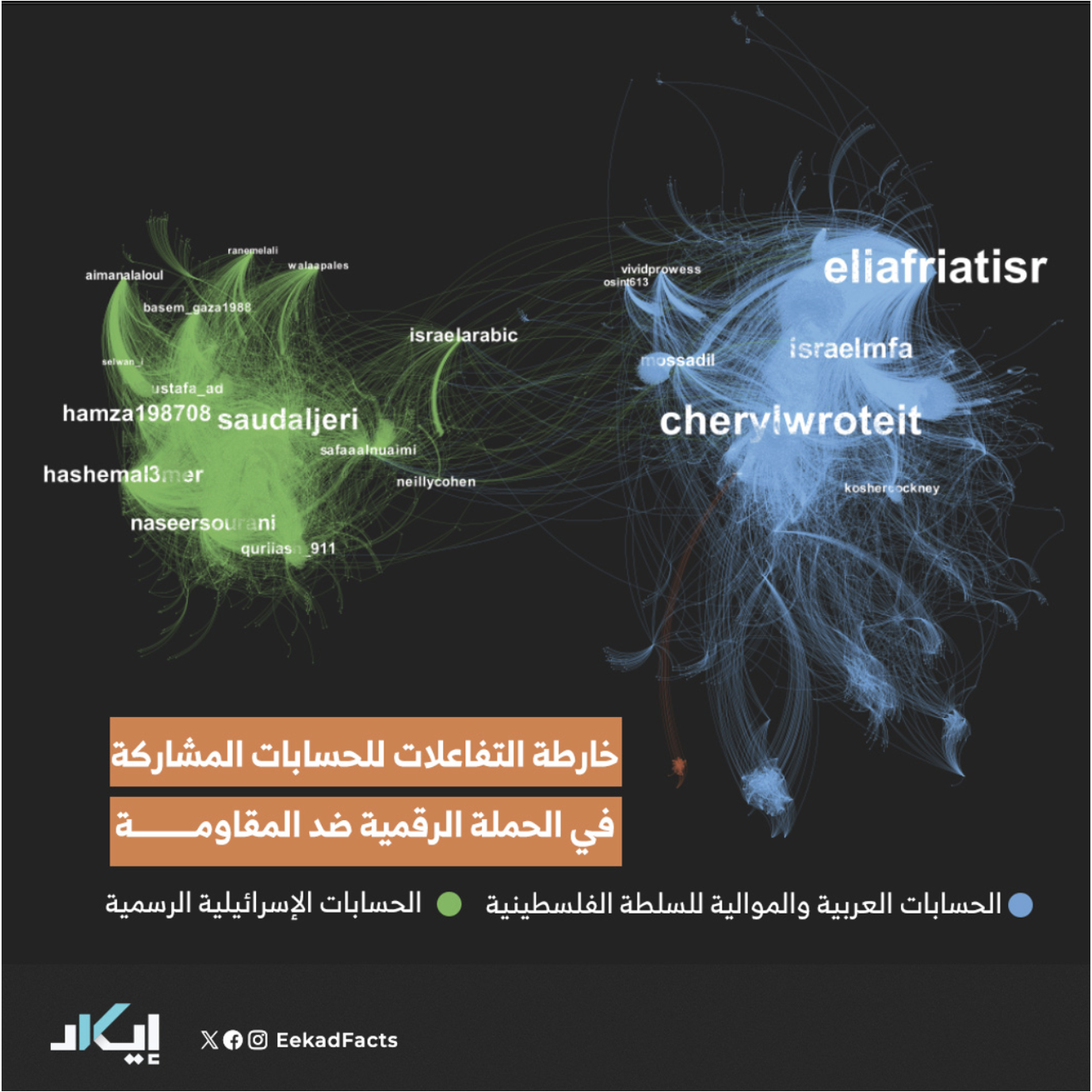
Figure 4: A Gephi social network graph purporting to support claims that anti-Hamas accounts are in fact Israeli by showing anti-“resistance” (Hamas) accounts, with clusters surrounding and allegedly amplifying official Israeli accounts in green and pro-Palestinian Authority accounts in blue.
Concurrently, Eekad provides positive coverage of Hamas whenever possible. Eekad refers to Hamas as “the resistance,” defends its reputation and besmirches its detractors online, and uses the red triangle logo associated with Hamas propaganda videos in many of its posts.10 Eekad has also promoted official Hamas statements to its sizable audience. One example, from October 2025, is an al-Qassam Brigades statement denying responsibility for a Hamas attack on Israeli forces that led to the deaths of two soldiers.11 Perhaps most egregiously, an Eekad thread in English posted on October 9, 2023, defended Hamas’s massacre of Israelis two days prior, referring to the attack in Arabic and English as “al-Aqsa Flood,” Hamas’s name for the October 7 attack (see Figure 5). Similarly, Eekad reported that a “military campaign” of “Saudi-affiliated” social accounts was responsible for spreading “allegations regarding Hamas’s alleged targeting and mistreatment of Israeli civilians and their families.”12 Eekad also dismissed allegations of mistreatment of hostages held by Hamas as Saudi lies. In another instance, Eekad published an English-language video criticizing The Washington Post’s coverage of rape and sexual assault of Israeli women by Hamas on October 7, 2023, claiming that the story didn’t include “Palestinian voices.”13
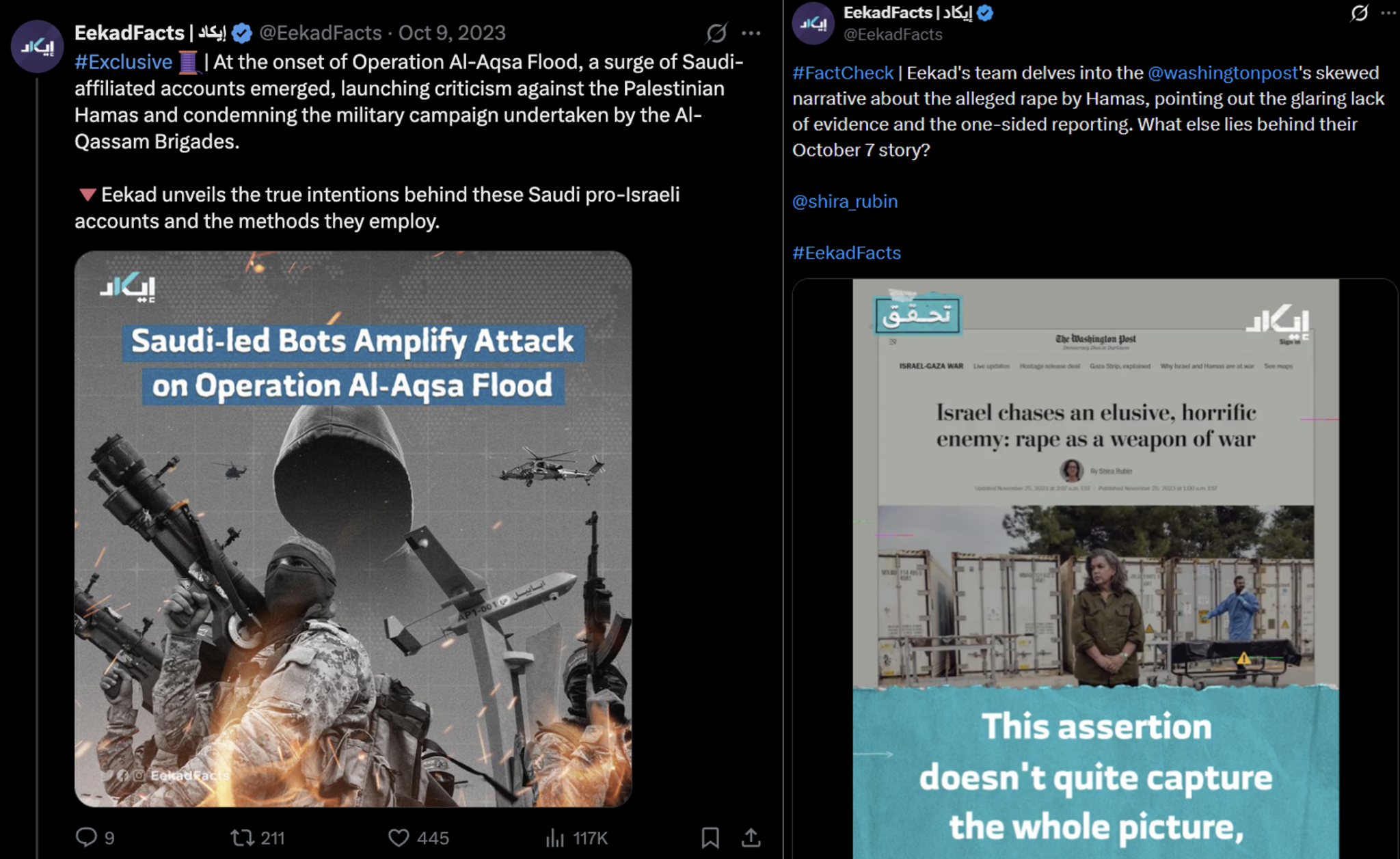
Figure 5: (Left) Eekad thread covering an alleged “Saudi” network, defending Hamas’s hostage-taking tactics, and calling the war by the official Hamas name, “al-Aqsa Flood.” (Right) Eekad post challenging the fact that Hamas committed rapes during the October 7 attack.
Eekad coverage of Syria, meanwhile, aligns with longstanding Qatari support for the forces now in charge of the country.14 One of Eekad’s featured Facebook posts, for example, claims to expose online influence operations from three different countries (Israel, Russia, and Iran) tarnishing the opposition that is now the government of Syria (see Figure 6).15 In addition to the X thread blaming Syrian Druze for the Suwayda hospital massacre, Eekad regularly portrays the Druze as disloyal to Syria. A pinned post on Eekad’s X account accused the Syrian Druze community of conspiring with Israel to secede from Syria and of adopting the “Torah” doctrine of “Greater Israel.”16
Eekad makes false claims against the Syrian Druze community without the reputational risk that other media would assume. As a covert outlet, Eekad can, with minimal reputational risk, publish content that would not meet the editorial standards of any ministry or media outlet.
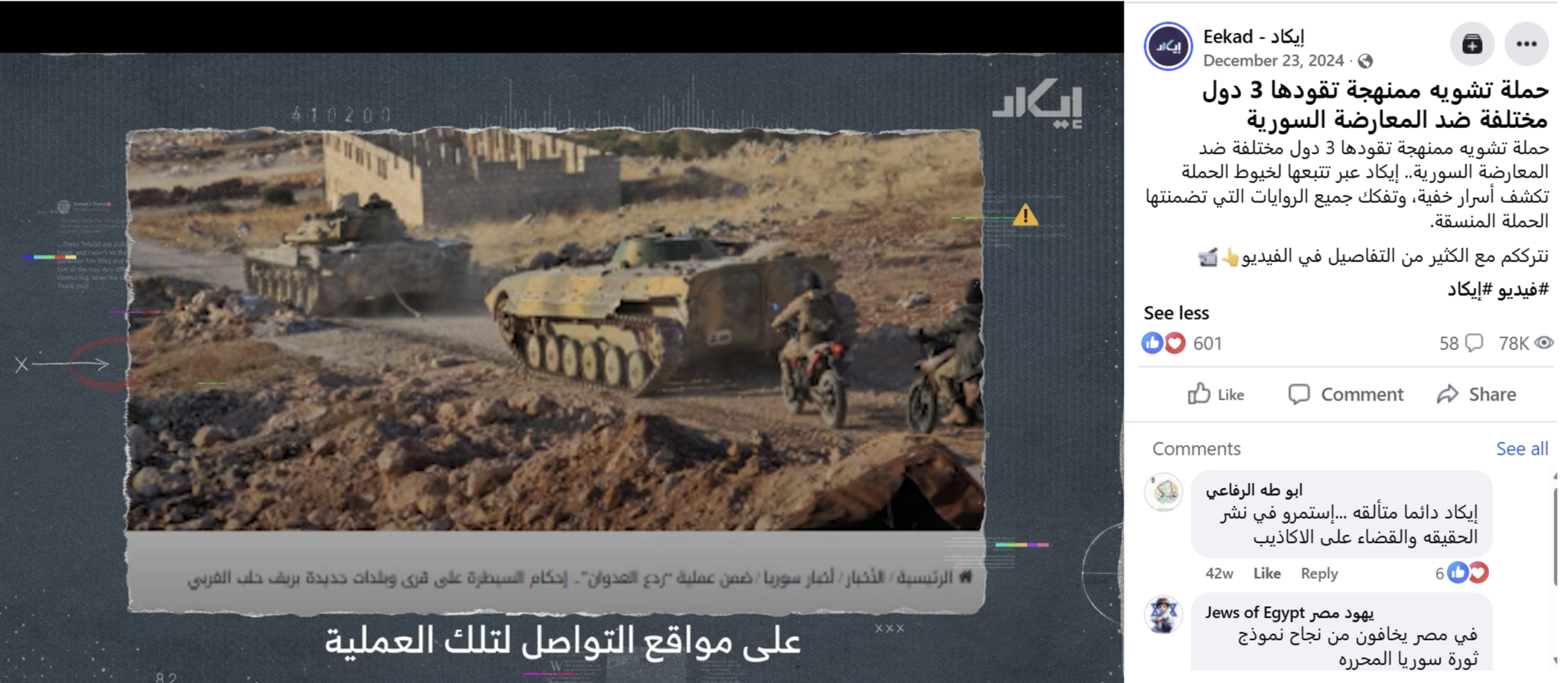
Figure 6: Eekad Facebook post from December 23, 2024, claiming to expose “a systematic smear campaign led by three different countries against the Syrian opposition.”
The UAE is also a key target of Eekad’s work. One of Eekad’s most prominent investigations claimed that the UAE was behind “QLeaks,” a website that posted leaked sensitive and secret Qatari government documents, even uncovering the alleged operator.17 Doha News covered Eekad’s investigation in depth and was the first to do so.18 Eekad also claimed that the UAE provided funds and other support to the Sudanese Rapid Support Forces in the group’s bloody conflict in Sudan.19
Eekad has consistently criticized the United States, focusing on a wide variety of topics, including U.S. military operations abroad. One post alleged that U.S. soldiers “terrorized” Afghan civilians prior to the U.S. withdrawal from Afghanistan in late 2021. Other posts focused on amplifying the human cost of past American wars to portray the United States negatively.20 During the 2024 U.S. election, Eekad covered research initially published by the Center for Information Resilience (an NGO dedicated to “exposing human rights violations and threats to democracy”) and CNN that claimed to discover a network of inauthentic X accounts supporting Donald Trump’s campaign.21 Eekad added analysis in English of an additional 100 accounts and claimed that the network provided “strategic” support for Trump.
In contrast, Eekad’s coverage of Qatar is always complimentary, often taking the form of “debunking” anti-Qatar content. Sometimes this involves simple posts on social media platforms.22 Other times, Eekad posts long-form videos, such as one from November 2022 that downplayed reports of the mistreatment of laborers building stadiums and infrastructure in Qatar to host the World Cup that year.23 Eekad also attempted to boost journalistic coverage of that video, tagging 97 X accounts in the comments, almost all of which belonged to journalists, activists, or academics, many of whom had ties to Qatar or Qatari media such as Al Jazeera.
Eekad also works to defend Qatar’s image in the United States. One Eekad X thread criticized online accounts that claimed that Qatar funded anti-Israel student protests on U.S. college campuses, accusing unnamed “Zionist” accounts that “meddle” in online U.S. discourse of defaming Qatar.24 Accusations of backing campus protests became a serious concern for Doha; Eekad posted its thread several weeks after, and in reference to, the official statement made by Qatar’s media attaché to the United States on May 3, 2024, denying any “disinformation … about Qatar’s relationship with certain US universities.”25
Eekad Employees and Freelancers Have Qatari Media and Government Connections
Eekad, in contrast to legitimate and authentic news or journalistic outlets, provides no transparency as to its ownership or employees. Yet the employment history of Eekad’s current and past employees reveals specific ties to Al-Jazeera, Qatari PR firms (or PR firms with a presence in Qatar) that contract for Al-Jazeera, and the Qatari government and its ministries.
Owing to Eekad’s opacity, it is only possible to examine the employment history of select employees who have shared personal information on public social media accounts. One cannot say to what degree this sample is representative, but many employees have connections to Qatar.
Eekad’s opacity extends to its social media entities. While its Facebook page notes that its managers are based in Qatar, Turkey, and Egypt (see Figure 7) and it pays in both Qatari and U.S. currency for ads (almost all of which have been taken down for violating Meta advertisement policies for political ads without proper disclosure),26 Eekad’s accounts contain no information about its management or employees. Eekad’s X account exposes some information as to its provenance. As of November 2025, the account was operated out of Turkey, according to X’s transparency data, which reports the general location of an account based on IP geolocation as well as the national-level app store used to download the app.27 A later check of Eekad’s X account shows that the operators are now concealing their location so that the account is now supposedly based in what X calls “West Asia.”
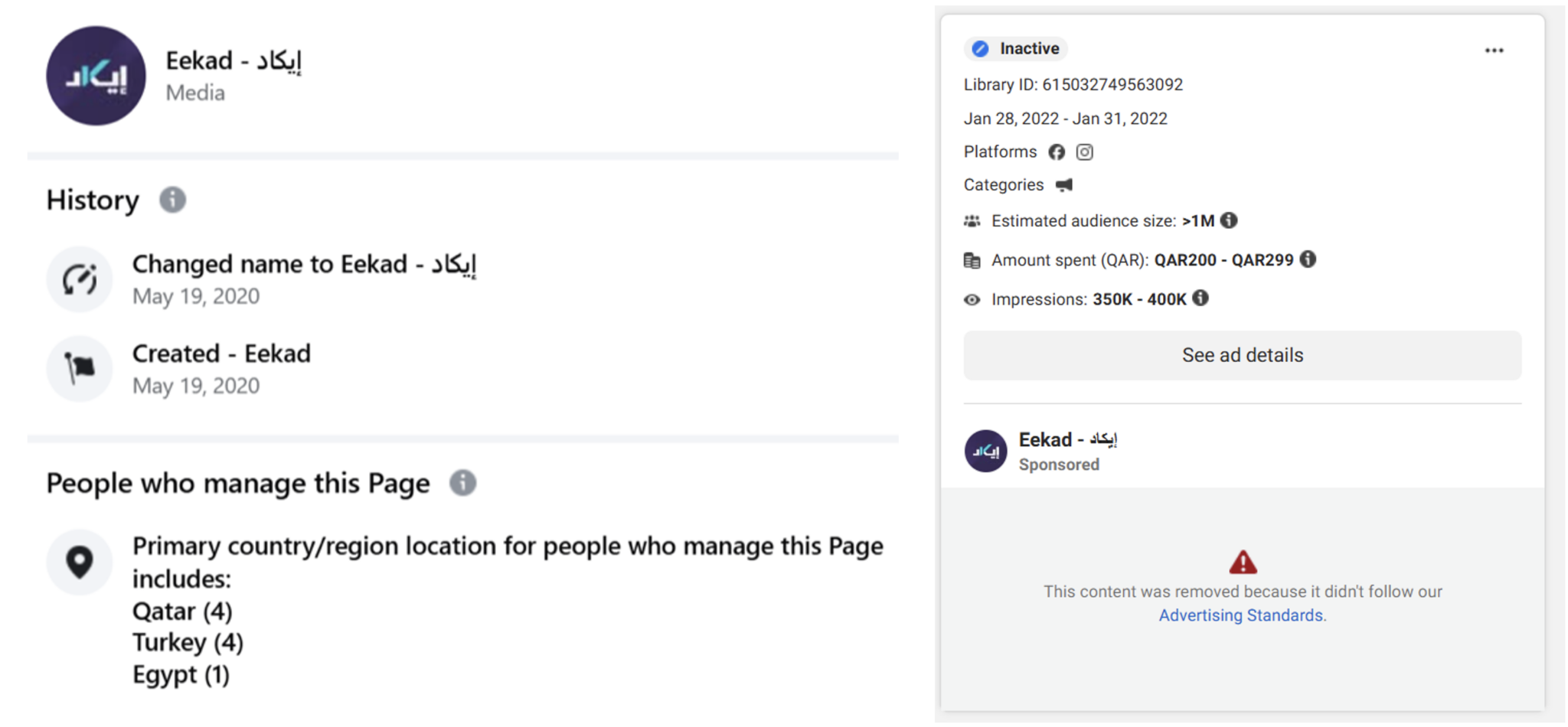
Figure 7: (Left) Screenshot of Eekad’s Facebook page transparency section, showing managers in Qatar, Turkey, and Egypt. (Right) A sample ad on Meta’s ad library showing ad spend in Qatari Rials.
In contrast to legitimate media outlets, Eekad publishes no information about its employees. Nevertheless, LinkedIn searches reveal individuals who previously worked with Eekad. Many of them are based in Qatar and Turkey and, as noted above, all have worked for Qatari government or media outlets, particularly Al Jazeera, as well as firms that contract for Al Jazeera and the Qatari government.
Rand Abu Hilalah — daughter of former Al Jazeera Managing Director Yaser Abu Hilalah — worked as a “social media coordinator and news editor” for Eekad, according to her bio on the online magazine Meer.28 Abu Hilalah also published multiple articles on Al Jazeera’s Arabic-language website until 2019, one year prior to the founding of Eekad, which registered its web domain in May 2020.29
Video editor Joanne Mrad posted on LinkedIn that she has “edited and produced highly engaging videos … documentaries and trailers across major social media platforms” for Eekad Facts as well as for the Qatar National Cyber Security Agency, Ministry of Interior, and National Archives (see Figure 8).30 Mrad’s clients are largely if not exclusively Qatari government ministries or government-owned ventures, a strong indicator that Eekad is itself government-backed.
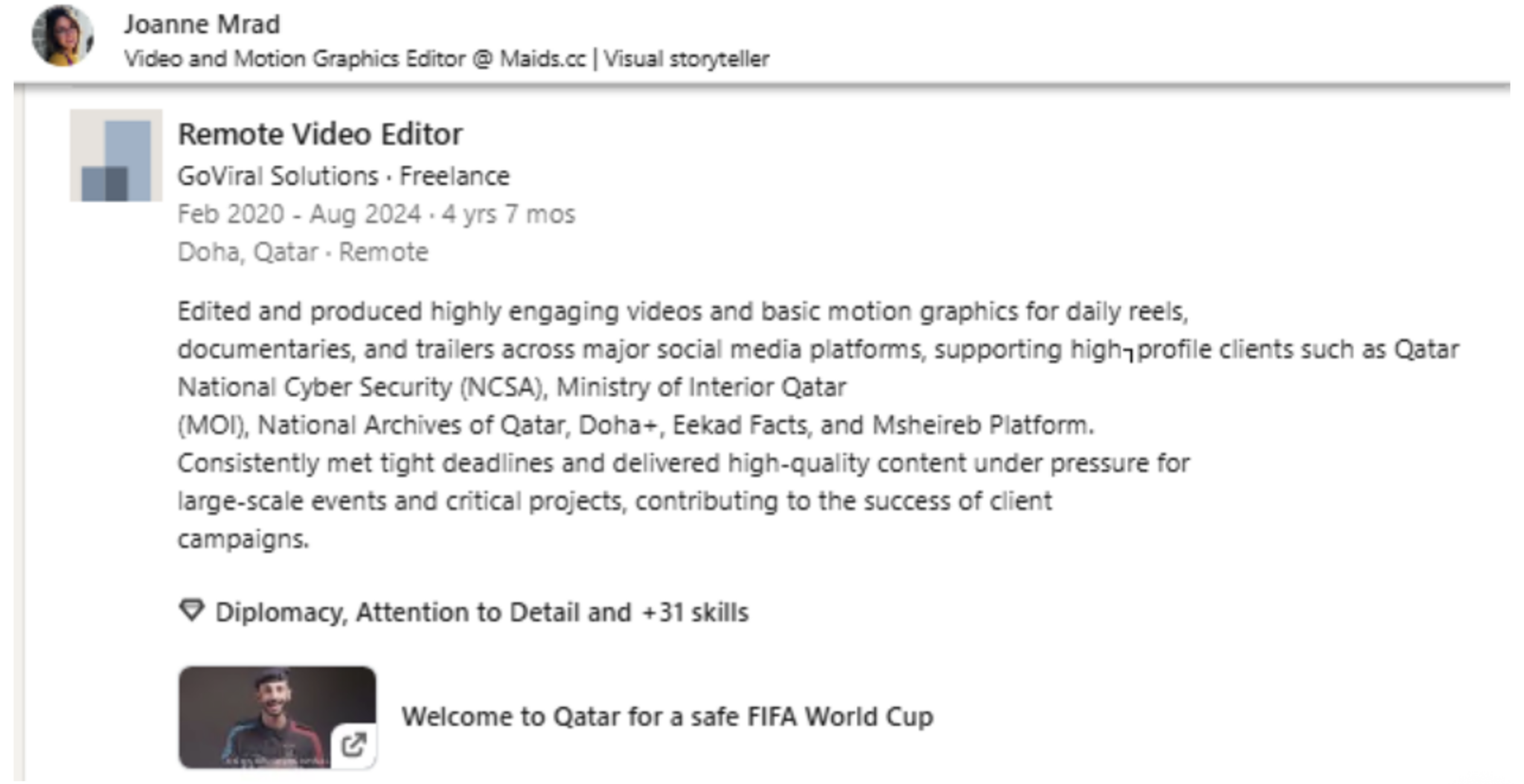
Figure 8: Screenshot of Joanne Mrad’s LinkedIn profile as of November 13, 2025.
Other affiliates of Qatari media outlets have also worked for Eekad. From June 2020 until at least January 2024, Mohyeddine al-Dimassi worked as a journalist and producer at Eekad. He also worked for Quds TV (a pro-Hamas media outlet not affiliated directly with Qatar), Al Jazeera, and the Qatari Ministry of the Interior, with his work at Al Jazeera and the Qatari Ministry of the Interior overlapping with the time frame that he worked at Eekad (see Figure 9). Al-Dimassi removed his affiliation with Eekad from his LinkedIn profiles in recent months, which may indicate a desire to keep information regarding Eekad secret.
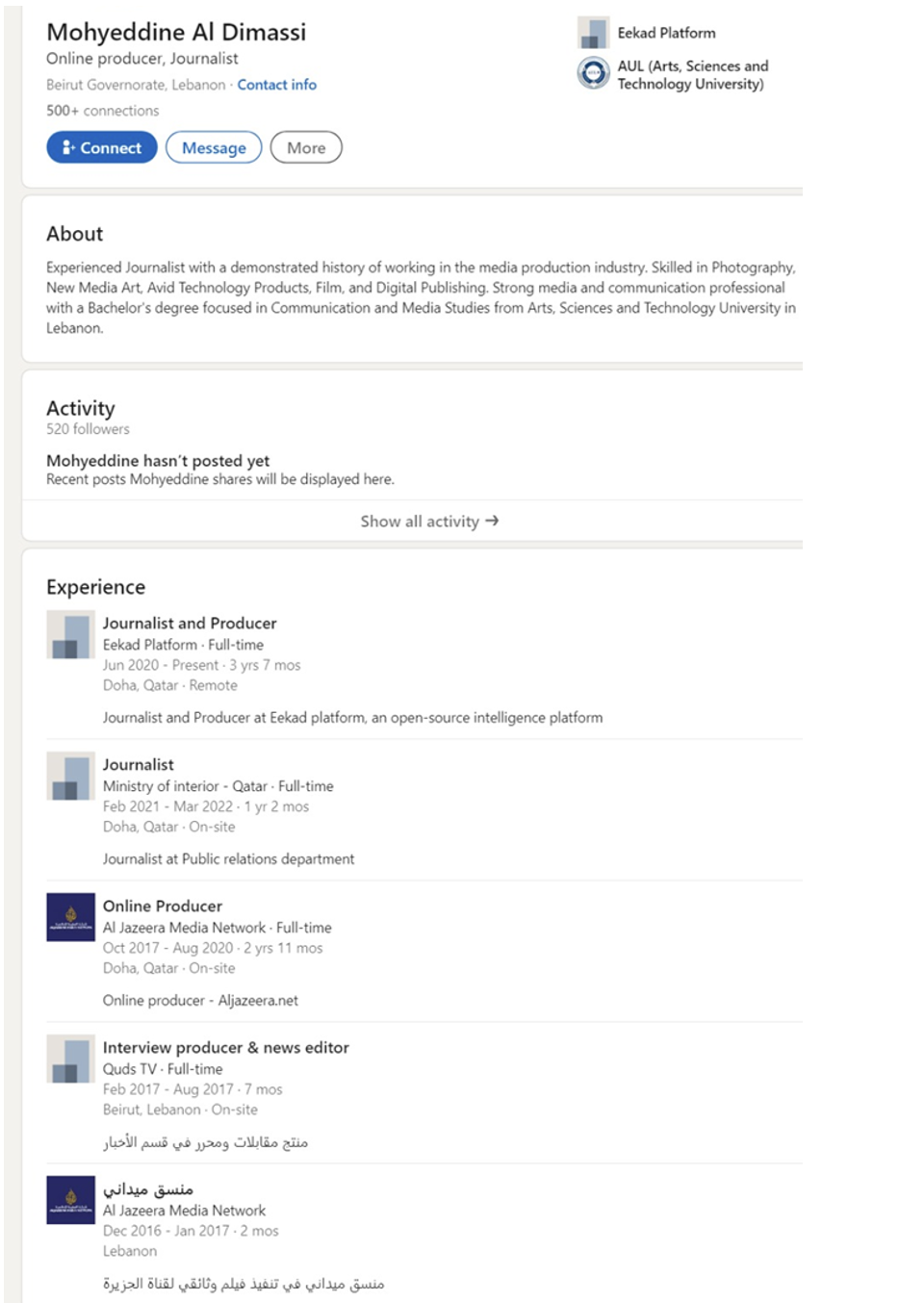
Figure 9: Screenshot of al-Dimassi’s LinkedIn page from January 2024, showing past simultaneous employment at Eekad and the Qatari Ministry of the Interior.
Other freelancers and contractors have also worked for both Eekad and Al Jazeera. Film director and video editor Thaer Haj Hamdan worked for Eekad between March 2022 and May 2023. He worked for Al Jazeera affiliates both before and after his stint at Eekad, including Al Jazeera in Turkey for more than three years.31 He currently works for the UK- and Qatar-based production company 39East, which produces primarily Islamic-oriented content for the Qatar Foundation, Al Jazeera, and other clients (see Figure 11 for examples of his work).32 His other current employer, iFilms, has similarly contracted for the Qatari government, and a sample of their content on their Facebook page is Al Jazeera branded (see Figure 12).33
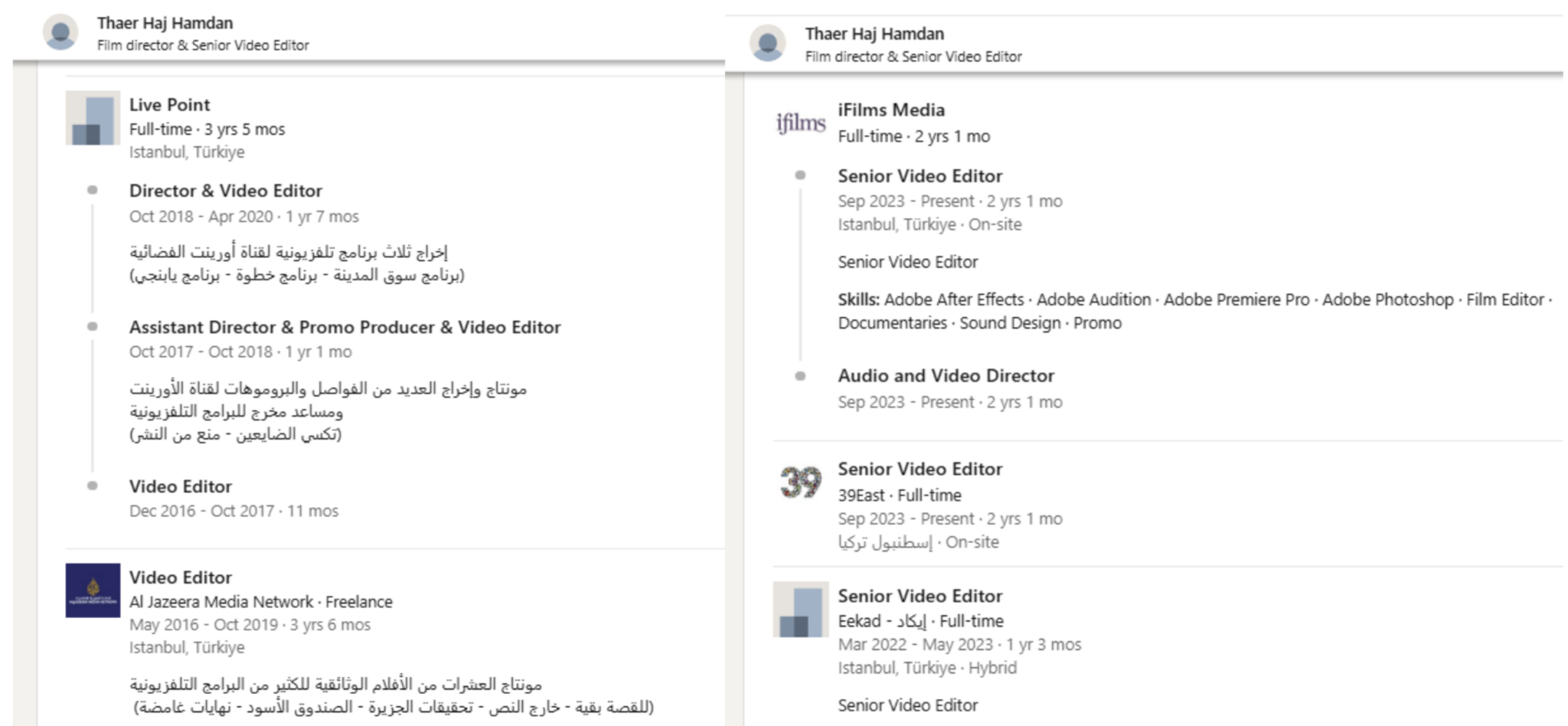
Figure 10: Screenshots of Hamdan’s LinkedIn profile showing experience at Eekad, Al Jazeera, and digital marketing firms that contract for Al Jazeera such as 39East.
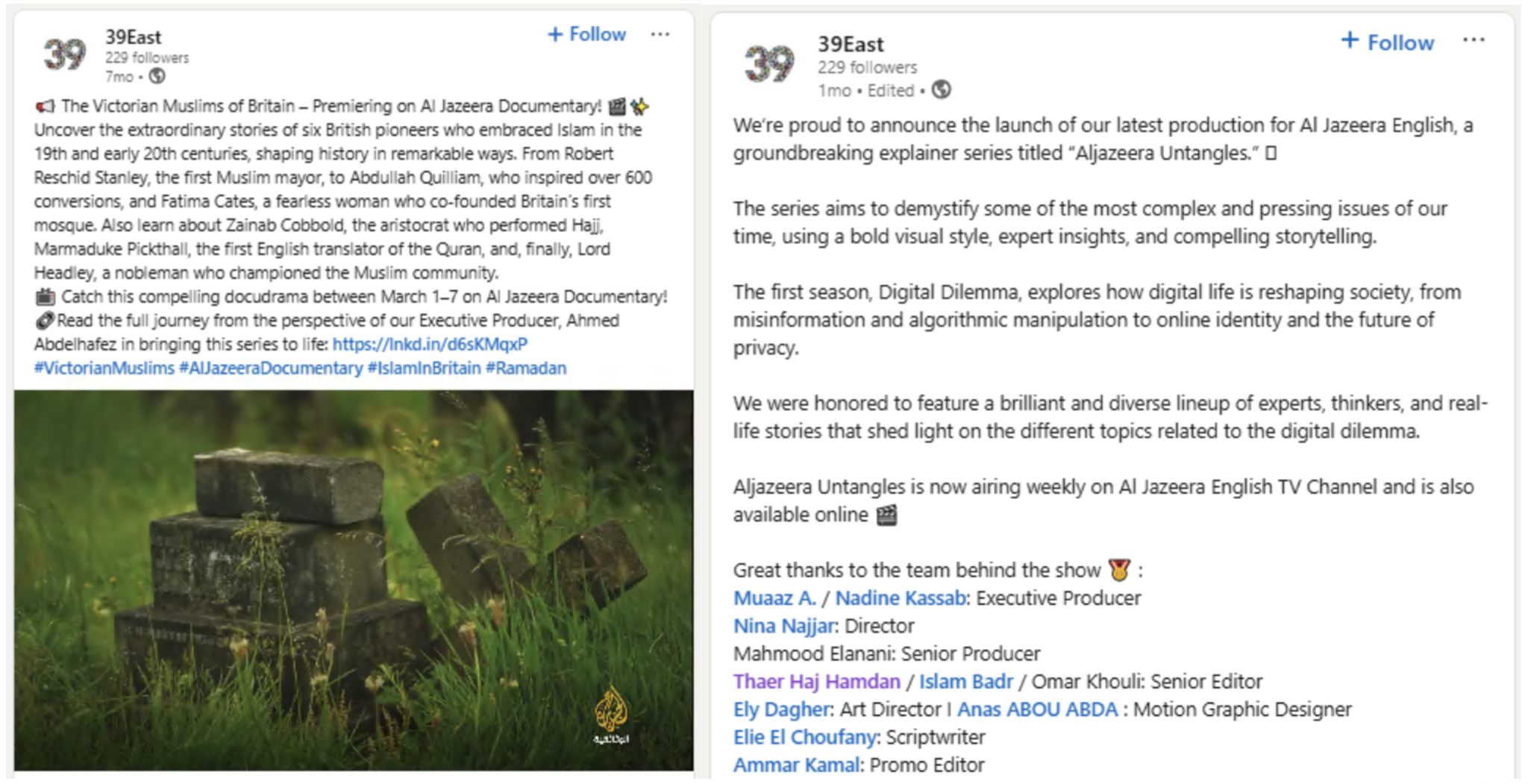
Figure 11: (Left) A LinkedIn post by 39East promoting an Al Jazeera documentary it created. (Right) An additional production by 39East for Al Jazeera emphasizing how “misinformation and algorithmic manipulation” impact society.
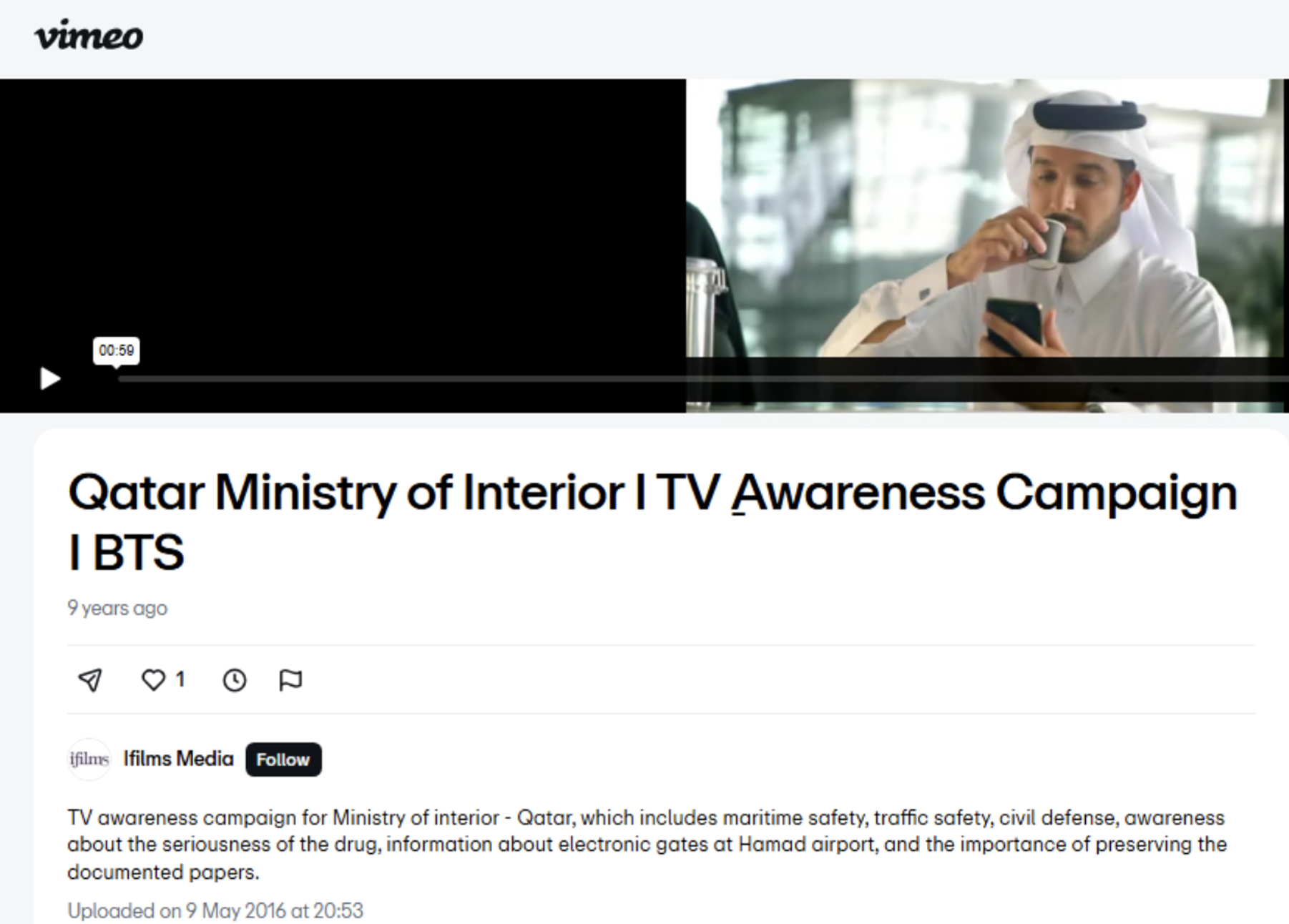
Figure 12: Screenshot of a Facebook post from iFilms Media promoting a video for the Qatari Ministry of the Interior.
In addition to relying on producers and video editors, Eekad’s content generation pipeline relies on various AI tools to expedite production. Eekad’s videos have long relied on AI voiceovers and recently have also used AI-generated still images and video footage. For example, one recent video about the Israeli Foreign Ministry bungled the printing of text in both English and Hebrew (see Figure 13).34 The use of these AI tools may speak to Eekad’s desire to expedite production at scale — a goal relevant for an influence operation, less so for a journalistic or investigative outlet.
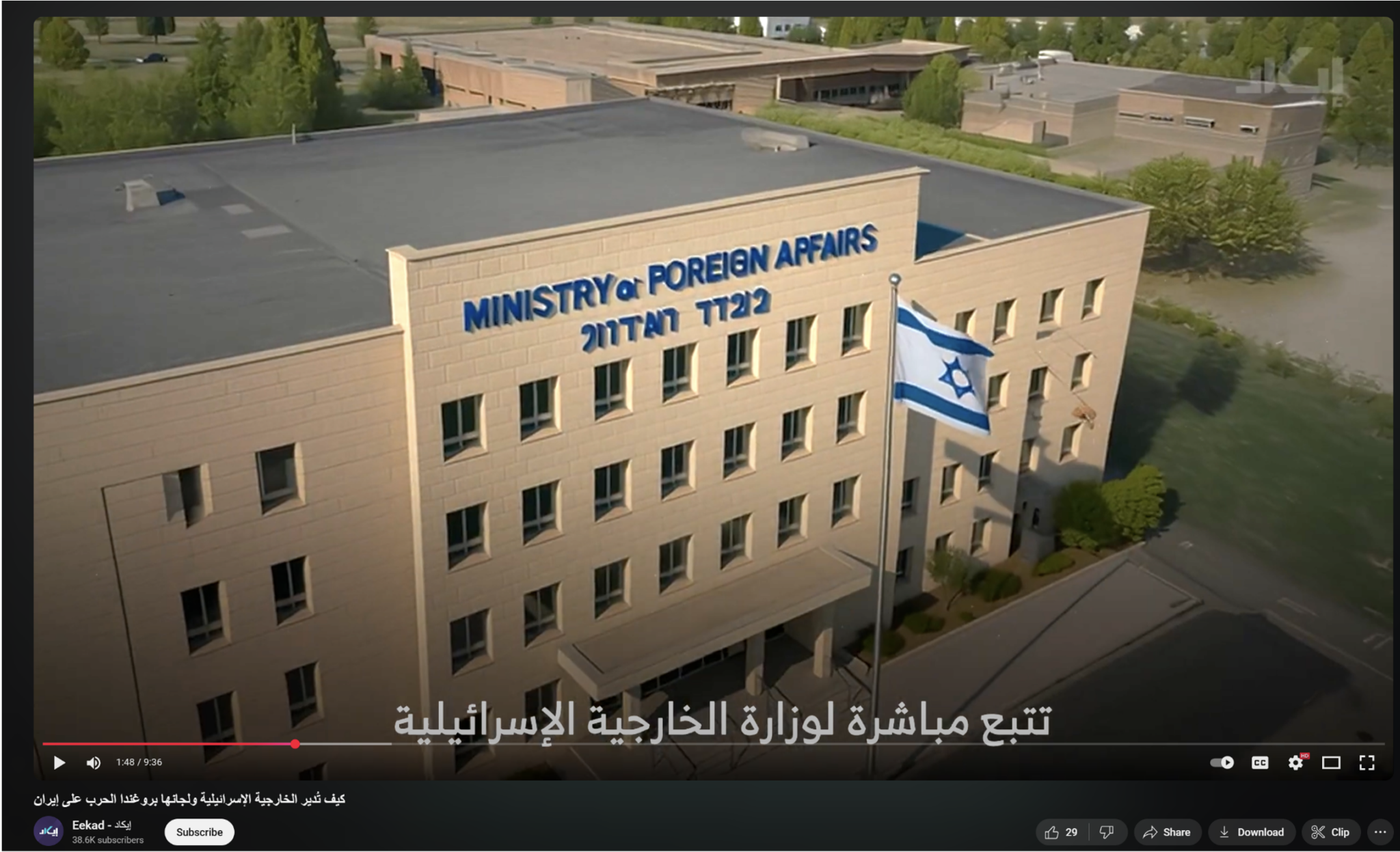
Figure 13: AI-generated video showing garbled text generation in Hebrew and English. Source: YouTube.
Eekad Social Media Presence Shows Signs of Inauthentic Support
Eekad’s social media presence is expansive, boasting more than 1 million followers on Facebook and nearly 300,000 on Instagram.35 Some of its content goes viral and reaches a wide audience in the Arabic-speaking world, garnering hundreds of thousands to millions of views. Other content, despite being well-produced, receives little or virtually zero engagement. This discrepancy indicates that at least some of Eekad’s social media presence may be at least partially inflated by inauthentic followers.
The organization posts investigative content in multiple formats across multiple platforms, covering issues such as disinformation and bot networks, often verifying or debunking online content. Most of its content is in Arabic, but Eekad also attempts to reach English speakers with a dedicated Facebook page as well occasional posts in English across its accounts.36
A serious discrepancy between follower counts and view counts is often indicative of inauthentic followers. Eekad’s YouTube channel has more than 38,000 subscribers, yet most of its videos have only several hundred views. The same dynamic applies to its X account, which has more than 342,000 followers, but most of its posts receive only a few thousand views. Eitan Fischberger, an Israeli investigator, pointed out that Eekad’s following on X grew from 76,000 followers to 181,000 between October 9 and 31, 2023, a rate of growth that is improbable to achieve naturally.37
The use of inauthentic followers to amplify engagement on social media is an indication that Eekad may be purchasing engagement or followers, which means that exposure and reach is the end goal, and not just the production of quality content with journalistic integrity. Additionally, the purchasing of inauthentic engagement is indicative of problematic ethics for an ostensibly journalistic outlet.
Domain Infrastructure Offers Additional Clues
Eekad’s domain, eekad[.]com, is inactive at the time of writing. However, subdomain enumeration of the domain, a technique that exposes subdomains hosted under the full domain name, found an active subdomain at facts.eekad[.]com. The domain registration location is listed as Qatar.
The subdomain is active. Except for a long pause between late-2023 and mid-2025, the operators have been actively publishing. The reason for the pause is unclear, though social media activity continued uninterrupted. This is unusual considering that Eekad’s accounts do not promote this subdomain. It may indicate that Eekad plans to relaunch the site. The site itself is well-organized and slickly produced, with most of its articles penned by “Abdallah al-Kateb,” which may be an actual name or a nom de plume, as it can be translated as Abdallah the Writer (see Figure 14).
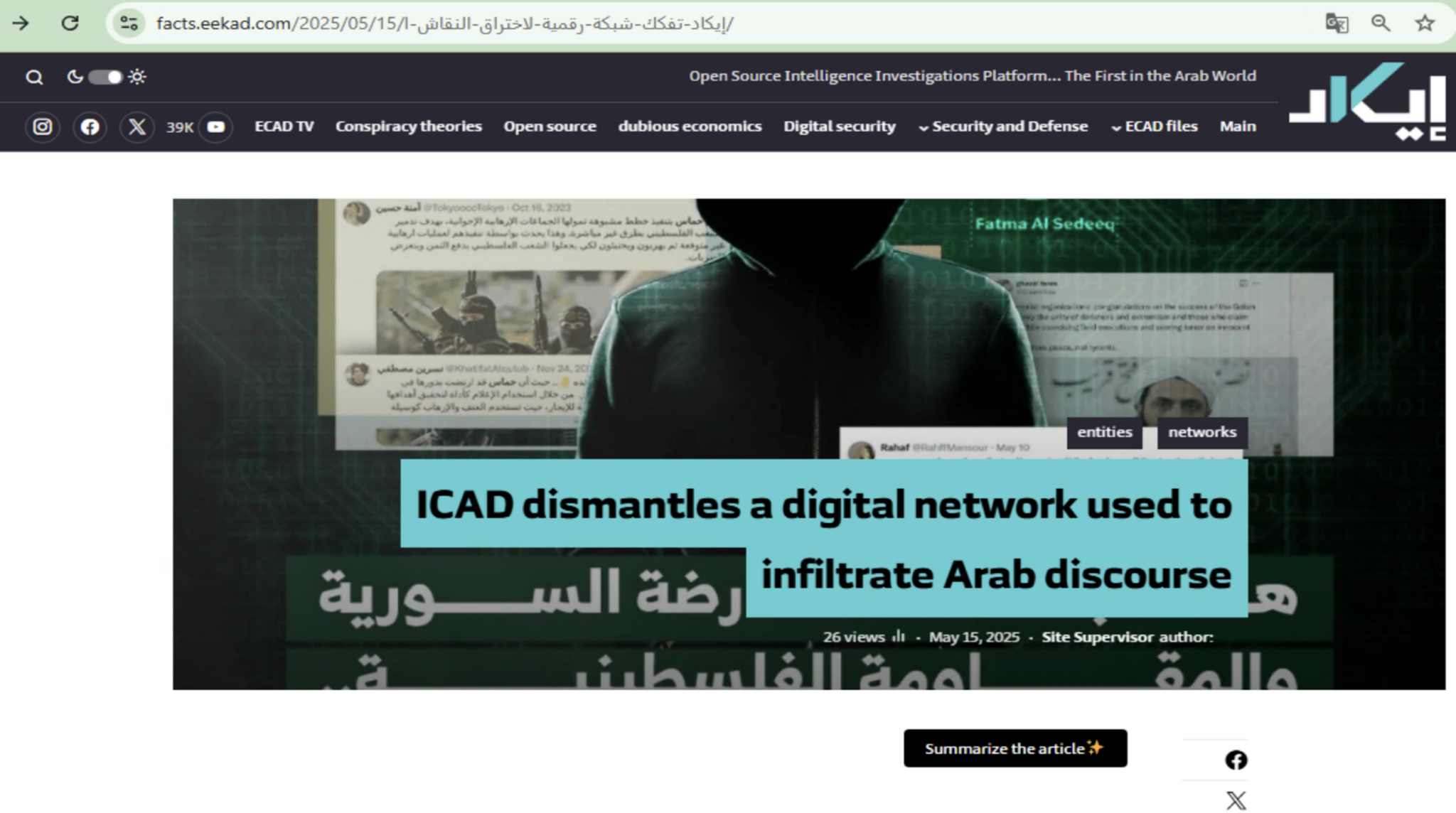
Figure 14: Translated example of an article posted on fact.eekad[.]com.
WHOIS registrations of the domain show it to be registered by anonymous individuals in Qatar (see Figure 15). Given the Qatari government’s surveillance of its citizens, the geopolitical sensitivity of Eekad, and Qatari legislation that limits journalism with a negative impact on state interests, it is unlikely that a Qatari citizen could operate such a website without Doha’s knowledge and at least tacit consent. For example, the Qatari Cybercrime Prevention Law’s Article 6 states that:
A sentence of not more than three years in prison and a fine of not more than (QR 500,000) five hundred thousand Qatari Riyals, or either of these penalties, shall be imposed on any person who through an information network or any information technology means sets up or runs a website to publish incorrect news to threaten the safety and security of the State or its public order or domestic and foreign security.38
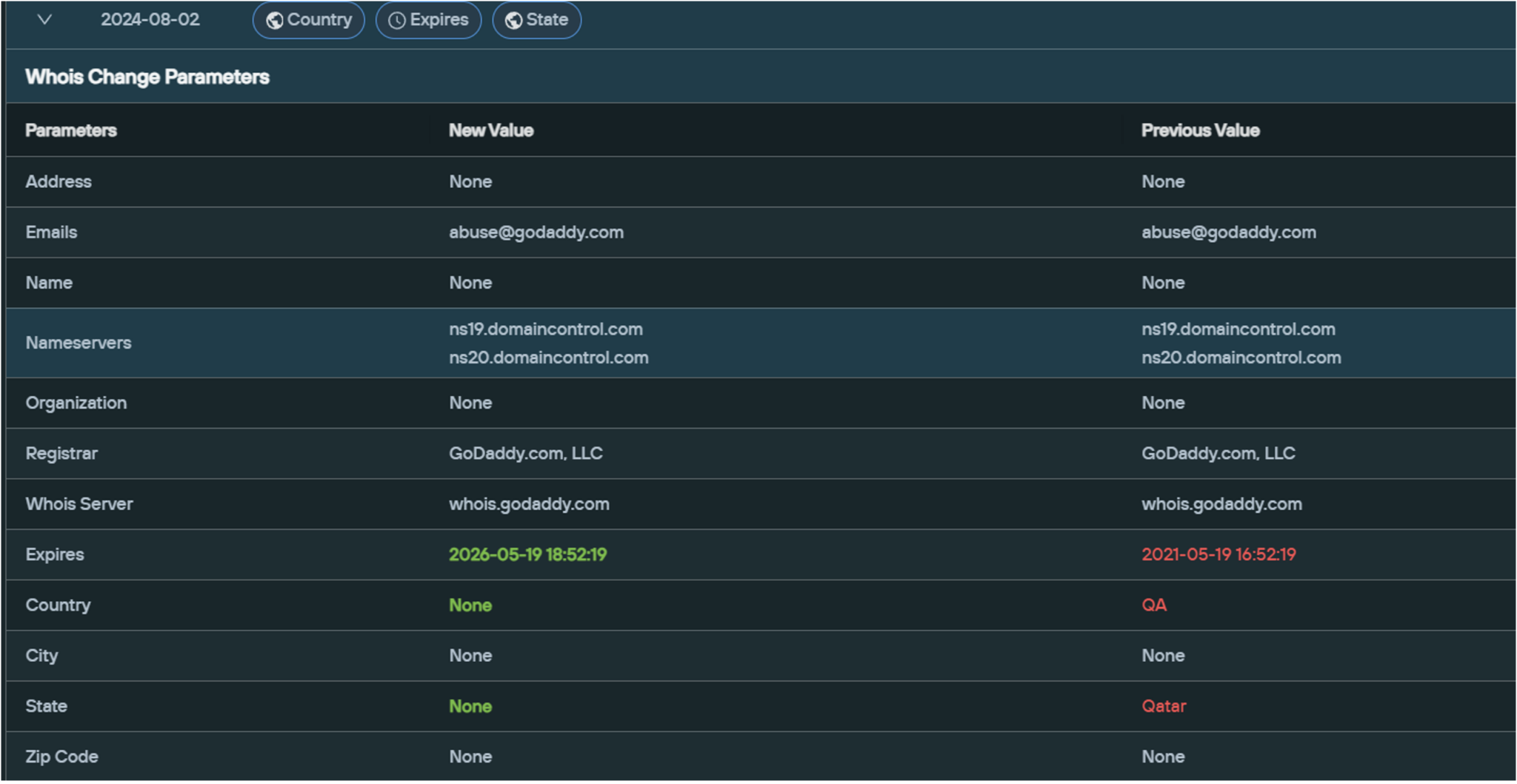
Figure 15: WHOIS registration showing that Eekad’s domain is registered in Qatar. Source: Silent Push.
Eekad’s infrastructure indicates that it enjoys significant budgetary support. Start of Authority records, an initial record for domain registration,39 show that the domain appears to have been registered by an Egyptian web developer otherwise unrelated to Eekad. The hiring of a web developer indicates that Eekad has sufficient budget to pay for a reasonably high-quality production, rather than using publicly available, low-cost tools.
Eekad also appears to contract digital marketing firms to amplify its message. A VPS (virtual private server) used by Astrolab Agency, a Tunisian digital media firm with offices in Qatar, hosts an instance of the now unavailable Eekad webpage identifiable via Censys, a tool that scans IP ranges to identify servers.40 Accessing the sitemap shows that Eekad had a subdomain on the Astrolab Agency website, indicating a business relationship (see Figure 16).
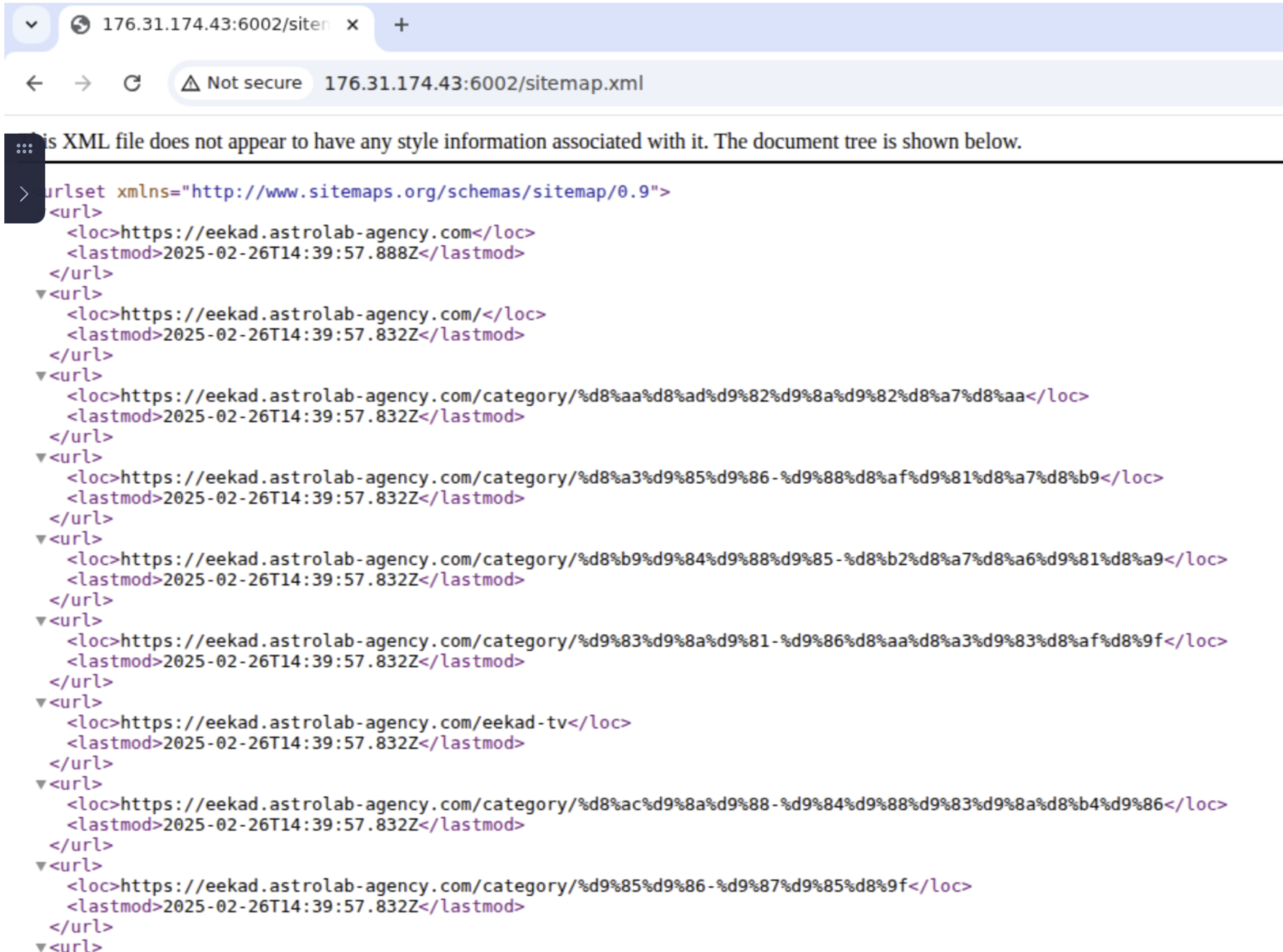
Figure 16: Dedicated host run by Astrolab Agency showing that Eekad has a subdomain on Astrolab’s domain and hosted by its server.
Qatari News Outlets Amplify Eekad’s Investigations
Eekad’s popularity online is not just the result of its own activity (or inauthentic followers). Eekad’s content is also amplified frequently by other outlets, most frequently Qatari state media outlets — another indication of Eekad’s connections to the Qatari government.
Doha News is one of Eekad’s most prolific amplifiers. It is an ostensibly independent news outlet in Qatar, now owned by Star Reputation Consulting Ltd., an Indian IT firm following Qatari censorship of content under the previous owners.41 Doha News has published multiple articles that focus on Eekad’s posts, especially prior to December 2023, at which point coverage slowed down. The dedicated “Eekad” tag on the Doha News site has just five articles listed, though multiple other articles that refer to Eekad on the site are not tagged as such.42 Most of the site’s coverage of Eekad is written by Asmahan Qarjouli, a Doha-based employee of Doha News who previously interned for Al Jazeera in both the United States and Qatar. Doha News has covered Eekad’s posts on the QLeaks domain, alleged Israeli hacking of Qatari phones, pro-Israel botnets, and other similar topics.43
Al-Araby al-Jadeed, a privately owned news outlet founded in Qatar and based in London, has promoted Eekad on at least four occasions, including, most notably, carrying Eekad’s coverage of the al-Suwayda hospital massacre.44 Other articles from al-Araby al-Jadeed, including its English-language paper The New Arab, cover Eekad’s posts on alleged foreign and Israeli interference in Jordan, UAE digital espionage networks, and foreign interference in Syria.45
Al Jazeera in Arabic has published multiple articles that refer to Eekad or cover its reporting. One such article focuses on the importance of fact-checking in “undermining the … Israeli ‘occupation’ narrative.”46 Middle East Monitor, a Qatari state-funded outlet, has referred to Eekad at least once.47 Sada Social, an Al Jazeera-funded Palestinian social media and digital awareness platform, has referred to Al Jazeera and Eekad together as leading fact-checking resources.48 Despite the coverage in Arabic, however, Al Jazeera has yet to reference Eekad in any of its English-language reporting.
Other, non-Qatari, Middle Eastern outlets have covered Eekad on multiple occasions.49 Iranian Press TV has referred to Eekad at least once.50 Syrian outlet Shaam covered Eekad’s narrative on al-Suwayda.51 Some Moroccan outlets have used Eekad’s reporting on alleged Israeli-funded anti-government activity, while other Moroccan outlets have parroted Eekad’s content on the Israel-Hamas war.52
Despite its measurable impact in the Arab and Muslim world, Eekad has not had a significant impact on Western media outlets. The only identified reference to Eekad’s fact-checking efforts in a Western media outlet appears in Australia’s Special Broadcasting Service.53 Eekad’s reporting has, however, been picked up by Western nonprofits including Freedom House, which featured Eekad’s uncorroborated reporting on alleged Israeli inauthentic X networks targeting Morocco.54 Airwars, an NGO registered in the United Kingdom that tracks airstrikes, has also relied on Eekad on a number of occasions.55
Recommendations
Eekad’s success offers a clear lesson for Washington and Western media outlets: there is a prime market in the Arabic-speaking world that is seeking online content with high production values, created in their language (not translated from English). Part of Eekad’s popularity stems from its appearance of independence. Social media platforms and partners in the region should expose Eekad as a Qatari front. This would undermine the reputation for independence Eekad has cultivated and, by extension, drain the credibility of its anti-American and anti-Western content.
Encourage Social Media Companies to Promote Transparency
All social media companies and platforms should strive for transparency. Account and platform transparency, such as openly listing general location information, username history, advertisement campaigns, and more, helps expose foreign influence operations, scams, and other illicit activity. Transparency thus complicates the efforts of those who seek to manipulate Americans online. X’s recent decision to expose general account locations is a welcome step. Eekad is also deserving of a “state-sponsored media” label on social media platforms, such as the one X puts on content from Al Jazeera. Transparency about its ownership would also provide viewers with clarity on its agenda. Social media platforms could enforce additional transparency requirements — such as registration date and location, last sign-in location (at the country level), and past usernames — for accounts with large followings, while demanding less of true personal accounts, whose owners merit a degree of privacy.
Expose Eekad’s Qatari Connections
The U.S. government should investigate Eekad as a possible high-value foreign influence operation for two reasons. First, to ensure that its target audience knows who is behind the messages they are reading, and, second, to ensure that the United States and its partners and allies are aware of Qatar’s controversial activity. While the findings above show the potential of open-source methods to expose influence operations like Eekad, the U.S. government can request or subpoena information from hosting companies and social media platforms, which may further expose Eekad’s foreign, state-affiliated actors.
Invest in High-Quality Journalism
The growth of Eekad’s influence indicates that a Middle East audience exists for high production investigative content in Arabic, Persian, and other regional languages. The United States and other democratic countries should offer genuine alternatives to Eekad that compete on quality via groundbreaking investigative work presented in digital-first content. However, recent U.S. funding cuts have created a vacuum. In 2024, Congress declined to reauthorize funding for the U.S. State Department’s Global Engagement Center, which had carried out activities to counter foreign disinformation and propaganda. In 2025, the Trump administration began efforts to dismantle the U.S. Agency for Global Media (USAGM) and its network of international broadcasters, including Voice of America (VOA). While these outlets were flawed, the need for U.S. government-supported news outlets that can reach younger, persuadable Middle Eastern audiences remains clear.
Conclusion
Eekad’s imitation of independent journalism complements Doha’s other efforts to influence foreign audiences. When Eekad produces content that is false, misleading, or heavily biased, Qatar’s media outlets can amplify that conflict while facing minimal reputational risk by attributing the findings to Eekad. Eekad’s “investigations” lack fact-checking or editorial standards, focusing instead on speed to market. And the appearance of independence makes Eekad more appealing to regional audiences that are accustomed to propaganda from their own governments.
Eekad’s success can in part be attributed to the lack of competition in the space. There is a dearth of high-quality Arabic-language information sources. Unverified and false reports about events in the Middle East run rampant online because few civil society resources are available to fact-check and verify information, while the region’s autocratic regimes produce their own propaganda. But there is a silver lining in the form of unmet demand for credible information. For now, the U.S. government has largely retreated from its long-standing but often imperfect efforts to provide credible sources of news to audiences in their native languages. But there is good reason for the White House to reverse its course because forces hostile to the United States have not abandoned their efforts.
Eekad is deceptive by nature, falsely representing itself as an independent organization, rather than a likely arm of Doha’s propaganda enterprise. That particular kind of deception does not violate the terms of usage to which users assent when joining X and other social media platforms. Thus, it would be difficult to advocate for those platforms to close down Eekad’s accounts. As a result, there is a greater burden on the U.S. government and other targets of Eekad’s campaigns to expose its true nature. Yet over the past year, the Trump administration has moved in the opposite direction, closing down offices in the State Department, FBI, and Office of the Director of National Intelligence that work to combat malign foreign influence. The main beneficiaries of such decisions are Eekad and similar entities. Their influence will only grow if America ignores their threat.
